

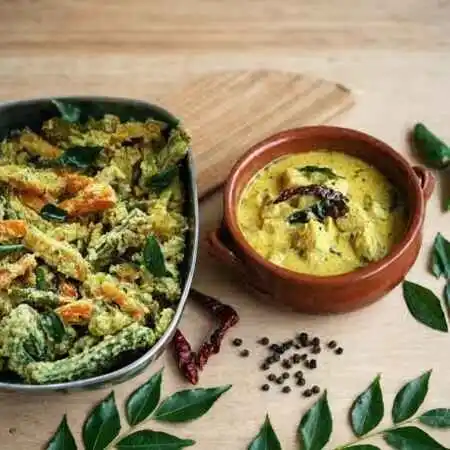
Aviyal & Kalan: The Ultimate Kerala Recipe Guide to Two Sadya Classics You Need to Master
Two coconut-laced curries, one banana leaf, and centuries of Kerala tradition on a single plate
Ask anyone who has sat cross-legged in front of a banana leaf during an Onam or Vishu sadya, and they will tell you the meal doesn’t truly begin until the first spoonful of aviyal hits the rice. Moments later comes kalan, thick, tangy, and warmly spiced, coating each grain in a completely different but equally unforgettable way. These two dishes are the backbone of traditional Kerala vegetarian cooking, and yet outside of South India, they remain some of the most misunderstood curries on the subcontinent.
Both aviyal and kalan share a coconut base, both hail from the same Malayali kitchens, and both are staples of the elaborate Sadya feast served on banana leaves. But that is roughly where the similarities end. Aviyal is a chunky, barely-there curry built on a rainbow of vegetables bound together with coconut and a whisper of sour raw mango or yogurt, finished with a generous pour of raw coconut oil and curry leaves. Kalan, on the other hand, is a thicker, more assertive yogurt-and-coconut curry traditionally made with raw plantain and yam, deepened with the slow heat of black pepper rather than the sharper bite of red chili.
This guide is a deep dive into both recipes: their origins, the ingredients that make them unmistakably Keralite, foolproof step-by-step methods for cooking each one at home, the mistakes that trip up most first-timers, regional variations you’ll find across Kerala’s different districts, and answers to just about every question a home cook could have about getting these two dishes exactly right.
The Story Behind Aviyal: A Curry Born of Resourcefulness
According to popular Kerala folklore, aviyal was invented by Bhima, one of the five Pandava brothers from the Mahabharata, during the family’s exile. Faced with a kitchen short on ingredients, the story goes, Bhima simply threw together whatever vegetables were on hand with grated coconut, and aviyal was born. Whether or not the legend is literally true, it captures something essential about the dish: aviyal has always been a way to use up whatever vegetables the season and the garden provide, bound together into something greater than the sum of its parts.
Traditionally, aviyal calls for at least five to seven different vegetables, chosen for a mix of textures and colors: ash gourd, drumstick, raw banana, yam, carrot, beans, and pumpkin are all common choices. The vegetables are cut into thick, uniform batons rather than small dice, because part of aviyal’s appeal is biting into distinct, intact pieces of vegetable rather than a smooth, homogenous curry. It is a dish that celebrates variety on purpose.
The Story Behind Kalan: Kerala’s Answer to a Yogurt Curry
Kalan is older than most people realize, appearing in temple feast traditions across Kerala for generations, particularly at the famous Guruvayur and Sabarimala temple kitchens, where it is still prepared in enormous quantities during festival seasons. Unlike aviyal’s vegetable medley, kalan sticks to a much narrower ingredient list, usually just raw plantain (unripe banana) and yam, simmered in a thick, well-soured yogurt and coconut gravy.
The defining flavor of kalan comes from black pepper rather than red chili powder, giving it a warm, slow-building heat that is completely different from the sharper spice of most North Indian curries. Because yogurt is the primary souring agent, kalan also has a distinct tang that deepens as it sits, which is part of why many Kerala households consider a day-old kalan even tastier than a freshly made batch.
Aviyal vs. Kalan: Understanding the Key Differences
- Vegetables: Aviyal uses five or more mixed vegetables; kalan typically uses just raw plantain and yam.
- Souring agent: Aviyal is soured with raw mango, tamarind, or a touch of yogurt; kalan relies almost entirely on well-fermented sour yogurt.
- Spice profile: Aviyal leans on green chili and cumin; kalan leans on black pepper and a hint of turmeric.
- Texture: Aviyal is chunky and relatively dry, almost a coconut-coated vegetable medley; kalan is thicker and more gravy-like, closer to a stew.
- Finishing touch: Aviyal is finished raw with coconut oil and curry leaves off the heat; kalan is typically finished with a light tempering of mustard seeds, curry leaves, and dried red chilies in coconut oil.
Understanding these differences matters because it’s easy to accidentally cook one dish thinking you’re making the other. Getting the souring agent and spice profile right is what separates an authentic Kerala kalan from a generic yogurt-vegetable curry, and getting the vegetable variety and finishing oil right is what separates a proper aviyal from an ordinary mixed-vegetable sabzi.
Essential Ingredients You’ll Need
For Both Dishes
- Fresh grated coconut (frozen grated coconut works as a substitute, but freshly grated gives the best flavor and texture)
- Coconut oil — non-negotiable for authentic flavor; do not substitute with a neutral oil if you want the real Kerala taste
- Fresh curry leaves
- Turmeric powder
- Salt to taste
Aviyal-Specific Ingredients
- A mix of vegetables: raw banana, yam, drumstick, carrot, beans, ash gourd or pumpkin, and cucumber
- Green chilies
- Cumin seeds
- Raw mango (or thick yogurt as an alternative souring agent)
Kalan-Specific Ingredients
- Raw (unripe) plantain, peeled and cut into thick pieces
- Yam (chena), peeled and cut into cubes
- Thick, well-soured yogurt or buttermilk
- Black pepper, freshly crushed or coarsely ground
- Fenugreek seeds (a small pinch, for tempering)
- Mustard seeds and dried red chilies (for tempering)
How to Make Authentic Kerala Aviyal: Step-by-Step Recipe
Ingredients (Serves 4–5)
- 2 cups mixed vegetables (raw banana, yam, drumstick, carrot, beans, ash gourd), cut into 2-inch batons
- 1 cup freshly grated coconut
- 2–3 green chilies
- 1 teaspoon cumin seeds
- 1/2 cup thick yogurt or 1 small raw mango, sliced
- 1/2 teaspoon turmeric powder
- A sprig of fresh curry leaves
- 2 tablespoons coconut oil
- Salt to taste
Method
- Boil the vegetables: Place the harder vegetables (yam, raw banana, drumstick) in a heavy-bottomed pan with just enough water to barely cover them, along with turmeric powder and salt. Cook on medium heat until they are about halfway tender.
- Add the softer vegetables: Add carrot, beans, and ash gourd next, since they cook faster. Continue simmering until all vegetables are tender but still hold their shape — this is not the moment to overcook them into mush.
- Grind the coconut paste: While the vegetables cook, coarsely grind the grated coconut with green chilies and cumin seeds, using just a splash of water. The texture should be coarse and grainy, not a smooth paste.
- Combine: Once the vegetables are tender and most of the water has reduced, stir in the coconut mixture and mix gently, being careful not to break the vegetable pieces.
- Add the sour element: Stir in the raw mango slices (letting them soften slightly in the residual heat) or the thick yogurt, off direct high heat, so the yogurt doesn’t split.
- Finish raw: Turn off the heat completely, then drizzle generously with raw coconut oil and scatter fresh curry leaves on top. Do not cook the oil in — this raw finish is what gives aviyal its signature aroma.
- Rest and serve: Let the aviyal sit, covered, for five to ten minutes before serving so the flavors settle. Serve warm with steamed rice.
How to Make Authentic Kerala Kalan: Step-by-Step Recipe
Ingredients (Serves 4–5)
- 1 raw plantain, peeled and cut into thick pieces
- 1 cup yam, peeled and cubed
- 1 1/2 cups thick, well-soured yogurt, whisked smooth
- 3/4 cup grated coconut
- 1 teaspoon black pepper, coarsely crushed
- 1/2 teaspoon cumin seeds
- 1/2 teaspoon turmeric powder
- A pinch of fenugreek seeds
- 1 teaspoon mustard seeds
- 2 dried red chilies
- A sprig of curry leaves
- 2 tablespoons coconut oil
- Salt to taste
Method
- Cook the base vegetables: In a heavy pan, combine the plantain and yam with turmeric, salt, and just enough water to cover. Simmer until completely tender, since kalan traditionally has a softer vegetable texture than aviyal.
- Grind the coconut paste: While the vegetables cook, grind the grated coconut with black pepper and cumin seeds into a smooth, fine paste using a little water.
- Add the coconut paste: Once the vegetables are soft, stir in the ground coconut-pepper paste and simmer for three to four minutes on low heat, allowing the raw coconut smell to cook off.
- Add the yogurt: Reduce the heat to its lowest setting, then slowly stir in the whisked yogurt. Keep stirring continuously and never let the mixture come to a rolling boil, or the yogurt will split and the curry will look curdled instead of smooth.
- Simmer gently: Let the curry warm through on low heat for another two to three minutes, stirring constantly, until it thickens slightly and coats the back of a spoon.
- Temper: In a small pan, heat coconut oil and add mustard seeds, fenugreek seeds, dried red chilies, and curry leaves. Once the mustard seeds splutter, pour this tempering directly over the kalan.
- Rest before serving: Kalan actually improves after resting for twenty to thirty minutes, and tastes even better the next day once the flavors have fully melded. Serve warm, never piping hot, with steamed rice.
Pro Tips and Common Mistakes to Avoid
For Aviyal
- Cut all vegetables to a similar thickness so they cook evenly and none turn to mush before the others are done.
- Grind the coconut coarsely, not into a fine paste — the slightly grainy texture is part of what makes aviyal distinct.
- Never skip the raw coconut oil finish; cooking the oil in changes the flavor completely.
- If using yogurt instead of raw mango, add it only after turning off the heat to prevent curdling.
For Kalan
- Use yogurt that is a day or two old and properly sour — fresh, mild yogurt will leave the curry tasting flat.
- Always add yogurt on low heat and keep stirring; boiling it directly will split the curry.
- Crush the black pepper coarsely rather than using fine pepper powder for a more authentic, textured bite.
- Let the yam and plantain cook until genuinely soft — kalan is meant to have a melt-in-the-mouth vegetable texture, unlike the firmer bite in aviyal.
Regional Variations Across Kerala
Like most traditional dishes, aviyal and kalan are not cooked identically in every Kerala household. In central Travancore, aviyal is often made slightly spicier with more green chilies, while in Malabar households further north, a touch of grated coconut roasted until golden is sometimes added for a nuttier flavor. Some coastal families skip raw mango altogether and rely purely on yogurt for tang, especially outside of mango season.
Kalan also has notable temple-style variations. The Guruvayur temple version, for instance, is famously thick and intensely peppery, made almost without any tempering at all, relying purely on the coconut-pepper-yogurt base for flavor. Home-style kalan in southern Kerala tends to be slightly thinner and milder, with a more generous tempering of mustard seeds and curry leaves added at the end for aroma.
Health Benefits of Aviyal and Kalan
Beyond their role in festive Sadya spreads, both dishes are quietly nutritious. Aviyal’s defining feature — a wide mix of vegetables in a single pot — makes it an easy way to pack in fiber, vitamins, and minerals from multiple sources in one dish, while the coconut adds healthy fats that help the body absorb fat-soluble vitamins from the vegetables. Because the vegetables are only lightly cooked rather than boiled to mush, more of their nutrients are preserved.
Kalan, built around yogurt, offers a good dose of probiotics and protein alongside the complex carbohydrates from yam and plantain, making it a filling, gut-friendly addition to a rice-based meal. Black pepper, kalan’s signature spice, has long been valued in Ayurvedic tradition for aiding digestion, which is part of why it pairs so naturally with a heavy, rice-centric feast.
What to Serve With Aviyal and Kalan
Both dishes are traditionally part of the Kerala Sadya, a multi-course vegetarian feast served on a banana leaf during Onam, Vishu, weddings, and temple festivals. On a full sadya spread, aviyal and kalan appear alongside dishes like sambar, olan, thoran, pachadi, and rasam, along with a generous mound of steamed rice, banana chips, and payasam for dessert.
For a simpler weeknight meal, both curries pair beautifully with plain steamed rice, a side of papadam, and a wedge of lime. Aviyal in particular also works well as a side dish alongside a simple dal or rasam-rice combination, while kalan makes an excellent match for curd rice on a hot day, since its yogurt base echoes the same cooling quality.
Storage and Reheating Tips
Aviyal keeps well in the refrigerator for two to three days in an airtight container, though it is best reheated gently on the stovetop rather than in a microwave, since high heat can make the vegetables mushy. A fresh drizzle of coconut oil after reheating helps restore the aroma that fades in storage.
Kalan actually tends to taste better the next day, once the yogurt and coconut flavors have had time to meld and deepen. When reheating, always use low heat and stir gently and continuously, since reheating too quickly or at too high a temperature is the most common way a stored kalan ends up curdled.
Kitchen Tools That Make These Recipes Easier
You don’t need specialized equipment to cook either dish well, but a few tools make the process noticeably smoother. A heavy-bottomed clay pot or thick stainless-steel vessel, traditionally called an urulli or manchatti in Kerala kitchens, distributes heat evenly and prevents the coconut base from scorching on the bottom, which is a common problem with thin pans. A small stone grinder, or a modern mixer-grinder used in short pulses, gives the best control over how coarse or fine the coconut paste turns out, which matters more than most home cooks realize for getting the right final texture.
A sharp, sturdy knife is essential for cutting yam and raw banana, both of which have a firmer texture than most everyday vegetables. It also helps to keep a small bowl of water with a little turmeric or oil nearby when peeling raw banana, since the sap can stain your hands and cutting board if left untreated.
A Closer Look at the Vegetables: Prep Notes for Beginners
Raw Banana (Ethakka / Kaya)
Raw banana should be firm, green, and unripe. Peel it just before cooking, since the flesh discolors quickly once exposed to air. Cutting the pieces and immediately dropping them into water helps prevent browning while you finish prepping the rest of the vegetables.
Yam (Chena)
Yam has a starchy, slightly sticky texture when raw. It should always be peeled generously, since the skin and the layer just beneath it can occasionally cause mild itching on contact. Rubbing a little oil on your hands before handling raw yam is a simple, effective precaution most Kerala cooks learn early on.
Drumstick (Muringakka)
Drumstick is typically cut into two- to three-inch segments and cooked with the fibrous outer skin intact, since the tender pulp and seeds inside are eaten by scraping them out with your teeth at the table, a texture and eating style that takes some newcomers a little getting used to.
Ash Gourd and Cucumber
Both vegetables cook quickly and release a fair amount of water, which is part of why they’re usually added toward the end of the boiling process in aviyal rather than at the very start, to avoid diluting the final curry.
Understanding the Sadya Tradition: Where Aviyal and Kalan Fit
A full Kerala Sadya can include anywhere from fifteen to more than twenty individual dishes, all served on a single banana leaf in a specific, customary arrangement. Aviyal and kalan are typically placed toward the top center of the leaf, close to the mound of rice, since both are meant to be mixed directly into rice rather than eaten on their own. The order in which dishes are traditionally eaten also matters: many Malayali families serve kalan slightly later in the meal than aviyal, allowing its richer, more intense flavor to follow the lighter vegetable notes of the earlier courses.
Sadya is almost always a strictly vegetarian meal, historically tied to temple food traditions, and both aviyal and kalan reflect that heritage directly. Neither dish contains onion or garlic in its most traditional form, relying instead on curry leaves, green chili, black pepper, and coconut to build layers of flavor without either ingredient, which also makes both dishes suitable for many traditional and religious dietary practices across South India.
Nutritional Snapshot: What’s in a Serving
While exact values vary depending on portion size and specific vegetables used, a typical one-cup serving of aviyal made with a mix of vegetables and moderate coconut generally provides a good source of dietary fiber, vitamin A and C from the vegetable mix, and healthy fats from the coconut, all in a dish that is naturally free of refined sugar and low in saturated fat compared to cream- or ghee-heavy curries.
A comparable serving of kalan tends to be slightly higher in protein thanks to the yogurt base, along with a good dose of calcium and probiotics that support digestion. The plantain and yam also contribute complex carbohydrates and potassium, making kalan a filling, well-rounded addition to a rice-based meal rather than just a flavoring element.
Adapting the Recipes: Dietary Modifications
Making Aviyal Vegan
Aviyal is naturally easy to make vegan simply by using raw mango or a small amount of tamarind as the souring agent instead of yogurt. Since coconut, vegetables, and coconut oil form the backbone of the dish, no other substitutions are typically needed.
Making Kalan Lower in Fat
For a lighter version of kalan, reduce the quantity of coconut slightly and use low-fat yogurt instead of full-fat, though be aware that this will also soften the richness that makes traditional kalan so distinctive. Some home cooks compensate by increasing the black pepper slightly to maintain a strong flavor profile even with less fat.
Reducing the Heat Level
For those sensitive to spice, both dishes can be made milder by reducing the number of green chilies in aviyal or the quantity of crushed black pepper in kalan, without significantly affecting the overall character of either dish.
Troubleshooting Guide: Fixing Common Problems
https://youtu.be/UuNNL41B-3g

