

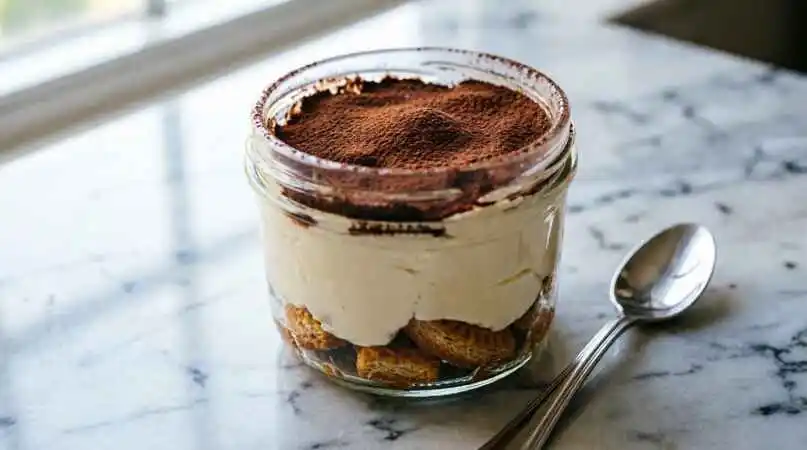
5-Minute Yogurt Tiramisu: The Viral Dessert Dupe Everyone’s Making
No whisking, no baking, no guilt — just Greek yogurt, Lotus Biscoff, and coffee doing all the heavy lifting.
If your For You Page has looked like an endless scroll of glass jars layered in gold-brown stripes lately, you’ve already met yogurt tiramisu. It’s the dessert that broke containment this year — the one home cooks, macro-counters, and dessert purists all somehow agree on. No oven. No eggs. No mascarpone. No hour-long chilling ritual. Just five minutes, four ingredients, and a spoon.
The premise is almost stupidly simple: swap the traditional mascarpone-and-egg-yolk custard for thick Greek yogurt, swap ladyfingers for crushed Lotus Biscoff cookies, keep the espresso soak, and layer it all in a jar or glass like a mini trifle. The result tastes shockingly close to the real thing — sweet, creamy, coffee-forward, with that signature caramelized-cookie crunch — while quietly packing in protein instead of a stick of butter and a carton of heavy cream.
This is the exact formula behind so many of this year’s biggest viral food wins: take a beloved, slightly indulgent classic, dupe it with a “better for you” swap that doesn’t ask you to sacrifice flavor, and package it in something photogenic enough to survive fifteen seconds of scrolling. Yogurt tiramisu checks every box, which is exactly why it’s not slowing down.
What Is Yogurt Tiramisu, Exactly?
At its core, yogurt tiramisu is a no-bake, layered dessert that mimics the flavor and texture of classic Italian tiramisu using simplified, protein-forward ingredients. Instead of raw egg yolks whipped with sugar and folded into mascarpone, the “cream” layer is just thick, strained Greek yogurt, usually lightly sweetened and sometimes stabilized with a spoon of honey, maple syrup, or vanilla. Instead of ladyfingers, which require baking and can turn soggy unevenly, most versions use Lotus Biscoff cookies — their caramelized, spiced flavor stands in beautifully for the coffee-soaked sponge, and their sturdier texture holds up better in the fridge.
The espresso element stays exactly the same as classic tiramisu: strong brewed coffee or espresso, sometimes with a splash of coffee liqueur for the adults-only version, used to soak the cookies just long enough to soften without turning to mush. The whole thing gets layered — cookie, yogurt, cookie, yogurt — in a jar, ramekin, or wide glass, dusted with cocoa powder, and left to chill for as little as thirty minutes, or eaten almost immediately if you like more crunch in your bite.
Why It’s the Viral Dessert Dupe of the Moment
A few things are converging to make yogurt tiramisu the exact kind of recipe that takes over social media, and understanding them explains why this trend has legs instead of fading in a week.
It Delivers on the “Healthy Dupe” Promise
The single biggest driver of food virality this year has been the healthy dupe format: a recognizable indulgent classic, remade with a swap that sounds almost too easy to be true. Classic tiramisu can run 400-plus calories per serving, loaded with saturated fat from mascarpone and heavy cream and minimal protein. Yogurt tiramisu flips that ratio, often landing in the 150–250 calorie range per serving with 12 to 20 grams of protein, depending on the yogurt and portion used. It reads as something you could genuinely eat as a snack, a breakfast, or a late-night treat without the usual mental tax.
It’s Genuinely Fast
Unlike most viral recipes that quietly require 40 minutes of prep disguised as a “quick” 10-minute video, yogurt tiramisu really does come together in about five minutes of active work. There’s no cooking, no tempering eggs, no whipping cream to stiff peaks. You crush cookies, dip them in coffee, layer with yogurt, and you’re done. That honesty is part of why it’s trusted and repeated rather than tried once and abandoned.
It’s Endlessly Customizable on Camera
Because the base recipe is so simple, it invites remixing — protein powder stirred into the yogurt, a drizzle of Biscoff cookie butter between layers, a matcha version, a chocolate version, single-serving jars versus a big trifle-style dish for a crowd. Every remix is its own piece of content, which keeps the trend perpetually refreshed instead of burning out.
It Photographs Itself
The layered glass-jar format is inherently video- and photo-friendly: you can see every layer through the glass, the cocoa dusting on top looks intentional and elegant, and the cross-section reveal when you dig in with a spoon is exactly the kind of satisfying visual that performs well as a short-form video.
A Quick History: How Tiramisu Became a Viral Sensation, in Reverse
Traditional tiramisu dates back to the 1960s and 1970s in the Veneto region of Italy, where it was created as a rich, coffee-soaked answer to the classic trifle — its name literally translates to “pick me up” or “cheer me up,” a nod to the jolt of espresso and sugar baked into every bite. For decades, it stayed a restaurant-menu classic: something you ordered at the end of an Italian dinner, rarely something home cooks attempted on a Tuesday night, largely because raw egg yolks, mascarpone, and multi-hour chilling times made it feel more special-occasion than weeknight.
Yogurt tiramisu flips that entire trajectory. Instead of a restaurant dish trickling down into home kitchens over decades, it started as a home-kitchen shortcut and went viral almost overnight, spreading through short-form video before most people had ever heard the phrase “protein tiramisu.” It’s a rare case of a decades-old dish getting reintroduced to an entirely new generation not through a restaurant or a cookbook, but through a fifteen-second video of someone dipping a Biscoff cookie into coffee.
The Science Behind Why This Swap Actually Works
Part of what makes yogurt tiramisu convincing rather than just a health-washed imitation is that the substitutions are structurally sound, not just calorically lighter. Mascarpone’s job in classic tiramisu is to provide a thick, slightly tangy, fat-rich base that holds its shape when sliced but still feels soft on the tongue. Strained Greek yogurt does almost exactly the same job: it’s thick because much of its liquid whey has already been removed, it carries a similar mild tang, and its protein structure gives it enough body to hold layers without collapsing.
The egg yolks in classic tiramisu mostly contribute richness and a custard-like silkiness, which Greek yogurt’s natural fat content (especially in full-fat versions) replicates reasonably well, particularly once it’s been lightly sweetened and flavored with vanilla. And because Biscoff cookies are denser and less porous than delicate ladyfingers, they absorb coffee more slowly and evenly, which actually makes them more forgiving for home cooks who tend to over-soak traditional ladyfingers into mush. In short, this isn’t a compromise dupe that only works because expectations are lowered — the substitutions solve real textural problems in the original recipe.
Tools and Equipment You’ll Need
One of the most appealing things about this recipe is how little equipment it demands. You don’t need a stand mixer, a double boiler, or any specialty bakeware.
- A mixing bowl and a spoon or spatula for combining the yogurt mixture
- A shallow dish or bowl for dipping the cookies in coffee
- Clear glass jars, cups, or small bowls for layering and serving
- A small fine-mesh sieve for dusting an even layer of cocoa powder on top
- Optional: a cheesecloth or coffee filter, if you want to strain your yogurt for an extra-thick texture
Common Mistakes to Avoid
- Over-dipping the cookies: leaving Biscoff cookies in coffee for more than a couple of seconds per side causes them to fall apart before you can even layer them.
- Using nonfat yogurt and expecting a rich texture: nonfat yogurt is thinner and less creamy, which can leave the finished dessert tasting more like a parfait than a tiramisu.
- Skipping the sweetener entirely: plain Greek yogurt is noticeably tangier than mascarpone, and without any sweetener the dessert can taste more like a savory yogurt bowl than a dessert.
- Assembling in a container that’s too deep and narrow: it makes it hard to get a clean spoonful with all the layers, and a wider glass or jar generally gives a better eating experience.
- Dusting the cocoa powder too early: adding it hours before serving can cause it to absorb moisture from the yogurt underneath and lose its light, dry finish.
- Using weak coffee: a watery, low-strength coffee won’t soften the cookies properly or deliver enough coffee flavor to read as tiramisu rather than just a yogurt-and-cookie parfait.
What to Serve It With
Yogurt tiramisu is rich enough to stand entirely on its own, but a few simple pairings can round out the experience if you’re serving it for guests. A small espresso or cappuccino on the side echoes the coffee flavor inside the dessert itself, while a few fresh berries add a bright, slightly acidic contrast to the sweet, creamy layers. For a more indulgent presentation, a few shavings of dark chocolate or a light drizzle of warmed Biscoff cookie butter over the top just before serving makes it feel more like a plated restaurant dessert than a five-minute jar recipe.
Ingredients Breakdown: What Each One Actually Does
Understanding the role each ingredient plays makes it much easier to customize the recipe without breaking it.
- Greek yogurt: the backbone of the whole dessert. Its thickness (from straining out whey) gives it a custard-like body close to mascarpone, and its tang balances the sweetness of the cookies and cocoa.
- Lotus Biscoff cookies: their caramelized, cinnamon-spiced flavor and crisp-but-not-hard texture make them the closest packaged substitute for coffee-soaked ladyfingers, and they soften at just the right rate.
- Brewed coffee or espresso: provides the essential tiramisu flavor base and the moisture that softens the cookies into a sponge-like texture without a single grain of flour.
- Sweetener: honey, maple syrup, or a spoon of sugar smooths out the tang of the yogurt so the dessert reads as “dessert” rather than “breakfast parfait.”
- Cocoa powder: the final dusting on top, purely for that classic tiramisu look and a light bittersweet contrast to the sweet layers underneath.
- Vanilla extract (optional): rounds out the flavor and makes the yogurt taste more like a custard rather than plain yogurt.
The 5-Minute Recipe
This version makes two generous single-serving jars, but it scales easily — just multiply everything by however many servings you need.
What You’ll Need
- 1 1/2 cups plain full-fat or 2% Greek yogurt
- 1–2 tablespoons honey or maple syrup, to taste
- 1/2 teaspoon vanilla extract
- 1/2 cup strong brewed coffee or espresso, cooled
- 10–12 Lotus Biscoff cookies
- 1–2 teaspoons unsweetened cocoa powder, for dusting
- Optional: 1 tablespoon coffee liqueur, added to the coffee
Instructions
- In a bowl, stir together the Greek yogurt, honey or maple syrup, and vanilla extract until smooth and evenly sweetened. Taste and adjust sweetness if needed.
- Pour the cooled coffee into a shallow dish. If using, stir in the coffee liqueur.
- Quickly dip each Biscoff cookie into the coffee for one to two seconds per side — just long enough to absorb some liquid without turning soggy — and place a layer of dipped cookies in the bottom of your serving jar or glass, breaking them to fit as needed.
- Spoon a layer of the sweetened yogurt mixture over the cookies, spreading it evenly to the edges of the jar.
- Repeat with a second layer of coffee-dipped cookies, followed by another layer of yogurt, until your jar is full, finishing with a yogurt layer on top.
- Dust the top generously with cocoa powder using a small sieve for an even, café-style finish.
- Chill for at least 30 minutes to let the layers set and the flavors meld, or serve immediately for a version with more cookie crunch.
Tips for Perfect Layers Every Time
- Use full-fat or 2% Greek yogurt rather than nonfat — the extra fat gives a creamier, more mascarpone-like mouthfeel and prevents the dessert from tasting thin.
- Strain your yogurt through a cheesecloth-lined sieve for 15–20 minutes first if you want an even thicker, more luxurious texture.
- Dip cookies fast. A one- to two-second dip per side is the difference between a soft, sponge-like bite and a mushy one — Biscoff cookies absorb liquid quickly.
- Use a clear glass jar so the layers show through; it’s the single biggest factor in how “professional” the finished dessert looks.
- Dust the cocoa powder right before serving, not hours ahead, since it can absorb moisture and lose its crisp, dry finish if it sits too long.
- Make it the night before for the best texture — the cookies fully soften and the flavors deepen, much like classic tiramisu.
Popular Variations Taking Over Social Media
Protein-Powder Boosted
Stirring a scoop of vanilla protein powder into the yogurt mixture is one of the most common remixes, turning the dessert into something closer to a post-workout treat, often pushing total protein per serving above 25 grams. If your protein powder is very thick, a small splash of milk helps keep the yogurt spoonable.
Sugar-Free Version
Swapping honey or maple syrup for a sugar-free sweetener like monk fruit or a stevia blend, and using sugar-free or reduced-sugar cookies, keeps the dessert closer to a low-sugar or diabetic-friendly treat without changing the basic method.
Chocolate Lotus Version
Using chocolate Biscoff cookies or stirring a spoon of cocoa powder directly into the yogurt layer turns this into a mocha-forward variation that leans more dessert than snack.
Cookie Butter Drizzle
Warming a spoonful of Biscoff cookie butter and drizzling it between the yogurt layers adds an extra hit of that caramelized flavor and a slightly gooey texture contrast that’s become a signature move in a lot of viral versions.
Dairy-Free Adaptation
Using a thick coconut or almond-based yogurt alternative in place of Greek yogurt makes the recipe dairy-free, though the texture will be slightly less rich and may need an extra thirty minutes of chilling to firm up.
How It Stacks Up Against Classic Tiramisu
The appeal of this dupe becomes obvious once you compare it side by side with the traditional version it’s standing in for.
- Classic tiramisu relies on raw or lightly cooked egg yolks and mascarpone cheese; yogurt tiramisu uses no eggs and no mascarpone at all.
- A typical serving of classic tiramisu can contain significantly more saturated fat and sugar, while the yogurt version trims both without losing the coffee-and-cream flavor profile.
- Classic tiramisu requires several hours of chilling for the ladyfingers to fully soften; yogurt tiramisu can be eaten in as little as thirty minutes.
- Because Greek yogurt is naturally high in protein, a serving of yogurt tiramisu can contain three to four times more protein than a serving of the traditional dessert.
- Classic tiramisu isn’t considered safe for pregnant women or anyone avoiding raw eggs; yogurt tiramisu sidesteps that concern entirely since nothing in it is raw or uncooked in a risky way.
Storage and Make-Ahead Tips
Yogurt tiramisu stores beautifully, which is part of why it’s become a popular meal-prep dessert alongside its viral appeal. Assembled jars keep well covered in the refrigerator for up to three days, with the texture actually improving on day one or two as the cookies continue to soften slightly. After the third day, the cookies can start to break down too much and the texture becomes noticeably softer, so it’s best enjoyed within that window. This dessert does not freeze well — the yogurt separates and turns watery once thawed, so it’s best made fresh or a few days ahead at most, never frozen.
Why This Trend Isn’t Going Away Anytime Soon
Food trends usually burn out fast, but the ones that stick around share a common thread: they solve a real problem instead of just looking good on camera. Yogurt tiramisu solves several at once. It satisfies a sweet craving without the guilt spiral that often follows a richer dessert. It requires no baking skill and no specialty equipment, which makes it accessible to people who wouldn’t attempt a from-scratch tiramisu. It’s portioned by default, since it’s usually made in individual jars, which naturally supports moderation without anyone having to think about portion control. And it’s flexible enough to fit dozens of dietary approaches — high-protein, low-sugar, dairy-free, gluten-adjacent — without losing its identity.
In many ways, yogurt tiramisu represents where dessert culture is heading more broadly: less about restriction, less about all-or-nothing indulgence, and more about clever, low-effort swaps that let people have both the craving and the nutrition label they’re comfortable with. Whether that’s a genuine shift in how people eat dessert or just this month’s version of a decades-old impulse to “healthify” comfort food, it’s clear this particular dupe has more staying power than most.
Scaling It Up for a Crowd
https://youtu.be/yXmePgd_9MA

