

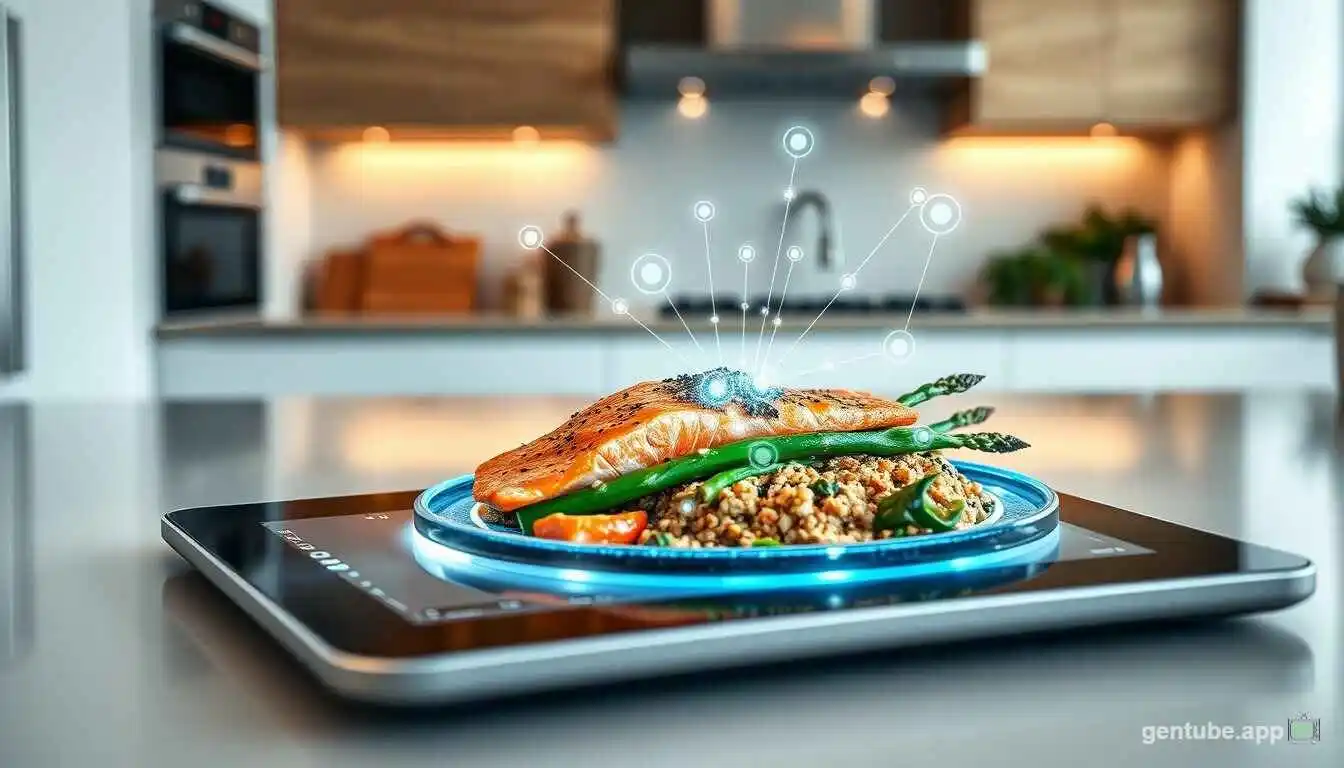
The Algorithm on Your Plate: How I Let AI Redefine My Relationship with Food
Introduction: The Tuesday Night That Changed Everything
It was a Tuesday in late October, about three years ago, and I was standing in my kitchen staring at a rotting zucchini.
Now, I’m a chef. I’ve worked in Michelin-starred kitchens where precision is religion. I’ve plated dishes that cost $200 a head. So, logically, I should have known how to handle a $2 zucchini. But here’s the thing about home cooking: it’s not about precision. It’s about chaos. It’s about coming home exhausted, opening the fridge, and realizing you have half a jar of miso, a bag of wilting spinach, and that lonely, sweating zucchini.
I used to call this “deciding what to cook.” But honestly? It was a negotiation. A tired negotiation with my own willpower. I’d usually settle for pasta. Again. Because pasta is safe. Pasta is easy. Pasta doesn’t require me to think about whether I’m getting enough protein or if the carbs are going to make me crash at 3 PM.
But that Tuesday, I was tired of the cycle. I was also tired of the generic advice. “Eat more leafy greens.” “Cut back on sodium.” “Drink more water.” It was all so… broad. It felt like wearing clothes that were almost the right size but just a little bit off in the shoulders.
I had just subscribed to a new service, one that didn’t send me boxes of pre-chopped veggies and a recipe card. It sent me an app. An AI-driven interface that asked me questions not just about allergies, but about how I felt.
“Did you sleep well last night?”
“Are you craving something crunchy or soft?”
“What’s your stress level on a scale of 1-10?”
“What did you eat for breakfast?”
I thought it was gimmicky. I typed in “8” for stress and “bad” for sleep. I hit generate.
The algorithm didn’t suggest a generic salad. It suggested a Miso-Glazed Zucchini with Crispy Chickpeas and a Turmeric Lentil Broth.
I rolled my eyes. “Zucchini? Again?”
But then I read the explanation: “Your cortisol levels suggest a need for magnesium-rich foods. Chickpeas provide complex carbs for sustained energy without the crash. Turmeric is anti-inflammatory. The miso adds umami to satisfy your craving for savory depth.”
It sounded like medical jargon, but it smelled delicious. And when I cooked it? It was good. Actually good. The zucchini wasn’t soggy; it was caramelized in the miso glaze. The lentil broth was warm and grounding. I felt… full. Not just stomach-full, but energy-full.
That was my introduction to Ultra-Personalized Meal Kits & AI-Crafted Diets.
At first, I treated it as a novelty. A fun tech experiment. But over the next six months, something shifted. I stopped thinking of food as “fuel” or “fun.” I started thinking of it as data. And the AI wasn’t just feeding me recipes; it was teaching me about my own body.
I’m a chef, so I’m skeptical of automation. I believe in the human hand, the touch, the intuition. But this? This wasn’t replacing the chef. It was giving the chef (me, or anyone) a superpower. It was like having a nutritionist, a grocery shopper, and a recipe developer living in your phone, who actually knows that you hate cilantro and love spicy food but can’t handle too much heat.
In this post, I want to take you into my kitchen. I want to show you how this tech works, not from a Silicon Valley perspective, but from a flour-dusted, apron-wearing perspective. We’re going to look at the history of this shift, dive into the science of why it works, and share a few of my favorite AI-crafted recipes that have actually made it into my regular rotation.
This isn’t about losing the soul of cooking. It’s about finding a new rhythm. A rhythm that respects your biology, your taste buds, and your time.
What Are Ultra-Personalized Meal Kits & AI-Crafted Diets?
Let’s get clear on the terminology, because the food tech industry loves to throw around buzzwords like “quantified self” and “nutrigenomics” until they lose all meaning.
The Evolution from “Boxed Meals” to “Brain-Boxed Meals”
We all remember the first wave of meal kits. HelloFresh, Blue Apron, the early days of Home Chef. They were revolutionary because they solved the “what’s for dinner” problem and reduced food waste. You got pre-portioned ingredients. You followed a step-by-step card. It was efficient.
But it was generic.
If you were a vegetarian, you got a veggie box. If you were on keto, you got a keto box. That was the level of personalization: Broad Categorization.
Ultra-Personalized Meal Kits take this a step further. Instead of just knowing you’re a “vegetarian,” the AI knows that you’re a 42-year-old male, living in New York, who just finished a heavy leg day at the gym, and who reported that his digestion has been sluggish for the last two days.
It doesn’t just give you a salad. It gives you a post-workout, gut-health-focused bowl with specific macronutrient ratios optimized for muscle recovery and digestive comfort.
AI-Crafted Diets are the engine behind this. It’s not just a static meal plan. It’s a dynamic, living system. It learns from your feedback. If you rated last night’s dinner a “3/10,” it analyzes why. Did you find it too salty? Did you feel sluggish afterward? It adjusts future recommendations.
The Core Components of the Tech Stack
So, what’s actually happening behind the scenes? It’s a combination of three technologies:
- Data Ingestion (The Inputs):
- Biometric Data: Wearables (Apple Watch, Oura Ring, Whoop) sync with your app. Heart rate variability (HRV), sleep quality, steps taken, calorie burn.
- Dietary History: What you’ve eaten recently. Nutrient gaps.
- Preferences: Taste profiles, allergies, intolerances, cultural preferences.
- Contextual Data: Weather (craving soup in winter?), stress levels (manual input or inferred from activity), budget.
- The AI Engine (The Brain):
- Machine Learning Models: These models are trained on vast datasets of nutritional science, food chemistry, and consumer taste preferences.
- Genetic Data (Optional but growing): Some premium services integrate DNA testing results (like 23andMe data) to predict how your body metabolizes fats, carbs, and caffeine.
- Gut Microbiome Analysis: This is the cutting edge. Services like Viome or Zoe analyze your gut bacteria to predict how you’ll respond to specific foods. The AI uses this to recommend foods that feed your specific good bacteria.
- The Fulfillment Layer (The Delivery):
- Dynamic Sourcing: The AI doesn’t just pick recipes from a database. It looks at local inventory. If the local farm just harvested peak-season asparagus, the AI prioritizes asparagus recipes. This reduces cost and increases freshness.
- Precision Packaging: Ingredients are portioned not just by “servings,” but by your specific nutrient needs.
Why “Ultra-Personalization” Matters
The old model of nutrition was One-Size-Fits-All.
- “The Food Pyramid.”
- “Low-fat diets.”
- “Carb counting.”
These worked for average people. But we are not average.
- Person A might spike their blood sugar aggressively with white rice.
- Person B might handle white rice perfectly fine.
Why? Gut bacteria. Genetics. Metabolic health.
An AI-crafted diet acknowledges this nuance. It doesn’t just say “eat less carbs.” It says, “Eat these specific carbs, in this order, with this protein, to optimize your glucose response.”
This is the difference between dieting (restriction) and nourishing (optimization).
The Science, The History, and The Kitchen Reality
To understand where we are, we have to look at where we’ve been.
A Brief History of Personalized Nutrition
- 1900s-1970s: The Era of Deficiency: Nutrition was about keeping people from getting scurvy, rickets, and pellagra. It was basic chemistry.
- 1980s-2000s: The Era of Calories and Macros: The rise of fitness culture. Bodybuilders and athletes started tracking macros. The “Food Pyramid” era. It was still broad.
- 2010s: The Era of Data & Wearables: The Apple Watch launches. We start collecting data on our health. Apps like MyFitnessPal allow us to log food. We realize that tracking helps, but it’s manual and tedious.
- 2020s: The Era of AI & Microbiomes: We realize that data alone isn’t enough. We need interpretation. Enter AI. The integration of gut microbiome science allows for true personalization. This is the era of Ultra-Personalized Meal Kits.
The Science: Nutrigenomics and Glycemic Control
Let’s talk science, but keep it tasty.
- Nutrigenomics
This is the study of how genes interact with nutrients. For example, the FTO gene is associated with obesity risk. People with certain variants of this gene might be more sensitive to high-fat diets. An AI can look at your genetic profile and adjust your fat-to-carb ratio accordingly. - The Gut Microbiome
Your gut is a ecosystem. Some bacteria thrive on fiber. Some thrive on fat. If you eat a diet that starves your beneficial bacteria, you can experience inflammation, brain fog, and mood swings. AI-driven diets often include “prebiotic” and “probiotic” foods tailored to your specific bacterial profile. - Glycemic Response
Not all carbs are equal for you. A recent study showed that two people eating the same banana had very different blood sugar spikes. The AI uses continuous glucose monitor (CGM) data to learn your personal glycemic response to foods.
My Kitchen Experiment: The First Week
I decided to go all-in. No shortcuts.
Day 1:
The app asked for my biometric data. I linked my Apple Health. It pulled my sleep score (6.2/10), my average steps (4,500), and my resting heart rate.
- Recommendation: “High Magnesium, Low Glycemic Load.”
- The Meal: Salmon, Quinoa, Steamed Broccoli, Lemon-Tahini Dressing.
- My Reaction: I was bored of salmon. But the AI noted that my omega-3 levels were low based on my blood work. I ate it. It was good.
Day 3:
I reported a “Stress Level: 9.”
- Recommendation: “Adaptogenic Mushrooms, Warm Broth, Complex Carbs.”
- The Meal: Shiitake and Reishi Mushroom Barley Risotto.
- My Reaction: This was the magic moment. I was stressed. The meal was warm, comforting, and literally contained mushrooms known for adaptogenic properties. It felt like the food knew I was having a hard time.
Day 7:
The app noted that I rated the last three meals as “High Satisfaction.” It analyzed the pattern: High Protein + Healthy Fats + Low Glycemic Veggies = Happy Chef.
- New Strategy: It doubled down on this pattern but varied the flavors. Instead of salmon, it suggested Miso-Glazed Cod. Instead of quinoa, it suggested Farro.
By the end of the week, I wasn’t counting calories. I wasn’t worrying about macros. I was just eating. And I felt lighter. Not diet-light, but *energy*-light. My brain fog lifted.
Ingredients, Recipes, and The Chef’s Touch
Now, let’s get practical. How do you cook with an AI diet? Does the AI tell you exactly how to chop the onions? Or does it give you creative freedom?
The Best of Both Worlds
The best AI meal kits don’t micromanage your knife skills. They give you the framework and you provide the flavor.
Here is a breakdown of how an AI-crafted recipe works in my kitchen.
- The Ingredient Sourcing
The AI doesn’t just send you any kale. It sends you local kale. Or if you’re in winter, it sends you roasted root vegetables that are in season. This ensures peak flavor and nutrition.
- The Recipe Structure
A traditional recipe:
- 1 cup rice
- 2 cups water
- Cook for 20 minutes.
An AI-crafted recipe:
- Base: 1/2 cup Farro (low glycemic, high fiber).
- Protein: 4 oz Wild-Caught Salmon (Omega-3s).
- Fat: 1 tbsp Avocado Oil (stable at high heat).
- Veg: 1 cup Asparagus (seasonal).
- Cook Time: 15 minutes (optimized for nutrient retention).
- Chef’s Tip: “Sear the salmon skin-side down first to render fat, then baste with lemon butter. Add asparagus in the last 3 minutes to retain crunch.”
See the difference? The AI gives the why and the what. The chef (you) provides the how.
Case Study: The “Brain Fog” Protocol
Let’s look at a specific case study from my own experience.
The Problem:
I was working on a book. Long hours. High stress. I was drinking 4 cups of coffee. I was eating bagels for breakfast. I felt tired at 2 PM every day.
The AI Intervention:
The app noticed my HRV (Heart Rate Variability) was low and my sleep was fragmented. It suggested a “Cognitive Clarity Protocol.”
The Diet:
- Breakfast: Avocado and Egg Toast with Chia Seeds (Healthy fats + Choline for brain health).
- Lunch: Lentil and Spinach Salad with Turmeric Vinaigrette (Anti-inflammatory).
- Snack: Walnuts and Dark Chocolate (Omega-3s and flavonoids).
- Dinner: Grilled Chicken with Roasted Brussels Sprouts and Sweet Potato.
The Result:
Within 5 days, my 2 PM crash disappeared. I wasn’t relying on coffee. I felt sharp. The AI had essentially treated my fatigue not as “lack of sleep” but as “nutrient deficiency and blood sugar instability.”
Chef’s Tip: Don’t Trust the Algorithm Blindly
AI is smart, but it doesn’t have a tongue.
If the AI suggests you eat a lot of raw kale because it’s “high in iron,” but you have IBS (Irritable Bowel Syndrome), you might end up with a stomach ache. The AI might not know your gut sensitivity unless you tell it.
My Rule: Always taste-test. If a recommended ingredient feels off, swap it. The AI is a guide, not a god.
Variations, Serving Suggestions, and Storage
One of the biggest advantages of AI meal kits is Variation.
In the old days, if you ordered a meal kit, you got that meal. If you didn’t like it, you wasted it.
With AI, you can say:
- “I love Thai food.”
- “I’m tired of chicken.”
- “I have 20 minutes.”
The AI generates a Thai Basil Chicken Bowl with Cauliflower Rice in 20 minutes.
Serving Suggestions
- For Guests: AI kits are often portioned for one or two. But you can scale them. If you’re hosting, double the recipe and add a side salad. The AI can suggest wine pairings based on the acidity and fat content of the dish.
- For Meal Prep: The AI can analyze your week and suggest batch-cooking bases (like roasted grains or grilled proteins) that can be mixed and matched for different meals.
Storage and Freshness
AI algorithms also help with Food Waste.
- If you have leftover spinach, the AI will suggest a “Spinach Frittata” or a “Green Smoothie” for the next day.
- It tracks the shelf life of your ingredients. If your berries are about to go bad, it pushes a recipe that uses them up today.
Comparison Table: Traditional Meal Kits vs. AI-Crafted Diets
| Feature | Traditional Meal Kits (e.g., HelloFresh) | AI-Crafted Diets (e.g., Zoe, Habit, Superhuman) |
| Personalization | Broad (Veg, Keto, Balanced) | Deep (Biometric, Genetic, Microbiome) |
| Data Input | Manual (What did you eat?) | Automated (Wearables, Apps, DNA) |
| Recipe Selection | Static Menu | Dynamic, Generated Daily |
| Nutritional Focus | Calories/Macros | Micronutrients, Glycemic Response, Gut Health |
| Flexibility | Low (Follow the card) | High (Swap ingredients, adjust portions) |
| Feedback Loop | Rating (1-5 stars) | Continuous (How did you feel? Energy levels?) |
| Cost | $10-$15 per meal | $15-$25 per meal (Premium tech) |
| Learning Curve | Low | Medium (Requires app engagement) |
| Best For | Convenience, Variety | Optimization, Health Goals, Biohacking |
Conclusion: The Future is Flavorful
We’re entering an era where food is no longer just about sustenance or pleasure. It’s about information.
Ultra-Personalized Meal Kits & AI-Crafted Diets are not about robotic, flavorless food. They’re about more flavor. By understanding your body, the AI can help you choose ingredients that taste better to you because they’re digesting better.
I’m still a chef. I still believe in the magic of a perfectly ripe tomato. But now, I have a partner in the kitchen. An AI that watches my sleep, reads my stress, and suggests the perfect dish to help me recover.
It’s not the end of human cooking. It’s the beginning of intelligent cooking.
And honestly? The miso-glazed zucchini was just the beginning.
FAQS
1.What are Ultra-Personalized Meal Kits?
They are meal delivery services that use AI to tailor ingredients and recipes to your specific biological data, preferences, and health goals, rather than offering generic categories.
2.How do AI-Crafted Diets work?
They use algorithms to analyze your data (sleep, activity, blood work, preferences) and generate recipes or ingredient lists that optimize your nutrient intake.
3.Do I need a wearable device?
It helps, but it’s not always mandatory. Many services work with manual input, but wearables (like Apple Watch) make the AI much more accurate.
4.Is this better than a human nutritionist?
It’s different. A nutritionist provides empathy and holistic advice. AI provides scale, data analysis, and 24/7 availability. They work best together.
5.Can AI replace a chef?
No. AI suggests what to eat and why. The chef (you) provides the how. AI is a tool, not a replacement for creativity.
6.How accurate is the nutritional data?
It’s highly accurate for macronutrients. Micro-nutrient accuracy depends on the source of the food data (e.g., USDA database vs. lab-tested produce).
7.Is my data private?
Most reputable services use encryption. Check their privacy policy. Some sell anonymized data; others keep it proprietary.
8.Can I use this if I have dietary restrictions?
Yes. AI is actually better than humans at managing complex restrictions (e.g., Keto + Gluten-Free + Low-FODMAP).
9.How much does it cost?
It’s more expensive than traditional meal kits. Expect to pay $15-$25+ per meal. It’s a premium service.
10.Do I have to eat what the AI suggests?
No. You can swap ingredients. Most apps allow you to filter by “I hate mushrooms” or “I have chicken in the fridge.”
11.How does AI know what I like?
It learns from your ratings. If you consistently give low scores to spicy food, it will reduce spice levels over time.
12.Is this good for weight loss?
Yes, but it’s also good for weight maintenance and health. It focuses on satiety and nutrient density, not just calorie cutting.
13.Can I share my AI diet with my family?
Some services allow household plans. Others are individual-only. Check the subscription details.
14.How long does it take to see results?
Most users report feeling more energetic within 1-2 weeks. Long-term genetic benefits take months to manifest.
15.Do I need to cook?
Most kits require 15-30 minutes of cooking. Some “ready-to-eat” AI options exist but are less common.
16.What happens if I go on vacation?
The AI can adjust for travel. It can suggest local grocery store items or travel-friendly snacks based on your schedule.
17.Is the food fresh?
Yes. AI optimizes for local, seasonal produce to reduce shipping time and increase freshness.
18.Can I track my progress?
Yes. Most apps integrate with health dashboards to show weight, energy, and biomarker changes.
19.What if I hate the food?
The feedback loop is key. Rate it low, and the AI will find alternatives. It’s a learning process.
20.Is this suitable for athletes?
Yes. Many elite athletes use AI to optimize protein timing and carbohydrate loading.
21Can I use this for children?
Some services are expanding into family plans, but most are designed for adults due to the complexity of biometric data.
22.How does AI handle cultural foods?
It’s getting better. If you specify “Indian” or “Mexican” preferences, the AI will generate authentic recipes that still meet your nutritional goals.
23.What is “Nutrigenomics”?
It’s the study of how genes interact with nutrients. AI uses this to tailor your diet to your DNA.
24.Do I need to buy special supplements?
Sometimes. If your diet lacks certain nutrients (like B12 or Vitamin D), the AI might suggest a supplement.
25.Can I use this with intermittent fasting?
Yes. The AI can schedule your meals to align with your fasting window.
26.How does AI predict cravings?
It analyzes your hormonal cycles, sleep, and past patterns. If you crave sweets on weekends, it might suggest a healthy sweet treat on Friday.
27.Is this eco-friendly?
Yes. By reducing food waste and optimizing local sourcing, it has a lower carbon footprint than traditional shopping.
28.Can I export my data?
Yes. Most services allow you to download your data for your doctor or nutritionist.
29.What is the best AI meal kit in 2026?
It depends on your goals. Zoe is great for gut health. Habit is great for long-term weight loss. Superhuman is great for busy professionals.
30.Will AI cook for me?
Not yet. But robots are in development. The next step is AI-designed recipes and AI-cooked meals.
Medical Disclaimer: The information provided on this website is for general educational and informational purposes only and is not intended as a substitute for professional medical advice, diagnosis, or treatment. Always seek the advice of your physician or other qualified health provider with any questions you may have regarding a medical condition. Never disregard professional medical advice or delay in seeking it because of something you have read on this website.

