

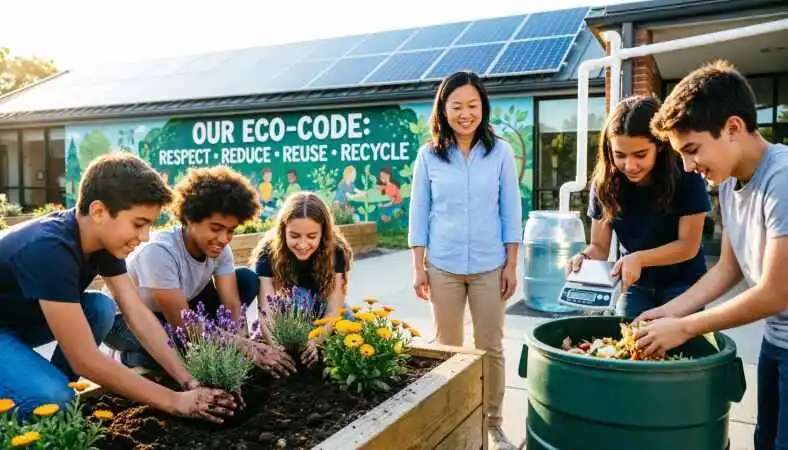
From Overwhelmed to Empowered: How Eco-Schools Turn Student Passion into Real-World Change
Picture this: It’s a Tuesday morning in the staff room. Ms. Patel, a middle school science teacher, is scrolling through her phone, reading yet another headline about record-breaking temperatures. She turns to her colleague and says, “I want my students to care about this stuff, not just memorize facts for a test. But where do I even start? I’m already stretched thin.”
Sound familiar?
You’re not alone. Educators everywhere feel that tug—the desire to prepare students for a world facing climate disruption, biodiversity loss, and resource scarcity, paired with the very real constraints of packed curricula, limited budgets, and the pressure to hit standardized test benchmarks.
Here’s the good news: there’s a framework that’s been quietly transforming schools for over three decades. It’s called Eco-Schools, and it’s not about adding another thing to your plate. It’s about weaving environmental literacy and student-led sustainability projects into what you’re already doing, in a way that actually makes teaching more engaging and meaningful.
This isn’t theoretical. Schools using this approach have cut energy bills by thousands, diverted tons of waste from landfills, and—perhaps most importantly—watched students who once zoned out during lectures light up when they realize they can solve real problems in their own community.
Whether you’re a classroom teacher looking for practical strategies, an administrator evaluating school-wide initiatives, or a parent advocating for change, this guide walks you through exactly how to integrate environmental literacy and student-led sustainability projects into your curriculum—step by step, with real examples and actionable advice.
Why Environmental Literacy Isn’t Optional Anymore
Let’s start with the basics. Environmental literacy isn’t just knowing the difference between renewable and nonrenewable resources. It’s the ability to understand how natural systems work, how human activity affects those systems, and how individuals and communities can make informed decisions in response.
Think of it like financial literacy. You don’t need to be an economist to manage a household budget, but you do need to understand income, expenses, and the consequences of debt. Similarly, environmental literacy equips students with the knowledge, skills, and habits to navigate a world where every choice—from what they eat to how they commute—has ecological ripple effects.
The Case for Integration (Not Addition)
Here’s where many educators get stuck: they assume “environmental education” means carving out class time for nature walks or sustainability units. That’s one approach, but it’s not the only—or even the most effective—way.
The Eco-Schools framework, used by over 67,000 schools across 78 countries, takes a different tack. Instead of treating sustainability as an add-on, it embeds environmental themes directly into existing subjects. A math lesson becomes a carbon footprint calculation. A history class examines how industrialization reshaped landscapes. An English assignment asks students to write persuasive letters to local officials about waste management.eco-schools.org+2
This integration does three critical things:
- Makes learning stick. When students connect abstract concepts to tangible problems they care about, retention skyrockets.
- Builds transferable skills. Critical thinking, data analysis, collaboration, and civic engagement aren’t just “nice to haves”—they’re core competencies for any career path.
- Reduces teacher workload. You’re not creating entirely new lessons; you’re enriching what you already teach with real-world context.
What the Research Says
The evidence isn’t just anecdotal. Studies show that schools implementing structured sustainability programs see measurable improvements in student engagement, academic performance, and even school culture. One 2025 impact report from Sustainability at School found that participating schools avoided nearly 80 tons of emissions through energy efficiency projects alone, while reaching over 12,000 students globally.
But beyond the metrics, there’s something more profound happening. Students who lead sustainability initiatives develop a sense of agency—the belief that they can influence outcomes, not just react to them. In an era where climate anxiety is rising among young people, that sense of empowerment is invaluable.
The Seven-Step Framework: Your Roadmap to Eco-School Status
If you’re wondering where to begin, the Eco-Schools program offers a clear, flexible roadmap called the Seven Steps. It’s been refined over 30 years and works across age groups, from preschools to high schools, and across vastly different contexts—from urban schools with no green space to rural campuses with sprawling grounds.
Here’s what each step entails, with practical tips for implementation:
Step 1: Form an Eco-Committee
What it is: A diverse team of students, teachers, administrators, and (ideally) parents or community members who drive the sustainability agenda.
Why it matters: Student leadership is non-negotiable. This isn’t a teacher-led initiative with student helpers; it’s student-led with adult support. That distinction changes everything.
How to do it:
- Recruit students from different grades and backgrounds. Don’t just grab the usual high-achievers—look for kids who might not shine in traditional academics but have passion, creativity, or community connections.
- Meet regularly (at least once a month) and give students real decision-making power. Adults facilitate, but students set priorities and lead projects.
- Include non-teaching staff. Custodians, cafeteria workers, and bus drivers often have insights into waste, energy use, and logistics that teachers miss.
Real-world example: At Qatar Academy Sidra Primary, students created the “Greenhouse Café,” an interdisciplinary project where they grew produce, designed menus, and promoted eco-friendly practices. The initiative was entirely student-driven and blended sustainability, healthy living, and creativity.
Step 2: Carry Out a Sustainability Review (Audit)
What it is: A systematic assessment of your school’s environmental impact across key themes like energy, water, waste, biodiversity, and transportation.
Why it matters: You can’t improve what you don’t measure. The audit identifies quick wins (like fixing leaky faucets) and long-term opportunities (like installing solar panels).eco-schools.
How to do it:
- Use a structured tool. Eco-Schools provides free Environmental Review templates, but you can adapt any audit framework.
- Involve students in data collection. Have them track electricity usage, weigh cafeteria waste, or survey peers about commuting habits.
- Look beyond the obvious. Yes, recycling matters, but so does procurement (what’s the school buying?), curriculum (how is sustainability taught?), and community engagement (are families involved?).
Pro tip: Don’t aim for perfection. The goal is progress, not a flawless audit. Even a rough assessment gives you a baseline to improve upon.
Step 3: Activate the Curriculum
What it is: Linking sustainability themes to at least three subject areas across the academic year.
Why it matters: This is where environmental literacy moves from “special project” to “core learning.” It ensures sustainability isn’t siloed in science class but woven into math, language arts, social studies, and beyond.
How to do it:
- Start small. You don’t need to overhaul every lesson. A single unit or project that connects to an Eco-Schools topic counts.
- Be creative. A geography class can map local biodiversity. An art class can create sculptures from recycled materials. A physics class can calculate the energy savings of LED bulbs versus incandescent.
- Document everything. Keep a simple log of which lessons link to which sustainability themes. This makes accreditation easier and helps you spot gaps.eco-schools.
Real-world example: At Freedom High School, biology students researched native plants before establishing a pollinator garden at the front of the school. The project aligned directly with their biology curriculum unit on native species, making the learning both relevant and memorable.
Step 4: Create an Action Plan
What it is: A concrete, time-bound plan with specific goals, actions, and responsibilities.
Why it matters: Without a plan, good intentions fizzle. The action plan turns ideas into execution.
How to do it:
- Prioritize. Based on your audit, pick 2–3 themes to focus on for the year. Trying to tackle everything at once leads to burnout.
- Set SMART goals. Instead of “reduce waste,” aim for “divert 50% of cafeteria waste from landfills by May through composting and recycling.”
- Assign roles. Who’s leading each action? What resources are needed? What’s the timeline?
Pro tip: Include “quick wins” alongside long-term projects. Early successes build momentum and credibility with skeptics.
Step 5: Measure Impact
What it is: Tracking progress toward your goals and evaluating what’s working (and what’s not).
Why it matters: Measurement isn’t just for accountability—it’s for learning. It helps you refine strategies, celebrate wins, and make the case for continued investment.eco-schools.
How to do it:
- Use both quantitative and qualitative data. Track kilowatt-hours saved, pounds of waste diverted, or gallons of water conserved. Also gather stories: How did students’ attitudes shift? What skills did they develop?
- Involve students in analysis. Have them create graphs, write reports, or present findings to the school board. This reinforces math and communication skills while deepening ownership.
- Adjust as needed. If a project isn’t working, pivot. Flexibility is a strength, not a failure.
Real-world example: Hersey High School’s Green Team collected and analyzed waste data, then used those insights to design targeted education campaigns. Their work reduced recycling contamination rates and improved overall environmental literacy.
Step 6: Inform and Involve
What it is: Sharing your work with the broader school community and beyond.
Why it matters: Sustainability isn’t a secret club. The more people know about your efforts, the more they’ll support—and join—them.
How to do it:
- Use multiple channels. Newsletters, social media, assemblies, parent apps, local newspapers—cast a wide net.
- Celebrate publicly. Recognize student leaders, thank supporters, and showcase results. Positive reinforcement fuels continued engagement.
- Invite participation. Host workshops, open houses, or “sustainability fairs” where families can learn and contribute.
Pro tip: Don’t just broadcast successes—share challenges too. Authenticity builds trust and invites collaboration.
Step 7: Produce an Eco-Code
What it is: A creative mission statement that captures your school’s sustainability vision.
Why it matters: The Eco-Code is more than a slogan. It’s a rallying cry, a reminder of why this work matters, and a symbol of collective commitment.
How to do it:
- Make it student-led. Let the Eco-Committee brainstorm, draft, and refine the code.
- Get creative. It can be a poem, song, poster, video, or artwork—whatever resonates with your community.
- Display it prominently. Put it on your website, in the lobby, on T-shirts. Make it visible and alive.
Real-world example: Schools have created Eco-Codes as murals, rap songs, and even short films. The medium matters less than the message: “We care, we act, we improve.”
Student-Led Sustainability Projects: Ideas That Actually Work
One of the most common questions educators ask is: “What kinds of projects can students realistically lead?” The answer: more than you might think. Here are proven ideas, categorized by theme, with implementation tips:
Waste Reduction & Recycling
- Cafeteria composting: Partner with a local farm or composting service. Students manage collection bins, track volumes, and educate peers about what’s compostable.
- Textile recycling drives: Collect old clothes, uniforms, and linens. Some programs keep thousands of pounds of textiles out of landfills annually.
- “Munch Machine” vending: Install a recycling vending machine where students exchange recyclables for snacks or school credits. Makes sustainability tangible and fun.
- Plastic-free lunch days: Conduct waste audits, then challenge students to bring zero-waste meals. Use data to show impact.
Energy & Water Conservation
- LED retrofit campaigns: Audit lighting, calculate savings, and advocate for upgrades. Students can present ROI analyses to administrators.
- Rainwater harvesting: Install rain barrels to water gardens or clean outdoor spaces. Ties into lessons on hydrology and resource management.
- Solar device charging stations: Build or purchase solar-powered charging hubs for phones and tablets. Combines engineering with renewable energy education.
Biodiversity & Green Spaces
- Pollinator gardens: Plant native species that support bees, butterflies, and other pollinators. Aligns with biology curricula on ecosystems.
- Wetland restoration: Transform unused fields into wetlands that filter runoff and provide habitat. Requires more space but offers rich learning opportunities.
- Outdoor classrooms: Build learning spaces using locally sourced materials. Students can design, construct, and use these spaces for lessons.
Food & Agriculture
- School gardens: Grow vegetables for the cafeteria or community. Integrates science, nutrition, and entrepreneurship.
- Meatless Mondays: Advocate for plant-based meal options. Students can research environmental and health impacts, then present findings.
- Aquaponics systems: Combine fish farming with hydroponic plant growth. A living lab for chemistry, biology, and systems thinking.
Community Engagement & Advocacy
- E-waste collection: Partner with recyclers to gather old electronics. Educate families about proper disposal.
- Policy advocacy: Have students write letters to elected officials about local environmental issues. Builds civic skills and amplifies impact.
- Peer education campaigns: Train students to lead workshops, create videos, or make announcements about sustainability topics.
Quick Wins for Busy Schools
Not every project needs to be massive. Some high-impact, low-effort ideas:
- Install water bottle refill stations to reduce single-use plastic.
- Switch to double-sided printing by default.
- Create a “borrow closet” for formal wear or sports equipment to reduce consumption.
- Host a “repair café” where students fix broken items instead of discarding them.
Key principle: Start where you are, use what you have, do what you can. Small actions, multiplied across a school community, create significant change.
Overcoming Common Obstacles (And How to Sidestep Them)
Even with the best intentions, sustainability initiatives can stall. Here are the most frequent roadblocks—and proven strategies to overcome them:
“We Don’t Have Time”
Reality check: You’re right. Teachers are overloaded. But integration—not addition—is the solution.
Workaround:
- Map sustainability to existing standards. Most curricula already include themes like ecosystems, resource management, or civic engagement. You’re not adding content; you’re enriching it.
- Use project-based learning. Instead of separate “sustainability lessons,” design units where students solve real problems. This meets multiple standards while building engagement.
- Leverage student leadership. When students drive projects, teachers shift from “doers” to “facilitators,” reducing workload while increasing ownership.
“We Don’t Have Money”
Reality check: Budgets are tight, but many sustainability actions save money over time.
Workaround:
- Focus on behavior change first. Turning off lights, reducing waste, and conserving water cost nothing but awareness.
- Seek grants and partnerships. Organizations like Project Learning Tree’s Green Works!, local utilities, and environmental nonprofits offer funding for student-led projects.
- Start small. A composting program might require bins, but a “meatless Monday” campaign needs only advocacy. Build momentum, then scale.
“Administration Won’t Support It”
Reality check: Leaders care about test scores, safety, and budgets. Frame sustainability in those terms.
Workaround:
- Show the ROI. Present data on energy savings, waste reduction costs, or student engagement.
- Align with school goals. If the school prioritizes STEM, highlight how sustainability projects build science and engineering skills. If community engagement is a focus, emphasize partnerships and service learning.
- Start grassroots. Build a coalition of teachers, parents, and students. When administrators see broad support, they’re more likely to buy in.
“Students Aren’t Interested”
Reality check: Some students won’t care—and that’s okay. You don’t need 100% participation to create change.
Workaround:
- Make it relevant. Connect projects to issues students already care about: social justice, health, technology, or local community challenges.
- Offer choice. Let students pick projects that match their interests—art, engineering, advocacy, gardening, data analysis.
- Celebrate contributions. Recognize effort, not just outcomes. A student who designs a poster, collects data, or recruits peers is making a difference.
“We Tried Before and It Fizzled”
Reality check: Burnout is real. Many schools launch initiatives with fanfare, then lose steam.
Workaround:
- Build for continuity. Document processes, train student leaders across grade levels, and embed projects into the school calendar.
- Measure and share progress. Regular updates—however small—keep momentum alive.
- Learn from setbacks. Conduct “post-mortems” on projects that didn’t work. What went wrong? What would you do differently? Use those insights to refine future efforts.
Measuring What Matters: Beyond the Green Flag
Earning an Eco-Schools Green Flag is a worthy goal—it signals that your school has met rigorous standards for student participation, curriculum integration, and environmental action. But accreditation is a milestone, not the finish line.
Metrics That Tell the Full Story
To capture the true impact of your sustainability work, track a mix of quantitative and qualitative indicators:
Environmental Metrics:
- Energy consumption (kWh) and cost savings
- Water usage (gallons) and reduction percentages
- Waste diverted from landfills (pounds or tons)
- Carbon emissions avoided (calculate using standard conversion factors)
Educational Metrics:
- Number of curriculum links to sustainability themes
- Student participation rates in Eco-Committee and projects
- Pre/post assessments of environmental literacy or attitudes.
Cultural Metrics:
- Staff and parent engagement (survey responses, event attendance)
- Student leadership development (skills gained, confidence levels)
- Community partnerships formed or strengthen.
Financial Metrics:
- Cost savings from efficiency measures
- Grant funding secured
- In-kind donations or volunteer hours contribute.
Making Data Work for You
Collecting data is only half the battle. Here’s how to use it effectively:
- Visualize progress. Create dashboards, infographics, or before/after comparisons. Visuals make abstract numbers concrete and compelling.
- Tell stories. Pair statistics with student quotes, photos, or videos. A graph shows waste reduction; a student explaining why composting matters makes it memorable.
- Share widely. Present findings at staff meetings, board sessions, parent nights, and community events. Transparency builds trust and invites collaboration.
- Iterate. Use data to refine strategies. If a project isn’t meeting goals, adjust. If something’s working exceptionally well, scale it.
The Bigger Picture: Why This Work Matters
At its core, integrating environmental literacy and student-led sustainability projects into curricula isn’t about producing a generation of environmentalists. It’s about preparing students to thrive in a complex, interconnected world where ecological, social, and economic challenges are deeply intertwined.
When students lead composting programs, they learn systems thinking. When they advocate for policy changes, they practice civic engagement. When they calculate energy savings, they apply math in context. When they collaborate across grades and backgrounds, they build empathy and communication skills.
These aren’t “soft skills.” They’re the competencies employers, colleges, and communities increasingly demand. And they’re the capacities young people need to navigate a future that will require adaptability, creativity, and collective action.
A Note on Hope
It’s easy to feel overwhelmed by the scale of environmental crises. But here’s what the Eco-Schools movement shows us: change doesn’t always come from grand gestures or top-down mandates. Often, it starts in classrooms, cafeterias, and schoolyards—places where students discover they have agency, voice, and the power to make a difference.
That’s not just good for the planet. It’s good for kids. And it’s good for the educators who get to witness that transformation firsthand.
FAQs
- What exactly is an Eco-School?
An Eco-School is a school that follows the Eco-Schools program framework—typically the Seven Steps—to embed sustainability into its culture, curriculum, and operations. It’s not just about recycling bins; it’s about student leadership, curriculum integration, and continuous improvement. Schools can earn recognition (like the Green Flag) for meeting specific criteria.
- Do I need to be a science teacher to lead this?
Not at all. While science classes naturally align with environmental topics, sustainability intersects with every subject. English teachers can assign persuasive essays on local issues. Math teachers can analyze energy data. Art teachers can create installations from recycled materials. The key is finding connections to your existing curriculum.
- How much time does this really take?
It varies. Some actions—like turning off lights or starting a composting bin—require minimal ongoing time. Larger projects—like installing solar panels or restoring wetlands—demand more planning but can be student-led with adult facilitation. The Seven Steps framework is designed to be flexible, so you can scale efforts to match your capacity.
- What if my school has no outdoor space?
No problem. Many impactful projects happen indoors: waste audits, energy monitoring, curriculum integration, advocacy campaigns, and art projects. Urban schools have created rooftop gardens, vertical planters, and partnerships with local parks. Lack of green space is a constraint, not a barrier.
- How do I get administrators on board?
Frame sustainability in terms they care about: cost savings, student engagement, test scores, community reputation, and alignment with school goals. Present data from other schools, propose pilot projects with low risk, and build a coalition of supportive staff and parents.
- Can elementary students really lead sustainability projects?
Absolutely. Younger students can manage classroom recycling, track water usage, plant gardens, or create art from recycled materials. The key is age-appropriate tasks with adult support. Many Eco-Schools program have specific resources for early years and elementary levels.
- What if students lose interest mid-year?
It happens. To sustain engagement: celebrate small wins, rotate leadership roles, connect projects to student passions, and involve families and community partners. Also, accept that not every project will run forever—some are meant to be short-term experiments.
- Are there grants or funding available?
Yes. Organizations like Project Learning Tree’s GreenWorks!, local utilities, environmental nonprofits, and government agencies offer grants for student-led sustainability projects. Some provide small seed funding ($100–$500), while others support larger initiatives. Check with your district’s sustainability office or search databases like GrantWatch.
- How do I measure the impact of our projects?
Track both quantitative metrics (energy saved, waste diverted, water conserved) and qualitative outcomes (student attitudes, skills gained, community engagement). Use pre/post surveys, photo documentation, and student reflections. The Eco-Schools framework includes guidance on monitoring and evaluation.
- What’s the difference between Eco-Schools and other green school programs?
Eco-Schools is distinguished by its Seven Steps methodology, emphasis on student leadership, curriculum integration requirement, and international recognition (Green Flag). Other programs may focus more on facilities (like LEED certification) or specific themes (like energy efficiency). Eco-Schools is holistic and education-centered.
- Do I need to complete all Seven Steps to see benefits?
No. Even partial implementation yields results. A school that forms an Eco-Committee and runs one student-led project will see engagement and learning gains. The full Seven Steps pathway leads to accreditation, but every step adds value.
- How do I involve parents and the community?
Host family sustainability nights, invite parents to join the Eco-Committee, partner with local organizations (parks, farms, nonprofits), and share updates via newsletters and social media. Community partnerships can provide expertise, resources, and real-world learning opportunities.
- What if our school already has a recycling program?
Great! Build on it. Expand to composting, conduct waste audits to identify contamination, educate peers about proper sorting, or advocate for reduced single-use items. Existing infrastructure is a foundation, not a ceiling.
- Can sustainability projects count toward service learning or graduation requirements?
Often, yes. Many districts allow student-led sustainability initiatives to fulfill service learning, capstone, or community engagement requirements. Check with your administration or guidance office about policies and documentation.
- How do I handle pushback from colleagues?
Listen to concerns (time, workload, relevance), share success stories from similar schools, invite skeptics to observe student presentations, and start with low-lift actions. Sometimes, seeing engaged students changes minds faster than any argument.
- What role should students play versus adults?
Students should lead decision-making, project design, and implementation. Adults facilitate, mentor, ensure safety, and handle logistics students can’t manage (like budgeting or vendor contracts). The goal is student agency with adult support—not adult-led projects with student helpers.
- How do I integrate sustainability into standardized test prep?
Use sustainability contexts for test-aligned skills. For example: reading comprehension passages about climate change, math problems calculating carbon footprints, or writing prompts advocating for local environmental policies. This makes test prep more engaging while meeting standards.
- What if we’re in a region with political resistance to climate education?
Focus on locally relevant, non-partisan issues: waste reduction, energy efficiency, water conservation, or community gardening. Frame projects around problem-solving, stewardship, and civic engagement rather than ideology. Many sustainability actions have broad support regardless of political views.
- How do I ensure projects are inclusive and equitable?
Recruit diverse student leaders, ensure projects benefit the whole school (not just certain groups), provide multiple ways to participate (physical, creative, analytical), and consider accessibility (e.g., raised garden beds for students with mobility challenges). Equity should be a design principle from the start.
- What’s the typical timeline for earning a Green Flag?
Most schools work through the Seven Steps over one academic year, then apply for the Green Flag during the annual window (often May–July, depending on the country). Some schools take longer, especially if starting from scratch. There’s no rush—quality matters more than speed.
- Do we need to reapply for the Green Flag every year?
Requirements vary by country, but many programs require reapplication every 2–3 years to maintain certification. This ensures continuous improvement rather than one-time achievement. Check with your national Eco-Schools coordinator for specific rules.
- How do I document curriculum links for accreditation?
Keep a simple log: date, subject, topic, sustainability theme, and brief description. Photos of student work, lesson plans, or assessment rubrics can serve as evidence. Some programs provide templates or online portals for documentation.
- What if our school is virtual or hybrid?
Adapt! Virtual schools can focus on digital sustainability (e-waste, energy use from devices), online advocacy campaigns, or curriculum integration. Hybrid models can combine remote learning with in-person action projects. The principles remain the same: student leadership, learning, and action.link.
- How do I handle safety concerns with outdoor projects?
Conduct risk assessments, establish clear protocols, ensure adult supervision, and train students on safe practices (e.g., tool use, plant identification). Many schools have liability insurance that covers student-led projects—check with your administration.
- Can we partner with other schools?
Yes, and it’s encouraged! Inter-school collaborations can amplify impact, share resources, and create friendly competition. Some regions host Eco-Schools networks or sustainability fairs where schools showcase projects.
- What if we make a mistake or a project fails?
That’s part of the learning process. Conduct a “post-mortem” with students: What went wrong? What would we do differently? Document lessons learned and apply them to future projects. Resilience and adaptability are core sustainability skills.
- How do I balance sustainability with other school priorities?
Integration is key. Don’t treat sustainability as a separate priority—embed it into existing priorities like STEM, literacy, or community engagement. This reduces competition for time and resources while enriching core initiatives.
- What resources are available for getting started?
Your national Eco-Schools program (if available) provides free resources, including the Seven Steps guides, Environmental Review tools, and curriculum links. Organizations like NAAEE, Project Learning Tree, and local environmental education centers also offer materials and training.
- How do I sustain momentum after the founding teacher leaves?
Build institutional structures: document processes, train multiple student leaders across grade levels, embed projects into the school calendar, and secure administrative support. The goal is a culture of sustainability, not dependence on one person.
- What’s the single best first step for a school just starting out?
Form an Eco-Committee with diverse student representation. From there, conduct a simple sustainability audit to identify quick wins, then pick one project to launch. Momentum builds from action, not perfection.eco-schools.
Final Thoughts: Start Where You Are
You don’t need a perfect plan, a huge budget, or unanimous support to begin. You need a willing group of students, a supportive adult or two, and the courage to take the first step.
Maybe that step is forming an Eco-Committee next week. Maybe it’s auditing your classroom’s energy use. Maybe it’s weaving a sustainability theme into your next unit. Whatever it is, start small, learn as you go, and let student passion lead the way.
Because here’s the truth: the students who will inherit this planet are already paying attention. They’re watching how adults respond to crises, whether institutions walk the talk, and whether their voices matter. When we give them real responsibility, real problems to solve, and real support to make a difference, we’re not just teaching sustainability—we’re modeling the kind of leadership the world needs.
So what’s your first step going to be?
Disclaimer: The content on this blog is for informational purposes only. The author’s opinions are personal and not endorsed. Efforts are made to provide accurate information, but completeness, accuracy, or reliability are not guaranteed. The author is not liable for any loss or damage resulting from the use of this blog. It is recommended to use the information on this blog at your own discretion.

