

Measurements in Mathematics: Why Does Everyone Get the Same Answer? The Simple Secrets Behind Rulers, Scales and Clocks
The Day Seven Spans Became Nine
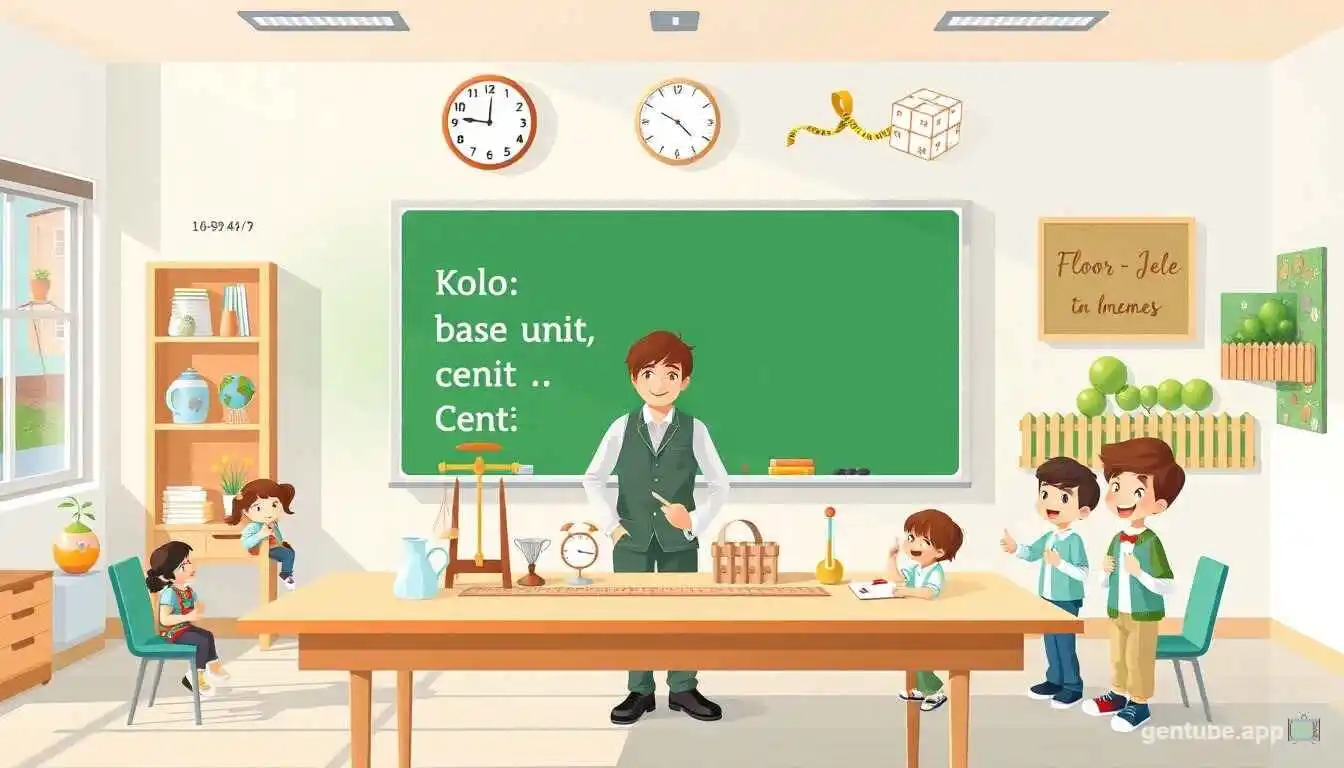
Last year, I began my Class 5 maths period with a small experiment. I called two students, Ananya and Rohan, to the front and asked them to measure the length of my table using only their hands. Ananya stretched her palm across the table again and again, counting aloud, and announced, “Seven spans!” Rohan did the same and said, “Nine spans!”
The class burst out laughing. “Sir, somebody made a mistake!” But nobody had. Ananya’s hand was bigger than Rohan’s, so she needed fewer spans to cover the same table. Both answers were honest, and both were useless if you wanted to order a tablecloth.
Then I took out a simple wooden ruler and a metre scale. “Let us measure again,” I said. This time, six different students measured the table, and all six said, “140 centimetres.” The room went quiet. I asked, “Why did the answers agree this time?”
After a long pause, Ananya raised her hand. “Because everyone used the same unit, Sir.” I could have hugged her. In one sentence, she had explained the heart of measurements in mathematics.
Over the next few weeks, those students started measuring everything: pencil boxes, school bags, the length of the corridor, even how long it took the bell to stop ringing. Measurement stopped being a chapter and became a game. If measurement has ever felt like a pile of tables to memorise, or if you lose marks on unit conversions, this post is for you. We will go step by step, with simple examples, a comparison table, common mistakes, and five study habits that work. Let us begin.
What Are Measurements in Mathematics?
Measurement is the process of finding out how much of something there is. How long is the road? How heavy is the bag? How much water does the bucket hold? How long does the journey take? Whenever we answer such a question with a number and a unit, we are measuring.
Measuring Means Comparing
At its core, to measure something is to compare it with a fixed quantity that everyone agrees on. That fixed quantity is called a unit. When we say a table is 140 cm long, we mean that the table is as long as 140 of those small centimetre pieces placed end to end.
Every Measurement Has Two Parts
- A number: It tells you how many units fit. For example, 140.
- A unit: It tells you what you counted. For example, centimetres.
A number without a unit is like a sentence without a full stop. “The rope is 5 long” means nothing. Is it 5 centimetres, 5 metres or 5 kilometres? The unit is not decoration. It is half the answer.
Standard and Non-Standard Units
The hand spans in my classroom story are non-standard units. They are useful for fun and for rough estimates, but they change from person to person. A standard unit, such as a metre, a kilogram or a litre, has the same size everywhere in the world. That is why a shopkeeper in Kerala and a shopkeeper in Delhi mean exactly the same thing by “one kilogram”.
A Short Story of How Measurement Began
Long ago, people measured with their own bodies. The ancient Egyptians used the cubit, which is roughly the distance from the elbow to the tip of the middle finger. Others used foot lengths, thumb widths and handfuls. It worked for a village, but trade between towns became a headache, because everyone’s body was different, just like Ananya’s and Rohan’s hands. Over time, countries agreed on common standards. In the 1790s, France began building the metric system, with units linked by tens, and it slowly spread across the world because it was so easy to use.
Measuring vs Counting
Counting tells you how many separate things there are, like 12 mangoes. Measuring tells you how much of a continuous thing there is, like 3 kilograms of mangoes. You can count mangoes one by one, but you cannot count “water” or “distance” one by one. You need a unit to measure them.
The Main Things We Measure in School Maths
- Length: how long, wide, tall or far something is.
- Mass (weight): how heavy something is.
- Capacity: how much liquid a container can hold.
- Time: how long something lasts.
- Temperature: how hot or cold something is.
- Area and volume: how much surface a shape covers and how much space a solid takes up.
Why Measurements Matter So Much
It is easy to think of measurement as a small topic you finish in one term. In reality, it is one of the most useful parts of mathematics, because it connects numbers to the real world.
- Daily life: Cooking, shopping, travelling, stitching clothes and filling a water bottle all need measurement. Imagine a recipe that said “some sugar” or a bus that left “after a while”.
- Safety and fairness: Medicine doses, petrol at the pump and vegetables at the market depend on correct measurement. A small error can cost money or even harm health.
- Other subjects: Science experiments, geography maps and scales, and even sports records all use units. If you cannot handle units, science becomes harder.
- Higher maths: Perimeter, area, volume, speed, ratio and mensuration in later classes are all built on measurement. A strong base now makes those chapters far easier.
- Careers: Engineers, nurses, tailors, carpenters, pilots, architects and farmers use measurement every single day.
- Exams: Measurement questions are usually scoring questions. They reward careful, step-by-step thinking more than difficult tricks.
Try this thought experiment. Imagine one day that nobody agreed on any units. A kilogram of rice would mean one thing in your shop and another in the next lane. Train timetables would be guesses, and buildings would not fit their doors. Measurement is a quiet agreement that holds daily life together, and learning it makes you part of that agreement.
So when you practise this chapter, you are not only preparing for a test. You are training your mind to deal with the real world in a clear and careful way.
Core Concepts: How Measurements in Mathematics Work
Let us walk through each type of measurement, one at a time. Take your time with every section, and try the small examples in your notebook.
The Metric System: A Ladder You Can Climb
India and most of the world use the metric system. Its best feature is that everything goes up and down in steps of 10, 100 or 1000. The secret lies in a few prefixes that you can reuse for every unit.
- kilo- means 1000 times (1 kilometre = 1000 metres)
- centi- means one-hundredth (1 centimetre = 1/100 of a metre)
- milli- means one-thousandth (1 millimetre = 1/1000 of a metre)
Once you know these three prefixes, you already understand the units of length, mass and capacity. Kilo-, centi- and milli- work the same way with metres, grams and litres. The international system built on this idea is called the SI system, and it is used in science and trade all over the world.
Length
Length tells us how far or how long something is. The base unit is the metre (m). Smaller lengths use the millimetre (mm) and centimetre (cm), and long distances use the kilometre (km). We measure length with a ruler, a metre scale, a measuring tape or a trundle wheel.
- 1 cm = 10 mm
- 1 m = 100 cm
- 1 km = 1000 m
A handy way to remember sizes: the width of your little finger is about 1 cm, a normal door is about 2 m high, and a brisk 10-minute walk covers about 1 km.
Mass (Weight)
Mass tells us how much matter is in an object, which in daily language we call “weight”. The base unit is the kilogram (kg), and smaller amounts use the gram (g) and milligram (mg). In science classes you will later learn that mass and weight are slightly different ideas, but in school maths we use the words for the same everyday meaning. We measure mass with a balance or a weighing scale.
- 1 g = 1000 mg
- 1 kg = 1000 g
- 1 quintal = 100 kg
- 1 tonne = 1000 kg
Capacity (Liquid Measure)
Capacity tells us how much liquid a container can hold. The main unit is the litre (L), and smaller amounts use the millilitre (mL). We use measuring jugs, cylinders and spoons. A small spoon of medicine syrup is about 5 mL, a standard water bottle is often 1 L, and a bucket may hold 15 to 20 L.
- 1 L = 1000 mL
Time
Time is the one measurement that does not follow the “10, 100, 1000” pattern, which is why many students find it tricky. We measure time with clocks and watches.
- 1 minute = 60 seconds
- 1 hour = 60 minutes
- 1 day = 24 hours
- 1 week = 7 days, and 1 year = 12 months (365 days, or 366 in a leap year)
The 24-hour clock avoids confusion between morning and evening. For example, 3:30 p.m. is written as 15:30. To find the end time of a journey, add hours to hours and minutes to minutes. A train leaves at 9:45 a.m. and travels for 3 hours 40 minutes. Adding hours gives 12:45, and adding 40 minutes gives 13:25, so it arrives at 1:25 p.m.
Temperature
Temperature tells us how hot or cold something is, and we measure it with a thermometer. In India we use degrees Celsius (°C). Water freezes at 0 °C and boils at 100 °C, and normal body temperature is about 37 °C. Some countries use Fahrenheit (°F). To convert, multiply the Celsius value by 9/5 and add 32. For example, 25 °C becomes 25 × 9/5 + 32 = 77 °F. Scientists also use the Kelvin scale, where the value is the Celsius temperature plus about 273.
Perimeter and Area
These two ideas appear in every school exam, and they are often mixed up. Let us separate them clearly.
- Perimeter is the total distance around the edge of a shape. Imagine walking around the boundary of a field. It is measured in ordinary length units such as cm or m.
- Area is the amount of flat surface a shape covers. Imagine painting the inside of the field. It is measured in square units such as cm² or m².
For a rectangle with length l and breadth b: Perimeter = 2 × (l + b) and Area = l × b. For a square with side a: Perimeter = 4a and Area = a × a.
Try this. A garden is 15 m long and 10 m wide. The perimeter is 2 × (15 + 10) = 50 m, which is the length of fence you need. The area is 15 × 10 = 150 m², which is the amount of grass you can grow. Notice how the units differ: metres for the fence, square metres for the grass.
Volume of Solids
Volume tells us how much space a solid object takes up. It is measured in cubic units, such as cm³ or m³. For a cuboid with length l, breadth b and height h, Volume = l × b × h. For a cube with side a, Volume = a × a × a.
A box is 5 cm long, 4 cm wide and 3 cm high. Its volume is 5 × 4 × 3 = 60 cm³. A helpful link between volume and capacity: 1 cm³ holds 1 mL of liquid, and 1 m³ holds 1000 L. So a water tank that is 2 m long, 1.5 m wide and 1 m deep has a volume of 3 m³, which means it holds 3000 litres.
Speed: When Two Measurements Work Together
Sometimes we combine two measurements to create a new one. Speed tells us how much distance is covered in a given time: Speed = Distance ÷ Time. If a bus travels 60 km in 2 hours, its speed is 60 ÷ 2 = 30 km per hour. This is why units matter so much. The unit “km/h” itself tells you that distance in kilometres is being divided by time in hours.
How to Convert Units Without Fear
Conversion is where most marks are lost, so please read this part slowly. Use one simple rule: going from a bigger unit to a smaller unit, multiply; going from a smaller unit to a bigger unit, divide. The reason is common sense. If you change kilometres into metres, you get more pieces, so the number grows. Let us practise.
- 5 km to m: bigger to smaller, so multiply by 1000. 3.5 × 1000 = 3500 m.
- 4500 g to kg: smaller to bigger, so divide by 1000. 4500 ÷ 1000 = 5 kg.
- 4 L to mL: bigger to smaller, so multiply by 1000. 2.4 × 1000 = 2400 mL.
- 2 hours 30 minutes to minutes: (2 × 60) + 30 = 150 minutes.
Before you finish, ask one quick question: “Should my answer be a bigger number or a smaller number than the one I started with?” That single check catches most conversion errors.
Two more quick examples. Change 5 kg 300 g into grams: 5 kg is 5000 g, so the answer is 5000 + 300 = 5300 g. A 2 L bottle has 650 mL poured out. Change 2 L to 2000 mL, then subtract: 2000 − 650 = 1350 mL remain. Notice that in both cases, we first changed everything into one unit and only then calculated.
Adding and Subtracting Measurements
You can only add or subtract measurements that have the same unit. If the units differ, convert first. Suppose a ribbon is 2 m 40 cm long and you add another piece of 85 cm. Change 2 m 40 cm to 240 cm, add 85 cm, and you get 325 cm, which is 3 m 25 cm. In the same way, three packets of 750 g weigh 3 × 750 = 2250 g, which is 2.25 kg.
Changing Area and Volume Units (Be Careful Here)
Area and volume units do not follow the same steps as length. Since 1 m = 100 cm, a square of side 1 m is 100 cm by 100 cm. So 1 m² = 100 × 100 = 10,000 cm². In the same way, 1 m³ = 100 × 100 × 100 = 10,00,000 cm³ (one million). Many students wrongly write 1 m² = 100 cm², and that single slip costs marks every year.
Estimation and Accuracy
Good mathematicians estimate before they measure. Guess the length of your desk first, then check with a ruler. Over time your guesses become surprisingly good. Estimation also protects you from silly mistakes. If your answer says a pencil is 18 m long, you will know at once that something is wrong.
When you use a ruler, place the zero mark exactly at the start of the object, keep your eye straight above the mark, and read the nearest small division. Careful reading is a skill, and it improves with practice.
Tools matter too. A ruler marked in millimetres lets you measure more finely than one marked only in centimetres, and a kitchen scale that shows single grams is more precise than one that shows only 50 g steps. Choose the tool that fits the job. You would not use a kilometre-sized unit to measure a pencil, or a tiny ruler to measure a playground.
A Four-Step Plan for Measurement Word Problems
- Read: Underline the numbers, the units and what the question asks.
- Match units: Convert everything to the same unit before calculating.
- Choose the idea: Is it length, perimeter, area, volume, time or mass? Pick the matching formula.
- Solve and label: Calculate, then write the answer with the correct unit.
Here is one in action. A room is 6 m long and 4 m wide. How many square tiles of side 50 cm are needed to cover the floor? First match units: 6 m = 600 cm and 4 m = 400 cm. Along the length we need 600 ÷ 50 = 12 tiles, and along the width 400 ÷ 50 = 8 tiles. The total is 12 × 8 = 96 tiles. You can check using area: the room is 24 m², one tile is 0.25 m², and 24 ÷ 0.25 = 96. Same answer, two ways.
Real-Life Case Study: How Dev Turned Measurement Fear into Full Marks
Dev is a composite of several Class 6 students I have taught, and I have changed the details. His story is a very common one.
In his first test on measurement, Dev scored 12 out of 30. He knew his tables, but he kept losing marks in the same three places: he forgot units in his answers, he mixed centimetres and metres in the same sum, and he confused perimeter with area. “Sir, I understand it while you explain,” he told me, “but in the exam everything gets jumbled.”
We made a four-week plan. In week one, Dev drew a large “unit ladder” poster for his wall, showing kilo, centi and milli with the 10, 100 and 1000 steps, and he looked at it every morning. In week two, he played an estimation game at home. Before measuring anything, he guessed its length or weight and wrote the guess and the real value in a small notebook. In week three, he helped his mother cook for a family gathering and had to scale a recipe. It needed 250 g of flour for 4 people, and 6 people were coming, so he worked out that 250 ÷ 4 × 6 = 375 g. The milk went from 300 mL to 450 mL. In week four, he began every word problem with the four-step plan and ended every answer by circling the unit.
His next test score was 25 out of 30. He said the kitchen was what made it click: “When the flour was wrong, the chapati dough was wrong. Units suddenly felt real.” That is the power of connecting maths to life. Dev did not become a genius overnight. He became careful, and measurement rewards carefulness more than almost any other topic.
Look at what Dev actually changed. He did not learn any new formula. He changed his habits: guessing first, matching units, writing labels and checking whether the answer made sense. Habits like these are within every student’s reach, whatever their starting marks. Small, repeated actions beat last-minute cramming every single time, and Dev’s notebook of guesses and real values is still the best proof I have seen of that.
Benefits of Learning Measurements Well
- Real-world confidence: You can cook, shop, plan a trip or help at home without anxiety about numbers.
- Better marks: Once your units and formulas are clear, you will find many questions are easy marks.
- A strong base for later chapters: Mensuration, speed, ratio, geometry and science all depend on this chapter.
- Sharper thinking: Estimating, checking and converting trains your brain to be precise and logical.
- Independence: When you can measure and calculate for yourself, you depend less on others and gain a feeling of control that no calculator can give.
These benefits grow with time. A student who feels comfortable with units in Class 5 usually finds science, geography and later maths less stressful, simply because one big source of confusion has already been removed.
Common Mistakes and Challenges (And How to Fix Them)
After fifteen years of marking answer sheets, I can almost predict where marks will be lost. Here are the usual suspects, with simple cures.
Mistake 1: Forgetting the Unit
A correct number with no unit often loses a mark. Fix: Write the unit next to every number in your working, not only at the end.
Mistake 2: Mixing Units in One Calculation
Adding 2 m and 50 cm to get “52” is a classic slip. Fix: Before calculating, convert everything to one unit and write it at the top of your working.
Mistake 3: Converting in the Wrong Direction
Students multiply when they should divide, and the answer becomes silly. Fix: Use the “bigger to smaller, multiply” rule and do the reasonableness check. Kilograms to grams must give a bigger number.
Mistake 4: Confusing Perimeter and Area
This happens when students memorise formulas without a picture. Fix: Think “fence” for perimeter and “paint” or “grass” for area. A fence goes around the edge, and paint covers the surface.
Mistake 5: Forgetting That Area and Volume Units Are Squared and Cubed
Writing “150 m” for an area, or converting 1 m² as 100 cm², is very common. Fix: Write m² or cm³ every time, and remember 1 m² = 10,000 cm².
Mistake 6: Reading the Ruler from the Wrong Place
Some students line up the object with the 1 cm mark instead of the 0 mark, which makes the answer 1 cm too short. Fix: Always begin at zero, and if the ruler’s end is worn, start at 1 and subtract 1 from your reading.
Mistake 7: Time Calculations with Decimals
Since there are 60 minutes in an hour, 2 hours 30 minutes is not 2.30 hours. It is 2.5 hours. Fix: Do time sums in minutes first, or change the minutes into a fraction of an hour (30 minutes is half an hour).
Mistake 8: Slipping with the Decimal Point
Moving the decimal the wrong way, or the wrong number of places, turns 4.5 kg into 450 g. Fix: Count the zeros in the conversion factor. For 1000, move three places, and always do a quick sense check.
A word for parents and teachers. Please let children handle real measuring tools at home and in class, such as kitchen scales, tape measures and measuring jugs. When a child makes a mistake with real objects, the lesson sticks far better than a red mark on paper. Praise the care taken, not only the final answer.
Comparison Table: The Main Types of Measurement
Keep this table in your notebook. A quick look before an exam will refresh your memory.
| Quantity | What it tells us | Common units | Usual tool | Key conversion |
| Length | How long or far | mm, cm, m, km | Ruler, measuring tape | 1 m = 100 cm, 1 km = 1000 m |
| Mass | How heavy | mg, g, kg, quintal, tonne | Balance, weighing scale | 1 kg = 1000 g |
| Capacity | How much liquid fits | mL, L | Measuring jug, cylinder | 1 L = 1000 mL |
| Time | How long it lasts | second, minute, hour, day | Clock, stopwatch | 1 hour = 60 minutes |
| Temperature | How hot or cold | °C, °F, K | Thermometer | °F = (°C × 9/5) + 32 |
| Area | Surface covered | cm², m², km² | Calculated with formula | 1 m² = 10,000 cm² |
| Volume | Space taken by a solid | cm³, m³ | Calculated with formula | 1 m³ = 1000 L |
5 Proven Study Tips for Measurements in Mathematics
Tip 1: Build and Use a Unit Ladder
Draw a small ladder with kilo at the top, then the base unit, then centi, then milli. Stick it where you study. Seeing the steps daily makes conversions almost automatic, because you can picture whether you are going up or down the ladder.
Tip 2: Measure Real Things Every Day
Keep a ruler, a measuring jug and a kitchen scale in your study corner. Measure your book, your water bottle, your pencil box, and your own height. Real objects stay in memory much longer than numbers in a textbook.
Tip 3: Estimate First, Measure Second
Before every measurement, guess the answer and write it down. Compare it with the real value. In a few weeks you will notice your guesses improving, and that sharpened sense will warn you when a calculated answer does not look right.
Tip 4: Use the Four-Step Plan Every Time
Read, match units, choose the idea, solve and label. Write these four words at the top of your rough page until they become a habit. Even very hard-looking questions become manageable when you follow the same steps.
Tip 5: Practise Daily and Make Your Own Problems
Spend 15 to 20 minutes a day on five mixed questions covering length, mass, capacity, time and area. Once a week, create a word problem from your own life, such as the distance to school or the amount of water you drink. Swap it with a friend. Creating questions is one of the best ways to understand a topic deeply.
Quick Self-Test: Five Questions to Check Yourself
Try these on paper first, then read the answers.
- Convert 6.2 km into metres.
- A rope is 3 m 20 cm long and another is 95 cm long. What is their total length in cm?
- Find the perimeter and area of a rectangle 12 cm long and 7 cm wide.
- How many litres of water does a tank 2 m long, 1 m wide and 1 m deep hold?
- A film starts at 6:50 p.m. and lasts 2 hours 25 minutes. When does it end?
Answers: (1) 6200 m. (2) 320 + 95 = 415 cm. (3) Perimeter 2 × (12 + 7) = 38 cm, and area 12 × 7 = 84 cm². (4) Volume is 2 m³, so 2000 litres. (5) 9:15 p.m. If you got four or more right, well done. If not, revisit the unit ladder and the four-step plan, then try again tomorrow.
Last-Minute Revision Checklist
Before a test, run through this short list and tick each item honestly.
- I can say the three key prefixes (kilo, centi, milli) and what they mean.
- I know the conversions for length, mass, capacity and time without looking.
- I can explain perimeter and area using the fence and paint pictures.
- I write m², cm² or cm³ correctly in every area and volume answer.
- I convert all units to one before adding, subtracting or multiplying.
- I ask myself whether my answer should be bigger or smaller after converting.
Conclusion: Measure Carefully, Think Clearly
Remember Ananya and Rohan, and their seven spans and nine spans. Neither of them was wrong. They simply needed a shared unit. That is the big idea behind measurements in mathematics: when everyone agrees on a standard, numbers become a language that the whole world can understand.
You now have everything you need: the metric ladder, the main types of measurement, simple conversion rules, formulas for perimeter, area and volume, a four-step plan for word problems, and a list of mistakes to avoid. What remains is practice, a little every day, with real objects in your hands.
Tonight, take a ruler and measure three things in your room. Write each answer with its unit and convert it into a different unit. Then ask yourself where else in your day measurement quietly helps you. Be patient with yourself, stay curious, and remember that careful measuring is really careful thinking. Every great builder, doctor and scientist once started with a simple ruler, just like you.
FAQS
Q1. What are measurements in mathematics?
Measurement is the process of finding how much of a quantity there is, using a number and a unit. It lets us compare things like length, mass, capacity and time in a fair way.
Q2. Why do we need standard units?
Standard units have the same size for everyone, so results can be shared and trusted. Without them, a “span” or a “step” would give different answers for different people.
Q3. What is the difference between measuring and counting?
Counting finds how many separate things there are, like 10 pencils. Measuring finds how much of something continuous there is, like 10 cm of length.
Q4. What are the main units of length?
They are the millimetre, centimetre, metre and kilometre. Each is used for a different size, from tiny objects to long roads.
Q5. How many centimetres are there in a metre?
There are 100 centimetres in 1 metre. So to change metres to centimetres, multiply by 100.
Q6. How many metres are there in a kilometre?
There are 1000 metres in 1 kilometre. To change kilometres to metres, multiply by 1000.
Q7. How many grams are there in a kilogram?
There are 1000 grams in 1 kilogram. So 2.5 kg is the same as 2500 g.
Q8. How many millilitres are there in a litre?
There are 1000 millilitres in 1 litre. A 500 mL bottle is therefore half a litre.
Q9. What is the difference between mass and weight?
Mass is the amount of matter in an object, while weight is the pull of gravity on it. In school maths, we use “weight” in the everyday sense, and the difference is studied properly in science.
Q10. What are a quintal and a tonne?
A quintal is 100 kg and a tonne is 1000 kg. They are used for heavy goods like grain, sand and vehicles.
Q11. What is perimeter?
Perimeter is the total distance around the boundary of a shape. For a rectangle, it is 2 × (length + breadth).
Q12. What is area?
Area is the amount of flat surface a shape covers. For a rectangle, it is length × breadth.
Q13. What is the difference between area and perimeter?
Perimeter is the boundary length, measured in units like cm or m. Area is the surface inside, measured in square units like cm² or m².
Q14. Why are area units written as squares?
Area counts how many unit squares cover a surface, like 1 cm by 1 cm squares. That is why the unit is cm², not cm.
Q15. What is volume?
Volume is the amount of space a solid object takes up. It is measured in cubic units, such as cm³ or m³.
Q16. What is the difference between volume and capacity?
Volume is the space a solid occupies, while capacity is how much liquid a container can hold. They are linked, because 1 cm³ holds 1 mL and 1 m³ holds 1000 L.
Q17. How do I convert a bigger unit into a smaller unit?
Multiply by the conversion factor. For example, 4 km × 1000 = 4000 m.
Q18. How do I convert a smaller unit into a bigger unit?
Divide by the conversion factor. For example, 3500 g ÷ 1000 = 3.5 kg.
Q19. How do I convert area units, such as m² to cm²?
Multiply the length factor by itself. Since 1 m = 100 cm, 1 m² = 100 × 100 = 10,000 cm².
Q20. What is the 24-hour clock?
It counts the hours from 0 to 24 without using a.m. or p.m. For example, 6:30 p.m. is written as 18:30.
Q21. How do I convert Celsius into Fahrenheit?
Multiply the Celsius value by 9/5 and add 32. For example, 25 °C × 9/5 + 32 = 77 °F.
Q22. What is the SI system?
SI is the international system of units built on the metric system. It uses the metre for length, the kilogram for mass, and the second for time, among others.
Q23. What is estimation, and why is it useful?
Estimation means making a sensible guess before measuring. It helps you spot answers that are far too big or too small.
Q24. What is the difference between accuracy and precision?
Accuracy means how close your measurement is to the true value. Precision means how finely you measured, such as to the nearest millimetre instead of the nearest centimetre.
Q25. Which tool is used to measure what?
A ruler measures length, a balance measures mass, and a measuring jug measures capacity. A clock measures time and a thermometer measures temperature.
Q26. Why should I start measuring from the zero mark on a ruler?
Zero is the true starting point of the scale. Starting from 1 would make your reading one unit too small.
Q27. How do I add measurements that have different units?
Convert them to the same unit first, then add. For example, 2 m + 50 cm becomes 200 cm + 50 cm = 250 cm.
Q28. What are non-standard units?
They are informal units like a hand span, a footstep or a pencil length. They are fun for practice, but they differ from person to person.
Q29. How much should I practise measurement each day?
Fifteen to twenty focused minutes is enough for most students. Short daily practice works better than one long session before a test.
Q30. What is the most common mistake in measurement questions?
The most common mistake is forgetting units or mixing different units in one sum. Writing the unit with every number and converting first fixes most errors.
Disclaimer: The content on this blog is for informational purposes only. The author’s opinions are personal and not endorsed. Efforts are made to provide accurate information, but completeness, accuracy, or reliability are not guaranteed. The author is not liable for any loss or damage resulting from the use of this blog. It is recommended to use the information on this blog at your own discretion.

