

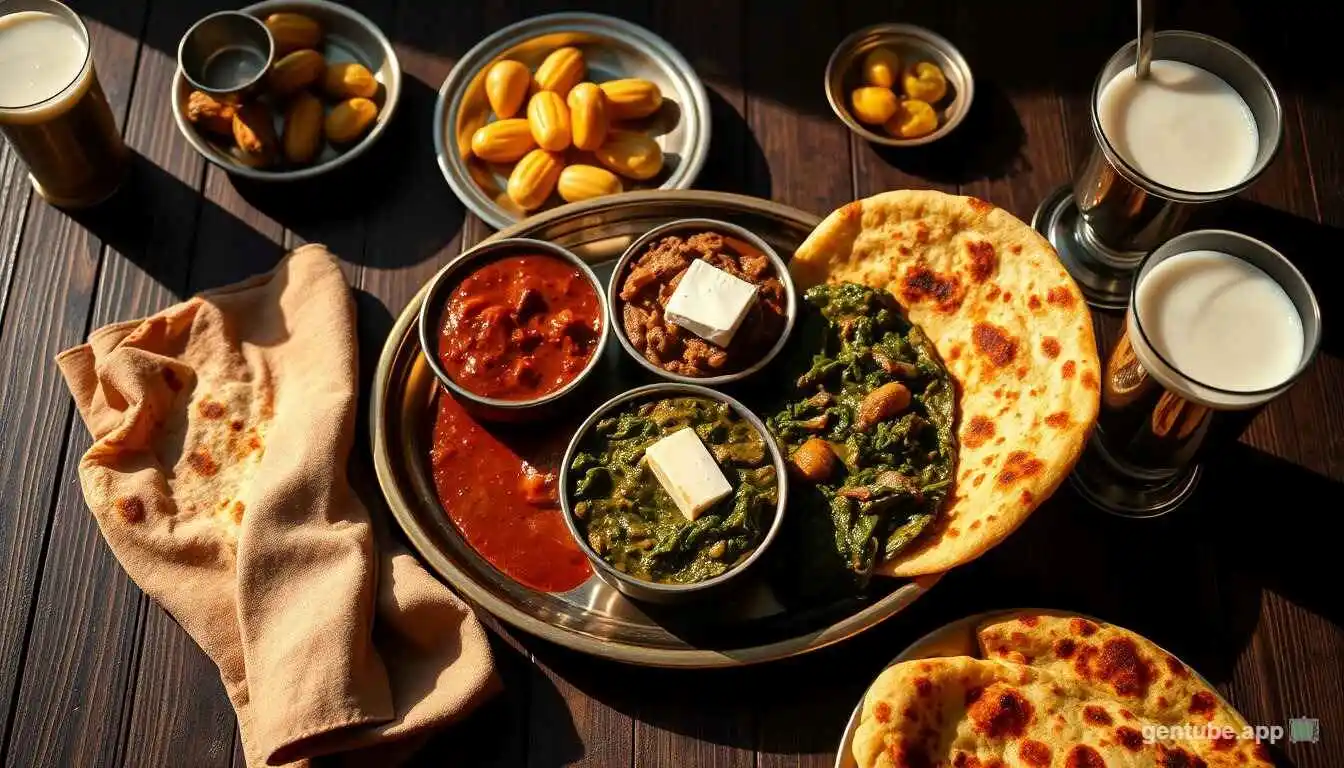
Punjabi cuisine is a reflection of its people: loud, generous, unpretentious, and full of life. It is a cuisine that does not whisper; it roars. It demands that you eat with your hands, that you lick the gravy off your fingers, and that you push your plate away only when you are physically incapable of taking another bite.
To eat Punjabi food is to participate in a ritual of joy. It is the sizzle of the tandoor, the loud pop of mustard seeds in hot oil, the comfort of a thick blanket of ghee, and the shared laughter over a steaming cup of chai. It is a reminder that food is not just about sustenance; it is about community, history, and the unbreakable spirit of the Land of Five Rivers.
So the next time you tear into a hot piece of tandoori chicken or dip a crispy paratha into a bowl of Dal Makhani, take a moment to appreciate the centuries of tradition, the fires of the tandoor, and the generous soul of Punjab that made it all possible.
Balle Balle!
FAQS
Geography & History
1.What does the word “Punjab” mean?
It translates to “Land of Five Rivers” (Punj means five, Aab means water), referring to the Beas, Sutlej, Ravi, Chenab, and Jhelum rivers.
2.How did the 1947 partition affect Punjabi cuisine?
The region was split into Indian Punjab and Pakistani Punjab. Eastern Punjab (India) developed a more dairy-heavy, vegetarian-leaning cuisine influenced by Sikhism, while Western Punjab (Pakistan) maintained a more meat-centric diet.
3.Why is the Punjabi diet so heavy on grains and lentils?
Punjab is an agrarian society. Farmers working long hours in the fields required calorie-dense, sustained energy, which whole grains (like wheat and maize) and protein-rich lentils provide.
The Tandoor
4.What is a tandoor?
It is a cylindrical clay oven heated by charcoal or wood fire, capable of reaching temperatures upwards of 480°C (900°F).
5.How does a tandoor create such unique flavor?
The extreme heat instantly sears meat to lock in juices, while the fat drips onto the coals below, creating smoke that flavors the food from the outside in.
- Who commercialized the tandoor?
Kundan Lal Gujral, who set up the Moti Mahal restaurant in Delhi after fleeing Peshawar during the partition, introduced the commercial tandoor and subsequently invented Tandoori Chicken.
Sarson da Saag & Makki di Roti
- What is Sarson da Saag made of?
It is primarily made of mustard greens, which are boiled for hours and vigorously churned. Bathua (goosefoot) and spinach are often added to balance the bitterness.
- Why is Makki di Roti so difficult to roll?
Makki (cornmeal) dough lacks the gluten found in wheat flour, making it structurally fragile. It usually has to be patted flat by hand rather than rolled with a rolling pin.
- What are the three essential accompaniments for Sarson da Saag and Makki di Roti?
Fresh white butter (makhan), jaggery (gur), and a tall glass of lassi.
Dal Makhani
- What lentils are used in authentic Dal Makhani?
Whole black lentils (urad dal) and red kidney beans (rajma).
- Why does traditional Dal Makhani take 24 hours to cook?
The lentils are slow-cooked overnight to allow them to break down naturally, releasing their starches to create a thick, creamy gravy without artificial thickeners.
- What is the “dhungar” technique?
It is a smoking technique where a piece of burning charcoal is placed in a bowl inside the pot of dal, ghee is poured over the coal, and the pot is covered to infuse the dish with a woody, smoky aroma.
Butter Chicken
- How was Butter Chicken invented?
It was a happy accident. Kundan Lal Gujral simmered leftover, dried tandoori chicken in a gravy of tomatoes, butter, and cream to prevent it from going to waste overnight.
- What makes the Butter Chicken gravy different from other curries?
Authentic Butter Chicken gravy uses no onions; its base is entirely pureed tomatoes cooked down until their acidity is neutralized and they caramelize.
- What is the key herb that gives Butter Chicken its distinct aroma?
Dried fenugreek leaves, known as kasuri methi, crushed and added at the very end.
Breads
- What is the difference between a chapati and a phulka?
Both are flatbreads cooked on a tawa and then puffed on an open flame, but a phulka is much thinner, eaten immediately, and often tears as the steam escapes.
- What makes an Amritsari Kulcha unique?
It’s a leavened bread made from maida (refined flour), baked in a tandoor, and heavily stuffed with spiced potato and paneer, resulting in a crispy exterior and soft interior.
- What is the traditional way to eat a stuffed paratha?
Piping hot off the griddle, smeared with white butter, and served with fresh curd (dahi) and sour mango pickle (achaar).
Street Food
- What gives Chole (in Chole Bhature) its dark color?
The dark hue comes from a specific chole masala (containing black cardamom and pomegranate seeds) and often a tea bag steeped during the cooking process.
- What makes Amritsari Fish Fry so flavorful?
The fish is marinated in a paste containing carom seeds (ajwain) and chaat masala, then coated in gram flour batter and deep-fried.
- What flavor profiles define Punjabi Chaat?
A chaotic symphony of sweet (tamarind chutney), sour (yogurt), spicy (green mint chutney), and salty, combined with contrasting textures of crispy and soft.
Achaar (Pickles)
- How does Punjabi achaar differ from Western pickles?
Western pickles use vinegar, while Punjabi achaar is cured using salt, sun exposure, and copious amounts of mustard oil.
- What are the “Big Three” Punjabi pickles?
Aam ka Achaar (mango), Gobhi-Gajar-Shalgam (cauliflower, carrot, turnip), and Mirch ka Achaar (stuffed chili).
Sweets & Beverages
- What gives Besan ka Ladoo its distinct nutty flavor?
The gram flour is roasted in ghee for a very long time until it caramelizes and turns a deep golden brown before being mixed with sugar.
- What is Pinni, and why is it eaten?
A winter sweet made with whole wheat flour, ghee, jaggery, and edible gum (gond), traditionally given to new mothers to help them regain strength.
- What is the difference between Kheer and Phirni?
Kheer is a rice pudding made with whole rice, while Phirni is made with ground rice and is set and served chilled in earthen pots.
- What is the difference between Meethi and Khatti Lassi?
Meethi lassi is sweetened with sugar and often flavored with cardamom or rosewater, while Khatti lassi is salted and flavored with roasted cumin powder.
- How is Punjabi Chai different from other teas?
Instead of steeping tea leaves in water and adding milk, Punjabi chai is boiled directly in a mixture of water and milk with crushed cardamom and ginger, making it thick and robust.
Culture & Community
- What is the Langar at the Golden Temple?
It is a free, communal kitchen that serves meals 24/7 to all visitors regardless of faith or background, feeding up to 100,000 people daily.
- What was a traditional Dhaba?
Originally a simple, mud-plastered roadside shack on the Grand Trunk Road built to feed truck drivers, characterized by charpais to sit on and rich, ghee-heavy food.
Medical Disclaimer: The information provided on this website is for general educational and informational purposes only and is not intended as a substitute for professional medical advice, diagnosis, or treatment. Always seek the advice of your physician or other qualified health provider with any questions you may have regarding a medical condition. Never disregard professional medical advice or delay in seeking it because of something you have read on this website.

