

For all its staggering success, Singapore is not without its challenges. The very engineered perfection that defines it also creates friction.
There is a growing concern among the youth about a stifling lack of creative freedom and a highly pressurized education system that breeds intense “kiasu” (a Hokkien word meaning a fear of losing out) mentality. The cost of living is astronomical; Singapore frequently ranks as one of the most expensive cities in the world, and owning a car requires purchasing a Certificate of Entitlement (COE) that can cost more than the car itself, a deliberate measure to limit traffic on the tiny island.
Furthermore, Singapore relies heavily on foreign labor. From the high-flying expat bankers to the thousands of migrant workers from South Asia who build the HDB flats and clean the streets, the social dynamics are complex. The migrant workers often live in cramped dormitories on the outskirts of the city, a stark contrast to the gleaming cores they maintain, a disparity highlighted during the COVID-19 pandemic.
Climate change is also an existential threat. Because the island is so low-lying, rising sea levels could literally wipe Singapore off the map. The government is spending billions on a massive “Punggol Digital District” and coastal defenses, including the ambitious plan to build a series of islands off the east coast to act as a barrier against the rising sea.
Yet, if any nation has the financial muscle, the political will, and the engineering audacity to solve these problems, it is Singapore.
Conclusion: The City of Tomorrow, Today
Singapore is not a place that easily lends itself to passive tourism. It demands to be tasted, smelled, and understood. It is a city of contradictions: a rigidly controlled state that fosters wild economic freedom; a hyper-modern metropolis obsessed with preserving its heritage; a tiny island with a global footprint.
It is a reminder that humanity is capable of incredible things when we put our minds to it. Singapore took a swamp and built a utopia—flawed, expensive, and highly regulated, yes—but a utopia nonetheless. It is the ultimate proof that geography is not destiny, and that a city can be anything it decides to be, as long as it has the vision to pull it off.
FAQS
- Is Singapore a country or a city?
Singapore is both. It is a sovereign island city-state and a country located at the southern tip of the Malay Peninsula.
2. What language do they speak in Singapore?
Singapore has four official languages: English, Mandarin Chinese, Malay, and Tamil. English is the main language of business and education, and most locals speak “Singlish,” a dynamic English-based creole with words and grammar borrowed from Chinese dialects and Malay.
- Why is Singapore called the “Lion City”?
According to legend, a Sumatran prince saw a strange, lion-like creature (likely a tiger, as lions are not native to the region) when he first arrived on the island. He named the settlement “Singapura,” which translates to Lion City in Sanskrit.
- Is it true that chewing gum is illegal in Singapore?
Yes and no. The importation and sale of chewing gum are banned. However, you can buy therapeutic, dental, or nicotine chewing gum from a pharmacy if you have a prescription or show your ID.
- Do I need a visa to visit Singapore?
It depends on your passport. Citizens of the US, Canada, UK, EU, Australia, New Zealand, and many Asian countries do not need a visa for tourist stays of 30 to 90 days. Always check the official Immigration & Checkpoints Authority (ICA) website before traveling.
- What is the best time of year to visit Singapore?
Singapore is a tropical country located near the equator, meaning it is hot, humid, and wet year-round (average temperature is around 31°C / 88°F). The “best” time is technically during the dry season from February to April, though sudden rain showers can happen at any time.
- Is Singapore safe?
Extremely safe. It consistently ranks as one of the safest cities in the world. Violent crime is incredibly rare, and you can walk alone at night almost anywhere without fear.
- Is Singapore expensive?
Yes. Singapore frequently ranks among the top 5 most expensive cities in the world for expatriates. However, tourism can be done on a budget if you eat at hawker centres, use public transport, and stay in hostels or budget hotels.
- What currency is used in Singapore?
The Singapore Dollar (SGD or S$).
- Can you drink tap water in Singapore?
Absolutely. The tap water in Singapore is highly purified and exceeds World Health Organization (WHO) standards. It is perfectly safe to drink.
- How do you get around Singapore?
The Mass Rapid Transit (MRT) subway system is world-class, clean, air-conditioned, and very cheap. Taxis and ride-hailing apps (Grab, Gojek) are also abundant and relatively affordable compared to other major cities.
- Can I own a car in Singapore?
Yes, but it is incredibly expensive. Because of space constraints, you must first purchase a Certificate of Entitlement (COE), which allows you to own a car for 10 years. A COE can cost upwards of $100,000 USD, making Singapore the most expensive place in the world to buy a car.
- What is a “Hawker Centre”?
A hawker centre is an open-air food court featuring dozens of small, independent stalls selling a massive variety of cheap, high-quality local foods. It is the backbone of Singaporean dining culture.
- Is Singapore a part of China?
No. Singapore is an independent, sovereign nation. While the majority of the population is of ethnic Chinese descent, Singaporeans are culturally, politically, and legally distinct from mainland China.
- What is the penalty for drugs in Singapore?
Singapore has some of the strictest drug laws in the world. The possession, consumption, manufacturing, or trafficking of drugs carries severe penalties, including lengthy prison sentences and mandatory capital punishment (death penalty) for trafficking large amounts.
- Do you tip in Singapore?
No. Tipping is not a standard practice in Singapore. Most restaurants and hotels automatically add a 10% service charge to your bill. At hawker centres, you simply pay the price listed.
- What is the “Michelin Guide” effect in Singapore?
Singapore is famous for having several hawker stalls that have been awarded Michelin stars, meaning you can eat a world-class, Michelin-starred meal for under $3 USD.
- What is “Kiasu”?
“Kiasu” is a Hokkien dialect word that literally means “fear of losing.” It is a pervasive cultural mindset in Singapore characterized by a desire to not miss out, to be overly competitive, and to grab the best opportunities (e.g., queuing for hours for a free giveaway).
- What is the dress code in Singapore?
Singapore is very casual due to the heat. T-shirts, shorts, and sandals are acceptable almost everywhere during the day. However, if you are visiting high-end clubs, fine-dining restaurants, or places of worship, you should dress modestly and smartly.
- What religion is Singapore?
Singapore is highly diverse religiously. The largest religion is Buddhism, followed by Christianity, Islam, Taoism, and Hinduism. The country guarantees freedom of religion, and major religious festivals (Chinese New Year, Hari Raya, Deepavali, Christmas) are all national holidays.
- Can I smoke in Singapore?
Smoking is heavily regulated. You cannot smoke in most indoor areas, near bus stops, or in covered walkways. You may only smoke in specifically designated yellow-box areas. The legal smoking age is 21.
- How big is Singapore?
Singapore is about 733 square kilometers (283 square miles), making it slightly smaller than New York City.
- Where does Singapore get its water?
Singapore relies heavily on imported water from Malaysia, but it has aggressively developed “NEWater”—highly purified, recycled wastewater that is cleaner than standard tap water and supplies a massive portion of the nation’s needs. They also use desalination plants.
- What is Marina Bay Sands?
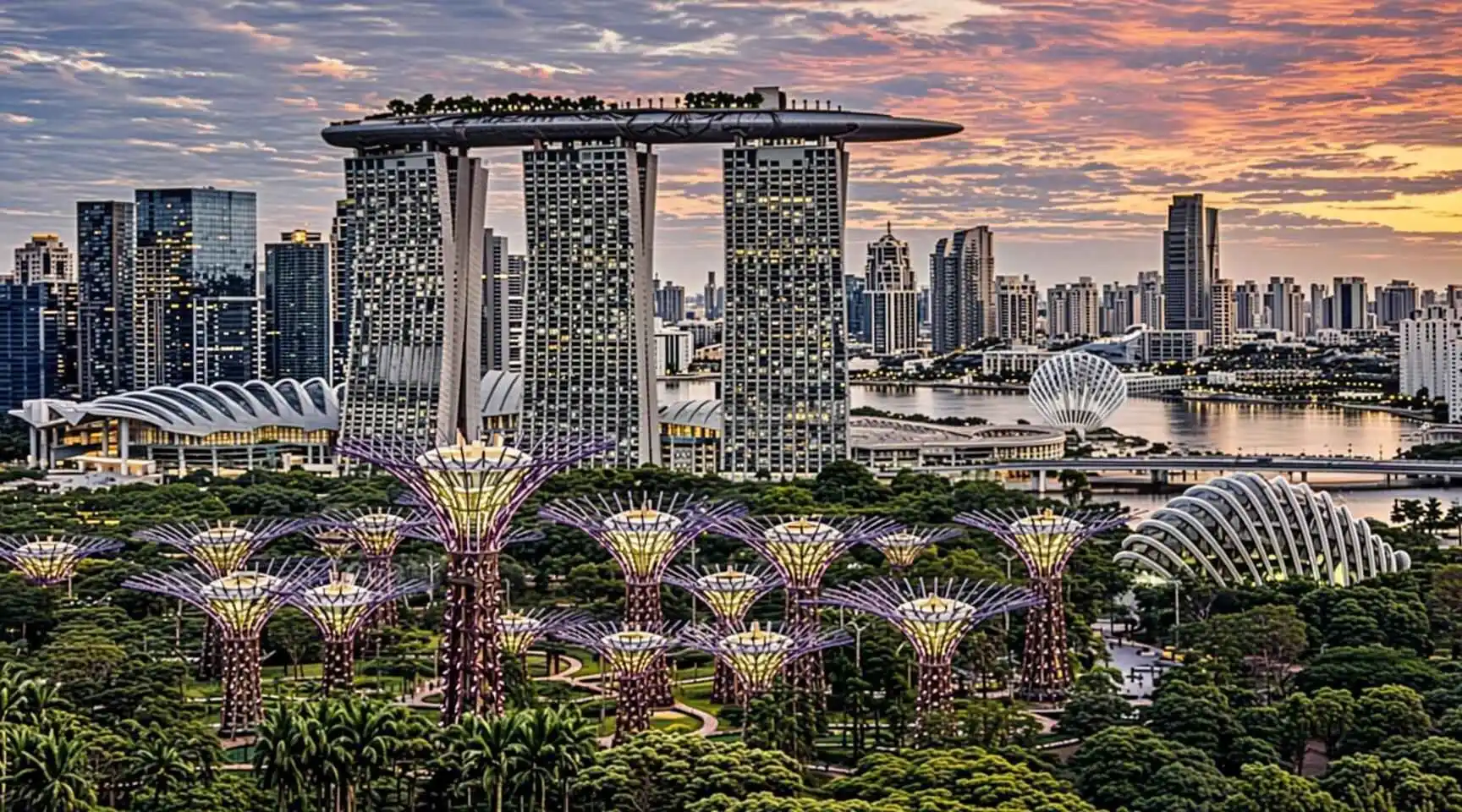
It is an iconic integrated resort featuring a hotel with three 55-story towers topped by a 340-meter-long SkyPark with an infinity pool, a massive casino, a mall, and theaters. It is the most photographed building in Singapore.
- What is Jewel Changi?
Jewel is a massive nature-themed entertainment and retail complex attached to Changi Airport. It features the Rain Vortex, the world’s tallest indoor waterfall, surrounded by a five-story indoor forest.
- What is the Peranakan culture?
Peranakans are the descendants of 15th-to-17th-century Chinese immigrants who married local Malays. They have a unique hybrid culture, speaking a creole language and possessing a distinct architectural and culinary style.
- Is jaywalking illegal in Singapore?
Yes. While you might see locals doing it when no cars are around, it is technically illegal and you can be fined if caught by police.
- Are there beaches in Singapore?
Yes, primarily on Sentosa Island. While the sand is imported and the water is the busy Singapore Strait rather than crystal-clear ocean, they are popular spots for beach clubs and water sports.
- How long should I spend in Singapore?
Most travelers find that 3 to 5 days is enough to see the major sights (Marina Bay, Gardens by the Bay, cultural neighborhoods, hawker centres) without feeling rushed.
- Can I extend my stay in Singapore?
Tourists who do not need a visa are typically granted a 30-day pass. You can apply for an extension online via the ICA website for up to 89 days total, subject to approval, for a fee.
Disclaimer: The content on this blog is for informational purposes only. Author’s opinions are personal and not endorsed. Efforts are made to provide accurate information, but completeness, accuracy, or reliability are not guaranteed. Author is not liable for any loss or damage resulting from the use of this blog. It is recommended to use information on this blog at your own terms.

