

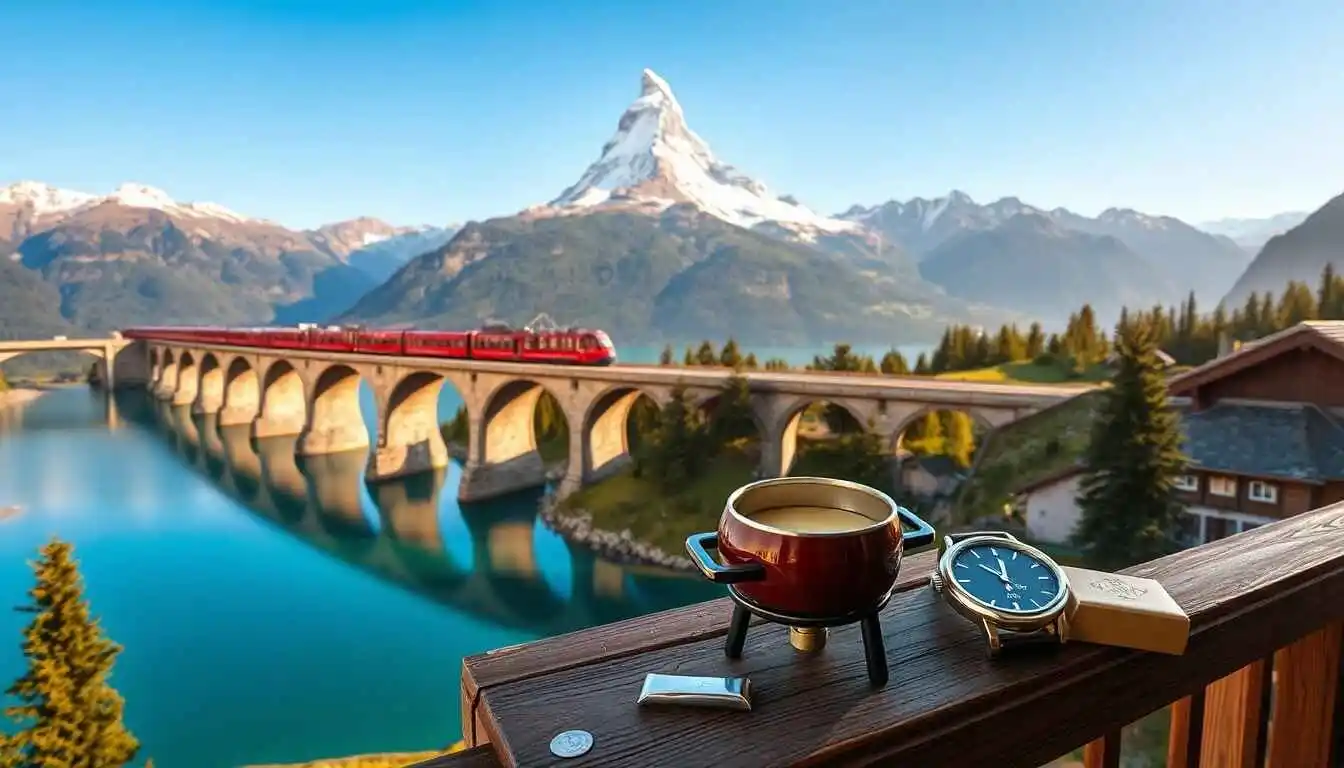
Beyond the Postcard: Unraveling the Enigma, Engineering, and Ecstasy of Switzerland
When you close your eyes and imagine the epitome of perfection on Earth, what do you see? Do you conjure images of impossibly peaked mountains dusted with powdered sugar snow? Do you picture lakes so still and translucent that they act as mirrors for the sky? Do you imagine streets so impeccably clean that you could eat off the cobblestones, or trains that arrive at the exact second the second hand strikes twelve?
You are imagining Switzerland.
For decades, this small, landlocked nation in the heart of Europe has served as the global shorthand for paradise. It is the ultimate fantasy destination, a backdrop for Bollywood romances, a setting for spy thrillers, and the custodian of the world’s wealth. But to dismiss Switzerland as merely a beautiful, expensive playground for the elite is to miss the most fascinating part of the story.
Switzerland is not just a place; it is an ongoing, audacious experiment in governance, precision, and cultural alchemy. How does a country with four official languages, drastically different cultural identities, and virtually no natural resources become one of the wealthiest, most stable, and innovative nations on the planet?
In this deep dive, we are peeling back the glossy brochure. We are going beyond the postcard to explore the engineering marvels, the culinary obsessions, the historical ironies, and the breathtaking landscapes that make Switzerland the masterpiece it is today. Welcome to the confederation that defied the odds.
The Roof of Europe: Where the Swiss Alps Touch the Sky
Let us begin with the very bones of the country: the Swiss Alps. Covering roughly 60% of the nation’s surface, these mountains are not just a backdrop; they are the character that shaped the Swiss psyche. For centuries, these colossal walls of granite and ice isolated communities, forcing them to become self-reliant, resilient, and fiercely independent.
Today, the Alps are the playground of the world. But standing at the Jungfraujoch—dubbed the “Top of Europe” at a staggering 3,454 meters—you realize that the mountains demand respect. The air is thin, the wind bites through the heaviest of coats, and the Aletsch Glacier, a 23-kilometer river of ancient ice, groans and cracks as it slowly carves its way through the valley. It is a humbling reminder of nature’s raw, indifferent power.
And then there is the Matterhorn. Perhaps the most photographed mountain on the planet, its near-perfect pyramidal peak has become the silhouette of alpine grandeur. Standing on the shores of Lake Riffelsee, watching the Matterhorn reflect perfectly in the still water at dawn, is a quasi-religious experience. But the mountain’s beauty belies its deadly nature. The Matterhorn claimed the lives of four of the seven men who first summited it in 1865, a tragic testament to the perilous allure of the Alps. Yet, it is precisely this danger that draws climbers, skiers, and dreamers to its base year after year, seeking a brush with the sublime.
Urban Elegance and Alpine Soul: The Tale of Three Cities
Switzerland’s cities are a masterclass in juxtaposition. They hum with cosmopolitan energy, yet you are never more than thirty minutes from a forest, a lake, or a mountainside.
Zurich: The Beating Heart of Wealth and Culture
When people hear Zurich, they think of banks, gold vaults, and sterile financial districts. But to visit Zurich is to discover a city that is vibrantly alive, deeply historical, and culturally audacious. Start at the Hauptbahnhof (the main train station), a cathedral of Swiss punctuality, and walk down the famed Bahnhofstrasse, one of the most exclusive shopping streets on earth.
But the true soul of Zurich lies in its Altstadt (Old Town). Wander through the narrow, winding alleys that echo with the footsteps of centuries. Look up to see oriel windows, painted facades, and guildhalls that date back to the Middle Ages. Sit by the Limmat River, watching the swans glide past the Fraumünster Church, its stained-glass windows masterpieces by Marc Chagall. Zurich is also home to the vibrant Kreis districts, where underground clubs, street art, and a thriving tech startup scene prove that this city is far more than a retirement home for bankers.
Lucerne: The Fairytale Frozen in Time
If Zurich is the brain of Switzerland, Lucerne is its romantic heart. Nestled beside a sapphire lake and surrounded by the sentinel peaks of Mount Pilatus and Rigi, Lucerne is the storybook Switzerland you dreamed of as a child.
The city’s crown jewel is the Chapel Bridge (Kapellbrücke), a 14th-century wooden footbridge that stretches across the Reuss River. Inside the bridge, a series of triangular 17th-century paintings depict the history and legends of the city. Walking across it as the sun sets, with the water reflecting the medieval pastel buildings, is like stepping into a time machine. Nearby, the Lion Monument—a carving of a dying lion in a sandstone cliff, commissioned to commemorate the Swiss Guards massacred during the French Revolution—is a heartbreaking work of art that even Mark Twain called “the most mournful and moving piece of stone in the world.”
Interlaken: The Adrenaline Capital Between the Lakes
Situated precisely as its name suggests—between Lake Thun and Lake Brienz—Interlaken is the undisputed adventure capital of the Alps. In the 19th century, it was the resort of choice for the European aristocracy, who came to take the mountain air. Today, the aristocrats have been replaced by thrill-seekers.
Interlaken is where you come to throw yourself out of a perfectly good airplane. Skydiving over the Jungfrau region, with the snow-capped peaks and turquoise lakes rushing up to meet you, is a sensory overload. Paragliding is almost a rite of passage here; the skies above the town are constantly dotted with colorful canopies, drifting silently on the alpine thermals. Whether you are canyon jumping, white-water rafting, or simply taking a cogwheel train up the Jungfrau, Interlaken demands that you engage with the landscape, not just observe it.
A Symphony for the Taste Buds: The Untold Story of Swiss Chocolate and Swiss Fondue
Switzerland’s contributions to global gastronomy are disproportionately massive for a nation of just 8.7 million people. They did not just invent dishes; they invented entire culinary categories.
The Sweet Science of Swiss Chocolate
It is impossible to talk about Switzerland without discussing Swiss chocolate. But the silky, melt-in-your-mouth bars we know today were not always the standard. In the early 19th century, chocolate was a coarse, bitter, and gritty affair, consumed primarily as a drink.
It took the genius of Swiss innovators to transform it. In 1875, Daniel Peter, a candle-maker from Vevey, had a revolutionary idea. He took his neighbor Henri Nestlé’s newly invented condensed milk and mixed it with cocoa powder. The result was the world’s first milk chocolate. Later, Rodolphe Lindt invented the “conching” machine—a device that continuously ground cocoa beans and sugar for days, resulting in a chocolate so smooth it melted on the tongue.
Visiting the Maison Cailler in Broc is a sensory pilgrimage. Walking through the factory, you are enveloped in the intoxicating aroma of roasting cocoa and warm milk. You learn that Swiss chocolate is not just a treat; it is the product of meticulous chemical engineering and agricultural sourcing. Every bite of Swiss chocolate is a bite of industrial history and culinary perfection.
The Communal Magic of Swiss Fondue
If chocolate is Switzerland’s gift to the sweet tooth, Swiss fondue is its gift to the soul. Born out of necessity in the harsh alpine winters, where isolated communities had to survive on stale bread and hard cheese, fondue has evolved into the ultimate communal dining experience.
The rules of fondue are sacred. The traditional mixture—usually a blend of Gruyère and Vacherin Fribourgeois cheeses—is melted in a caquelon (earthenware pot) with white wine, a splash of kirsch (cherry brandy), and rubbed with a clove of garlic. You spear a cube of crusty bread on a long fork, dip it into the bubbling cauldron, and stir in a figure-eight motion to keep the mixture smooth.
But beware the faux pas! If you lose your bread in the pot, tradition dictates a penalty—historically, men had to buy a round of drinks, and women had to kiss the man to their left. And at the bottom of the pot lies the religieuse (the religious one)—a crispy, caramelized layer of cheese that must be scraped out and shared. Fondue is not just a meal; it is a ritual of unity, a warm embrace against the cold, and a testament to the Swiss ability to turn scarcity into luxury.
Timekeepers of the World: The Genius Behind Swiss Watches and Swiss Efficiency
There is a running joke that if God had a nationality, He would be Swiss, because only the Swiss could have engineered the universe with such breathtaking precision. This obsession with exactitude permeates every facet of Swiss life, manifesting most iconically in Swiss watches and the legendary Swiss efficiency.
The Micro-Mechanical Marvel of Swiss Watches
To look inside a high-end Swiss watch is to look at the pinnacle of human micro-engineering. Brands like Patek Philippe, Vacheron Constantin, Audemars Piguet, and Rolex do not merely tell time; they are the custodians of a 500-year-old horological tradition that began in Geneva.
In the 16th century, the Protestant reformer John Calvin banned the wearing of ornate jewelry in Geneva. Forced to pivot from making decorative baubles to making functional objects, the city’s jewelers turned to watchmaking. The industry eventually migrated to the Jura mountains, where, during the long, harsh winters, farmers whiled away the hours by assembling microscopic gears, springs, and escapements.
A grand complication Swiss watch can contain over 1,000 individual parts, assembled by hand by artisans who spend months creating a single timepiece. They chime the minute repeater, track the phases of the moon, and calculate the equation of time—all without a single battery, relying solely on the kinetic energy of the wearer or the winding of a mainspring. A Swiss watch is a rebuke to the disposable culture of the modern age; it is an heirloom designed to outlast its owner, ticking on the wrists of generations yet unborn.
The Existential Beauty of Swiss Efficiency
But watches are merely the aesthetic expression of a deeper cultural trait: Swiss efficiency. This is a country where things simply work.
The Swiss Federal Railways (SBB) is the gold standard of public transport. The trains do not merely run on time; they run to the second. The entire national timetable is a marvel of mathematical choreography. If your train arrives at Platform 3 at 14:32, you can set your watch by it. And the infrastructure! The Gotthard Base Tunnel, stretching 57 kilometers through the heart of the Alps, is the longest and deepest railway tunnel in the world—a $12 billion monument to the Swiss refusal to let mountains get in the way of a tight schedule.
This efficiency is born of a deeply ingrained respect for the collective. The Swiss do not tolerate tardiness because one person’s delay creates a domino effect that disrupts the social fabric. It is the practical application of the Ordnung (order) that keeps a diverse, multilingual nation functioning seamlessly.
The Irony of Peace: How Swiss Neutrality Forged a Fierce Identity
Perhaps the most defining characteristic of Switzerland on the global stage is its neutrality. The Swiss have not fought in a foreign war since 1815. But Swiss neutrality is often profoundly misunderstood. It is not pacifism; it is armed deterrence.
To understand this, you must look at the landscape. The Swiss Alps are literally honeycombed with secret military installations. During the Cold War, the Swiss strategy was the “National Redoubt.” The plan was simple: if the Soviet Union or any other power invaded, the Swiss army would blow up the bridges, tunnels, and passes, retreating into the alpine fortresses. From there, they would wage a brutal, unending guerrilla war. The message to the world was clear: You can invade Switzerland, but you will never own it, and you will bleed for every inch.
Switzerland has mandatory military service for men, and citizens are required to keep their government-issued assault rifles at home. The country’s famous shooting festivals, like the Feldschiessen, are a blend of cultural tradition and military readiness.
This neutrality, combined with an unbreakable defense, has made Switzerland the world’s trusted mediator. Geneva hosts the United Nations, the Red Cross (founded by Swiss businessman Henry Dunant), and countless international NGOs. The Swiss have turned their geopolitical isolation into a moral authority, becoming the vault of the world’s secrets, wealth, and diplomatic hope.
The Slow Travel Revolution: Riding the Glacier Express
If you truly want to understand the scale and beauty of Switzerland, you must not fly over it; you must glide through it. And there is no better way to do that than aboard the Glacier Express.
Don’t let the word “Express” fool you. This is the slowest express train in the world, taking nearly eight hours to travel the 291 kilometers between the glitzy resort town of St. Moritz and the alpine village of Zermatt. And that is entirely the point.
Sitting in the panoramic car, with floor-to-ceiling glass windows that curve up into the roof, you are immersed in a slow-motion IMAX film of the Swiss countryside. The train climbs the Oberalppass, winds through the dramatic Rhine Gorge (the “Swiss Grand Canyon”), and loops through the UNESCO World Heritage-listed Albula line, an engineering marvel of soaring stone viaducts and spiraling tunnels.
As the train clicks and clacks over the iconic Landwasser Viaduct—a six-arched bridge that plunges directly into a tunnel inside a sheer cliff face—you feel a profound connection to the landscape. You are not conquering the mountains; you are respecting them. The Glacier Express is a meditation, a reminder that in a world obsessed with speed and instant gratification, the most luxurious thing you can do is slow down and savor the journey.
Hacking the Swiss Dream: The Ultimate Insider’s Guide
Switzerland has a reputation for being prohibitively expensive, and while it is undeniably pricey, it doesn’t have to break the bank if you travel smartly. Here is how to hack the Swiss dream.
- The Swiss Travel Pass is Your Best Friend If you are relying on point-to-point tickets, you will hemorrhage money. The Swiss Travel Pass offers unlimited travel on the national rail network, buses, and boats, plus free entry to over 500 museums. More importantly, it gives you the psychological freedom to jump on and off trains without calculating the cost. Fancy a spontaneous boat ride on Lake Lucerne? Just hop on.
- Embrace the Grocery Store Gourmet Swiss restaurants are expensive, but Swiss grocery stores like Coop and Migros are affordable and of incredible quality. You can buy fresh bread, artisanal cheeses, cured meats, and ready-to-eat salads for a fraction of the restaurant price. Many grocery stores even have microwave stations or small seating areas. Dining al fresco with a grocery-store picnic by a lake is a quintessential Swiss experience.
- Sundays Are Sacred (and Closed) Do not plan to do your shopping on a Sunday. In Switzerland, Sunday is a day of rest by law. Almost all shops, grocery stores, and malls are closed. Only the railway station stores and some gas stations remain open. Use Sundays to hike, ride the trains, and explore the outdoors.
- The Water is Free and Phenomenal Switzerland has some of the cleanest tap water in the world, sourced directly from the Alps. Do not buy bottled water. Carry a reusable bottle and drink from the thousands of public fountains found in every city, town, and village. If a fountain doesn’t have a sign saying “Kein Trinkwasser” (No Drinking Water), it is safe to drink.
- Speak the Local Lingo (Even Badly) Switzerland has four national languages: Swiss German, French, Italian, and Romansh. While English is widely spoken, making an effort to say Grüezi (Hello in Swiss German), Bonjour (Hello in French), or Buongiorno (Hello in Italian) goes a long way. The Swiss deeply appreciate the effort to respect their linguistic diversity.
The Echo of the Alphorn: Why Switzerland Changes You
As your plane lifts off the tarmac and you look out the window one last time at the patchwork of green valleys, sapphire lakes, and white-capped peaks, something shifts inside you.
Switzerland does not just show you beauty; it recalibrates your standards. It shows you that precision and passion are not mutually exclusive, that a society can function both efficiently and compassionately, and that nature is not an obstacle to be overcome, but a master to be revered.
From the mesmerizing peaks of the Swiss Alps to the meticulous ticking of Swiss watches, from the gooey, communal joy of Swiss fondue to the sweet, melting perfection of Swiss chocolate, this country is a masterclass in living well. Whether you are wandering the medieval streets of Lucerne, chasing adrenaline in Interlaken, banking on the quiet confidence of Zurich, or marveling at the stunning Matterhorn, Switzerland leaves an indelible mark on your soul.
It is a nation built on an unshakeable foundation of Swiss neutrality and propelled forward by an unrelenting Swiss efficiency. It invites you to slow down on the Glacier Express, to breathe the mountain air, and to realize that perfection is not a destination, but a continuous, beautiful journey.
Switzerland is not just a place to visit. It is a place to believe in.
FAQS
The Swiss Alps & The Matterhorn
1.What percentage of Switzerland is covered by the Swiss Alps?
Roughly 60% of the country’s surface is covered by the Alps.
2.What is the “Top of Europe”?
It is the Jungfraujoch, a glacial pass and scientific observatory located at a staggering 3,454 meters.
3.How long is the Aletsch Glacier?
It is a 23-kilometer river of ancient ice and the largest glacier in the Alps.
4.Which mountain is considered the most photographed in Switzerland?
The Matterhorn, famous for its near-perfect pyramidal peak.
5.What tragic event occurred during the first ascent of the Matterhorn in 1865?
Four of the seven climbers in the summit party lost their lives on the descent.
Swiss Cities: Zurich, Lucerne, & Interlaken
6.Is Zurich only a financial hub?
No, beyond banking, it boasts a vibrant Old Town (Altstadt), world-class art, and a thriving tech startup scene.
7.Who designed the stained-glass windows in Zurich’s Fraumünster Church?
The renowned artist Marc Chagall.
- What is the Chapel Bridge (Kapellbrücke) in Lucerne?
It is a 14th-century wooden footbridge spanning the Reuss River, featuring triangular 17th-century paintings inside.
- What does the Lion Monument in Lucerne commemorate?
It commemorates the Swiss Guards who were massacred during the French Revolution.
- Where is Interlaken located?
It is situated exactly as its name suggests—between Lake Thun and Lake Brienz.
- What is Interlaken known as today?
It is the undisputed adventure and adrenaline capital of the Alps, famous for skydiving and paragliding.
Swiss Chocolate & Culinary Traditions
- Who invented milk chocolate?
Daniel Peter, a candle-maker from Vevey, invented it in 1875 by mixing cocoa with his neighbor Henri Nestlé’s condensed milk.
- What did Rodolphe Lindt invent?
He invented the “conching” machine, which continuously ground cocoa and sugar for days to create chocolate that melts on the tongue.
- Where can you visit the Maison Cailler chocolate factory?
In the town of Broc.
- What cheeses are traditionally used for Swiss fondue?
A blend of Gruyère and Vacherin Fribourgeois.
- What is the proper way to stir fondue?
You stir in a figure-eight motion to keep the mixture smooth and prevent it from separating or burning.
- What happens if you lose your bread in the fondue pot?
Tradition dictates a penalty: men must buy a round of drinks, and women must kiss the man to their left.
- What is the religieuse in a fondue pot?
It is the crispy, caramelized layer of cheese left at the bottom of the pot, which is scraped out and shared.
Swiss Watches & Efficiency
- How did the Swiss watchmaking industry begin in Geneva?
In the 16th century, reformer John Calvin banned ornate jewelry, forcing jewelers to pivot to functional watchmaking.
- What is a “grand complication” Swiss watch?
A highly complex mechanical watch containing over 1,000 parts, featuring functions like minute repeaters and moon phases without batteries.
- What is the Gotthard Base Tunnel?
A 57-kilometer railway tunnel through the Alps; the longest and deepest of its kind in the world.
- Why is Swiss efficiency so deeply ingrained in the culture?
It is born of a respect for the collective; one person’s delay creates a domino effect that disrupts the social fabric and timetable.
Swiss Neutrality & History
- Since what year has Switzerland not fought in a foreign war?
Since 1815.
- Is Swiss neutrality the same as pacifism?
No, it is armed deterrence. The country has mandatory military service and heavily fortified alpine defenses.
- What was the “National Redoubt” strategy?
The plan to retreat into alpine fortresses, blow up passes, and wage guerrilla warfare if invaded.
- Why is Geneva home to so many international organizations?
Switzerland’s armed neutrality and unbreakable defense have given it the moral authority to act as the world’s trusted mediator and diplomatic hub.
Travel & The Glacier Express
- How long does the Glacier Express take to travel from St. Moritz to Zermatt?
Nearly eight hours, making it the slowest express train in the world.
- What is the Landwasser Viaduct famous for?
It is a six-arched stone bridge that plunges directly into a tunnel inside a sheer cliff face.
- What is the Swiss Travel Pass?
A pass that offers unlimited travel on the national rail, bus, and boat networks, plus free entry to over 500 museums.
- Can you drink water from public fountains in Switzerland?
Yes, Switzerland has some of the cleanest tap water in the world; fountain water is safe to drink unless marked with a “Kein Trinkwasser” sign.
Disclaimer: The content on this blog is for informational purposes only. Author’s opinions are personal and not endorsed. Efforts are made to provide accurate information, but completeness, accuracy, or reliability are not guaranteed. Author is not liable for any loss or damage resulting from the use of this blog. It is recommended to use information on this blog at your own terms.

