

Where Swamps Became Supertrees: The Baffling, Flawless Paradox of Singapore
The Impossible City: Inside the Sensory Overload and Sheer Genius of Singapore
Step out of the air-conditioned cavern of Changi Airport and into the humid, tropical embrace of Singapore, and your senses are immediately hijacked. The air is thick, carrying the intoxicating aroma of sizzling garlic, lemongrass, and slow-roasted pork. Towering above you, glass and steel supertrees pierce the sky, draped in living, breathing ferns and orchids. In the distance, a three-towered casino ship seems to glide atop three massive skyscrapers, while a pristine, robot-cleaned subway shuttles millions of people flawlessly beneath the streets.
Welcome to Singapore.
It is a city that defies logic. It is a sovereign island nation roughly the size of Fresno, California, yet it possesses a GDP that rivals entire continents. It has no natural resources—no oil, no gold, no vast arable land, not even enough drinking water to sustain itself—yet it is one of the wealthiest nations on Earth. It is a strict, tightly regulated republic where chewing gum is famously banned, yet it is also a vibrant, chaotic, multicultural melting pot where Chinese, Malay, Indian, and Western influences collide in a spectacular frenzy of food, language, and architecture.
Singapore is not just a city; it is a masterclass in human ingenuity. It is a testament to what happens when visionary leadership, ruthless efficiency, and a desperate need to survive are combined. From a swampy, malaria-ridden trading post at the tip of the Malay Peninsula to a hyper-modern, sci-fi metropolis, the story of Singapore is the greatest urban success story of the 21st century.
In this expansive deep dive, we are going to peel back the glossy, postcard-perfect exterior of the Lion City. We will explore its miraculous history, its obsession with futuristic green architecture, the sacred grounds of its hawker centres, the peculiarities of its strict laws, and the complex cultural tapestry that makes this island unlike any other place on the planet.
The Miracle by the Malay Strait
To understand modern Singapore, you must understand the sheer panic of 1965. On August 9th of that year, Singapore was unceremoniously ejected from the Federation of Malaysia. The separation was not amicable; it was born out of racial tensions and political deadlock.
The founding father, Lee Kuan Yew, wept on national television. Singapore was a tiny island surrounded by larger, potentially hostile neighbors. It had a massive, rapidly growing population, high unemployment, a severe housing crisis, and absolutely no natural resources. The prevailing sentiment among global observers was that Singapore was doomed.
But Lee Kuan Yew and his People’s Action Party (PAP) had other plans. They adopted a pragmatic, almost clinical approach to nation-building. First, they secured water agreements with Malaysia, ensuring the island wouldn’t literally dry up. Then, they aggressively courted foreign multi-national corporations, offering a corruption-free, highly disciplined, English-speaking workforce.
To fix the housing crisis, the Housing & Development Board (HDB) was empowered to build public housing on an unprecedented scale. Today, over 80% of Singapore’s resident population lives in HDB flats, a staggering statistic that has virtually eliminated slums and created a uniquely egalitarian society where the wealthy and the working class live in close proximity.
Singapore didn’t just survive; it engineered its own relevance. It became the vital port and financial hub bridging the East and the West. It cleaned up its rivers, drove out corruption with an iron fist, and transformed from a third-world port into a first-world powerhouse in a single generation.
A Concrete Jungle That Actually Breathes
If there is one word synonymous with Singapore today, it is “futuristic.” But unlike the cold, dystopian cyberpunk futures envisioned by Hollywood, Singapore’s future is intensely green.
The government’s vision shifted years ago from being a “Garden City” (just planting trees alongside roads) to being a “City in a Nature” (integrating nature into the very fabric of the architecture).
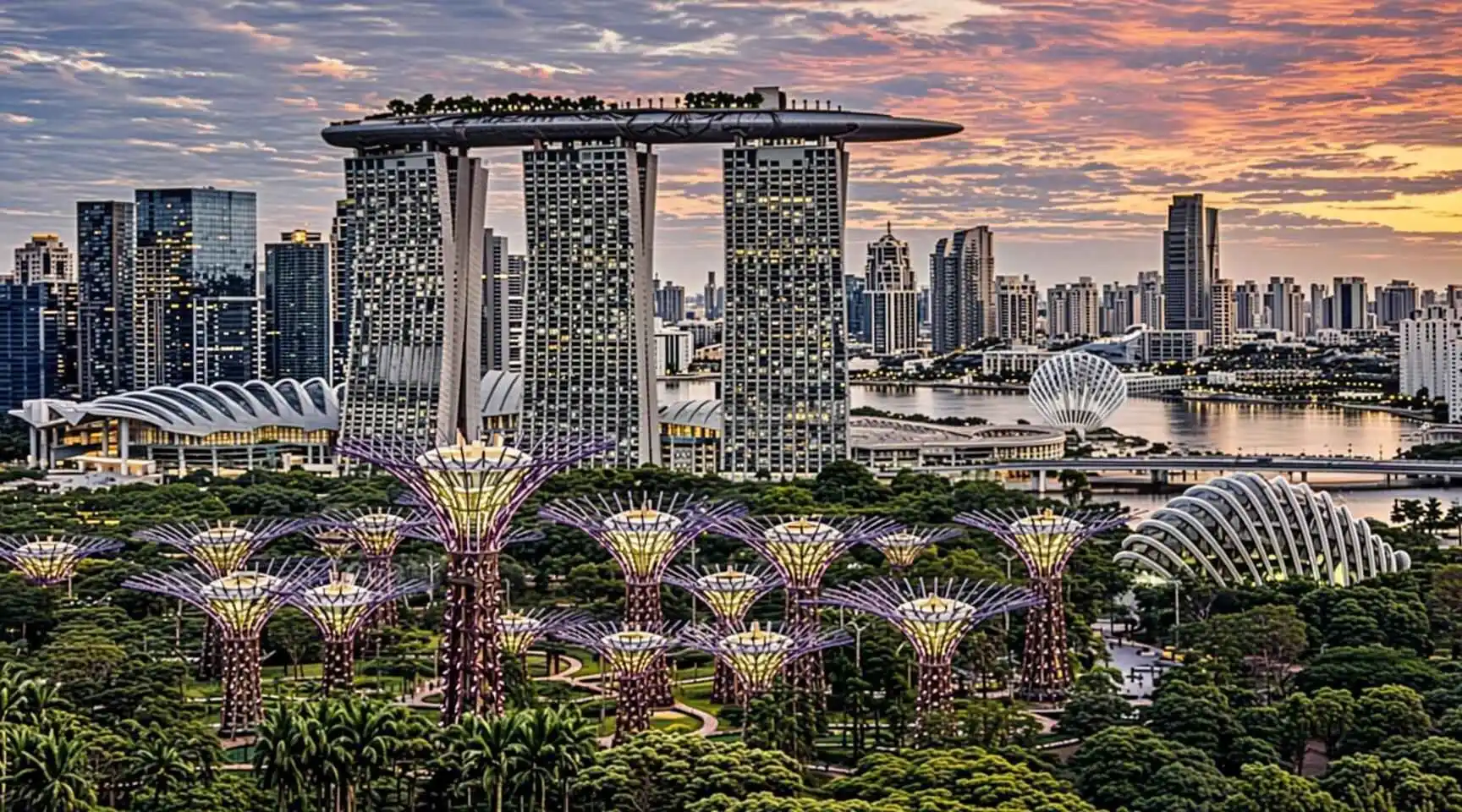
Nowhere is this more evident than at Gardens by the Bay. Spanning 101 hectares of reclaimed land, this park is a surreal masterpiece. The centerpiece consists of the Supertrees—vertical gardens ranging from 25 to 50 meters tall. These steel frameworks are covered in living plants, ferns, and climbing vines. At night, they come alive with a synchronized light and sound show that feels like stepping into the movie Avatar. Beneath the Supertrees sit massive, glass-domed conservatories: the Cloud Forest, which features a 35-meter-tall indoor waterfall covered in tropical highland vegetation, and the Flower Dome, which replicates Mediterranean climates.
But the green architecture goes far beyond tourist attractions. Take a look at CapitaSpring, a 280-meter skyscraper in the financial district. It features a “Green Oasis”—a massive, open-air spiral garden that winds its way up the building, integrating over 80,000 plants. Look at Parkroyal on Pickering, a hotel designed to look like a giant green cliffside, draped in cascading plants and featuring sky gardens that naturally cool the building and filter the air.
Singapore has mandated that any new green space replaced by a building must be compensated for with greenery on the building. The result is a skyline that looks like it is being slowly reclaimed by the jungle—a beautiful, breathable paradox.
The Sacred Grounds of the Hawker Centre
You can have all the futuristic architecture in the world, but the true beating heart of Singapore is found under the fluorescent lights of its Hawker Centres.
In 2020, Singapore’s hawker culture was inscribed on the UNESCO Representative List of the Intangible Cultural Heritage of Humanity. It is the great equalizer of Singaporean society. Inside these massive, noisy, open-air food courts, a billionaire in a tailored suit might be sitting elbow-to-elbow with a construction worker, both eating off cheap plastic plates, waiting in the same chaotic lines.
Hawker centres evolved from the street food vendors of the 19th and 20th centuries. The government moved them into sanitized, regulated facilities in the 1970s and 80s, but the soul of the food remained untouched.
This is where the true fusion of Singapore happens. You can find a Malay stall selling Nasi Lemak (fragrant coconut rice with spicy sambal, fried anchovies, and peanuts). Next to it, a Chinese uncle is expertly tossing Char Kway Teow (smoky stir-fried flat rice noodles with lup cheong sausage and cockles) in a blazing wok. Across the aisle, an Indian vendor is slapping dough onto a hot griddle to make Roti Prata, served with a fish head curry that is spicy enough to make your eyes water.
And then there is the holy grail of Singaporean cuisine: Hainanese Chicken Rice. Poached to silky perfection, served with fragrant rice cooked in chicken fat and pandan leaves, dipped in a sharp chili sauce and minced ginger. It is deceptively simple, yet incredibly difficult to perfect.
The miracle of the hawker centre is that this world-class, Michelin-recognized food (several hawker stalls have actually won Michelin stars) costs between $2 and $6 USD. It is an ecosystem built on razor-thin margins, grueling 14-hour workdays, and multi-generational family recipes.
The Rules of the Realm
You cannot talk about Singapore without talking about its rules. It is often mocked in the West as a “nanny state” or a “fine city” (a pun on the numerous financial fines one can incur).
The most famous ban is, of course, chewing gum. Implemented in 1992, the ban was not because the government hated the concept of gum, but because vandals were sticking chewed gum onto the door sensors of the newly built MRT (subway) trains, causing the doors to malfunction and creating severe delays. It was a surgical solution to a highly specific infrastructural problem. (Therapeutic and dental gum is now legally available with a prescription).
But the strictness goes deeper than gum. Littering carries heavy fines; failing to flush a public toilet can result in a police summons; jaywalking is strictly penalized; and the sale, importation, and consumption of chewing tobacco and e-cigarettes are totally banned.
More seriously, Singapore is famous for its zero-tolerance policy on drugs. Drug trafficking carries a mandatory death penalty. Even minor drug possession results in severe prison sentences.
To a Westerner raised on the ideals of absolute personal liberty, this can feel suffocating. But to a Singaporean, it is the very foundation of their quality of life. The social contract in Singapore is different: citizens trade a certain degree of personal liberty for immense public safety, incredible public order, and near-zero street crime. You can walk alone through any neighborhood in Singapore at 3:00 AM, and you will almost certainly be completely safe. Women feel safe walking at night. Children take public transport alone. The streets are spotless. The trains run exactly on time, down to the second. For Singaporeans, the rules are not a burden; they are the invisible architecture that allows 5.5 million people to live in dense harmony on a tiny island.
The Cultural Tapestry and Neighborhoods
Beneath the gleaming skyscrapers, Singapore is a patchwork of deeply rooted cultural enclaves. The government’s early policy of ethnic integration in HDB housing prevented the formation of racial ghettos, but the historical neighborhoods remain vital cultural touchstones.
Chinatown: A sensory overload of red and gold. The Buddha Tooth Relic Temple dominates the skyline, while the side streets are packed with traditional medicine shops selling dried sea horses and ginseng, alongside modern cocktail bars hidden behind unmarked doors.
Little India: Step off the MRT at Little India and the atmosphere changes instantly. The air smells of jasmine garlands, burning incense, and cumin. The streets are lined with shops selling vibrant silk saris and gold jewelry. The Mustafa Centre, a 24-hour mega-mall, is a chaotic, beloved institution where you can buy everything from a Samsung phone to a sack of basmati rice at 4 in the morning.
Kampong Glam: The historic Muslim quarter, centered around the stunning Sultan Mosque with its massive golden domes. Today, it is a hipster haven where traditional Malay garment shops sit next to artisanal coffee roasters and street art murals. Haji Lane, a narrow alley in the area, is one of the most photographed streets in Asia.
The Peranakan Culture: Perhaps the most uniquely “Singaporean” culture is the Peranakan (or Baba-Nyonya) culture. These are the descendants of Chinese immigrants who settled in the Malay archipelago centuries ago and married local Malay women. They developed a completely distinct culture, language (a mix of Hokkien and Malay), and arguably, one of the greatest cuisines on earth—a complex, labor-intensive blend of Chinese techniques and Malay spices, often served in beautiful, colorful porcelain.
The Ultimate Playground
Singapore has deliberately engineered itself to be a global tourist magnet, a place where luxury and entertainment know no bounds.
Marina Bay Sands (MBS): The iconic three-tower integrated resort is a monument to excess and engineering. Topped by a 1-hectare SkyPark that looks like a ship balancing on top of the buildings, it houses a massive casino, high-end luxury boutiques, a canal complete with sampan boat rides, and the world’s largest rooftop infinity pool (reserved for hotel guests).
Sentosa Island: Connected to the mainland by a pedestrian boardwalk and a cable car, Sentosa is Singapore’s playground. It houses Universal Studios Singapore, several beach clubs where you can party in the sand while looking up at cargo ships, a waterpark, and the S.E.A. Aquarium, one of the largest oceanariums in the world.
Jewel Changi Airport: You haven’t really left Singapore until you’ve seen Jewel. Attached to Terminal 1, it is a massive, multi-story cylindrical building built around a 40-meter-tall indoor waterfall called the Rain Vortex, surrounded by thousands of trees and plants. It is a shopping mall and a nature park fused together, ensuring that your vacation doesn’t end when you reach the airport—it just shifts gears.
The Challenges Ahead
https://youtu.be/mvfU8x3E8hE

