

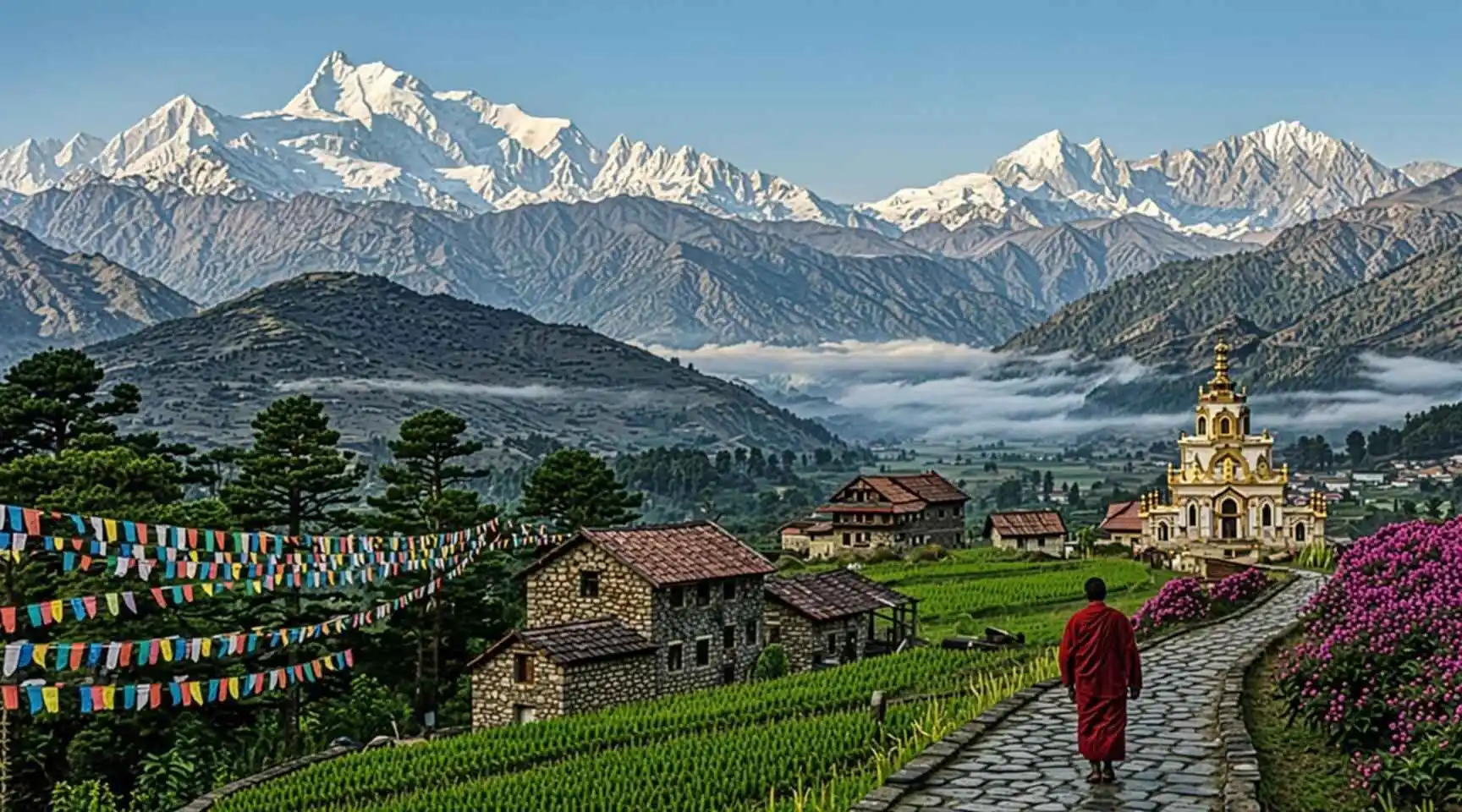
Discovering Nepal: A Journey Through the Land of Mountains, Mysticism, and Marvels
Nestled in the lap of the mighty Himalayas, where ancient traditions blend seamlessly with breathtaking natural beauty, lies Nepal—a country that transcends the ordinary and beckons the soul. More than just the home of Mount Everest, Nepal is a tapestry of vibrant cultures, profound spirituality, rich history, and awe-inspiring landscapes. It’s a land where snow-capped peaks pierce the heavens, where saffron-robed monks chant in centuries-old temples, and where the spirit of resilience and harmony thrives in every corner.
In this extensive exploration, we embark on a journey through Nepal, uncovering its geography, history, culture, religion, cuisine, economy, and the vibrant tapestry of life that defines this enchanting nation. Whether you’re a seasoned traveler, a culture enthusiast, or someone captivated by the stories of distant lands, this deep dive into Nepal will illuminate why this Himalayan gem continues to inspire wanderers and seekers from across the globe.
Geography and Natural Splendor: A Landscape Like No Other
Spanning just over 147,000 square kilometers, Nepal is a geographically diverse country that runs east to west along the southern flank of the Himalayan mountain range. Surrounded by India to the south, east, and west, and by the Tibet Autonomous Region of China to the north, Nepal is a landlocked nation that boasts some of the most dramatic topographical contrasts on Earth.
From the sun-baked Terai plains in the south—lush with sal forests, grasslands, and wildlife sanctuaries—to the rolling hills of the Mahabharat Range, and finally to the soaring peaks of the Himalayas in the north, Nepal encapsulates all of Earth’s climatic zones in a mere 200-kilometer north-south stretch. This incredible variation gives Nepal an unparalleled range of ecosystems, making it one of the most biodiverse countries per unit area in the world.
The crown jewel of Nepal’s geography is, of course, Mount Everest (known locally as Sagarmatha in Nepali and Chomolungma in Tibetan), which stands at a staggering 8,848.86 meters (29,031.7 feet) above sea level—the highest point on Earth. But Everest is just one of eight of the world’s fourteen peaks above 8,000 meters located in Nepal, including Kanchenjunga, Lhotse, and Makalu. These giants are not just feats of nature; they are sacred symbols, spiritual gateways, and challenges that attract mountaineers and adventurers from every corner of the world.
Beyond the towering peaks, Nepal is crisscrossed by river systems fed by glacial meltwaters. The Koshi, Gandaki, and Karnali rivers cut deep gorges through the mountains, creating some of the most scenic and treacherous terrains on the planet. These rivers are not only lifelines for agriculture and hydroelectric power but also sacred arteries in Nepal’s cultural and religious life.
Nepal is also home to ten national parks and numerous conservation areas, protecting endangered species like the Bengal tiger, one-horned rhinoceros, snow leopard, and the elusive red panda. Chitwan National Park and Bardia National Park in the Terai are renowned for wildlife safaris, where tourists can spot rhinos, elephants, crocodiles, and even the occasional tiger on elephant-back or jeep tours.
The country’s biodiversity extends to its plant life—over 6,000 species of flowering plants and hundreds of orchid varieties thrive in its varied microclimates. From subtropical forests at lower altitudes to alpine meadows and arid highlands at the roof of the world, Nepal offers an ecological mosaic found few places on Earth.
A Tapestry of History: From Ancient Kingdoms to Modern Nationhood
Nepal’s history is as layered and complex as its terrain. While written records go back to the Licchavi period (circa 400–750 CE), archaeological evidence suggests human habitation in the region dates back to at least 30,000 years ago. The Kathmandu Valley, known for its fertile soil and strategic location on trade routes between India and Tibet, was a cradle of early civilization.
The Malla period (1200–1768) is often considered Nepal’s golden age of art, architecture, and culture. Under the rule of various Malla kings, the valley’s cities—Kathmandu, Bhaktapur, and Patan—flourished as centers of learning, craftsmanship, and trade. Exquisite temples, palaces, and stepped water tanks (known as dharamsala or pokharis) were constructed, many of which still stand today and form UNESCO World Heritage Sites.
In the late 18th century, a small principality in central Nepal—Gorkha—began a dramatic campaign of unification under the leadership of King Prithvi Narayan Shah. In 1768, he captured the Kathmandu Valley, marking the birth of modern Nepal. Prithvi Narayan Shah’s vision was to create a unified nation that could resist colonial powers and maintain independence—an ambition that succeeded. Unlike its neighbors, Nepal was never formally colonized by the British, though it did sign the Sugauli Treaty in 1816 after the Anglo-Nepalese War, which ceded nearly a third of its territory.
The Rana dynasty, which ruled from 1846 to 1951, brought a different kind of rule—hereditary prime ministers who held absolute power, reducing the monarchy to a ceremonial figurehead. During this time, Nepal remained isolated from the world, with limited infrastructure and modernization. However, the Ranas also left behind a legacy of grand palaces, such as the Singha Durbar in Kathmandu and the Lal Durbar in Bhaktapur.
The turning point came in 1951, when a democratic revolution, supported by political parties and international actors, ended Rana rule and restored power to the monarchy—now with a parliamentary system. Nepal saw periods of democracy, monarchy, and even a civil war.
From 1996 to 2006, the Maoist insurgency—or “People’s War”—plunged the country into a decade of conflict. Fueled by grievances over inequality, caste discrimination, and political exclusion, the Maoists fought to overthrow the monarchy and establish a communist republic. The war claimed over 17,000 lives and displaced thousands.
In 2006, the people of Nepal rose again, through the Jana Andolan II (Second People’s Movement), forcing King Gyanendra to relinquish power. In 2008, after 240 years, the monarchy was abolished, and Nepal became a federal democratic republic. The new constitution, adopted in 2015, established Nepal as a secular, federal state with seven provinces, aiming to ensure greater inclusion and representation for marginalized communities, including Indigenous groups, women, and Madhesi populations from the Terai.
This journey—from ancient kingdoms to a modern republic—reveals Nepal’s enduring spirit of resilience and reinvention.
Culture and Traditions: A Living Kaleidoscope
Nepal is a cultural microcosm where over 125 ethnic groups and 123 languages coexist in harmony. This diversity is not merely statistical—it’s lived every day in the festivals, clothing, music, and rituals that color Nepali life.
Hinduism and Buddhism are the dominant religions, and their intertwining is evident in almost every aspect of cultural life. Nepal is believed to be the birthplace of Siddhartha Gautama, who became the Buddha. Lumbini, located in the Rupandehi District near the Indian border, is one of the most sacred pilgrimage sites for Buddhists worldwide. The Lumbini Peace Pagoda, monasteries built by different Buddhist nations, and the Ashoka Pillar—all contribute to the spiritual aura of this UNESCO World Heritage Site.
Kathmandu Valley, too, is a cultural heartland. Its seven UNESCO World Heritage Sites—Durbar Squares in Kathmandu, Bhaktapur, and Patan; the Buddhist stupas of Swayambhunath and Boudhanath; and the Hindu temples of Pashupatinath and Changu Narayan—are testaments to Nepal’s syncretic spiritual heritage.
One of the most iconic images of Nepal is Boudhanath Stupa, a massive white dome topped with a golden spire and painted eyes that symbolize the all-seeing wisdom of the Buddha. Surrounded by prayer wheels, monasteries, and the scent of incense, Boudhanath buzzes with devotion. Pilgrims from Tibet, Bhutan, and around the world circumambulate the stupa, spinning prayer wheels and whispering mantras.
Pashupatinath, dedicated to Lord Shiva, is one of the most important Hindu temples in the world. Located on the banks of the Bagmati River, the temple complex sees daily rituals and cremations, with bodies laid out on stone platforms along the river—a powerful reminder of life’s impermanence. The site is especially revered during Maha Shivaratri, when hundreds of thousands of sadhus (holy men), many from India, gather in Kathmandu in a vibrant, sometimes surreal, display of devotion.
Festivals in Nepal are not just religious—they are community celebrations that unite people across caste, religion, and region. Dashain, the longest and most important Hindu festival, lasts 15 days and celebrates the victory of good over evil. Families reunite, elders bless the young with tika (a mixture of yogurt, rice, and vermillion), and kite flying fills the skies.
Tihar, also known as the Festival of Lights, honors animals like crows, dogs, and cows, each day dedicated to a different creature. Homes are decorated with diyas (oil lamps), and brothers and sisters celebrate Bhai Tika, a ritual of sibling love.
Indigenous communities have their own rich traditions. The Newar people of the Kathmandu Valley, for example, celebrate Indra Jatra, a lively festival featuring masked dances, the living goddess Kumari, and the pulling of a chariot. The Tharu people of the Terai perform Dhimal dances during harvest festivals, while the Sherpas of Solukhumbu region honor their culture with Mani Rimdu, a colorful festival featuring masked monk dances and prayers for peace.
Traditional dress varies widely. Women often wear the sari or gunyu cholo (a blouse and wrap-around skirt), while men wear dhoti or daura suruwal. In mountain regions, Sherpas don thick woolen bakhus, and women wear pattu shawls and silver jewelry. The topi (Nepali cap) is a national symbol, worn by men of all ages and backgrounds.
Nepali art and craftsmanship are equally vibrant. From intricate thangka paintings and metal statues to wood carvings, pottery, and handwoven carpets, Nepal’s artisans continue ancient traditions that attract global admiration. Patan, in particular, is renowned for its metalwork and is home to some of the finest bronze sculptors in the world.
Spirituality and Pilgrimage: The Soul of Nepal
In a world increasingly driven by technology and speed, Nepal remains a sanctuary for spiritual seekers. It is a land where meditation, yoga, and pilgrimage are not trending practices but living traditions.
Nepal has long been a hub for spiritual exploration. In the 1960s and ’70s, it attracted Western hippies seeking enlightenment—many of whom settled in Kathmandu’s Freak Street or trekked to Pokhara and Upper Mustang. While the counterculture era has passed, Nepal continues to draw spiritual tourists, yogis, and monks from around the world.
Lumbini, as the birthplace of the Buddha, is a top destination for Buddhist pilgrims. The Sacred Garden marks the exact spot where Queen Mayadevi is said to have given birth to Siddhartha under a sal tree. Today, it’s a serene park with monasteries, meditation halls, and a serene pool, creating a tranquil space for reflection.
Tengboche Monastery in the Everest region is another spiritual gem. Perched at 3,867 meters, it’s the largest gompa in the Khumbu region and a key stop for trekkers and pilgrims alike. The monastery belongs to the Sherpa community and the Nyingma sect of Tibetan Buddhism. Every year, during the Mani Rimdu festival, the lamas perform ritual dances that are believed to purify the land and bring good fortune.
In Kathmandu, the Swayambhunath Stupa—also known as the Monkey Temple—offers panoramic views of the city and a strong spiritual aura. Climbing the 365 steps to the top, one passes by shrines, prayer flags, and playful monkeys. The stupa’s eyes, painted on all four sides of its tower, represent compassion and wisdom, reminding visitors that the Buddha sees in all directions.
Ashrams and meditation centers abound in cities like Pokhara and Bandipur. The International Meditation Centre in Kopan Monastery (near Kathmandu), run by the FPMT (Foundation for the Preservation of the Mahayana Tradition), offers regular meditation retreats and Buddhist philosophy courses. Yoga schools in Pokhara and Kathmandu train thousands of students annually, many of whom go on to become teachers themselves.
For Hindu pilgrims, Muktinath Temple in Mustang is a sacred site believed to grant liberation (moksha). Nestled at 3,710 meters, it’s one of the few temples revered by both Hindus and Buddhists. The temple houses 108 water spouts shaped like ox heads, and devotees bathe under them as part of a purification ritual.
The Annapurna Circuit, especially the village of Muktinath, has long been a pilgrimage route. Even today, trekkers follow in the footsteps of ancient traders, sadhus, and monks, experiencing both physical and spiritual transformation.
Cuisine: A Taste of Tradition and Terroir
Nepali cuisine is as diverse as its people. Influenced by Tibetan, Indian, and indigenous traditions, it’s hearty, flavorful, and deeply connected to the land.
The staple of Nepali meals is dal bhat—lentil soup served with steamed rice, accompanied by tarkari (vegetable curry), achar (spicy pickle), and sometimes meat or raita (yogurt). This simple yet satisfying meal is eaten twice a day by many Nepalis and is prized for its balance and energy—perfect for the mountainous terrain.
In the hills and mountains, tsampa (roasted barley flour) is a common food, often mixed with butter tea. Sherpas enjoy thukpa (noodle soup) and shyaphale (similar to Tibetan dumplings or momos), which have now become national favorites. Momo, in fact, is Nepal’s most beloved street food—steamed or fried dumplings filled with spiced meat or vegetables, served with a tangy tomato-based chutney.
In the Terai, the cuisine leans toward Indian flavors—rich curries, flatbreads like roti and naan, and dishes like dal pithe or yomari (a steamed dumpling made of rice flour and filled with chaku, a dark molasses).
Nepali tea, or chiya, is a daily ritual. Made with black tea, milk, sugar, and sometimes cardamom or ginger, it’s served in small glasses or cups at roadside stalls, homes, and guesthouses.
For those with a sweet tooth, sel roti (a ring-shaped rice bread), barfi (a milk-based sweet), and yomari are popular treats, often made during festivals.
Locally brewed alcohol includes raksi (a strong distilled spirit made from millet or rice) and jaand (a milky fermented drink). In the highlands, chang (barley beer) is a staple among Sherpas and monks.
While Western fast food is becoming more common in cities, the true essence of Nepali cuisine lies in its home-cooked warmth, use of seasonal ingredients, and connection to community and celebration.
Economy and Development: Progress Amid Challenges
Nepal remains one of South Asia’s least developed countries, with a per capita GDP of around $1,300 (as of 2023). However, it’s also one of the fastest-growing economies in the region, driven by remittances, tourism, and agriculture.
Remittances make up over 20% of Nepal’s GDP, with millions of Nepali workers—mainly men—employed in Gulf countries, Malaysia, and India. Their earnings support families back home and fuel local consumption. However, this reliance on foreign employment highlights the lack of domestic job opportunities and economic diversification.
Tourism is a cornerstone of Nepal’s economy. Pre-pandemic, the country welcomed over 1.2 million visitors annually, drawn by trekking, mountaineering, wildlife, and cultural tourism. Everest Base Camp and the Annapurna Circuit are among the world’s most iconic trekking routes. In recent years, community-based tourism, homestays, and eco-lodges are gaining popularity, allowing travelers to engage more deeply with local communities.
Agriculture employs nearly 60% of the population. Major crops include rice, maize, wheat, potatoes, and millet. In the hills, livestock farming and terrace cultivation are common. However, the sector is vulnerable to climate change, erratic rainfall, and land fragmentation.
Hydropower holds immense potential. Nepal’s steep rivers and high elevation differences make it ideal for hydroelectric projects. Estimates suggest the country has over 83,000 MW of potential capacity, yet less than 2,000 MW has been tapped. Increasing energy access could transform industries, reduce reliance on imported fuels, and create jobs.
Despite progress, Nepal faces challenges: political instability, corruption, infrastructure deficits, and brain drain. Natural disasters like the 2015 earthquake—which killed nearly 9,000 people and destroyed thousands of heritage sites—have underscored the need for resilient development.
Yet, Nepal’s civil society is vibrant. NGOs, youth groups, and women’s cooperatives are leading social change in education, health, and environmental conservation. Digital startups and tech hubs are emerging in Kathmandu, signaling a new era of innovation.
The Future of Nepal: Challenges and Hope
https://youtu.be/QJk6r32Luqk

