

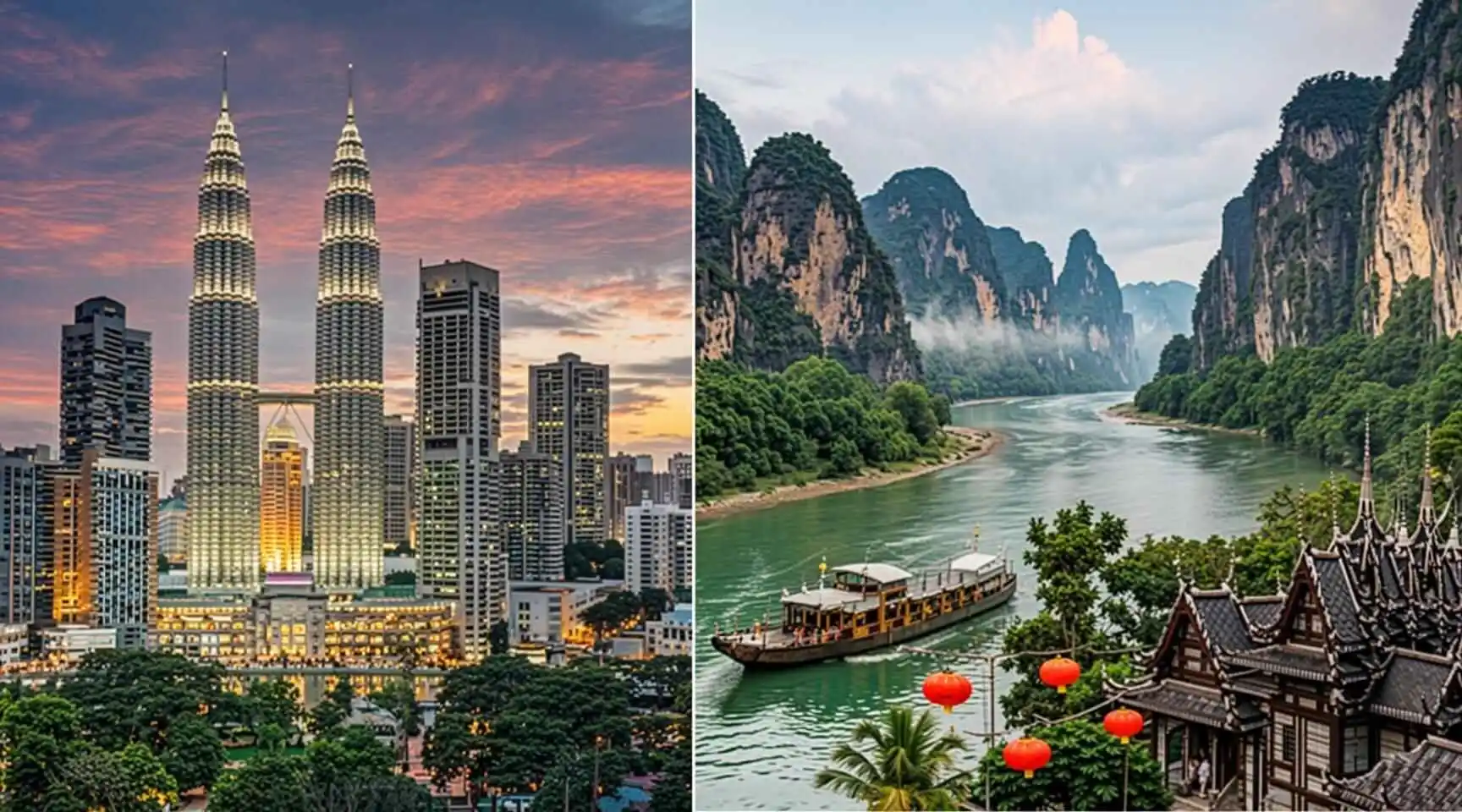
Malaysia: Where Futuristic Skylines Collide with Ancient Rainforests (The Ultimate Guide)
There is a specific kind of magic that happens when you take a country and seamlessly blend the ultra-modern with the deeply ancient. Nowhere on earth is this paradox more beautifully realized than in Malaysia. For decades, the tourism board’s slogan has famously declared it as the place where “Malaysia, Truly Asia” lives, and while marketing jargon is often hyperbolic, in this instance, it is an undeniable geographic and cultural truth.
If you close your eyes and imagine Asia, the images that flash through your mind are all here: the scent of lemongrass and sizzling wok hei drifting through a humid night market; the piercing, hypnotic call to prayer echoing beside a glittering Buddhist temple; the architectural arrogance of glass-and-steel megatowers reflecting the clouds; and the primordial, breathing vastness of a rainforest that has existed for 130 million years.
Malaysia is split neatly by the South China Sea into two distinct landmasses. Peninsular Malaysia (West Malaysia) is the heavily developed, culturally dense anchor, connected to the Asian mainland and sharing borders with Thailand and Singapore. Then, across the water, lies East Malaysia on the island of Borneo, a wild frontier of impenetrable jungles, sheer limestone peaks, and indigenous tribes.
To visit Malaysia is to constantly have your expectations subverted. You might start your morning drinking a perfectly brewed flat white in a high-end Kuala Lumpur café housed in a skyscraper, spend your afternoon marveling at centuries-old Portuguese colonial ruins, and end your day eating spicy noodles off a plastic stool on a neon-lit sidewalk, serenaded by the hum of mopeds.
This is not just a destination to be seen; it is a destination to be felt, tasted, and absorbed. Whether you are a hardcore adrenaline junkie looking to dive with pelagics in Sipadan, a history buff tracing the spice trade routes, or a gastronome on a pilgrimage for the world’s best street food, Malaysia has a corner of the world waiting just for you. Let’s dive deep into the ultimate guide to this Southeast Asian paradise.
The Magnetic Pull of Kuala Lumpur Travel
Any grand Malaysian odyssey inevitably begins in the capital, and Kuala Lumpur travel is an exercise in sensory overload. Kuala Lumpur (affectionately known as KL) is a city that refuses to be categorized. It is a melting pot of Malay, Chinese, Indian, and expatriate communities, all crammed into a sprawling urban jungle that is constantly reaching for the sky.
The skyline is the city’s defining feature, dominated by the Petronas Twin Towers. Standing at 451.9 meters, these twin spires were the tallest buildings in the world from 1998 to 2004, and they remain the tallest twin towers on the planet. To truly appreciate their scale, book a ticket to the Skybridge and the Observation Deck. Walking between the two towers on the 41st floor, looking down at the miniature cars and the meticulously curated KLCC Park below, is a moment of sheer vertiginous awe.
But KL is not just about looking up; it’s about looking closely. Step out of the air-conditioned malls of Bukit Bintang and dive into the vibrant, chaotic streets of Chinatown (Petaling Street) and Little India (Brickfields). Here, the city’s heartbeat is loudest. You will find vendors selling everything from counterfeit handbags to traditional Chinese herbs, the air thick with the smell of incense and roasting meats.
Then, there is Batu Caves, a limestone hilltop temple complex located just outside the city center. The ascent requires climbing 272 steep, brightly painted steps, guarded by a colossal, 42.7-meter-high golden statue of Lord Murugan. Inside the cavernous cathedral caves, shrines are lit by natural light filtering through holes in the rock ceiling, while macaque monkeys swing aggressively overhead looking for snacks. It is a raw, intense, and visually staggering introduction to the country’s Hindu heritage.
When the sun goes down, KL transforms. The rooftop bar scene is legendary, offering cocktails with panoramic views of the illuminated skyline, while the street food markets come alive, proving that in Malaysia, the best dining experiences rarely happen inside a restaurant.
The Culinary Mecca: Penang Street Food
If KL is the beating heart of Malaysia, the island of Penang is its stomach. George Town, the capital of Penang state, is a UNESCO World Heritage site famous for having some of the best-preserved colonial architecture in Southeast Asia. But let’s be honest: people don’t cross the Penang Bridge for the buildings. They come for the legendary Penang street food.
George Town is widely regarded as the food capital of Asia, a title it fiercely defends. The cuisine here is a reflection of its demographic makeup—a brilliant fusion of Malay, Chinese, Indian, and Peranakan (Straits Chinese) flavors, honed over generations of street-side cooking.
To eat in Penang is to engage in a cardio-intensive, flavor-explosive scavenger hunt. The hawker centers (open-air food courts) are universities of gastronomy. You must start with Char Kway Teow—flat rice noodles stir-fried in a blazing-hot wok with dark soy sauce, shrimp, cockles, Chinese sausage, and bean sprouts, imparting a smoky flavor known as wok hei (breath of the wok).
Next, seek out Assam Laksa, a pungent, tangy, and spicy fish-based noodle soup that CNN Travel once declared the “World’s Best Street Food.” It is an acquired taste, characterized by a tamarind-based broth that punches you in the palate with sour and spicy notes, topped with shredded mackerel, pineapple, and mint.
Beyond the hawker stalls, George Town is an art lover’s dream. The streets are a sprawling, open-air gallery of interactive street art, most famously the iron rod caricatures and the murals by Lithuanian artist Ernest Zacharevic (like the famous “Little Children on a Bicycle”). You can spend an entire day simply wandering the narrow, crumbling lanes, stumbling upon clan houses, ornate Chinese temples, and crumbling colonial mansions, using your appetite as your compass.
The Duty-Free Oasis: Langkawi Islands
After the dense, humid, concrete embrace of the cities, you need an antidote. You need the Langkawi islands. An archipelago of 99 islands (plus five that appear during low tide) floating in the Andaman Sea off the northwest coast of the peninsula, Langkawi is Malaysia’s premier beach destination.
Designated as a duty-free island in 1987, Langkawi has a slightly different vibe from the rest of the country. Alcohol and chocolate are ridiculously cheap, and the pace of life slows to a luxurious crawl. But beyond the cheap booze and beach resorts, Langkawi possesses a raw, geological beauty.
The island’s crown jewel is the Langkawi SkyCab, one of the steepest cable car rides in the world. It transports you from the base of Machinchang mountain to the summit, offering terrifying, exhilarating views of the lush rainforest canopy and the turquoise sea stretching to the horizon. At the top, the curved SkyBridge suspended over the jungle provides a photo opportunity that will make your Instagram followers weep with envy.
Nature is the main attraction here. Take a mangrove boat tour through the Kilim Karst Geoforest Park. You will glide silently through emerald-green water, weaving beneath massive limestone karsts that shoot out of the water like jagged teeth. Eagles circle overhead, diving to catch the fish thrown by the boatmen, while macaques lounge on the muddy banks, and you can literally reach out and touch ancient, fossilized shells embedded in the cave walls.
For beach lovers, Tanjung Rhu offers powdery, pristine sand and shallow, warm waters, largely sheltered from the monsoon winds. It is a place to do absolutely nothing but read a book, listen to the waves, and let the tropical heat melt your stress away.
Entering the Primeval: The Borneo Rainforest
If Peninsular Malaysia represents the civilized, developed side of the country, East Malaysia—specifically the states of Sabah and Sarawak on the island of Borneo—represents its wild, untamed soul. Entering the Borneo rainforest is like stepping back in time to the dawn of creation. This is one of the oldest rainforests on the planet, predating even the Amazon.
To understand the scale of Borneo’s biodiversity, consider this: it is home to the Rafflesia, the largest single flower in the world (which smells horrifyingly of rotting flesh), and to a staggering array of wildlife found nowhere else on earth.
Sabah is the go-to destination for wildlife encounters. A boat safari down the Kinabatangan River is a life-altering experience. As the sun rises, cutting through the morning mist, you glide silently past Proboscis monkeys—endemic to Borneo—leaping through the canopy with their bizarre, bulbous noses and potbellies. You might see wild orangutans swinging lazily through the branches, pygmy elephants crossing the river, or saltwater crocodiles lurking just beneath the muddy surface.
For the adventurous, climbing Mount Kinabalu (4095m), the highest peak between the Himalayas and New Guinea, is a grueling but deeply rewarding two-day trek. For those who prefer their adventures underground, Sarawak’s Gunung Mulu National Park is a UNESCO World Heritage site boasting the largest cave chamber in the world (Sarawak Chamber) and the world’s largest cave passage (Deer Cave), where millions of bats exit in a spectacular, swirling vortex every evening at sunset. Borneo is not a place you “tour”; it is a place you survive, respect, and revere.
A Walk Through Time: Malacca History
Sometimes, to understand a country’s present, you must walk through its past. For a masterclass in Malacca history, you must travel down the west coast of the peninsula to this sleepy, riverside city. Malacca (Melaka) is ground zero for Malaysian colonial history, and its streets are a living museum of the nations that fought to control the incredibly lucrative spice trade routes.
Founded in the 15th century by a fleeing Sumatran prince, Malacca quickly became a wealthy, powerful Sultanate. Because of its strategic position on the narrowest point of the Straits of Malacca, it caught the eye of the European superpowers. The Portuguese conquered it in 1511, the Dutch took it from them in 1641, and the British finally wrestled it away in 1824.
Each conqueror left an indelible architectural and cultural fingerprint. The most famous remnant is A Famosa, a modest-looking gatehouse that is all that remains of a massive Portuguese fortress built in 1511. Down the hill, the crimson-red Christ Church and the Stadthuys (the old Dutch town hall) dominate the central square, their vibrant red paint a stark contrast against the tropical sky.
But Malacca’s most fascinating cultural contribution is the Peranakan, or Baba-Nyonya, culture. When Chinese merchants settled here, they married local Malay women, creating a unique hybrid community. The Peranakan Museum in Malacca is a must-visit, showcasing a culture obsessed with opulence, characterized by intricate beadwork, antique porcelain, and a cuisine that blends Chinese wok-frying techniques with Malay spices and coconut milk (Laksa, again, features heavily).
Today, Malacca’s historic center is lined with trendy cafes, antique shops, and art galleries. The Jonker Walk night market is a chaotic, colorful weekend affair where you can buy anything from vintage postcards to aggressively promoted “Chicken Rice Balls,” Malacca’s peculiar culinary claim to fame.
The Cool Escape: Cameron Highlands Tea Plantations
Malaysia is famously hot and humid. It is a heat that sits on your shoulders like a heavy, wet blanket. But there is an escape, a geographic anomaly located a few hours north of Kuala Lumpur. The Cameron Highlands tea plantations offer a lush, cool, mist-shrouded respite from the tropical heat of the lowlands.
Developed in the 1920s by the British as a hill station retreat, the Cameron Highlands sit at an elevation of over 1,500 meters. As your car winds up the twisting mountain roads, the temperature drops noticeably, the air becomes crisp, and the landscape transforms from palm oil plantations to rolling, emerald-green hills.
The visual centerpiece of the highlands is the BOH Tea Plantation (and the equally stunning Sungai Palas estate). Walking along the trails that border the tea bushes, which are meticulously pruned into geometric perfection, feels like walking through a giant, green carpet. You can take a tour of the factory to see how the tea is processed, but the absolute best part is sitting on the terrace of the BOH Tea Centre, drinking a hot, strong cup of local tea while looking out over a valley completely shrouded in white mist.
Beyond the tea, the highlands are famous for their agriculture. The local markets are overflowing with giant, juicy strawberries (a rarity in tropical Asia), crisp lettuce, tomatoes, and vibrant flowers. It’s a bit kitschy—there are honeybee farms, butterfly gardens, and strawberry-themed cafes everywhere—but it has a charming, retro, 1950s holiday vibe that is impossible not to enjoy. Just be sure to pack a sweater; it gets surprisingly cold at night.
The Tapestry of Malaysian Cultural Diversity
What makes Malaysia truly exceptional isn’t just its geography; it is its people. The Malaysian cultural diversity is a delicate, complex tapestry woven from Malay, Chinese, Indian, and Indigenous threads. It is a country where mosques, churches, Buddhist temples, and Hindu shrines peacefully coexist on the same street.
The Malays, who make up the majority of the population, are defined by their Islamic faith and traditional customs (Adat). Their culture is most visibly expressed during Hari Raya Aidilfitri, the festival marking the end of Ramadan, where homes are opened to guests for lavish feasts of rendang and ketupat.
The Malaysian Chinese community, descendants of immigrants who arrived in the 19th and 20th centuries, dominate the business sectors and have fiercely preserved their linguistic and culinary roots. During the Lunar New Year, the streets of cities like KL and Ipoh erupt in red lanterns, lion dances, and the explosive cracking of firecrackers.
The Malaysian Indian community, primarily of Tamil descent, brought with them the vibrant traditions of the subcontinent. The festival of Thaipusam, celebrated spectacularly at the Batu Caves, is a jaw-dropping display of devotion where devotees carry kavadis (heavy, elaborate frames) pierced to their skin with hooks and skewers, entering a deep trance as they climb the 272 steps.
Then there are the indigenous peoples: the Orang Asli in Peninsular Malaysia, and the Iban, Bidayuh, and Kadazan-Dusun groups in Borneo, each with their own animist beliefs, longhouse architectures, and rich mythologies. This coexistence isn’t always perfectly smooth, but it is this very friction and blending that gives Malaysia its undeniable, vibrant energy.
Gastronomy Deep Dive: The Mamak Culture
We talked about Penang street food, but we must separate the broader street food culture from a specific, uniquely Malaysian institution: The Mamak Stall.
“Mamak” refers to Tamil Muslims from Southern India who migrated to Malaysia. The Mamak stall is usually an open-air, 24-hour eatery covered by a corrugated tin roof, with plastic tables and chairs spilling out onto the sidewalk. It is the great equalizer of Malaysian society. At 2 AM at a Mamak stall, you will find a millionaire in a Rolex sitting next to a construction worker, a group of university students cramming for exams, and a family having a late dinner, all eating the same food, watched over by a giant television screen broadcasting English Premier League football.
The menu is a masterclass in comfort food. The undisputed king of the Mamak stall is Roti Canai (or Roti Prata). It is a flaky, buttery, pan-fried flatbread that requires an incredible amount of skill to toss and spin into thin layers before cooking. It is served with a bowl of dhal (lentil curry) or chicken curry. You must also order Teh Tarik (“pulled tea”), a hot, sweet mixture of black tea and condensed milk, poured back and forth between two vessels from a great height to create a thick, frothy top.
If you want something heavier, there is Maggi Goreng (fried instant noodles elevated to an art form with vegetables, egg, and chili), or Nasi Lemak, the unofficial national dish: fragrant coconut rice served with spicy sambal, fried anchovies, roasted peanuts, a hard-boiled egg, and cucumber. The Mamak stall is the heartbeat of Malaysian nightlife, a place where time stands still over a cup of tea and a stack of roti.
Planning Your Trip: Best Time to Visit Malaysia
Because Malaysia is split by the South China Sea, its weather patterns are dictated by two separate monsoon seasons. Determining the best time to visit Malaysia depends entirely on which part of the country you plan to explore.
Generally, the shoulder seasons of March to April and October to November are the safest bets for covering both the peninsula and Borneo without getting entirely washed out.
However, let’s break it down geographically:
- West Coast (Peninsular Malaysia – KL, Penang, Langkawi, Malacca): This region experiences its heaviest rainfall from April to October due to the Southwest Monsoon. The best time to visit the west coast is between November and March, when the skies are generally clear, the humidity is manageable, and the islands are calm.
- East Coast (Peninsular Malaysia – Perhentian Islands, Redang, Tioman): The East Coast has a completely opposite monsoon season. From November to March, the Northeast Monsoon brings heavy rains, massive swells, and many resorts and islands completely shut down. The peak season here is strictly from March to October. If you are looking for pristine, untouched island diving, you must visit between June and August.
- East Malaysia (Borneo – Sabah, Sarawak): Borneo is equatorial, meaning it can rain at any time of the year. However, it tends to be wettest from October to February. The best time for wildlife spotting (like on the Kinabatangan River) is during the drier months of March to October, when animals congregate near the shrinking water sources.
Avoid the major public holidays if you dislike crowds. The weeks surrounding Chinese New Year (Jan/Feb) and Hari Raya Aidilfitri (dates vary based on the lunar calendar) see massive domestic migrations, booked-out hotels, and sky-high prices.
The Blueprint: Crafting the Perfect Malaysia Travel Itinerary
Because the country is so diverse, you cannot see it all in a week. To truly appreciate the contrasts, you need a minimum of two to three weeks. Here is a blueprint for the perfect Malaysia travel itinerary spanning 14 days, balancing urban energy, historical depth, culinary obsession, and natural wonder.
Days 1-3: The Urban Jungle of Kuala Lumpur Arrive in KL. Spend the first day shaking off jet lag with a stroll through the KLCC Park and visiting the Petronas Towers. Day two: take the commuter train out to the Batu Caves in the morning. In the afternoon, explore the colonial heritage around Merdeka Square (the Moorish-style Sultan Abdul Samad Building is stunning). Spend your evenings eating your way through the hawker stalls in Bukit Bintang and Jalan Alor.
Day 4: The Time Capsule of Malacca Rent a car or take a bus (about 2 hours) down to Malacca. Spend the day walking the red-brick streets of the Dutch Square, exploring the ruins of A Famosa, and getting lost in the antique shops along Jonker Walk. Stay for the Jonker Walk night market (if it’s a weekend) and feast on chicken rice balls and fresh coconut shakes.
Days 5-7: The Cool Heights and Culinary Capital Take a bus or drive from Malacca to the Cameron Highlands (approx. 3-4 hours). Spend a day touring the tea plantations, picking strawberries, and enjoying the cool air. On day 6, drive down to Penang (about 4 hours). Spend days 7 and 8 entirely dedicated to George Town. Rent a bicycle, hunt down the street art, and spend every meal at a different hawker center. Do not leave without eating Char Kway Teow, Hokkien Mee, and Cendol (a shaved ice dessert with palm sugar and coconut milk).
Days 8-10: Island Time in Langkawi Catch a quick, cheap domestic flight from Penang to Langkawi (or take the ferry, though flying is much faster). Spend day 9 riding the SkyCab and walking the SkyBridge. Day 10 should be reserved for a mangrove boat tour in Kilim Karst Geoforest Park. Spend your last evening on the beach with a duty-free beer, watching the sunset over the Andaman Sea.
Days 11-14: The Wild Frontier of Borneo (Sabah) Fly from Langkawi to Kota Kinabalu in Sabah (this usually requires a layover in KL). This is a shift in gears. Spend day 12 taking a day trip to Tunku Abdul Rahman Marine Park for some snorkeling right off the coast of the city. Days 13 and 14 require an early morning flight or a long drive to Sandakan to embark on a 2-day/1-night river safari on the Kinabatangan River. Fall asleep to the sounds of the jungle, wake up to the sight of proboscis monkeys, and fly home with a profoundly changed perspective on what Malaysia truly is.
Hidden Gems: Beyond the Tourist Trail
https://youtu.be/UmrUn5Ag9GE

