

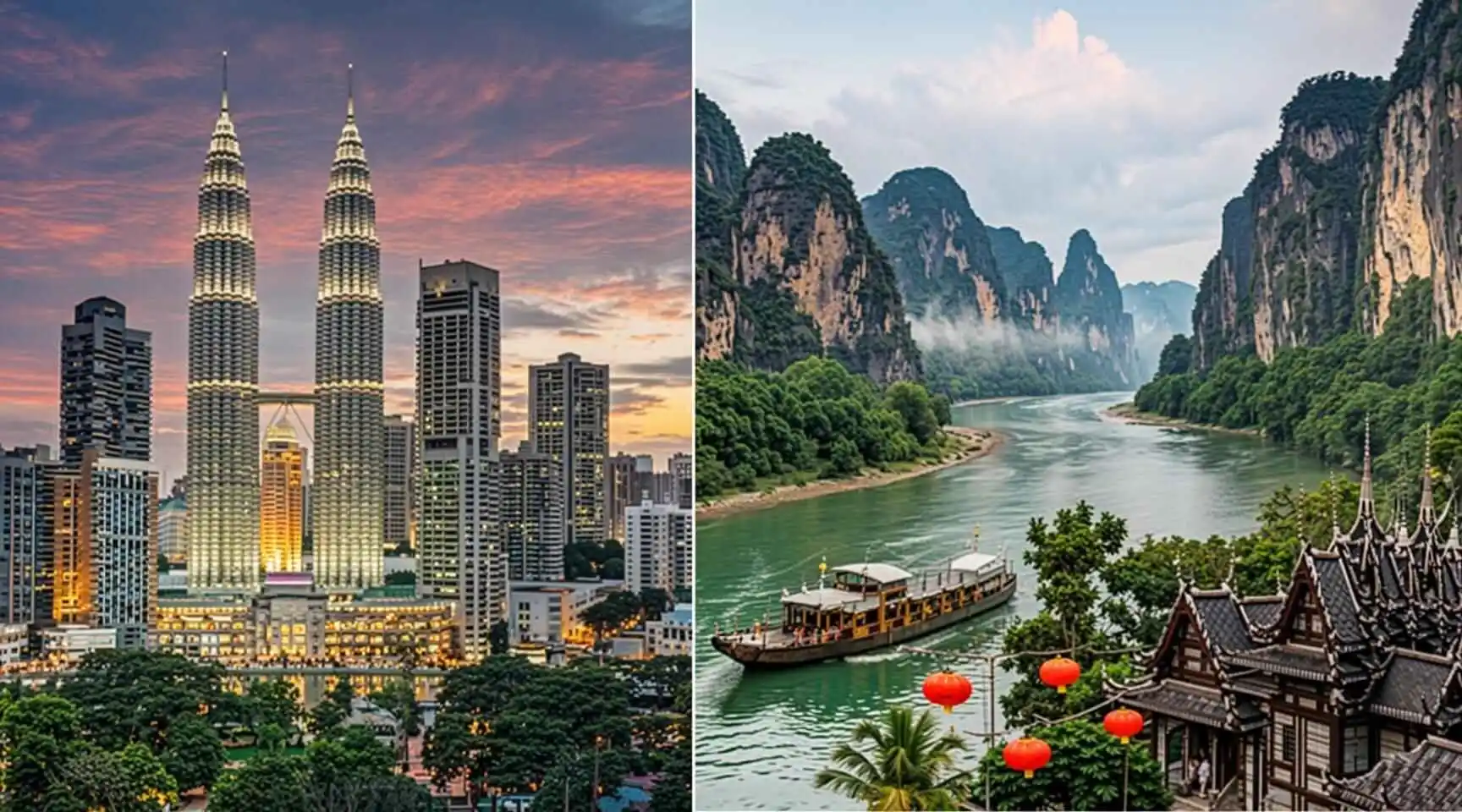
While the mainstays are famous for a reason, true travel nerds know that the magic often lies in the overlooked corners. If you want to step away from the crowds and experience a slightly more authentic, localized version of the country, consider these spots:
- Ipoh: Often overshadowed by Penang, Ipoh is the capital of Perak state. It is experiencing a massive cultural renaissance. The old town is beautifully preserved, filled with stunning street art, indie cafes, and, most importantly, legendary “Ipoh White Coffee”—coffee roasted with margarine and served with condensed milk. It is also the gateway to the breathtaking Kek Lok Tong cave temple.
- Kuching: The capital of Sarawak in Borneo is a remarkably clean, relaxed city situated right on the river. It is famous for its cat statues (Kuching translates to “Cat City”), excellent museums detailing headhunting history, and access to the Bako National Park, where you can see wild bearded pigs and proboscis monkeys on stunning coastal trails.
- Tioman Island: While the Perhentian Islands get all the backpacker hype, Tioman Island (located off the east coast of the peninsula) is a densely forested, volcanic island that was once voted one of the world’s most beautiful islands by Time Magazine. It is quieter, more rugged, and offers incredible diving without the massive party scene.
- Taman Negara: If you can’t make it to Borneo but want to experience primary rainforest, Taman Negara (on the peninsula) is one of the world’s most ancient deciduous rainforests. You can walk the world’s longest canopy walkway, go on a night safari to spot tapirs and tigers (if you are incredibly lucky), and shoot the rapids.
Final Thoughts: Why Malaysia Will Always Call You Back
Malaysia is a country of profound duality. It is a place where you can have a Michelin-starred meal for $5 on a plastic stool. It is a place where you can stand in a bustling, futuristic metropolis and know that just a few hours away, indigenous tribes are living a lifestyle largely unchanged for millennia. It is a place that challenges the western notion of progress, proving that you can build glittering skyscrapers without losing your soul, your traditions, or your sense of community.
The friction between the old world and the new, the urban and the wild, the spicy and the sweet—that is the engine that drives Malaysia forward. It is a country that demands you engage with it. You cannot be a passive observer here; you have to navigate the night markets, haggle with a taxi driver, sweat through your shirt by 10 AM, and inevitably fall in love with the chaotic, beautiful rhythm of it all.
So, pack your bags, leave your preconceptions at the door, and prepare to have your senses thoroughly hijacked. Malaysia isn’t just a destination to check off a list; it is an experience that will rewrite your definition of what travel can be. From the towering peaks of Mount Kinabalu to the steaming bowls of Laksa in George Town, a Southeast Asia paradise of this caliber is waiting to show you what it means to truly be Asia.
FAQS
General & Geography
1.What makes Malaysia unique compared to other Southeast Asian countries?
Malaysia flawlessly blends the ultra-modern with the deeply ancient, offering a unique paradox where futuristic skyscrapers exist just hours away from 130-million-year-old primeval rainforests.
2.How is Malaysia geographically divided?
Malaysia is split by the South China Sea into two distinct landmasses: Peninsular Malaysia (West Malaysia, connected to the Asian mainland) and East Malaysia (located on the island of Borneo).
3.What does the slogan “Malaysia, Truly Asia” mean?
It highlights how the country serves as a cultural microcosm of the entire Asian continent, seamlessly blending Malay, Chinese, Indian, and indigenous cultures, foods, and architectures in one place.
4.Is East Malaysia (Borneo) different from Peninsular Malaysia?
Yes. While Peninsular Malaysia is heavily developed and culturally dense, East Malaysia (Sabah and Sarawak) is a wild frontier characterized by impenetrable jungles, sheer limestone peaks, and indigenous tribes.
Kuala Lumpur & City Life
5.How tall are the Petronas Twin Towers?
The Petronas Twin Towers stand at a staggering 451.9 meters and remain the tallest twin towers on the planet.
6.Can you go inside the Petronas Twin Towers?
Yes, visitors can book tickets to the Skybridge (connecting the two towers on the 41st floor) and the Observation Deck for vertiginous views of Kuala Lumpur.
- What is Batu Caves and how many steps does it have?
Batu Caves is a spectacular limestone hilltop Hindu temple complex located just outside KL. To reach the cathedral caves, you must climb 272 brightly painted steps guarded by a massive golden statue of Lord Murugan.
- What should I be careful of at Batu Caves?
You should keep a close eye on your belongings and avoid feeding them, as the caves are inhabited by aggressive macaque monkeys looking for food.
Penang & Gastronomy
- Why is George Town in Penang famous?
George Town is a UNESCO World Heritage site renowned for having some of the best-preserved colonial architecture in Southeast Asia and for being widely regarded as the street food capital of Asia.
- What is “Char Kway Teow”?
It is Penang’s signature street food: flat rice noodles stir-fried in a blazing-hot wok with dark soy sauce, shrimp, cockles, and bean sprouts.
- What gives Char Kway Teow its distinct flavor?
The distinct smoky flavor comes from “wok hei” (breath of the wok), achieved by tossing the noodles at incredibly high heat.
- What is Assam Laksa?
It is a pungent, tangy, and spicy fish-based noodle soup flavored with tamarind, topped with shredded mackerel, pineapple, and mint. CNN Travel once declared it the “World’s Best Street Food.” 13. Who created the famous street art in Penang?
Much of the famous interactive street art in George Town was created by Lithuanian artist Ernest Zacharevic, including the iconic “Little Children on a Bicycle” mural.
Langkawi & Islands
- How many islands make up the Langkawi archipelago?
Langkawi is made up of 99 islands, with an additional five islands appearing during low tide.
- Why is Langkawi a “duty-free” island?
Langkawi was designated as a duty-free island in 1987, making items like alcohol and chocolate remarkably cheap compared to the mainland.
- What is the Langkawi SkyCab?
It is one of the steepest cable car rides in the world, transporting visitors from the base of Machinchang mountain to the summit for terrifying but exhilarating views.
17. What can you see at Kilim Karst Geoforest Park?
On a mangrove boat tour here, you can glide past massive limestone karsts, watch eagles dive for fish, and see ancient fossilized shells embedded in cave walls.
Borneo & Nature
- How old is the Borneo rainforest?The rainforest in Borneo is one of the oldest in the world, predating the Amazon and estimated to be around 130 million years old.
- What wildlife can I spot on the Kinabatangan River?
A boat safari here offers the chance to see wild orangutans, Proboscis monkeys (endemic to Borneo), pygmy elephants, and saltwater crocodiles.
- What is the Rafflesia?
It is the largest single flower in the world, native to Borneo, famous for its massive size and its horrifying smell of rotting flesh.
21.How tall is Mount Kinabalu?
Mount Kinabalu is the highest peak between the Himalayas and New Guinea, standing at 4,095 meters.
- What is special about Gunung Mulu National Park in Sarawak?
It is a UNESCO World Heritage site boasting the largest cave chamber in the world (Sarawak Chamber) and a nightly spectacle where millions of bats exit the caves in a swirling vortex.
Malacca & History
- Which European powers colonized Malacca?
Malacca was conquered by the Portuguese in 1511, taken over by the Dutch in 1641, and finally ceded to the British in 1824.
- What is A Famosa?
It is a modest-looking gatehouse that is the only remaining structure of a massive Portuguese fortress built in Malacca in 1511.
- Who are the Peranakan (Baba-Nyonya)?
They are a unique hybrid community created when Chinese merchants married local Malay women, resulting in a distinct culture famous for intricate beadwork, antique porcelain, and blended cuisine.
- What is a “Chicken Rice Ball”?
It is Malacca’s peculiar culinary claim to fame, where traditional Hainanese chicken rice is molded into tight, golf-ball-sized spheres.
Cameron Highlands & Culture
- Why were the Cameron Highlands developed?
The highlands were developed in the 1920s by the British as a hill station retreat to escape the tropical heat of the lowlands.
- What is the main attraction in the Cameron Highlands?
The main visual attraction is the sprawling, emerald-green BOH Tea Plantation, where visitors can walk the trails and drink fresh tea on a terrace overlooking the misty valley.
- What is a “Mamak Stall”?
It is a 24-hour, open-air Malaysian eatery run by Tamil Muslims, famous for being the great equalizer of society where all classes gather to eat cheap food and watch football.
- What are the essential items to order at a Mamak stall?
You must order Roti Canai (flaky, buttery flatbread served with dhal curry) and Teh Tarik (sweet, frothy “pulled tea” made with condensed milk).
Disclaimer: The content on this blog is for informational purposes only. Author’s opinions are personal and not endorsed. Efforts are made to provide accurate information, but completeness, accuracy, or reliability are not guaranteed. Author is not liable for any loss or damage resulting from the use of this blog. It is recommended to use information on this blog at your own terms.

