

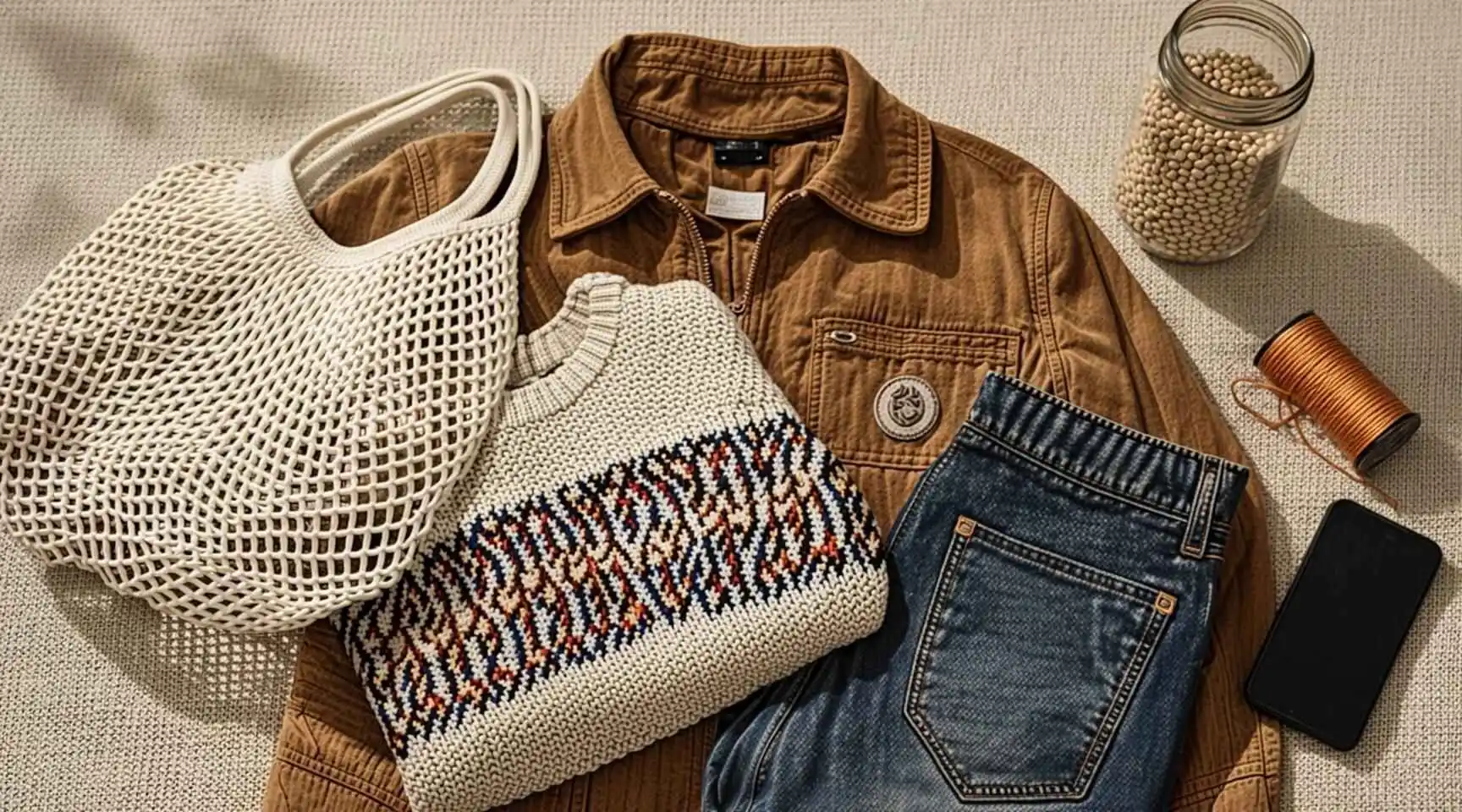
The Anti-Fast Fashion Manifesto: How to Shop Sustainably on a Budget in 2026 Without Selling Your Soul
Scroll through the aesthetic, curated feeds of Instagram or TikTok in 2026, and you would be forgiven for thinking that “sustainable living” requires a six-figure salary. The algorithm feeds you a endless stream of $200 organic cotton trench coats, $150 Tencel loungewear sets, and $90 “zero-waste” kitchen starter kits packaged in impossibly chic, minimalist bamboo boxes.
Meanwhile, the cost of living is higher than ever, inflation is a persistent shadow, and your paycheck is stretched to the breaking point. When faced with the choice between a $5 fast-fashion t-shirt that will survive three washes and a $50 “ethically made” alternative, the budget almost always wins.
But here is the dirty secret the eco-luxury brands don’t want you to know: Fast fashion is not cheap. It is actually the most expensive way to clothe yourself. And buying new, expensive “green” products is rarely the most sustainable option, either.
True sustainability is not a aesthetic you can buy; it is a fundamental shift in how you interact with the material world. It is an anti-consumerist approach. By 2026, the tools, technologies, and communities required to completely bypass the destructive cycle of new production are right at our fingertips. You do not need to buy your way into the sustainable movement—you need to opt out of the disposable one.
If you are tired of the false dichotomy between ethical living and financial survival, this is your blueprint. Here is the exhaustive, step-by-step guide on how to shop sustainably on a budget in 2026, proving that the most radical thing you can do for the planet is keep your money in your wallet.
Phase 1: Rewiring Your Shopping Brain (The Mathematical Mindset Shift)
Before we talk about where to shop, we have to talk about how to think. The reason we fall into the budget-vs-sustainability trap is because we have been conditioned to evaluate cost incorrectly.
The “Cost Per Wear” (CPW) Revelation
Mindless consumers look at price tags. Intentional consumers look at math.
Imagine you need a winter coat.
- Option A (The Fast Fashion Route): You buy a trendy, lightly insulated synthetic jacket from a mega-retailer for $60. Because it is poorly constructed, the seams fray by year two, the synthetic filling flattens, and it loses its warmth. You get 30 wears out of it. Cost Per Wear = $2.00.
- Option B (The Sustainable Route): You scour a high-end second-hand platform and find a pristine, classic Wool Pea Coat or a Patagonia insulated parka for $80. It is timeless, heavily durable, and you wear it 150 times over five years before passing it on. Cost Per Wear = $0.53.
The $80 coat was drastically cheaper than the $60 coat. When you shop sustainably, you are front-loading the cost, but collapsing the long-term expense. Budget sustainability means treating your wardrobe and your home as an investment portfolio, where durability yields the highest dividends.
The 30-Wear Test
In 2026, micro-trends move at warp speed. “Cottagecore” gives way to “Mob Wife Aesthetic,” which gives way to “Office Siren.” If you buy into these trends, you are renting your clothes, not owning them.
Before purchasing anything—new or used—apply the 30-Wear Test. Ask yourself: “Will I wear this at least 30 times?” If the answer is no (like a novelty graphic tee, a highly specific party dress, or fast-fashion sneaker collabs), do not buy it. It is mathematically unsustainable, regardless of what it is made of.
Escaping the “Green Premium” Trap
We must redefine what sustainable materials mean. The industry wants you to believe that “sustainable” equals “expensive novel fabrics.” It doesn’t. The most sustainable fabric in the world is the one that already exists. A $4 polyester blouse from a thrift store is infinitely more sustainable than a $100 organic linen blouse that required massive amounts of water and virgin resources to create. As a budget shopper, your superpower is utilizing the millions of tons of textiles already in circulation.
Phase 2: Mastering the Second-Hand Matrix in 2026
Thrift shopping used to require digging through dusty bins in dimly lit basements. While that still has its charm, the second-hand economy in 2026 is a hyper-efficient, tech-driven ecosystem. If you know how to navigate it, you can find exactly what you want at a fraction of the cost.
- AI-Powered Resale Platforms
Gone are the days of mindlessly scrolling through pages of irrelevant junk. Apps like Vinted, Depop, Poshmark, and ThredUp have integrated highly specific AI search filters. In 2026, you can literally take a photo of a garment you see on a runway or a celebrity, upload it to the app, and let the image-recognition software find exact matches or near-exact duplicates in the second-hand market within seconds. You get the look of a $2,000 designer piece for $40.
- The Art of the “Keyword Sniper”
The difference between a successful budget thrifter and a frustrated one comes down to search vocabulary. Most people search for generic terms like “dress” or “jacket.” To find the high-quality, sustainable brands on a budget, you must search for the materials and the brands specifically.
- Material Keywords: “100% wool,” “heavyweight cotton,” “raw silk,” “genuine leather,” “full-grain,” “cashmere,” “denim selvedge.”
- Brand Keywords: Search for legacy brands known for durability (e.g., “L.L. Bean,” “Carhartt,” “Land’s End,” “Eddie Bauer,” “Docker’s made in USA”). These brands built their empires on quality before globalization, meaning their vintage items are often indestructible and incredibly cheap on resale sites.
- Local Ecosystems & “Buy Nothing” Groups
Facebook Marketplace, Craigslist, and the BuyNothing Project remain the absolute pinnacle of budget sustainability. These platforms completely remove shipping costs, packaging waste, and corporate middlemen. People routinely give away perfectly good furniture, high-end kitchenware, and bags of high-quality clothing simply because they are moving or decluttering. Spending an hour a day checking your local “Buy Nothing” group is the closest thing to a financial cheat code that exists today.
Phase 3: The “Thrift Flip” and Upcycling Revolution
One of the most exciting developments in the budget sustainable space is the democratization of upcycling. You no longer have to be a master tailor to transform cheap, ill-fitting second-hand finds into custom, high-fashion pieces.
Embracing the “Ugly” Find
When thrifting, look past the initial silhouette. A horrific 1980s oversized men’s blazer with shoulder pads can become a cropped, tailored feminine jacket with a few strategic cuts. A maxi skirt that is too long can be hemmed into a midi skirt. The key is to look at the material and the color, not the current shape.
The Rise of Community Maker Spaces
In 2026, you don’t need to buy a $500 sewing machine. Most cities and even many suburban areas now host “Maker Spaces” or community tool libraries. For a very low monthly fee (or sometimes free through a local library program), you get access to industrial sewing machines, sergers, and even embroidery machines. You can take a $3 thrifted pair of jeans, use the community serger to distress them or add patches, and create a piece that would cost $120 at a boutique.
Visible Mending as Aesthetic
Do not throw away clothes with holes or stains. “Visible mending”—the Japanese art of Sashiko stitching—has transitioned from a niche hobby to a mainstream fashion statement. You can buy a kit of colorful embroidery thread and a needle for $5. Darning a hole in the elbow of a thrifted wool sweater doesn’t just save the sweater from a landfill; it turns it into a unique, hand-crafted artifact that no one else in the world owns.
Phase 4: Building a Bulletproof Capsule Wardrobe
The fashion industry relies on you feeling like you have “nothing to wear” because nothing matches. A capsule wardrobe is a curated collection of a few dozen high-quality, mix-and-match items that all coordinate perfectly. It is the ultimate budget sustainable hack because it annihilates impulse buying.
The Color Palette Rule
To build a capsule wardrobe on a budget, you must first establish a strict color palette. Choose three neutral colors (e.g., black, navy, and charcoal grey) and two accent colors (e.g., olive green and burgundy). When you thrift or shop, you only buy items within this palette. By doing this, every single top matches every single bottom. You can get dressed in the dark, and you never have to buy an item just because it “goes with that one shirt.”
Identifying the “Skeleton” vs. the “Flesh”
A sustainable wardrobe has two parts. The “Skeleton” is your foundational pieces: a perfect pair of dark wash jeans, a versatile blazer, a high-quality white tee, a durable leather belt, and a neutral outerwear piece. These should be the most durable items you own (often bought second-hand but high quality).
The “Flesh” is the trendier, fun items (printed scarves, colored socks, funky jewelry). Because the skeleton is so neutral and solid, you can buy these trendier items from ultra-cheap, sustainable sources (like a thrift store or a local artisan) without worrying about them going out of style quickly, because they only take up a small percentage of your visual outfit.
The “One In, One Out” Law
Your closet is a finite physical space. Treat it like a museum. If you bring a new item into your home, an old item must be donated or sold. This law forces you to truly consider the value of a new purchase. If buying a new sweater means you have to get rid of your favorite current sweater, you will only make the trade if the new one is vastly superior.
Phase 5: The Care, Repair, and Maintenance Ecosystem
The most sustainable garment is the one you already own. In 2026, extending the life of your possessions is easier and cheaper than ever, thanks to a booming repair economy. Taking care of your things is a budget strategy.
Laundering Less (The Microplastic Secret)
We wash our clothes entirely too much. Washing machines agitate fibers, causing them to break down and shed microplastics into the water supply. It also degrades the fabric rapidly.
- Jeans: Put them in the freezer overnight to kill bacteria and odors. Wash them only when visibly stained.
- Wool/Sweaters: Wool is naturally antimicrobial. Air them out on a sunny windowsill.
- General rule: Spot clean stains immediately instead of washing the whole garment. When you do wash, use cold water and a microplastic-catching bag (like the Guppyfriend, which costs $20 but saves hundreds in ruined clothes).
The Resurrection of the Cobbler and the Tailor
Fast fashion has convinced us that when a shoe loses its sole or a pant is too long, the item is dead. Nonsense. A local cobbler can resole a high-quality leather shoe for $30 to $50, giving it another five years of life. A local tailor can hem pants or take in a waistband for $15. In 2026, seek out these small businesses. Utilizing their services is often cheaper than buying a new replacement item, and it keeps money circulating in your local community rather than sending it to a mega-corporation’s offshore bank account.
Tech Repair over Tech Replacement
When your smartphone battery degrades or your laptop screen cracks, the instinct (heavily pushed by tech companies) is to buy the newest model. Budget sustainability means fighting this. Utilize independent repair shops (many of which have sprung up in response to the Right to Repair movement) to replace batteries, screens, and ports for a fraction of the cost of an upgrade.
Phase 6: Navigating “Greenwashing” on a Budget
When you do have to buy something new—say, undergarments, socks, or specialized athletic gear—you will be bombarded with marketing claims. As a budget-conscious shopper, you cannot afford to pay a 40% “green premium” for a lie. You must become a forensic investigator of greenwashing.
The Vague Vocabulary Watch
In 2026, the Federal Trade Commission (FTC) has stricter guidelines, but brands still push the boundaries. Ignore any of the following words unless they are backed by hard, third-party data:
- “Eco-friendly” (Meaningless. What does this mean? Nothing.)
- “Sustainably made” (Sustainably by whose metrics? Their own?)
- “Conscious collection” (Usually just a marketing term for a line where they used 10% recycled polyester and charged 20% more).
Trust the Certifications, Not the Brands
Look for specific, audited, third-party certifications. They are the only things that cut through the BS:
- GOTS (Global Organic Textile Standard): The gold standard for organic fibers. It ensures environmental and social criteria are met at every step of manufacturing.
- B Corp Certification: Means the entire company meets rigorous standards of social and environmental performance, not just one specific product.
- Fair Trade Certified: Ensures the workers who made the item were paid a living wage.
- OEKO-TEX Standard 100: Tests for harmful chemicals in textiles. If you have sensitive skin or are buying for kids, this is vital.
The “Hype” Tax
Be deeply skeptical of brands that spend millions on influencer marketing telling you how sustainable they are. A truly sustainable, budget-friendly brand puts its money into its supply chain, not into paying TikTokers to do “hauls.” Often, the most sustainable brands are the boring ones with outdated websites that you’ve never heard of.
Phase 7: Strategic Navigating of New Sustainable Purchases
Even with all the thrifting and repairing in the world, sometimes you must buy new. Here is how to do it sustainably and on a budget.
Clothing Rental for High-Impact Events
Do not spend $150 on a dress for a wedding, a gala, or a vacation that you will wear once. In 2026, clothing rental services are sophisticated, highly hygienic, and incredibly cost-effective. Services like Rent the Runway (or local boutique rental options) allow you to rent a $400 designer dress for $40. It arrives cleaned, pressed, and ready to wear. You send it back. Zero closet clutter, zero waste, and vastly cheaper than buying.
Direct-to-Consumer Basics (Without the Hype)
When you need new underwear, socks, or basic tank tops, avoid the trendy sustainable brands and look for utility-focused DTC (Direct-to-Consumer) brands. Look for companies that offer lifetime warranties on their basics, or brands that use closed-loop recycling programs (where you can send back your old, worn-out basics to be recycled into new ones in exchange for a discount on your next purchase).
Food and Household: The Bulk Bin Savior
Sustainable shopping extends far beyond clothing. The kitchen is a massive source of waste and budget leakage. Stop buying pre-packaged spices, grains, and legumes. In 2026, most grocery stores (even mainstream ones) have implemented bulk bin sections. Bring your own mason jars or cloth bags. Buying organic rice or spices from the bulk section is often 40% to 60% cheaper than buying it in plastic packaging, and it generates zero waste. It is better for the earth, better for your wallet, and the food is often fresher.
Phase 8: The Psychological Armor Against the Algorithm
https://youtu.be/0w8V2-0WAzA

