

What if you didn’t just store your food in the fridge, but you froze it for a later date? Freezing halts bacterial growth entirely, but it introduces a new enemy: ice crystals. Ice crystals rupture cell walls, which is why thawed food can be mushy.
- Thaw Safely: The safest way to thaw frozen leftovers is in the refrigerator. This keeps the food out of the Danger Zone. If you are in a rush, you can thaw under cold running water or in the microwave (though the microwave will start cooking the edges).
- The Casserole Strategy: If you are reheating a frozen casserole, do not thaw it on the counter! Put it straight from the freezer into a 350°F (175°C) oven, covered with foil. It will take about double the normal reheating time (usually 45-60 minutes). Remove the foil for the last 15 minutes to brown the top.
- The Soups and Sauces Method: Run the bottom of the frozen container under hot water to release the block of frozen soup. Drop the block into a pot with a tablespoon of water and heat on low with the lid on. As the bottom melts, you can scrape it into the pot to speed up the process.
The Conclusion: Respect the Reheat
Leftovers are not a burden; they are an opportunity. They are a chance to be resourceful, to save money, and to enjoy the flavors of a great meal twice over. But to unlock that potential, you must abandon the lazy convenience of the “30-second nuke.”
By understanding the science of heat and moisture, choosing the right appliance for the job, and treating each ingredient with the respect it deserves, you can elevate your second-day meals from tragic to magic. The skillet is your friend, the air fryer is your ally, and the damp paper towel is your secret weapon.
Stop settling for soggy sadness. Reheat like a pro, and never waste a delicious bite again.
FAQS
The Science & Basics
1.Why do my leftovers never taste as good the next day?
Food loses its mojo due to moisture loss, starch retrogradation (which makes rice and bread hard), and the contraction of proteins and fats as they cool.
2.What are the two main goals when reheating food?
To bring the internal temperature to a safe 165°F (74°C) to kill bacteria, and to restore the original texture of the food.
3.What is the ultimate enemy of reheating food?
Improper moisture management—either losing too much moisture (drying out) or trapping too much moisture (sogginess).
Microwave Mastery
4.Is the microwave always a bad choice for leftovers?
No, it’s excellent for moist foods like soups, stews, and steamed vegetables, but terrible for crispy or fried foods.
5.Why does my food get rubbery on the edges and stay cold in the middle in the microwave?
Microwaves heat from the outside in by agitating water molecules. Using too high of a power level nukes the edges before the heat can reach the center.
6.How can I prevent food from drying out in the microwave?
Always cover the dish with a damp paper towel to create a steam environment that locks in moisture.
7.Should I microwave leftovers on High power?
Usually no. Lower the power to 50% or 70% and increase the time to allow heat to distribute evenly without overcooking.
- What is the “Ring Method” for microwaving?
Arranging foods like pasta or rice in a donut shape (with a hole in the middle) so the microwaves can heat the outside and inside evenly.
Oven & Stovetop Strategies
- When should I use the oven instead of the microwave?
Use the oven when you want to restore crispy edges, melt cheese, or reheat dense, large portions of food.
- How do I keep food from drying out in the oven?
Loosely cover the dish with aluminum foil to trap internal moisture. Remove it for the last 5 minutes if you want a crisp top.
- Why is the stovetop skillet so good for reheating?
Direct contact with a hot pan creates instant browning and crisping that mimics the original cooking method.
- What is the skillet “Water Trick”?
Adding a tablespoon of water to the pan and immediately covering it with a lid. The water creates steam to heat the interior quickly while the pan keeps the bottom crispy.
Air Fryer Magic
- Why is the air fryer considered a game-changer for leftovers?
It circulates hot air at high speeds, rapidly evaporating surface moisture and making it the ultimate tool for resurrecting crunchy or fried foods.
- What temperature should I use to reheat food in an air fryer?
Lower the temperature to 350°F (175°C) instead of the standard 400°F cooking temp to avoid burning the outside before the inside is warm.
Specific Food Reheating
- What is the absolute best way to reheat pizza?
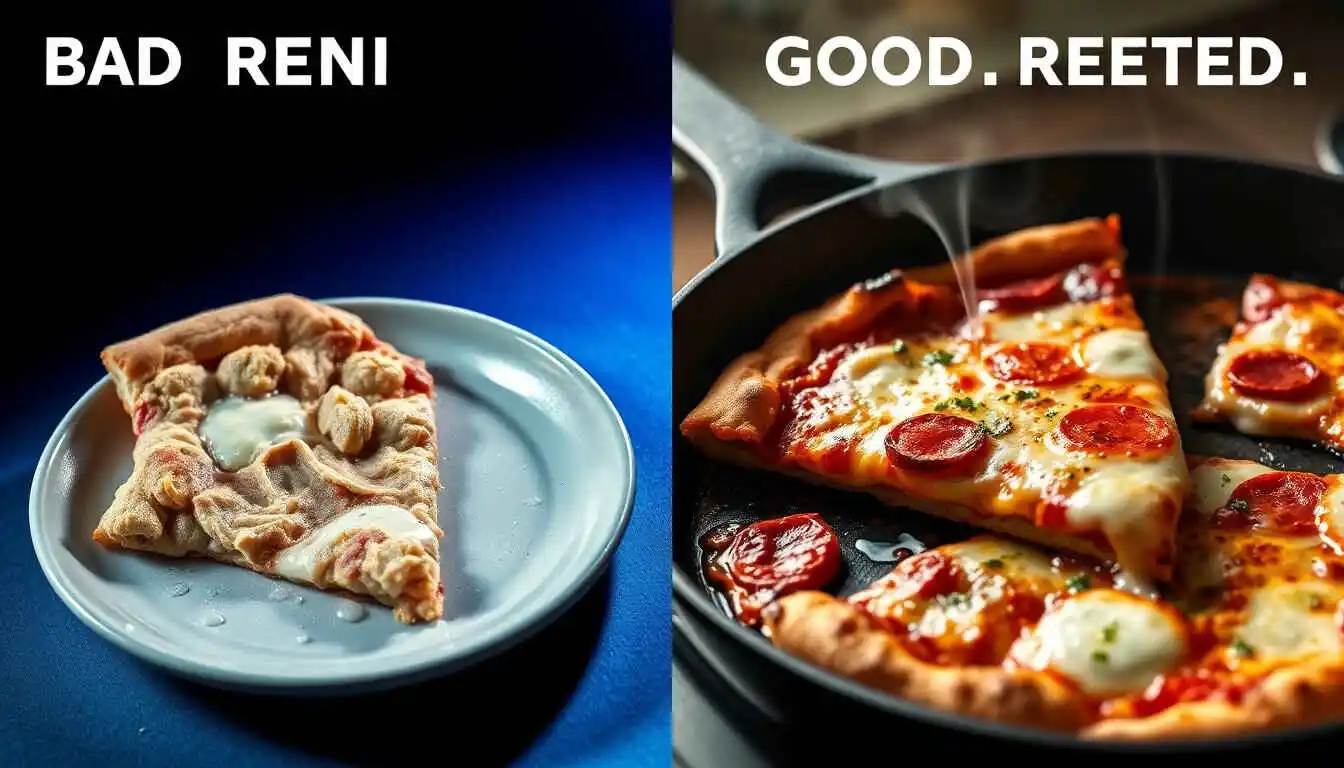
The skillet method. Place slices in a dry, non-stick skillet on medium-low heat and cover tightly with a lid. It re-crisps the dough and melts the cheese perfectly.
- How do I reheat fried chicken so the breading stays crispy?
Let it sit at room temp for 20 minutes, then place it on a wire rack over a baking sheet and bake at 400°F (200°C) for 15-20 minutes. The wire rack prevents the bottom from getting soggy.
- Can I reheat a medium-rare steak without cooking it well-done?
Yes, use the reverse sear. Warm it in a 250°F oven on a wire rack until the internal temp hits 110°F, then sear it in a smoking-hot cast-iron skillet for 60 seconds per side.
- Why does leftover rice get hard and crunchy in the fridge?
Because of starch retrogradation—the starches crystallize in cold temperatures.
- How do I make leftover rice fluffy again?
Sprinkle 1-2 tablespoons of water over the rice, cover tightly, and microwave. The added water re-hydrates the starches. 20. How should I reheat sauced pasta like spaghetti bolognese?
Place it in an oven-safe dish, add a splash of water or milk, top with fresh cheese, cover with foil, and bake at 350°F for 20 minutes.
- What is the best way to reheat soup?
On the stovetop over medium-low heat until it reaches a gentle simmer. Microwaving soup often leaves it volcanic on the edges and cold in the center.
- How do I reheat cream-based soups without them curdling?
Heat them very gently on low heat on the stovetop. If they look separated, whisk in a splash of cream or milk to bring the emulsion back together.
- How can I revive stale bread or rolls?
Run the bread under the tap for a split second to make it slightly damp, then place it directly on the oven rack at 350°F for 5-7 minutes.
- Can I save leftover soggy french fries?
Yes. Pan-fry them in a little oil in a hot skillet, or toss them in the air fryer at 360°F for 3-5 minutes.
- How do I reheat fish without stinking up the house and drying it out?
Bake it at a low temperature (275°F) with a pat of butter or oil, covered tightly with foil, for 10-15 minutes just until warmed through.
Food Safety
- What is the “Danger Zone” for bacterial growth?
Between 40°F and 140°F. Bacteria multiply rapidly in this temperature range.
- How long can I leave leftovers out at room temperature?
No more than 2 hours. If it’s hotter than 90°F outside, the window shrinks to just 1 hour. 28. What internal temperature must leftovers reach to be safe to eat?
165°F (74°C). Use a food thermometer to check dense meats and casseroles. 29. Is it safe to reheat food more than once?
No. Every time you cool and reheat food, surviving bacteria get a chance to multiply. Only reheat the portion you plan to eat.
- Why is there a “standing time” recommended after microwaving?
Microwaves agitate water molecules, which continue to cook the food even after the timer stops. Standing time allows the heat to distribute evenly, eliminating cold spots where bacteria could survive.
Medical Disclaimer: The information provided on this website is for general educational and informational purposes only and is not intended as a substitute for professional medical advice, diagnosis, or treatment. Always seek the advice of your physician or other qualified health provider with any questions you may have regarding a medical condition. Never disregard professional medical advice or delay in seeking it because of something you have read on this website.

