

Why Is My Hair Falling in Clumps After Exams? The Stress-Hair Connection Every MBBS Student Should Understand
Aarav, a 21-year-old second-year MBBS student, noticed something strange while combing his hair one morning: a thick clump of strands was sitting in the comb, far more than usual. Over the next two weeks he started finding hair on his pillow, in the shower drain, and on his desk while he studied. He had just finished a brutal run of internal assessments, had been sleeping four to five hours a night for nearly a month, and had skipped most of his meals in favour of extra revision time. By the time he walked into the dermatology outpatient department, he was convinced he was going bald.
The dermatologist took a careful history, examined his scalp, performed a simple hair-pull test, and asked one key question: ‘What was happening in your life about two to three months ago?’ Aarav paused and realised that was exactly when his university exams and hostel-related conflicts had been at their peak. The diagnosis was telogen effluvium, a temporary, diffuse shedding of hair triggered by a stressful event weeks earlier. There was no scarring, no patchy bald spot, and no permanent damage. With reassurance, correction of his diet, better sleep habits, and stress management, his hair growth returned to normal within a few months.
Stories like Aarav’s are extremely common among medical students and young professionals in India, and addressing hairfall linked to stress is one of the most frequent, and most anxiety-provoking, complaints seen in both general practice and dermatology clinics. Hairfall connected to chronic stress, panic attacks, and poor sleep is rarely dangerous, but it is deeply distressing for patients, and understanding the biology behind it will make you a far more reassuring and effective doctor. This article walks through the anatomy and physiology of hair growth, the link between anxiety, burnout, and hair loss, a real case study for addressing hairfall in practice, and finishes with five evidence-based tips for managing chronic stress, coping with panic attacks, and improving sleep hygiene to protect both the mind and the hair.
What Is Stress-Related Hairfall? Definition and Overview of Anxiety and Burnout
Hairfall, in medical terms, refers to shedding of hair strands beyond the normal daily amount, which is usually around fifty to one hundred hairs per day for a healthy adult. When shedding rises well above this number, or when a patient reports hair thinning, widening of the parting line, or clumps of hair on the pillow and in the comb, it is worth taking a structured history and examination, because the underlying causes range from completely reversible stress-related shedding to conditions that need active medical treatment.
Addressing hairfall properly starts with understanding that hair loss is rarely just a cosmetic issue for the patient sitting in front of you. For many young people, especially students and early-career professionals, hair is closely tied to self-image and confidence, so hairfall linked to stress often becomes a source of even more anxiety, creating a difficult cycle where stress causes hair loss, and hair loss then increases stress.
Anxiety is a state of heightened worry and physical arousal that can be short-lived, as in a single panic attack, or ongoing, as in generalized anxiety disorder. Burnout, on the other hand, is a slower, cumulative response to chronic, unrelieved stress, marked by emotional exhaustion, detachment, and a sense of reduced accomplishment. Burnout is extremely common among MBBS students, especially during clinical postings and examination periods, and it shares many of the same hormonal pathways as anxiety. Both anxiety and burnout push the body’s stress-response systems into a prolonged state of activation, and this activation has a direct, well-documented effect on the hair growth cycle, which is why addressing hairfall in a young, otherwise healthy patient so often means addressing their underlying stress first.
A Quick Look at the Anatomy of Hair and the Hair Growth Cycle
Each hair on the scalp grows from a structure called the hair follicle, a small pocket in the skin that contains the hair bulb, the dermal papilla, and a rich supply of blood vessels and nerve endings. The dermal papilla is particularly important because it acts as the command centre for the follicle, receiving signals from hormones, growth factors, and the nervous system that decide whether a hair should keep growing or move toward shedding.
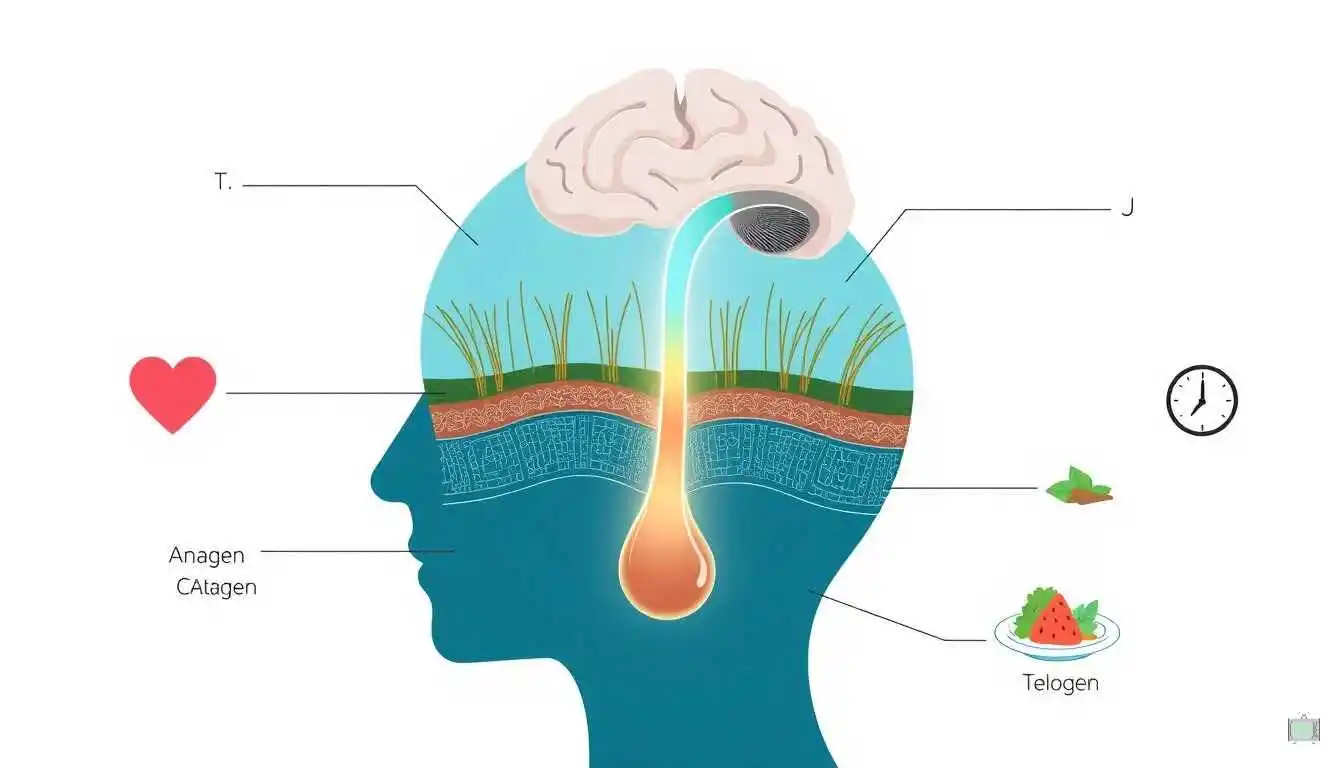
Hair does not grow continuously. Instead, every single hair follicle cycles through three main phases. The first is anagen, the active growth phase, which normally lasts between two and seven years and is when the hair is firmly anchored and actively lengthening. The second is catagen, a short transitional phase lasting a few weeks, during which the follicle shrinks and growth stops. The third is telogen, the resting phase, which lasts about two to three months, after which the old hair is shed and a new hair begins to grow from the same follicle, restarting the cycle.
At any given time, roughly eighty-five to ninety percent of scalp hairs are in anagen, about one percent are in catagen, and around ten to fifteen percent are in telogen. This balance is what keeps hair density stable over time, with only a small, steady number of hairs shedding each day as part of the normal cycle. Addressing hairfall clinically really means understanding what has pushed this balance out of its normal proportions.
Functions, Physiology, and Types of Stress-Related Hairfall
The single most important physiological concept linking stress to hairfall is a condition called telogen effluvium. Under normal conditions, hair follicles cycle through anagen, catagen, and telogen at their own pace, staggered so that only a small percentage are shedding at once. A significant physical or emotional stressor, however, can push a large number of follicles out of anagen and prematurely into telogen all at the same time. Because telogen lasts about two to three months before the hair actually falls out, patients typically notice diffuse shedding roughly six to twelve weeks after the stressful event, which is why the timeline in the history is so important for addressing hairfall correctly, as Aarav’s case demonstrated.
The hormonal pathway behind this is the same hypothalamic-pituitary-adrenal, or HPA, axis that drives the rest of the body’s stress response. Chronic stress and anxiety raise circulating cortisol, and animal and human studies have shown that elevated cortisol and related stress hormones can shorten the anagen phase and push follicles into catagen and telogen earlier than they would naturally go. In addition, the sympathetic nervous system, activated strongly during panic attacks and periods of chronic anxiety, causes vasoconstriction, narrowing the small blood vessels around the hair follicle and temporarily reducing the oxygen and nutrient supply the follicle needs to keep producing healthy hair.
Chronic stress and burnout also affect hairfall indirectly, through behaviour rather than hormones alone. Students under heavy academic pressure often eat irregularly, skip protein-rich meals, and sleep far less than they need. Since hair follicles are metabolically very active tissues, needing a steady supply of protein, iron, zinc, and B vitamins, poor nutrition and sleep deprivation during stressful periods compound the direct hormonal effects of stress, worsening hairfall further. Poor sleep itself also raises cortisol and disrupts the normal repair processes that occur in tissues, including hair follicles, during deep sleep.
It helps to classify stress-related hairfall into a few practical types for clinical use. Acute telogen effluvium follows a single, identifiable stressful event, such as an exam, an illness, or a personal crisis, and usually resolves within six to twelve months once the trigger passes. Chronic telogen effluvium, lasting beyond six months, is often linked to ongoing, unresolved stress or burnout rather than a single event, and may need a broader work-up to rule out other contributing causes. There is also a functional overlap type sometimes seen in students with panic disorder, where repeated acute stress episodes keep triggering fresh waves of shedding, so the hair never gets a chance to fully recover before the next wave begins.
It is worth distinguishing telogen effluvium clearly from androgenetic alopecia, the common pattern hair loss seen in genetically predisposed men and women, which follows a specific pattern of thinning at the crown or hairline and is not primarily stress-driven, though stress can worsen it in someone who already has the underlying tendency. Recognising this distinction is central to addressing hairfall accurately in clinical practice.
Case Study: Addressing Hairfall in a Stressed Final-Year Student
Case presentation: A 24-year-old final-year MBBS student presents with a three-month history of noticeably increased hair shedding, describing large clumps of hair on her pillow and in the shower. She denies any patchy bald spots, scalp itching, redness, or scaling. On direct questioning, she recalls that the shedding began roughly two months after a particularly stressful clinical posting combined with her university exams, during which she was sleeping around four hours a night, skipping breakfast most days, and experiencing occasional episodes of a racing heart and breathlessness that she now recognises as panic attacks.
On examination, the scalp shows diffuse thinning without any localized bald patches, no scarring, no redness, and no scaling. A hair-pull test, gently pulling a small section of about sixty hairs, dislodges more than the normal number of hairs, supporting active shedding. General examination is unremarkable, with no pallor to suggest significant anaemia. Basic blood investigations, including a complete blood count, serum ferritin, and thyroid function tests, are ordered to rule out common medical contributors to hairfall.
Investigation results return largely normal, with serum ferritin at the lower end of the normal range. Thyroid function is normal. There is no clinical or laboratory evidence of an autoimmune or infective cause of hair loss.
Clinical reasoning: The diffuse, non-patchy pattern of shedding, the clear two-month lag after a significant stressful period, the positive hair-pull test, and the largely normal investigations all point toward telogen effluvium precipitated by chronic stress, sleep deprivation, and irregular nutrition, rather than a primary scalp disease or a purely hormonal disorder. Addressing hairfall in this student means treating the underlying stress and lifestyle disruption as the primary problem, while keeping iron and thyroid status optimised as supporting measures.
Management: The student is reassured that the pattern is consistent with a reversible, stress-related type of hair loss and is counselled about the expected timeline, since visible improvement in telogen effluvium typically takes three to six months even after the trigger resolves. She is advised on iron-rich and protein-rich meals, given breathing techniques to manage her panic episodes, and referred to her college’s student counselling service for ongoing exam-related stress. A structured sleep schedule is also discussed in detail. At a follow-up visit four months later, her hair-pull test is normal and new, shorter regrowth hairs are visible along her hairline, confirming recovery.
This case illustrates a teaching point that is easy to forget under time pressure in a busy outpatient department: addressing hairfall well often means treating the person’s stress, sleep, and nutrition together, rather than reaching straight for a topical or oral medication, especially when the history and examination point clearly toward a temporary, stress-related cause.
Common Disorders and Diseases Linked to Hairfall
Addressing hairfall accurately requires keeping a short, practical differential diagnosis in mind, since several conditions can present with increased shedding or thinning and need to be told apart from simple stress-related shedding.
- Telogen effluvium — diffuse, temporary hair shedding triggered by stress, illness, surgery, childbirth, or crash dieting, usually appearing six to twelve weeks after the trigger.
- Anxiety and panic disorder — recurrent worry or sudden panic episodes that raise cortisol and sympathetic activity, contributing to telogen effluvium over time.
- Burnout syndrome — chronic occupational or academic exhaustion, common in medical students, associated with prolonged stress hormone elevation and disrupted sleep and eating patterns that worsen hairfall.
- Chronic insomnia or poor sleep hygiene — persistently short or disrupted sleep that raises cortisol, impairs tissue repair, and independently contributes to increased shedding.
Alongside these functional and stress-related causes, several organic conditions can also cause hairfall and should be actively considered, especially when shedding is patchy, prolonged, or associated with other symptoms:
- Androgenetic alopecia — genetically determined, pattern hair thinning at the crown or hairline, gradual in onset and not primarily driven by stress.
- Iron deficiency anaemia — low iron stores, common in young women with heavy menstrual periods or poor diet, can cause or worsen diffuse hair shedding.
- Thyroid dysfunction — both an underactive and an overactive thyroid gland can cause diffuse hair thinning, usually with other systemic symptoms.
- Alopecia areata — an autoimmune condition causing sudden, well-defined round or oval bald patches, distinct from the diffuse pattern seen in stress-related shedding.
- Scalp infections, such as tinea capitis — fungal infection of the scalp causing patchy hair loss, often with scaling, redness, or itching, more common in children.
Comparison Table: Stress-Related Hairfall vs Other Common Causes
| Feature | Stress-Related Telogen Effluvium | Androgenetic Alopecia | Alopecia Areata |
| Pattern | Diffuse thinning over the whole scalp | Gradual thinning at crown or hairline | Sudden, well-defined round bald patches |
| Onset | Six to twelve weeks after a stressful trigger | Gradual, over months to years | Sudden, over days to weeks |
| Hair-pull test | Positive, increased shedding | Usually normal or mildly positive | Positive at the edge of active patches |
| Underlying cause | Cortisol and sympathetic effects on hair cycle | Genetic sensitivity to androgens | Autoimmune attack on hair follicles |
| Course | Usually reversible within six to twelve months | Progressive without treatment | Variable, can relapse and remit |
| Key clue in history | Clear stressful event two to three months earlier | Family history of similar pattern | No clear stress link, may have other autoimmune conditions |
5 Evidence-Based Tips for Managing Chronic Stress, Coping with Panic Attacks, and Improving Sleep Hygiene
1. Practice Slow Breathing and Regular Relaxation to Lower Cortisol
Since sustained high cortisol is a key driver of stress-related hairfall, lowering it matters as much as any topical treatment. Slow, diaphragmatic breathing at around six breaths per minute, practiced for even five to ten minutes daily, has good evidence for reducing physiological arousal and blunting cortisol responses to stress. Encourage patients and fellow students to build this into a daily routine rather than using it only during a panic attack, so the nervous system gradually learns a calmer baseline.
2. Use Cognitive Behavioral Techniques to Manage Panic Attacks
Cognitive behavioral therapy, or CBT, remains the best-studied psychological treatment for panic disorder and anxiety, with strong evidence for reducing both the frequency and severity of attacks over time. Simple, practical tools drawn from CBT, such as recognising catastrophic thoughts during an attack and using grounding techniques like naming objects in the room, can be taught even in a short outpatient visit and can meaningfully reduce the chronic stress load that drives hairfall.
3. Prioritise Protein, Iron, and Overall Nutrition Alongside Stress Management
Hair follicles are highly active tissues that need a steady supply of protein, iron, zinc, and B vitamins to sustain the anagen growth phase. Evidence-based dietary advice for addressing hairfall includes ensuring adequate daily protein intake, checking and correcting iron deficiency where present, and avoiding extreme or crash dieting, which is itself a well-documented trigger for telogen effluvium, especially in students trying to lose weight quickly during stressful periods.
4. Follow a Consistent, Evidence-Based Sleep Hygiene Routine
Sleep and stress hormones are closely linked, and poor sleep independently raises cortisol while impairing the tissue repair processes that occur during deep sleep, including in hair follicles. Practical sleep hygiene steps with strong supporting evidence include going to bed and waking at the same time every day, avoiding caffeine and bright screens for at least an hour before bed, and keeping the sleep environment dark, quiet, and cool. Structured programs like cognitive behavioral therapy for insomnia have shown consistent improvements in both sleep quality and daytime anxiety, which in turn supports healthier hair growth.
5. Build Long-Term Protection Against Burnout
Because chronic, unrelieved stress causes more prolonged and harder-to-reverse hairfall than a single acute event, protecting against burnout is itself an evidence-based strategy for addressing hairfall in medical students. Useful, well-supported approaches include structured study-break cycles, such as focused study blocks followed by short breaks, regular physical activity, staying connected with friends and mentors, and seeking support from college wellness or counselling services early, rather than waiting until exhaustion and physical symptoms like hairfall become severe.
Conclusion
Hairfall is one of those symptoms that looks purely cosmetic on the surface but often tells a much deeper story about a patient’s stress levels, sleep, and overall wellbeing. Addressing hairfall well as a clinician means going beyond the scalp itself, taking a careful history that looks for stressful events two to three months earlier, checking for red flags that suggest an organic cause, and reassuring patients that most stress-related shedding is temporary and fully reversible once the underlying trigger is managed.
As you progress through your MBBS training and into clinical practice, remember that chronic stress, panic attacks, and poor sleep will not just be conditions you diagnose in patients, they will very likely be part of your own life as a medical student and, later, as a doctor. Learning to recognise early warning signs in yourself, including something as ordinary-looking as extra hair in your comb, and responding early with breathing techniques, better sleep habits, good nutrition, and timely support, is a skill that will protect both your patients and yourself for the rest of your career.
FAQS
1.Can stress and anxiety really cause hairfall?
Yes, chronic stress and anxiety raise cortisol and push hair follicles out of their growth phase into the resting phase earlier than normal. This leads to diffuse shedding known as telogen effluvium, usually noticed weeks after the stressful period.
2.Why does hairfall start weeks after a stressful event, not immediately?
The resting phase of the hair cycle lasts about two to three months before the hair actually sheds. This is why addressing hairfall properly requires asking about stress from two to three months earlier, not just the current week.
3.What is telogen effluvium?
It is a diffuse, temporary type of hair shedding triggered by significant physical or emotional stress, illness, or major life events. It usually improves on its own within six to twelve months once the trigger is managed.
4.Is stress-related hairfall permanent?
In most healthy individuals, stress-related hairfall through telogen effluvium is temporary and fully reversible. Hair regrowth typically becomes visible within three to six months once the underlying stress is addressed.
5.How much daily hairfall is considered normal?
Losing around fifty to one hundred hairs per day is considered part of the normal hair growth cycle. Addressing hairfall as a concern usually becomes relevant when shedding is clearly and consistently higher than this.
6.Can panic attacks alone cause noticeable hairfall?
Occasional panic attacks alone are less likely to cause major hairfall, but frequent, ongoing panic episodes raise overall stress hormone levels. Over time, this repeated activation can contribute to telogen effluvium in a similar way to chronic anxiety.
7.What is the hair-pull test and why is it done?
It involves gently pulling a small section of about sixty hairs to see how many come out easily. A higher than normal number of hairs coming loose supports active shedding, such as in telogen effluvium.
8.Can poor sleep alone cause hairfall?
Yes, chronically short or disrupted sleep raises cortisol levels and impairs the tissue repair that normally happens during deep sleep. This can contribute to hairfall even without a separate identifiable stressful event.
9.What is burnout and how is it linked to hairfall?
Burnout is a state of chronic exhaustion, cynicism, and reduced sense of achievement from prolonged, unrelieved stress. Because it involves long-term high cortisol and disrupted sleep and eating, it is a common contributor to persistent hairfall in medical students.
10.How is stress-related hairfall different from pattern baldness?
Stress-related hairfall causes diffuse thinning across the whole scalp, while pattern baldness causes gradual thinning at the crown or hairline. Pattern baldness is largely genetic and progresses slowly, unlike the more sudden, diffuse shedding of telogen effluvium.
11.Do I need blood tests if I notice increased hairfall?
Yes, basic tests like a complete blood count, serum ferritin, and thyroid function are commonly checked to rule out other contributing causes. This helps confirm that stress is the main driver rather than missing a treatable medical cause.
12.Can iron deficiency cause hairfall along with stress?
Yes, low iron stores are a common and often overlooked contributor to diffuse hairfall, especially in young women. Addressing hairfall effectively often means correcting iron deficiency alongside managing stress and sleep.
13.Does crash dieting or skipping meals worsen hairfall?
Yes, sudden calorie restriction or inadequate protein intake is a well-known trigger for telogen effluvium on its own. Combined with stress, poor nutrition during exam periods can significantly worsen shedding.
14.Can hairfall from stress be treated with shampoo alone?
Topical products may support scalp health, but they do not address the underlying hormonal and physiological drivers of stress-related hairfall. Managing the underlying stress, sleep, and nutrition is usually necessary for real improvement.
15.How long does it take for hair to grow back after stress-related shedding?
Once the stressful trigger is managed, visible new hair growth is usually noticed within three to six months. Full recovery of hair density can take up to a year in some cases.
16.Is it normal to feel more anxious about hairfall itself?
Yes, hairfall can affect self-image and confidence, which often adds another layer of stress on top of the original trigger. Recognising this cycle is an important part of addressing hairfall in a caring, reassuring way.
17.What breathing technique helps lower stress hormones?
Slow, diaphragmatic breathing at around six breaths per minute, practiced for five to ten minutes daily, helps calm the nervous system. Regular practice, not just during a panic attack, has better long-term effects on stress hormone levels.
18.Can regular exercise help reduce stress-related hairfall?
Yes, moderate regular exercise has good evidence for lowering anxiety symptoms and improving sleep quality over time. Both effects can indirectly support a healthier hair growth cycle by reducing chronic stress hormone exposure.
19.What are simple sleep hygiene steps for medical students?
Keeping a fixed sleep and wake time, avoiding caffeine and screens close to bedtime, and reserving the bed only for sleep are key steps. These habits help lower cortisol and support better overall recovery, including for hair growth.
20.When should hairfall be treated as an emergency?
Hairfall by itself is rarely an emergency, but sudden patchy bald spots, scalp redness, scaling, or pain should be evaluated promptly. These features suggest a cause other than simple stress-related shedding and need timely assessment.
21.Can thyroid problems cause hairfall similar to stress?
Yes, both an underactive and an overactive thyroid gland can cause diffuse hair thinning that looks similar to stress-related shedding. Thyroid function tests are commonly checked when addressing hairfall to rule this out.
22.What is alopecia areata and how is it different from stress-related hairfall?
Alopecia areata is an autoimmune condition causing sudden, well-defined round or oval bald patches, unlike the diffuse pattern of stress-related shedding. It usually needs a different treatment approach and should be assessed by a dermatologist.
23.Can hairfall come back again during future stressful periods?
Yes, someone who has had stress-related hairfall once may notice it again during future periods of high stress, such as final exams. Continuing good stress management and sleep habits can help reduce how often and how severely it recurs.
24.Does caffeine make stress and hairfall worse?
High caffeine intake can increase jitteriness and disrupt sleep, indirectly raising stress hormone levels over time. Reducing caffeine, especially in the afternoon and evening, is a simple step that supports both better sleep and stress control.
25.Is hairfall more common in medical students than the general population?
Reliable comparative data is limited, but the combination of long study hours, irregular sleep, and high academic stress makes medical students particularly prone to stress-related hairfall. Recognising this risk early allows for timely lifestyle changes.
26.Can cognitive behavioral therapy help with hairfall indirectly?
Yes, cognitive behavioral therapy is a well-studied treatment for anxiety and panic disorder that can reduce the chronic stress load driving telogen effluvium. Addressing hairfall often improves as the underlying anxiety is better managed.
27.Should I worry if my hairfall does not improve after a few months?
If shedding continues well beyond six months despite better sleep, stress management, and nutrition, further evaluation is recommended. This helps check for other underlying causes such as thyroid dysfunction or ongoing nutritional deficiency.
28.Can hairfall affect both men and women equally due to stress?
Yes, stress-related telogen effluvium can affect anyone regardless of gender, since the underlying hormonal and physiological mechanisms are the same. Pattern hair loss, in contrast, tends to follow different patterns in men and women.
29.Is it necessary to see a dermatologist for stress-related hairfall?
A dermatologist visit is useful for confirming the diagnosis, ruling out other causes, and getting reassurance and a clear management plan. This is especially important if the pattern is unclear or shedding is severe.
30.What is the single most important step in addressing hairfall linked to stress?
Identifying and managing the underlying chronic stress, panic attacks, or sleep disruption is usually the most important step. Once the trigger is controlled, the hair growth cycle typically returns to normal on its own.
Medical Disclaimer: The information provided on this website is for general educational and informational purposes only and is not intended as a substitute for professional medical advice, diagnosis, or treatment. Always seek the advice of your physician or other qualified health provider with any questions you may have regarding a medical condition. Never disregard professional medical advice or delay in seeking it because of something you have read on this website.

