

The One Triangle Lesson That Made 40 Students Suddenly Stop Struggling With Geometry
The Friday Afternoon That Changed How I Teach Triangles Forever
It was November 2014. A rainy Friday. The kind of afternoon where the classroom clocks seem to run backwards and even the most enthusiastic students are checking the window every two minutes.
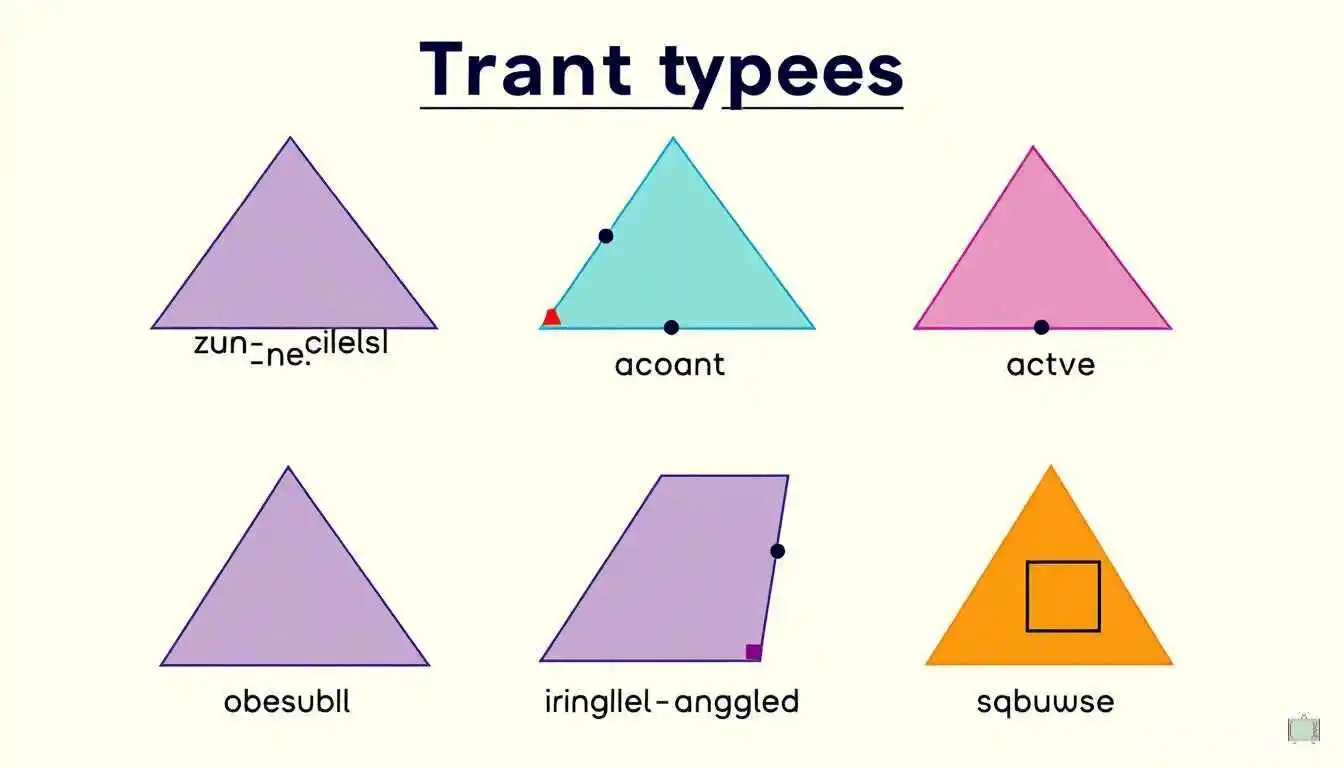
I had just put up a slide titled “Types of Triangles” and started going through them one by one — equilateral, isosceles, scalene, right-angled, acute, obtuse. The standard parade. The same list every textbook gives in the same order with the same little diagrams.
Within ten minutes, I could see it. That familiar glazed look. Nodding heads that weren’t actually understanding. Notebooks filling up with copied words but empty comprehension.
Then Aarav, a quiet boy who usually sat in the second row and rarely raised his hand, asked a question that stopped me mid-sentence.
“Sir, are equilateral and acute-angled two different triangles, or can the same triangle be both?”
The room went silent. Not because the question was wrong — but because half the class had never even considered that possibility. They had been sorting triangles into separate boxes in their heads, never realizing that the boxes overlap.
That question became the foundation of how I teach triangles today. Over the past fifteen years, I have refined this topic into something that doesn’t just list types — it explains how they relate, how they overlap, and why those relationships matter.
And that is exactly what this post will do for you.
By the time you finish reading, you will not just know the names of different types of triangles. You will understand how they connect, how to identify them in seconds, and how to use that understanding to solve problems with confidence.
No memorization without meaning. No lists without logic. Just clear, connected thinking.
What Are the Different Types of Triangles?
The Starting Point — What Is a Triangle?
Before we sort triangles, let us agree on what a triangle is.
A triangle is a closed shape made of three straight lines (sides) and three angles. The three sides meet at three points called vertices. The sum of the three interior angles is always 180 degrees. Always. No exceptions. This is not a rule that sometimes applies — it is a mathematical certainty.
Every triangle that has ever existed or will ever exist follows this rule. The total of its three angles is 180 degrees.
Now, within that fixed framework, triangles can look very different from each other. And those differences are what we classify.
The Two Ways to Classify Triangles
This is the most important concept in this entire post, and it is the one most students miss:
Triangles are classified in two separate ways:
- By the lengths of their sides
- By the sizes of their angles
These two classification systems are independent. A triangle can be described using a label from each system. That is exactly what Aarav was asking about — and he was absolutely right to ask.
Think of it like describing a person. You can describe someone by their height (tall, medium, short) and by their hair color (black, brown, blonde). These are two different categories. A person can be tall AND have black hair. Neither description cancels the other.
Same with triangles. A triangle can be equilateral (by sides) AND acute-angled (by angles). We will get to exactly how these overlap soon.
For now, remember: two systems, independent of each other, both valid, both useful.
Classification by Sides — The Three Types
When we sort triangles by the lengths of their three sides, we get three distinct categories. Let us look at each one carefully.
-
Equilateral Triangle
Definition: A triangle in which all three sides are equal in length.
What it means: If one side is 5 cm, all three sides are 5 cm. Every single time.
Properties:
- All three sides are equal: a = b = c
- All three angles are equal, and each angle is exactly 60 degrees
- It has three lines of symmetry
- It is the most “balanced” triangle possible
- The altitude, median, angle bisector, and perpendicular bisector all coincide for each side
How to identify it: Measure all three sides. If they are equal, it is equilateral. No need to check angles — if the sides are equal, the angles are automatically 60 degrees each.
Example: A triangle with sides 6 cm, 6 cm, 6 cm.
Real-world appearance: The triangular road signs (yield signs) in many countries are equilateral. Tripod legs are often designed using equilateral triangles for maximum stability.
-
Isosceles Triangle
Definition: A triangle in which exactly two sides are equal in length.
What it means: Two sides match, and the third side is different. That third side is called the base, and the angle opposite to it is called the vertex angle or apex angle.
Properties:
- Exactly two sides are equal
- The angles opposite to the equal sides are also equal (this is called the Base Angle Theorem)
- It has one line of symmetry — through the vertex angle and the midpoint of the base
- The altitude from the vertex angle to the base also acts as the median and the angle bisector
How to identify it: Check the sides. If exactly two are equal and the third is different, it is isosceles.
Common confusion: Some students think isosceles means “only two sides equal and never three.” In most modern textbook definitions, equilateral is considered a special case of isosceles (since it does have two equal sides — in fact, it has three pairs of equal sides). However, in many school-level contexts, isosceles means exactly two sides equal. Follow your textbook’s convention, but be aware of the broader definition.
Example: A triangle with sides 7 cm, 7 cm, and 10 cm.
Real-world appearance: The shape of many roof trusses, the cross-section of a laptop when viewed from the side, and the shape formed by a person standing with legs apart.
-
Scalene Triangle
Definition: A triangle in which all three sides have different lengths.
What it means: No two sides are equal. Every side is a different length from the other two.
Properties:
- All three sides are of different lengths
- All three angles are of different measures
- It has no lines of symmetry
- No altitude coincides with a median unless specifically constructed
How to identify it: Measure all three sides. If all three values are different, it is scalene.
Example: A triangle with sides 3 cm, 5 cm, and 7 cm.
Real-world appearance: Most real-world triangles are scalene. Sail on a boat, land plots, and structural supports often take scalene forms because real conditions rarely produce perfect symmetry.
Classification by Angles — The Three Types
Now we switch lenses. Instead of looking at sides, we look at angles. Specifically, we look at the largest angle in the triangle, because that determines the category.
-
Acute-Angled Triangle (Acute Triangle)
Definition: A triangle in which all three angles are less than 90 degrees.
What it means: Every single angle in the triangle is acute (less than 90°). There is no right angle and no obtuse angle.
Properties:
- Each angle is between 0° and 90° (strictly less than 90°)
- The sum of all three angles is 180°
- An equilateral triangle is always acute-angled (each angle is exactly 60°)
How to identify it: Find all three angles. If every single one is less than 90 degrees, the triangle is acute-angled.
Example: A triangle with angles 50°, 60°, and 70°.
Real-world appearance: Many architectural designs use acute triangles for aesthetic appeal and load distribution, such as decorative trusses and certain bridge segments.
-
Right-Angled Triangle (Right Triangle)
Definition: A triangle in which one angle is exactly 90 degrees.
What it means: One angle is a perfect right angle (90°). The other two angles must add up to 90° (since the total is 180°), and each of them must be acute.
Properties:
- Exactly one angle is 90°
- The other two angles are complementary (they add up to 90°)
- The side opposite the right angle is called the hypotenuse — it is always the longest side
- The Pythagorean Theorem applies: (hypotenuse)² = (side 1)² + (side 2)²
- It has no lines of symmetry unless it is also isosceles (45-45-90 triangle)
How to identify it: Check the angles. If one angle is exactly 90°, it is right-angled. You can also check using the converse of the Pythagorean Theorem: if a² + b² = c² for the three sides, the triangle is right-angled.
Example: A triangle with angles 90°, 37°, and 53°. Or a triangle with sides 3, 4, and 5 (the classic right triangle).
Real-world appearance: Corners of rooms, book covers, ladder leaning against a wall, the Egyptian pyramids’ cross-sections, set squares in geometry boxes — right triangles are everywhere in human construction.
-
Obtuse-Angled Triangle (Obtuse Triangle)
Definition: A triangle in which one angle is greater than 90 degrees.
What it means: One angle is obtuse (between 90° and 180°, exclusive). The other two angles must be acute and their sum must be less than 90°.
Properties:
- Exactly one angle is greater than 90°
- The other two angles are both acute
- The side opposite the obtuse angle is the longest side
- The altitude from the vertex of the obtuse angle falls outside the triangle
How to identify it: Find the angles. If one angle exceeds 90°, the triangle is obtuse-angled.
Example: A triangle with angles 110°, 40°, and 30°.
Real-world appearance: Certain roof designs, boomerang shapes, and the path of a ball thrown at a steep angle create obtuse-angled triangle formations.
The Overlap — How the Two Classification Systems Interact
This is where the real understanding begins. Most students learn the six types as if they are six separate, unrelated categories. But they are not. They are two classification systems that overlap.
Let me show you exactly how.
All Possible Combinations
Since there are 3 side-based types and 3 angle-based types, there are 9 possible combinations. But not all of them are possible. Here are the ones that actually exist:
- Equilateral + Acute-angled: Always true. Every equilateral triangle is automatically acute-angled because each angle is 60°.
- Isosceles + Acute-angled: Possible. Example: a triangle with angles 70°, 70°, and 40°. Two equal angles mean two equal sides, so it is isosceles. All angles are less than 90°, so it is acute.
- Isosceles + Right-angled: Possible. Example: a triangle with angles 90°, 45°, and 45°. Two equal angles (45° and 45°) mean two equal sides. This is the famous 45-45-90 or isosceles right triangle.
- Isosceles + Obtuse-angled: Possible. Example: a triangle with angles 100°, 40°, and 40°. Two equal angles, and one angle exceeds 90°.
- Scalene + Acute-angled: Possible. Example: a triangle with angles 50°, 60°, and 70°. All angles different (so all sides different), and all angles less than 90°.
- Scalene + Right-angled: Possible. Example: a triangle with angles 90°, 53°, and 37°. Or the 3-4-5 triangle. All sides different, one right angle.
- Scalene + Obtuse-angled: Possible. Example: a triangle with angles 120°, 35°, and 25°. All angles different, one exceeds 90°.
Combinations That Are NOT Possible
- Equilateral + Right-angled: Impossible. An equilateral triangle has each angle at 60°. None of them can be 90°.
- Equilateral + Obtuse-angled: Impossible. Same reason. All angles are 60°, so none can exceed 90°.
This overlap table is one of the most powerful tools a student can have. It answers the “can a triangle be both?” question for every possible pair. Print it. Bookmark it. Refer to it until it becomes second nature.
Why Understanding Triangle Types Matters
It Is the Foundation of All Geometry
Triangles are the building blocks of geometry. Every polygon — quadrilateral, pentagon, hexagon, and beyond — can be divided into triangles. If you understand triangles well, you understand the skeleton of all plane geometry. And if you do not understand triangle types correctly, every concept built on top of them becomes shaky.
It Directly Affects Problem-Solving Strategy
The type of triangle determines which tools you can use:
- Right-angled? You can use the Pythagorean Theorem and trigonometric ratios (sin, cos, tan).
- Isosceles? You know two sides are equal and two angles are equal, which simplifies equations.
- Equilateral? You know all sides are equal and all angles are 60°, which dramatically reduces variables.
- Scalene? You have no shortcuts — you need full information or general formulas like Heron’s Formula.
Knowing the type tells you which weapons are in your arsenal. Walking into a problem without identifying the triangle type is like walking into a kitchen without checking what ingredients you have.
It Prevents Errors in Proofs and Constructions
Many geometry proofs require you to state the type of triangle before applying a specific theorem. If you misidentify the type, you might apply a theorem that does not hold, and the entire proof collapses.
For example, the Pythagorean Theorem applies ONLY to right-angled triangles. Applying it to an acute triangle will give you a wrong answer every time. This is one of the most common errors I see in exams.
It Is Heavily Tested in Exams
Triangle classification questions appear in some form in almost every math exam from middle school through competitive entrance tests. Sometimes directly (“identify the type”), sometimes indirectly (“find the value of x if the triangle is isosceles”), and sometimes as a prerequisite for a larger problem.
It Connects to Real-World Applications
Engineers, architects, surveyors, and physicists constantly work with triangles. The type of triangle they choose for a structure or calculation depends on what they need — right triangles for perpendicular forces, equilateral triangles for uniform stress distribution, isosceles triangles for balanced loads on a slope. The classification is not academic — it is practical.
Detailed Properties of Each Triangle Type — Your Quick Reference
Equilateral Triangle — Complete Property List
| Property | Value |
| Number of equal sides | 3 |
| Number of equal angles | 3 (each 60°) |
| Lines of symmetry | 3 |
| Order of rotational symmetry | 3 |
| Area formula | (√3 / 4) × side² |
| Perimeter formula | 3 × side |
| Height formula | (√3 / 2) × side |
| Circumradius | side / √3 |
| Inradius | side / (2√3) |
| Pythagorean Theorem applies? | No |
Isosceles Triangle — Complete Property List
| Property | Value |
| Number of equal sides | 2 |
| Number of equal angles | 2 (base angles) |
| Lines of symmetry | 1 |
| Order of rotational symmetry | 1 |
| Area formula | ½ × base × height |
| Perimeter formula | 2 × equal side + base |
| Pythagorean Theorem applies? | Only if also right-angled |
| Base angles | Always equal |
| Vertex angle | Can be acute, right, or obtuse |
Scalene Triangle — Complete Property List
| Property | Value |
| Number of equal sides | 0 |
| Number of equal angles | 0 |
| Lines of symmetry | 0 |
| Order of rotational symmetry | 1 |
| Area formula | ½ × base × height, or Heron’s Formula |
| Perimeter formula | a + b + c |
| Pythagorean Theorem applies? | Only if also right-angled |
Right-Angled Triangle — Complete Property List
| Property | Value |
| Right angle | Exactly one (90°) |
| Other angles | Complementary (sum to 90°) |
| Longest side | Hypotenuse (opposite right angle) |
| Pythagorean Theorem | a² + b² = c² (always holds) |
| Trigonometric ratios | sin, cos, tan all defined naturally |
| Area formula | ½ × (leg 1) × (leg 2) |
| Lines of symmetry | 1 if isosceles, 0 otherwise |
Acute-Angled Triangle — Complete Property List
| Property | Value |
| Largest angle | Less than 90° |
| All angles | Less than 90° |
| For sides a, b, c | a² + b² > c² (for all combinations) |
| Circumcenter position | Inside the triangle |
| Orthocenter position | Inside the triangle |
Obtuse-Angled Triangle — Complete Property List
| Property | Value |
| Largest angle | Greater than 90° |
| Other angles | Both acute |
| For sides a, b, c (c longest) | a² + b² < c² |
| Circumcenter position | Outside the triangle |
| Orthocenter position | Outside the triangle |
Real-Life Case Study: How Meera Used Triangle Types to Solve a Competition Problem in 90 Seconds
In 2019, I was coaching a group of students for the Regional Mathematics Olympiad. One of my students, Meera, was strong in algebra but inconsistent in geometry — she could solve equations faster than anyone in the group, but geometry problems made her hesitate.
During a mock test, she faced this problem:
“Triangle ABC has sides AB = 13, BC = 14, and CA = 15. Find the length of the altitude from B to AC.”
Most students in the group immediately started drawing the triangle, trying to construct the altitude visually, and getting lost in coordinate geometry approaches. They spent 8–10 minutes on the problem, and many gave up.
Meera did something different. She paused for 15 seconds and identified the triangle type first.
She checked: 13, 14, 15 — all different. So it is a scalene triangle. No equal sides, no equal angles, no shortcuts from symmetry.
She checked if it was right-angled: 13² + 14² = 169 + 196 = 365. And 15² = 225. Since 365 ≠ 225, it is NOT right-angled. No Pythagorean shortcut.
She checked if it was obtuse: the longest side is 15. 13² + 14² = 365, which is greater than 15² = 225. So a² + b² > c², which means the triangle is acute-angled.
This told her three things: no symmetry shortcuts, no Pythagorean shortcuts, and the altitude from B falls inside the triangle (since it is acute). Clean information.
Then she applied Heron’s Formula to find the area:
s = (13 + 14 + 15) / 2 = 21
Area = √[21 × (21−13) × (21−14) × (21−15)] = √[21 × 8 × 7 × 6] = √[7056] = 84
Now, area also equals ½ × base × height. The base is AC = 15.
84 = ½ × 15 × height height = (84 × 2) / 15 height = 168 / 15 height = 11.2
Done. Total time: under 90 seconds.
When I asked her how she solved it so fast, her answer was: “I spent time understanding what kind of triangle it was before I chose my method. That told me what would work and what wouldn’t.”
That is the power of triangle classification. It is not a labeling exercise — it is a strategic decision-making tool. Meera went on to clear the Olympiad that year, and she still credits that moment as the one where geometry clicked for her.
Benefits of Understanding Triangle Types Thoroughly
-
Faster Problem Identification
When you can recognize a triangle type at a glance, you skip the “figuring out” phase and jump straight to solving. You see a 3-4-5 triangle and immediately know: scalene, right-angled. You see 10-10-10 and immediately know: equilateral, acute. That instant recognition saves precious minutes in exams.
-
Correct Theorem Selection
Each triangle type comes with its own set of applicable theorems. Right triangles get the Pythagorean Theorem and trigonometric ratios. Isosceles triangles get the Base Angle Theorem and the property that the altitude to the base is also the median. Equilateral triangles get all properties compressed into one variable. Knowing the type ensures you reach for the right tool.
-
Efficient Construction in Geometry
When a problem asks you to construct a triangle, the construction steps depend entirely on the type. Constructing an equilateral triangle (using only a compass and ruler) takes fewer steps than constructing a scalene triangle. Knowing the type tells you the minimum information needed and the correct sequence of construction steps.
-
Stronger Proof Writing
Many geometry proofs begin by identifying the type of triangle formed by certain points or lines. This identification then justifies the use of specific properties. A well-written proof always states the triangle type and the property being used — and examiners reward this clarity.
-
Better Visual Estimation
With practice, you can estimate triangle types from visual diagrams. A triangle that “looks” like it has a 90° angle probably does (in well-drawn exam figures). A triangle with two sides that appear equal is likely isosceles. This visual intuition, backed by proper checking, is a valuable skill for competitive exams where diagrams are drawn to scale.
-
Foundation for Advanced Topics
Trigonometry is built almost entirely on right-angled triangles. Coordinate geometry uses triangle types to find areas and distances. Circle theorems involve triangles inscribed in circles. 3D geometry projects surfaces into triangular faces. Every advanced topic in mathematics that involves shapes traces back to triangle classification.
Common Mistakes and Challenges Students Face
Mistake 1: Thinking the Six Types Are Mutually Exclusive
This is the most widespread misconception. Students believe that equilateral, isosceles, scalene, right-angled, acute, and obtuse are six different kinds of triangles with no overlap.
The truth: They are two classification systems with significant overlap. An equilateral triangle is also acute. An isosceles triangle can be acute, right, or obtuse. A scalene triangle can be acute, right, or obtuse.
Fix: Always ask two questions: “What is it by sides?” and “What is it by angles?” Answer both. That gives you the complete description.
Mistake 2: Assuming Every Triangle Is Either Right-Angled or Not, With No Further Classification
Some students only think in terms of right-angled vs. non-right-angled and ignore the acute/obtuse distinction entirely.
The truth: The difference between acute and obtuse matters. The position of the circumcenter, orthocenter, and centroid changes based on whether the triangle is acute or obtuse. Formulas and inequalities behave differently.
Fix: Always classify by the largest angle. Less than 90° — acute. Equal to 90° — right. Greater than 90° — obtuse. Three options, not two.
Mistake 3: Calling an Isosceles Triangle “Equilateral” When All Three Sides Happen to Be Equal
If a problem states that two sides are equal and then through calculation you find that the third side is also equal, some students call it equilateral and stop.
The truth: It IS equilateral. And there is nothing wrong with that conclusion. But some exam questions expect you to note that it is equilateral as a special case of isosceles and mention both properties.
Fix: If all three sides are equal, state that it is equilateral. Note that equilateral is a special case of isosceles. Cover both if the question is open-ended.
Mistake 4: Applying the Pythagorean Theorem to Non-Right Triangles
This mistake is alarmingly common. Students see a triangle, assume it is right-angled (often because the figure “looks” right), and apply a² + b² = c².
The truth: The Pythagorean Theorem applies ONLY to right-angled triangles. Using it on any other type of triangle will give you an incorrect result.
Fix: Before using the Pythagorean Theorem, always verify that the triangle is right-angled. Check the angles (is one 90°?) or check the sides (does a² + b² = c² hold?). If you cannot verify, do not apply.
Mistake 5: Confusing the Hypotenuse With the Longest Side in Non-Right Triangles
In a right-angled triangle, the longest side is the hypotenuse, and it is opposite the right angle. Students sometimes carry this terminology to non-right triangles, calling the longest side the “hypotenuse.”
The truth: The term “hypotenuse” applies only to right-angled triangles. In other triangles, the longest side is simply called the longest side.
Fix: Use “hypotenuse” only when there is a right angle. In all other cases, say “longest side” or “side opposite the largest angle.”
Mistake 6: Ignoring the Triangle Inequality When Classifying
Some students try to form triangles with sides like 2, 3, and 10, then classify the result. But these sides do not form a triangle at all — the sum of the two smaller sides (2 + 3 = 5) is less than the largest side (10).
The truth: The Triangle Inequality Theorem must be satisfied before any classification makes sense. For any three lengths to form a triangle, the sum of any two must exceed the third.
Fix: Always check the Triangle Inequality first. If it fails, no triangle exists, and classification is meaningless.
Challenge 1: Problems That Give Only Angles or Only Sides
Some problems give you the three angles but not the sides, or the three sides but not the angles, and ask you to classify.
Strategy: If you have all three angles, you can classify by angles directly. You can also sometimes classify by sides — if all three angles are equal (each 60°), the triangle is equilateral. If exactly two angles are equal, it is isosceles. If all are different, it is scalene. Similarly, if you have all three sides, you can classify by sides directly, and you can determine the angle type using the side-length relationships (a² + b² vs. c²).
Challenge 2: Problems With Variables Instead of Numbers
Questions like “If the angles of a triangle are x, 2x, and 3x, classify the triangle” require you to solve for x first and then classify.
Strategy: Use the angle sum property (angles add to 180°) to find x. Then compute each angle. Then classify.
x + 2x + 3x = 180° → 6x = 180° → x = 30°
Angles are 30°, 60°, 90°. So: scalene (all different), right-angled (one is 90°).
Challenge 3: Diagrams That Are Not Drawn to Scale
Some exam diagrams are intentionally misleading. A triangle might “look” isosceles but isn’t, or “look” right-angled but isn’t.
Strategy: Never trust a diagram alone. Always verify using the given information — measurements, angles, or relationships. If the problem does not give enough information to verify, state your assumptions.
Comparison Table — All Triangle Types Side by Side
| Feature | Equilateral | Isosceles | Scalene | Right-Angled | Acute-Angled | Obtuse-Angled |
| Classification by | Sides | Sides | Sides | Angles | Angles | Angles |
| Equal sides | 3 | 2 | 0 | Any | Any | Any |
| Equal angles | 3 | 2 | 0 | 0 (unless isosceles right) | Any | Any |
| Largest angle | 60° | Varies | Varies | 90° | < 90° | > 90° |
| Lines of symmetry | 3 | 1 | 0 | 0 or 1 | Varies | Varies |
| Pythagorean Theorem | No | Only if right | Only if right | Yes | No | No |
| Area formula | √3/4 × side² | ½ × base × height | Heron’s preferred | ½ × leg1 × leg2 | ½ × base × height | ½ × base × height |
| Circumcenter | Inside | Inside | Inside | On hypotenuse | Inside | Outside |
| Orthocenter | Inside | Inside | Inside | At right-angle vertex | Inside | Outside |
| Common in exams | Very common | Very common | Moderate | Extremely common | Common | Moderate |
5 Proven Study Tips and Strategies for Mastering Triangle Types
Tip 1: Draw Every Type With Your Own Hand
Reading about a triangle type is not the same as drawing it. When you draw an equilateral triangle with a compass and ruler, you feel the equal sides being created. When you draw an isosceles triangle, you see the symmetry line. When you draw an obtuse triangle, you notice how the shape “opens up” beyond 90°.
Physical act of drawing creates spatial memory that pure reading cannot match. Spend one focused session drawing each of the six types. Label the sides and angles. Color-code the equal parts. This single exercise will cement the visual identity of each type in your mind.
Tip 2: Create a Classification Decision Tree
A decision tree is a flowchart that guides you through classification step by step. Here is one you can use:
Step 1: Check the sides.
- All three equal? → Equilateral
- Exactly two equal? → Isosceles
- All different? → Scalene
Step 2: Check the angles (or use side relationships).
- One angle exactly 90°? → Right-angled
- All angles less than 90°? → Acute-angled
- One angle greater than 90°? → Obtuse-angled
Step 3: Combine both labels.
Example: “This triangle is isosceles and right-angled.”
Write this decision tree on a card and keep it with your geometry notebook. Refer to it for every problem until the process becomes automatic.
Tip 3: Practice the “Two-Label” Habit
Every time you encounter a triangle in a problem, get into the habit of giving it two labels — one for sides and one for angles. Even if the problem only asks for one classification, do both.
This habit serves three purposes: it keeps both classification systems active in your mind, it prevents the “mutually exclusive” misconception, and it often reveals additional properties you can use to solve the problem faster.
After two weeks of consistent practice, this two-label habit becomes automatic. You will not be able to look at a triangle without classifying it both ways — and that is exactly the point.
Tip 4: Use the Side-Angle Relationship to Verify Without a Protractor
You do not always need angle measurements to classify by angles. The sides tell you:
- If a² + b² = c² (where c is the longest side), the triangle is right-angled
- If a² + b² > c², the triangle is acute-angled
- If a² + b² < c², the triangle is obtuse-angled
This is incredibly useful when the problem gives you side lengths but no angles. Instead of computing the angles (which can be tedious), just check the relationship between the sum of squares of the two shorter sides and the square of the longest side.
Practice this with ten different sets of three numbers. For each set, compute a² + b² and compare it to c². Classify the triangle by angles without ever finding an actual angle. This skill alone will save you significant time in exams.
Tip 5: Build a “Triangle Type Journal” With Real-World Examples
For each of the six types, find three real-world examples and photograph or sketch them. Write a short note about why that particular type is used in that context.
Example entries:
- Equilateral: Yield sign — equal visibility from all directions
- Isosceles right: Roof truss — balanced load with right-angle support
- Scalene right: Ramp — different rise and run for specific slope needs
This journal transforms abstract classification into tangible reality. When you can connect a triangle type to a physical object and a reason for its use, the type stops being a definition and becomes a concept. Concepts stick. Definitions fade.
Review your journal once a week. Add new examples as you spot them. Within a month, you will start seeing triangles everywhere — and classifying them instinctively.
Special Triangles You Should Know About
Beyond the basic six types, there are certain special triangles that appear repeatedly in exams and higher mathematics. Knowing them saves time and provides ready-made solutions.
The 3-4-5 Right Triangle
Sides: 3, 4, 5. Angles: approximately 37°, 53°, 90°. This is the simplest Pythagorean triple. It appears constantly in construction, surveying, and exam problems. Any triangle similar to 3-4-5 (like 6-8-10, 9-12-15, 30-40-50) is also right-angled.
The 5-12-13 Right Triangle
Another Pythagorean triple. Sides: 5, 12, 13. Less common than 3-4-5 but still appears frequently in exam problems.
The 45-45-90 Triangle (Isosceles Right Triangle)
Angles: 45°, 45°, 90°. Side ratio: 1 : 1 : √2. This triangle is half of a square (cut along the diagonal). It appears in coordinate geometry, trigonometry, and problems involving squares and their diagonals.
The 30-60-90 Triangle (Half-Equilateral Triangle)
Angles: 30°, 60°, 90°. Side ratio: 1 : √3 : 2 (short leg : long leg : hypotenuse). This triangle is half of an equilateral triangle (cut along the altitude). It is fundamental in trigonometry and appears in problems involving equilateral triangles, hexagons, and circular geometry.
The Golden Triangle
An isosceles triangle where the ratio of the longer side to the shorter side equals the golden ratio (approximately 1.618). The vertex angle is 36° and the base angles are 72°. This triangle appears in pentagons, the Fibonacci sequence, and certain biological structures.
The Heronian Triangle
A triangle with integer sides and integer area. The 3-4-5 triangle is Heronian (area = 6). The 5-5-6 triangle is also Heronian (area = 12). These triangles are special because they avoid fractions entirely, making them popular in exam problems.
How Triangle Types Connect to Other Topics
Connection to Trigonometry
Trigonometry is built on the right-angled triangle. The definitions of sin, cos, and tan come directly from the ratios of sides in a right triangle. The unit circle extends these definitions, but the foundation is always that right angle.
Understanding that only right-angled triangles have natural trigonometric ratios (without extending to the unit circle) is crucial. When a problem involves sin, cos, or tan, you should immediately look for or construct a right-angled triangle.
Connection to Coordinate Geometry
When you plot three points on a coordinate plane and connect them, you get a triangle. The type of that triangle depends on the coordinates. You can determine the type by:
- Finding the side lengths using the distance formula
- Classifying by sides (equal, two equal, all different)
- Classifying by angles (using the a² + b² vs. c² test)
This is a common exam question type: “Given points A(1,2), B(4,6), C(7,2), classify triangle ABC.”
Connection to Polynomials and Algebra
The side lengths and angles of triangles appear in algebraic equations and polynomial problems. For example, “if the sides of a triangle are x, x+2, and x+4, and the perimeter is 30, find x and classify the triangle.” This combines algebra with triangle classification.
Connection to Circle Geometry
Triangles inscribed in circles (cyclic triangles) have special properties. If one side of the inscribed triangle is a diameter, the triangle is always right-angled (Thales’ Theorem). The circumradius depends on the triangle type. Understanding triangle classification helps predict and verify these circle-triangle relationships.
Connection to Area and Volume
The type of triangle directly affects which area formula is most efficient:
- Right-angled: ½ × leg1 × leg2
- Equilateral: √3/4 × side²
- Any type (given three sides): Heron’s Formula
In 3D geometry, the surface area of pyramids, prisms, and tetrahedrons involves triangular faces. Identifying the type of each face simplifies the calculation.
Conclusion
Triangles are everywhere — in your classroom, in your city, in your phone screen, in the bridges you drive across, and in the roof over your head. And every single one of those triangles has a type. Actually, two types.
When you understand that triangles are classified by sides (equilateral, isosceles, scalene) and by angles (acute, right, obtuse), and when you understand how these two systems overlap, something shifts in your brain. Triangles stop being a random collection of shapes and start being an organized, predictable system.
You can look at any triangle — whether it is drawn on paper or formed by the corner of a building — and within seconds, classify it. And once you know the type, you know which properties apply, which theorems work, and which formulas to use. That is not just knowledge. That is power.
Aarav’s question back in 2014 was simple, but it revealed a gap that most students carry without knowing it. They learn the types as isolated labels instead of connected categories. Once that gap is filled, geometry becomes easier, proofs become clearer, and exam problems become faster.
So here is my request to you: never look at a triangle and give it just one label. Always ask both questions. “What is it by sides? What is it by angles?” Two questions. Two answers. Complete understanding.
And the next time someone tells you there are six types of triangles, you can smile and say: “There are three by sides and three by angles, and they overlap in seven valid combinations. Want me to list them?”
That is not showing off. That is knowing what you are talking about.
FAQS
Q1: How many types of triangles are there?
There are three types by sides (equilateral, isosceles, scalene) and three by angles (acute, right, obtuse), making six labels across two classification systems.
Q2: Can a triangle belong to two types at once?
Yes, because the two classification systems are independent. A triangle can be isosceles by sides and right-angled by angles simultaneously.
Q3: Is every equilateral triangle also acute-angled?
Yes, every equilateral triangle has each angle equal to 60°, which is less than 90°, so it is always acute-angled.
Q4: Can an equilateral triangle be right-angled?
No, because all angles in an equilateral triangle are 60°, and none can be 90°.
Q5: Can an isosceles triangle be right-angled?
Yes, the 45-45-90 triangle is isosceles (two equal angles and sides) and right-angled (one 90° angle).
Q6: What is the difference between isosceles and scalene?
An isosceles triangle has exactly two equal sides, while a scalene triangle has all three sides of different lengths.
Q7: How do I classify a triangle if I only know the sides?
Compare the sides for equal-length pairs to classify by sides, then use a² + b² versus c² to classify by angles.
Q8: How do I classify a triangle if I only know the angles?
Check for angle equality and size to classify by angles; equal, then it is isosceles by sides; if all different, it is scalene.
Q9: What is the Pythagorean Theorem and which triangles does it apply to?
The Pythagorean Theorem (a² + b² = c²) applies only to right-angled triangles.
Q10: What is a scalene right-angled triangle?
A right-angled triangle where all three sides have different lengths, such as a 3-4-5 triangle.
Q11: How many lines of symmetry does an equilateral triangle have?
An equilateral triangle has three lines of symmetry, one through each vertex to the midpoint of the opposite side.
Q12: How many lines of symmetry does an isosceles triangle have?
An isosceles triangle has exactly one line of symmetry, from the vertex angle to the midpoint of the base.
Q13: How many lines of symmetry does a scalene triangle have?
A scalene triangle has zero lines of symmetry because no sides or angles are equal.
Q14: What is the Triangle Inequality Theorem?
It states that the sum of any two sides of a triangle must be greater than the third side.
Q15: Can an obtuse triangle be equilateral?
No, an equilateral triangle always has 60° angles, so no angle can exceed 90°.
Q16: Can an obtuse triangle be isosceles?
Yes, for example a triangle with angles 100°, 40°, and 40° is both isosceles and obtuse.
Q17: What is the longest side of a right-angled triangle called?
The longest side, opposite the right angle, is: a² + b² > c². If obtuse: a² + b² < c². If right: a² + b² = c².
Q20: What is a 30-60-90 triangle?
It is a right-angled triangle with angles 30°, 60°, and 90°, and side ratios 1 : √3 : 2.
Q21: What is a 45-45-90 triangle?
It is an isosceles right-angled triangle with angles 45°, 45°, 90°, and side ratios 1 : 1 : √2.
Q22: Can a triangle have two right angles?
No, because the angle?** The circumcenter lies inside for acute triangles, on the hypotenuse for right triangles, and outside for obtuse triangles.
Q24: Does an isosceles triangle always have equal base angles?
Yes, the angles opposite the equal sides are always equal in an isosceles triangle.
Q25: What is the most common triangle type in real life?
Scalene triangles are most common in real life because natural and constructed shapes rarely have perfect symmetry.
Q26: How do I quickly check if three sides form a right triangle?
Square all three numbers. If the sum of the two smaller squares equals the largest square, it is right-angled.
Q27: What is the area of an equilateral triangle with side ‘a’?
The area is (√3 / 4) × a², which comes from the standard area formula combined with the height calculation.
Q28: Can a triangle have two obtuse angles?
No, two obtuse angles would exceed 180° together, which is impossible since the total must be exactly 180°.
Q29: Why is triangle classification important for trigonometry?
Trigonometric ratios are defined using right-angled triangles, so identifying right triangles is essential for applying sin, cos, and tan.
Q30: What is the relationship between the largest angle and the longest side?
In any triangle, the longest side is always opposite the largest angle, and the shortest side is opposite the smallest angle.
Disclaimer: The content on this blog is for informational purposes only. The author’s opinions are personal and not endorsed. Efforts are made to provide accurate information, but completeness, accuracy, or reliability are not guaranteed. The author is not liable for any loss or damage resulting from the use of this blog. It is recommended to use the information on this blog at your own discretion.

