

The Invisible Hand That Moves the Universe: How Newton’s Laws Explain Everything from Apples to Rockets
Let me take you back to a crisp autumn morning in late September, about ten years ago. I was standing in the middle of a chaotic secondary school science lab. The air smelled faintly of sulfur from a previous chemistry experiment and the stale, recycled air of a room that had been packed with thirty energetic teenagers all morning. It was 10:15 AM, right in the thick of the post-lunch slump. I could see it in their eyes—the glaze over, the slumping shoulders, the collective desire to just melt into their desks.
We were starting Newton’s Laws of Motion. Now, you might think, “Newton? We all know Newton. Apples fall down. It’s common sense.” But I knew better. I had taught this topic for over a decade, and I knew that “common sense” is often just “prejudice” in disguise. Students thought they understood motion because they saw things move every day. But they didn’t understand why. They didn’t understand the invisible rules governing the universe.
I looked at a student in the front row, a boy named Sam. Sam was bright but distracted. He was constantly tapping his pen against his desk, creating a little rhythm of chaos. I walked over to his desk, picked up his pen, and held it still in my hand.
“Sam,” I said, “why is this pen not moving?”
He shrugged. “Because I’m holding it.”
“Exactly,” I said. “And if I let go?”
“It falls,” he said, bored.
“Why?” I asked.
“Gravity,” he said, reciting the word like a mantra without meaning.
“But what does gravity do?” I pressed. “Does it just pull? Or does it accelerate? And what happens to the pen if I throw it sideways?”
That was the spark. I didn’t want them to memorize formulas. I wanted them to feel the physics. I wanted them to realize that the universe isn’t random. It’s structured. It’s predictable. And once you know the rules, you can predict the future of any moving object, from a soccer ball to a spacecraft.
That’s what I want to give you today. Not just the definitions, but the understanding. We are going to break down Newton’s Three Laws of Motion, one by one. We’ll look at why they matter, how they work in the real world, and how you can master them so they become second nature. Whether you are a student preparing for exams, a teacher looking for fresh angles, or just a curious mind wondering why your coffee spills when the bus stops, this guide is for you.
Newton’s laws are not just old history. They are the operating system of our macroscopic world. Until you hit the quantum scale or move near the speed of light, these three laws rule supreme. Let’s dive in.
What Are Newton’s Laws of Motion?
Sir Isaac Newton published his laws of motion in 1687 in his masterpiece, Philosophiæ Naturalis Principia Mathematica. These three laws describe the relationship between the motion of an object and the forces acting on it. They are foundational to classical mechanics.
Here is the summary:
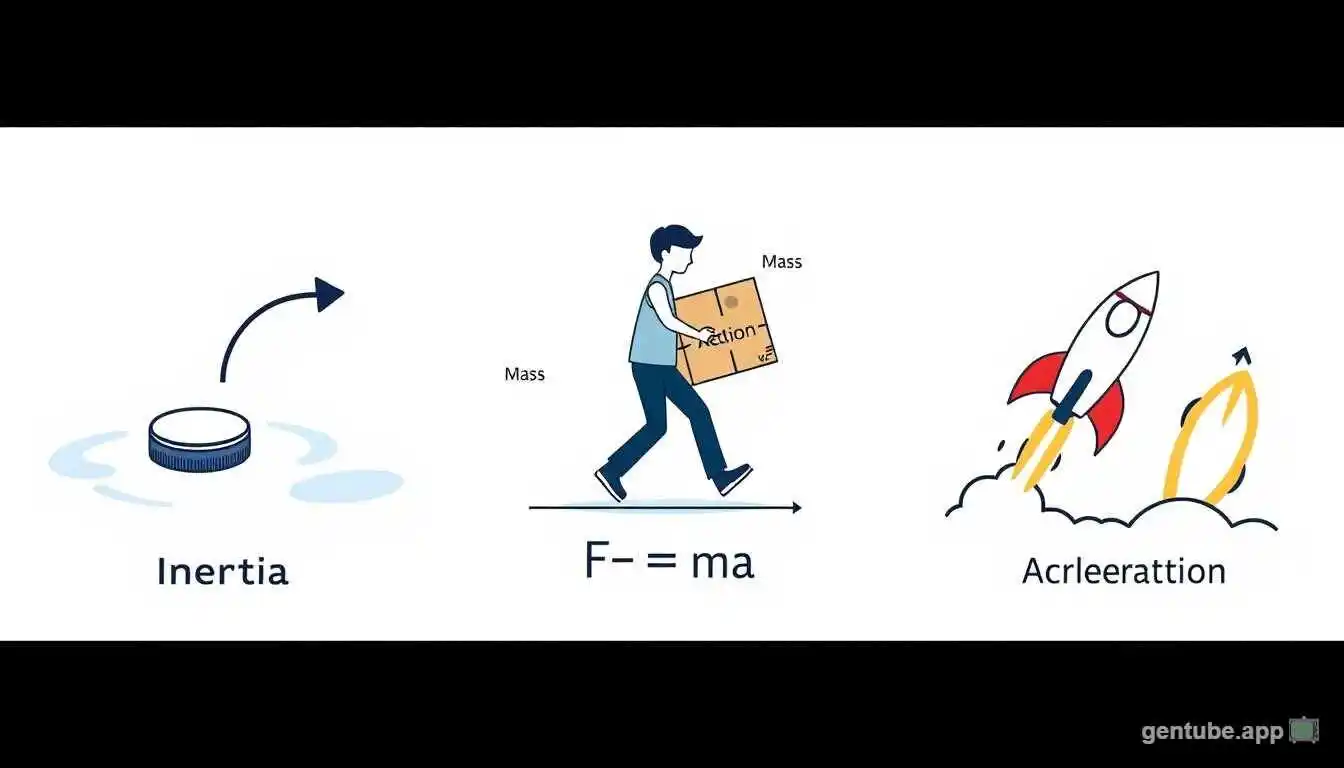
- Newton’s First Law (Law of Inertia): An object at rest stays at rest, and an object in motion stays in motion with the same speed and in the same direction unless acted upon by an unbalanced force.
- Newton’s Second Law (Law of Acceleration): The acceleration of an object is directly proportional to the net force acting on it and inversely proportional to its mass. Formula: $F = ma$.
- Newton’s Third Law (Action-Reaction): For every action, there is an equal and opposite reaction.
These sound simple, almost trivial. “Things keep moving unless stopped.” “Push harder, it moves faster.” “Kick the wall, the wall kicks back.” But their implications are profound. They explain why seatbelts save lives, how rockets fly in space, why planets orbit the sun, and why it’s harder to push a car than a bicycle.
Newton’s First Law: The Law of Inertia
Let’s start with the first law. This is the law of laziness. Objects are lazy. They want to keep doing what they are already doing.
The Core Concept
If an object is sitting still, it will sit there forever unless something pushes or pulls it. If an object is moving in a straight line at a constant speed, it will keep doing that forever unless something changes its speed or direction.
This property of resisting changes in motion is called Inertia. Inertia is not a force. It is a property of matter. The more mass an object has, the more inertia it has. A train has huge inertia. A ping-pong ball has tiny inertia.
Real-World Example: The Bus Stop
You know that feeling when you are standing on a bus, and the driver slams on the brakes? Your body jerks forward. Why? Because your body has inertia. You were moving at the same speed as the bus. When the bus stops (due to the force of the brakes), your body wants to keep moving at that original speed. The seatbelt or the rail provides the “unbalanced force” to stop you.
Or the opposite: the bus starts moving suddenly. You fall backward. Your feet move forward with the bus floor, but your upper body wants to stay at rest due to inertia.
Why It Matters
The First Law defines what a force is. A force is not just a push; it is a change in motion. If there is no net force, there is no acceleration. This was a revolutionary idea before Newton. People used to think that objects naturally wanted to be at rest. Aristotle thought that. Newton corrected him. Things don’t naturally stop; forces naturally stop them. Friction is the force that usually stops things on Earth. If you were in deep space, far from any gravity, and you threw a ball, it would go in a straight line forever. It would never slow down. That is the First Law in its purest form.
Common Misconception
Many students think that if an object is moving, there must be a force pushing it. This is wrong. If a hockey puck slides on perfectly frictionless ice, it moves without any force pushing it. The force was only needed to start it moving or to change its motion. Once it’s moving, no force is needed to keep it moving. This is counter-intuitive because on Earth, friction is always there, so we associate motion with force. But in space, they are separate.
Newton’s Second Law: The Law of Acceleration
This is the workhorse of physics. This is the law that engineers use to calculate everything from the thrust of a rocket to the braking distance of a car.
The Core Concept
The law states: Force equals Mass times Acceleration ($F = ma$).
Let’s break that down.
- Force ($F$): The push or pull applied to the object. Measured in Newtons (N).
- Mass ($m$): The amount of matter in the object. Measured in kilograms (kg). Mass is also a measure of inertia.
- Acceleration ($a$): The rate of change of velocity. Measured in meters per second squared ($m/s^2$).
The equation tells us two crucial things:
- If you apply more force to an object, it accelerates more. (Direct proportionality).
- If an object is heavier (more mass), it accelerates less for the same force. (Inverse proportionality).
Real-World Example: The Shopping Cart
Think about pushing a shopping cart.
- Scenario A: The cart is empty. You give it a gentle push. It accelerates quickly. Why? Low mass ($m$). Small force ($F$) creates high acceleration ($a$).
- Scenario B: The cart is full of groceries. You give it the same gentle push. It barely moves. Why? High mass ($m$). Same force ($F$) creates low acceleration ($a$).
- Scenario C: The cart is full, and you want it to accelerate as fast as the empty one. You have to push much harder. You need more force ($F$) to overcome the higher mass ($m$).
This is Newton’s Second Law in action. It quantifies the relationship between cause (force) and effect (acceleration), mediated by the object’s resistance (mass).
Why It Matters
This law allows us to predict the future. If we know the forces acting on an object and its mass, we can calculate exactly how it will move. This is crucial for engineering. When designing a bridge, engineers need to know how much force the structure can withstand. When designing a car, they need to know how much engine power (force) is needed to accelerate a certain weight (mass) to highway speeds.
The Vector Nature
Force and acceleration are vectors. They have direction. If you push an object to the right, it accelerates to the right. If you push it to the left, it accelerates to the left. The net force determines the direction of acceleration. If forces are balanced (net force = 0), acceleration is 0, and the object maintains constant velocity (which could be zero).
Newton’s Third Law: Action and Reaction
This is the most misunderstood law of physics. “For every action, there is an equal and opposite reaction.”
The Core Concept
Forces always come in pairs. You cannot touch something without it touching you back. If Object A exerts a force on Object B, then Object B exerts an equal and opposite force on Object A.
Crucially, these forces act on different objects. This is the key to understanding why things move.
Real-World Example: Walking
When you walk, you push the ground backward with your foot. That is the Action.
The ground pushes your foot forward with an equal and opposite force. That is the Reaction.
Because the Earth is massive, it doesn’t really move when you push it. But you, being much lighter, accelerate forward.
If you try to walk on ice, it’s hard. Why? Because there is less friction. You can’t push the ground backward effectively, so the ground can’t push you forward effectively.
Real-World Example: Rockets
People often ask, “How does a rocket move in space where there is no air to push against?”
The answer is Newton’s Third Law. The rocket engine expels hot gas backward at high speed. That is the Action (rocket pushes gas).
The gas pushes the rocket forward. That is the Reaction (gas pushes rocket).
The rocket doesn’t need air to push against. It pushes against its own exhaust. This is why rockets work better in a vacuum!
Common Misconception: Balanced Forces
Students often confuse Newton’s Third Law pairs with balanced forces.
- Balanced Forces (Equilibrium): Two forces acting on the same object. If I push a box and friction pushes back equally, the net force is zero, and the box doesn’t accelerate. These forces cancel each other out for that object.
- Action-Reaction Pairs: Two forces acting on different objects. I push the box, and the box pushes me. These forces do not cancel each other out because they act on different bodies. I might move backward while the box moves forward.
Why It Matters
This law explains interactions. It shows that force is not a property of one object, but a relationship between two. It is universal. From subatomic particles colliding to galaxies merging, action and reaction pairs are everywhere.
Importance of Newton’s Laws in Daily Life and Science
Why should you care about these three rules? Because they are everywhere.
- Transportation: Cars, planes, ships, and rockets all rely on these laws. Engineers use $F=ma$ to design engines and brakes.
- Sports: Every sport is physics. A baseball pitcher uses the second law to throw a ball fast. A gymnast uses the third law to jump off the vault. A soccer player uses the first law to control the ball’s trajectory.
- Construction: Bridges and buildings must withstand forces without accelerating (changing shape or collapsing). The first law is key here—structures are designed to be in equilibrium.
- Safety: Seatbelts, airbags, and helmets are all designed based on inertia and force. Seatbelts provide the force to stop your body when the car stops. Airbags increase the time of impact, reducing the force (from $F=ma$, if time increases, acceleration decreases, so force decreases).
- Space Exploration: NASA uses these laws to send probes to other planets. Trajectory calculations are pure Newtonian physics (with some Einstein corrections for extreme precision).
Core Concepts and How It Works
Let’s dig deeper into the mechanics. How do we actually use these laws?
Free Body Diagrams (FBDs)
To solve physics problems, we use Free Body Diagrams. We draw the object as a dot or a box. Then we draw arrows representing all the forces acting on that object.
- Gravity ($mg$) points down.
- Normal force ($N$) points perpendicular to the surface.
- Friction ($f$) points opposite to motion.
- Applied force ($F_{app}$) points in the direction of the push.
Once we have the FBD, we sum the forces to find the net force ($F_{net}$). Then we use $F_{net} = ma$ to find the acceleration.
Friction: The Hidden Force
Friction is a force that opposes motion. It arises from microscopic interactions between surfaces. There are two types:
- Static Friction: The force that keeps an object at rest. You have to overcome this to start moving.
- Kinetic Friction: The force that opposes an object already in motion. Kinetic friction is usually less than static friction, which is why it’s harder to start pushing a heavy box than to keep it moving.
Friction is crucial for everyday life. Without it, we couldn’t walk, drive, or hold things. But it also wastes energy, creating heat and wear.
Gravity: The Universal Glue
Newton’s law of universal gravitation states that every mass attracts every other mass. $F = G \frac{m_1 m_2}{r^2}$.
On Earth, this simplifies to $W = mg$, where $g \approx 9.8 m/s^2$.
Gravity is what gives weight to objects and keeps us on the ground. It is also the force that keeps planets in orbit. The Earth pulls on the Moon, and the Moon pulls on the Earth. They orbit a common center of mass.
Real-Life Case Study: The Student Who Cracked the Code
Let’s go back to Sam, the boy from the beginning. Sam was struggling with a problem involving a block sliding down a ramp. The problem gave him the mass of the block, the angle of the ramp, and the coefficient of friction. He was confused by all the forces.
I sat down with him and drew a square representing the block.
“Sam,” I said, “close your eyes. Imagine you are the block. What do you feel?”
He opened his eyes. “I feel… heavy? And sliding down?”
“Exactly. What forces are acting on you?”
He started drawing arrows. Gravity down. Normal force perpendicular to the ramp. Friction up the ramp.
“Now,” I said, “break gravity into components. One part pulls you into the ramp. One part pulls you down the slope.”
He did the math. He found the net force down the slope. Then he used $F=ma$ to find the acceleration.
He got the right answer. But more importantly, he understood why. He saw that gravity was being split, that friction was fighting back, and that the net force was small, so the acceleration was small. He had moved from memorizing formulas to visualizing forces. That is the power of Newton’s Laws.
Benefits of Mastering Newton’s Laws
- Predictive Power: You can predict how objects will move before they even move.
- Problem-Solving Skills: It teaches you to break complex problems into simple parts (FBDs).
- Intuition: You develop a “physics gut feeling” for how the world works.
- Foundation for Advanced Physics: Thermodynamics, electromagnetism, and even quantum mechanics build on these concepts.
- Real-World Application: You understand the technology around you, from elevators to roller coasters.
Common Mistakes and Challenges
- Confusing Mass and Weight: Mass is amount of matter (kg). Weight is force of gravity (N). They are related ($W=mg$) but not the same.
- Ignoring Friction: Assuming surfaces are perfectly smooth when they are not.
- Wrong Direction of Friction: Friction always opposes relative motion, not just motion. If you push a block on a moving conveyor belt, friction might push it forward!
- Action-Reaction Confusion: Thinking action and reaction forces cancel out on the same object. They act on different objects.
- Vector Errors: Forgetting that force and acceleration are vectors. Direction matters.
Comparison Table: The Three Laws
| Feature | First Law (Inertia) | Second Law (Acceleration) | Third Law (Action-Reaction) |
| Key Concept | Objects resist change in motion. | Force causes acceleration. | Forces come in pairs. |
| Formula | $F_{net} = 0 \implies a = 0$ | $F_{net} = ma$ | $F_{A on B} = -F_{B on A}$ |
| Focus | Equilibrium / Constant Velocity | Cause and Effect of Motion | Interaction between Objects |
| Example | Hockey puck sliding forever | Pushing a shopping cart | Rocket launching |
| Key Variable | Mass (Inertia) | Mass, Force, Acceleration | Force Pairs |
| Real World Use | Seatbelts, headrests | Engine design, braking | Walking, swimming |
5 Proven Study Tips to Master Newton’s Laws
Tip 1: Draw Free Body Diagrams for Everything
Don’t just solve problems. Draw diagrams for real life. Look at a car on a hill. Draw the forces. Look at a bird flying. Draw the forces. This builds visual intuition. When you see a problem, your brain should automatically generate an FBD.
Tip 2: Practice with “What If” Scenarios
Change the variables. What if the mass doubles? What if friction is zero? What if gravity is weaker? Predict the outcome before calculating. This deepens understanding. If you double the mass, does the acceleration double or halve? (It halves). Why? Because $a = F/m$.
Tip 3: Use Simulation Apps
Apps like PhET Interactive Simulations allow you to drag blocks, apply forces, and watch them move in real-time. You can see the vectors change as you adjust mass and force. This visual feedback is powerful.
Tip 4: Teach It to Someone Else
Explain Newton’s Third Law to a friend using the example of walking. If you can explain it clearly, you understand it. If you get stuck, go back to the books.
Tip 5: Solve Problems Backwards
Start with the answer. “The car accelerates at $2 m/s^2$. What force was required?” This helps you understand the relationship between variables in reverse.
Conclusion: The Language of Motion
Newton’s laws are not just equations. They are a way of seeing. They teach us that the universe is orderly. That every action has a consequence. That nothing moves without a reason.
From the smallest dust mote to the largest galaxy, these laws apply. They are simple, elegant, and profound. Master them, and you master the language of motion. You will never look at a falling leaf, a speeding car, or a flying bird the same way again. You will see the invisible forces at play, the balance of inertia, the push and pull of interaction.
So, pick up your pen. Draw your arrows. Calculate your forces. And join the long line of thinkers who have used these laws to understand the world. The universe is waiting to be decoded. And you hold the key.
FAQS
1.What are Newton’s three laws of motion?
They are: 1) Inertia, 2) $F=ma$, 3) Action-Reaction. They describe how forces affect motion.
2.What is inertia?
Inertia is the resistance of an object to changes in its motion. It depends on mass.
3.Does inertia depend on speed?
No, inertia depends only on mass. A fast car and a slow car have the same inertia if they weigh the same.
4.What is the unit of force?
The unit is the Newton (N). One Newton is the force needed to accelerate 1 kg at $1 m/s^2$.
5.What is the difference between mass and weight?
Mass is the amount of matter (kg). Weight is the force of gravity on that mass (N).
6.Why do you fall forward when a bus stops?
Your body has inertia and wants to keep moving forward while the bus stops.
7.How does $F=ma$ help engineers?
It allows them to calculate the force needed to move a vehicle of a certain mass at a desired acceleration.
8.What is friction?
Friction is a force that opposes motion between two surfaces in contact.
9.Is static friction stronger than kinetic friction?
Yes, it is harder to start moving an object than to keep it moving.
10.Why do rockets work in space?
They push exhaust gas backward, and the gas pushes the rocket forward (Newton’s 3rd Law).
11.Do action and reaction forces cancel out?
No, they act on different objects, so they don’t cancel each other out for a single object.
12.What is a free body diagram?
It is a sketch showing all forces acting on a single object as arrows.
13.Why do you need a seatbelt?
To provide the force that stops your body when the car stops due to inertia.
14.What happens if net force is zero?
The object’s acceleration is zero. It moves at constant velocity or stays at rest.
15.Can an object move without a force?
Yes, in space, an object can move at constant velocity without any force acting on it.
16.What is the acceleration due to gravity?
On Earth, it is approximately $9.8 m/s^2$ downward.
17.Does gravity affect all objects equally?
Gravity accelerates all objects at the same rate in a vacuum, regardless of mass.
18.Why is it harder to push a heavy box?
Because it has more mass, so it has more inertia and requires more force to accelerate.
19.What is the normal force?
It is the support force exerted by a surface perpendicular to the object resting on it.
20.Does Newton’s laws apply to light?
No, light is massless and follows different rules (photons). Newton’s laws are for massive objects.
21.What is equilibrium?
Equilibrium is when the net force on an object is zero, so it has no acceleration.
22.Why do we slip on ice?
Ice has low friction, so it’s hard to push the ground backward to move forward.
23.How does a swimmer move?
The swimmer pushes water backward, and the water pushes the swimmer forward.
24.What is the formula for weight?
$W = mg$, where $g$ is the acceleration due to gravity.
25.Can force change direction without changing speed?
Yes, like in circular motion, where the force is perpendicular to velocity.
26.Why do planets orbit the sun?
The sun’s gravity pulls the planet, causing it to accelerate toward the sun, creating an orbit.
27.What is the role of mass in $F=ma$?
Mass is the proportionality constant that determines how much acceleration a force produces.
28.Is Newton’s laws always accurate?
No, they break down at very high speeds (relativity) or very small scales (quantum mechanics).
29.How do airbags save lives?
They increase the time of impact, reducing the force experienced by the passenger.
30.What is the most important law for everyday life?
Many say the Third Law, as it explains walking, driving, and swimming.
Disclaimer: The content on this blog is for informational purposes only. The author’s opinions are personal and not endorsed. Efforts are made to provide accurate information, but completeness, accuracy, or reliability are not guaranteed. The author is not liable for any loss or damage resulting from the use of this blog. It is recommended to use the information on this blog at your own discretion.

