

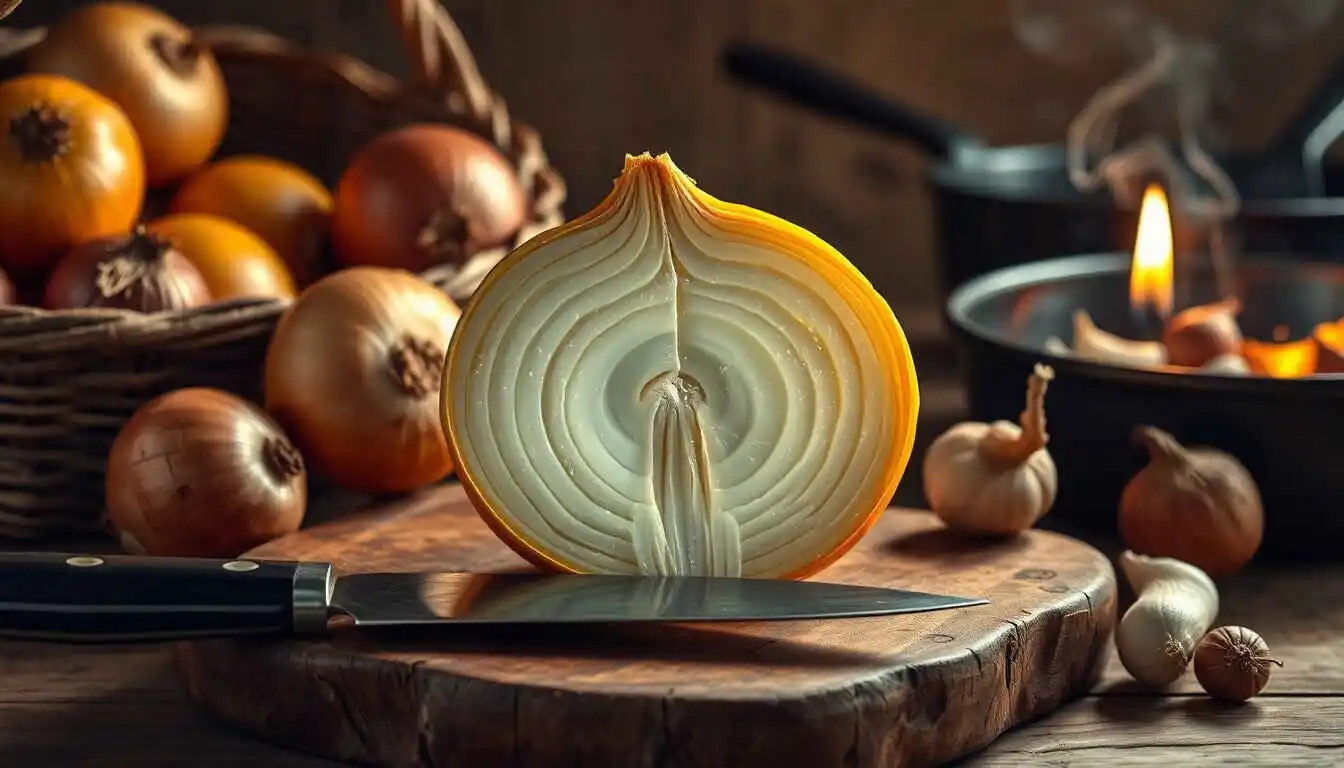
The onion’s pervasive presence in daily life has woven it deeply into the cultural, literary, and superstitious fabric of humanity.
In folklore, the onion is often a symbol of futility and the illusion of depth. The most famous metaphor is “peeling the onion”—the idea that as you dig deeper into a mystery or a person’s psyche, you expect to find a core truth, but you only find more layers, eventually leaving you with nothing. This metaphor was famously utilized by psychologist Carl Jung and playwright Eugène Ionesco in his absurdist play The Bald Soprano, highlighting the absurdity of seeking a central meaning in life.
Yet, the onion is also a symbol of resilience and the earth. In Chaucer’s The Canterbury Tales, the corrupt Summoner is described as having a face “like a fiery cherubim,” but his diet is that of a lowly peasant: garlic, onions, and leeks. In Russian folklore and peasant life, the onion is a savior. In Nikolai Gogol’s short story “The Overcoat,” the impoverished clerk’s meager diet of onions and bread underscores the harsh reality of the lower classes, while the vegetable sustains them.
Superstitions surrounding the onion abound. In parts of rural England, it was believed that placing a sliced onion under the bed of a sick person would draw out the fever. In the American South, folklore dictated that scattering onion skins on the floor would ward off evil spirits. In dreams, an onion is often said to represent layers of the self that need to be explored, or a situation that is complicated and multifaceted.
Even in language, the onion holds power. To “know your onions” means to be highly experienced and knowledgeable in a particular field—a nod to the deep agricultural expertise required to cultivate the tricky bulb.
Conclusion: The Unseen King
We live in an era of culinary obsession. We fetishize the wagyu steak, the white truffle, the 25-year-aged balsamic vinegar. We spend fortunes on exotic spices shipped from the corners of the earth. Yet, in the quiet of our kitchens, it is the onion we reach for first.
It is the first thing to hit the hot oil in the pan. It is the scent that signals dinner is on its way. It is the foundation upon which every great meal is built. Without the onion, our plates would be flat, our palates bored, and our history profoundly altered.
The onion has traveled from the dusty plains of Central Asia to the tombs of pharaohs. It has fueled the construction of wonders, triggered the downfall of governments, and provided medicine to the masses. It makes us weep, yes, but those tears are a small price to pay for the profound depth, sweetness, and comfort it brings to our lives.
The next time you slice into an onion, and your eyes begin to sting, don’t curse it. Pay your respects. You are holding in your hand a botanical marvel, an ancient survivor, and the undisputed, tearful king of the kitchen.
FAQS
Origins & History
1.What is the scientific name of the onion?
Allium cepa, which is a member of the lily family.
2.Where did the onion originate?
In the harsh, arid soils of Central Asia, stretching from the Middle East to the Indian subcontinent.
3.Why were onions so important to early hunter-gatherers?
Wild onions were a vital source of hydration and energy because they stored water and sugars underground, protected from the scorching sun.
4.How did ancient Egyptians view the onion?
They considered it sacred. Its concentric, unbroken rings were seen as a symbol of eternal life, and it was often buried with the dead to sustain them in the afterlife.
5.How were onions involved in building the Pyramids of Giza?
Records show vast sums were spent feeding onions to the laborers. The bulbs provided essential hydration and nutrients to keep the workforce alive under the brutal desert sun.
The Science of Tears
6.Why do onions make us cry?
It is an evolutionary defense mechanism. Slicing the onion ruptures cells, mixing enzymes and amino acids to create a volatile gas that hits our eyes and dissolves into mild sulfuric acid, triggering tears to flush it out.
7.What are the two separate chemical compounds inside an intact onion that cause tears?
Sulfur-containing amino acids (chiefly PRENCSO) and an enzyme called alliinase.
- What is the specific gas created when you cut an onion?
Syn-propanethial-S-oxide.
- Does using a sharp knife help reduce tears when cutting onions?
Yes, a sharper knife causes less cellular damage, rupturing fewer cells and releasing less of the tear-inducing gas.
- What are some other methods to stop onion tears?
Chilling the onion before cutting, cutting it under running water, or wearing protective goggles.
Culinary Alchemy
- What are the two main chemical processes that occur when cooking onions?
The Maillard reaction (browning of amino acids and sugars) and caramelization (concentration and browning of natural sugars).
- What happens to the pungent compounds in an onion when it is slowly cooked?
The pyruvic acid (responsible for the raw pungency) breaks down and dissipates, leaving a sweet flavor.
- What is a French mirepoix?
A flavor base consisting of diced onions, carrots, and celery, usually in a 2:1:1 ratio.
- What is the Cajun/Creole “Holy Trinity”?
A flavor base of onions, celery, and green bell pepper.
- What is a sofrito?
A slow-cooked Spanish and Latin American flavor base of onions, garlic, and tomatoes or peppers.
- What is the Indian bhuna process?
Frying onions until deeply golden before adding ginger, garlic, and spices to create the base of a curry.
Varieties & Types
- Which onion is the standard “workhorse” of Western cooking?
The yellow onion, known for its high sulfur content and deep sweetness when cooked.
- What is a red onion best used for?
Raw applications where crunch and color are desired, such as salads, burgers, and quick pickles.
- Which onion is most commonly used in Latin American salsas?
The white onion, favored for its sharper raw bite and sweeter puree when cooked.
- Why are sweet onions like Vidalias so mild?
They are grown in low-sulfur soils, which prevents them from developing the harsh pyruvic acid found in other varieties.
- How does a shallot differ in flavor from a standard onion?
It offers a sophisticated, delicate blend of onion and garlic flavors and is favored in French vinaigrettes and sauces.
- What part of the scallion (green onion) is used for cooking vs. finishing?
The white bottoms are cooked for a soft base, while the hollow green tops are sliced raw to finish a dish with fresh crunch.
Health & Medicine
- What powerful antioxidant is abundant in onions?
Quercetin, which has anti-inflammatory, antiviral, and anti-carcinogenic properties.
- How do onions benefit gut health?
They are rich in inulin and fructo-oligosaccharides, which act as prebiotics that feed beneficial gut bacteria.
- Can onions help regulate blood sugar?
Yes, sulfur compounds in onions, particularly S-methylcysteine, have been shown to lower blood glucose levels.
- Did medieval people use onions to fight the plague?
Yes, they stuffed windows with onions, believing the strong sulfur fumes would ward off the disease-causing “miasma,” though this was scientifically ineffective.
Politics & Agriculture
- Why is the onion considered a political weapon in India?
Onions are a staple of the Indian diet with inelastic demand. When prices soar due to bad harvests, public outrage is so severe that it can cause governments to fall.
- What does it mean that onions are “photoperiodic”?
Their bulb development is triggered by the length of daylight they receive, dividing them into short-day and long-day varieties.
- What is “curing” an onion?
Laying freshly pulled onions in the sun to dry the outer skin into a papery shell, which seals in moisture and allows for long-term storage.
- Why shouldn’t you store whole onions in the refrigerator?
The fridge is too humid, causing onions to soften and rot. They also absorb fridge odors and can taint other foods like milk and butter.
Medical Disclaimer: The information provided on this website is for general educational and informational purposes only and is not intended as a substitute for professional medical advice, diagnosis, or treatment. Always seek the advice of your physician or other qualified health provider with any questions you may have regarding a medical condition. Never disregard professional medical advice or delay in seeking it because of something you have read on this website.

