

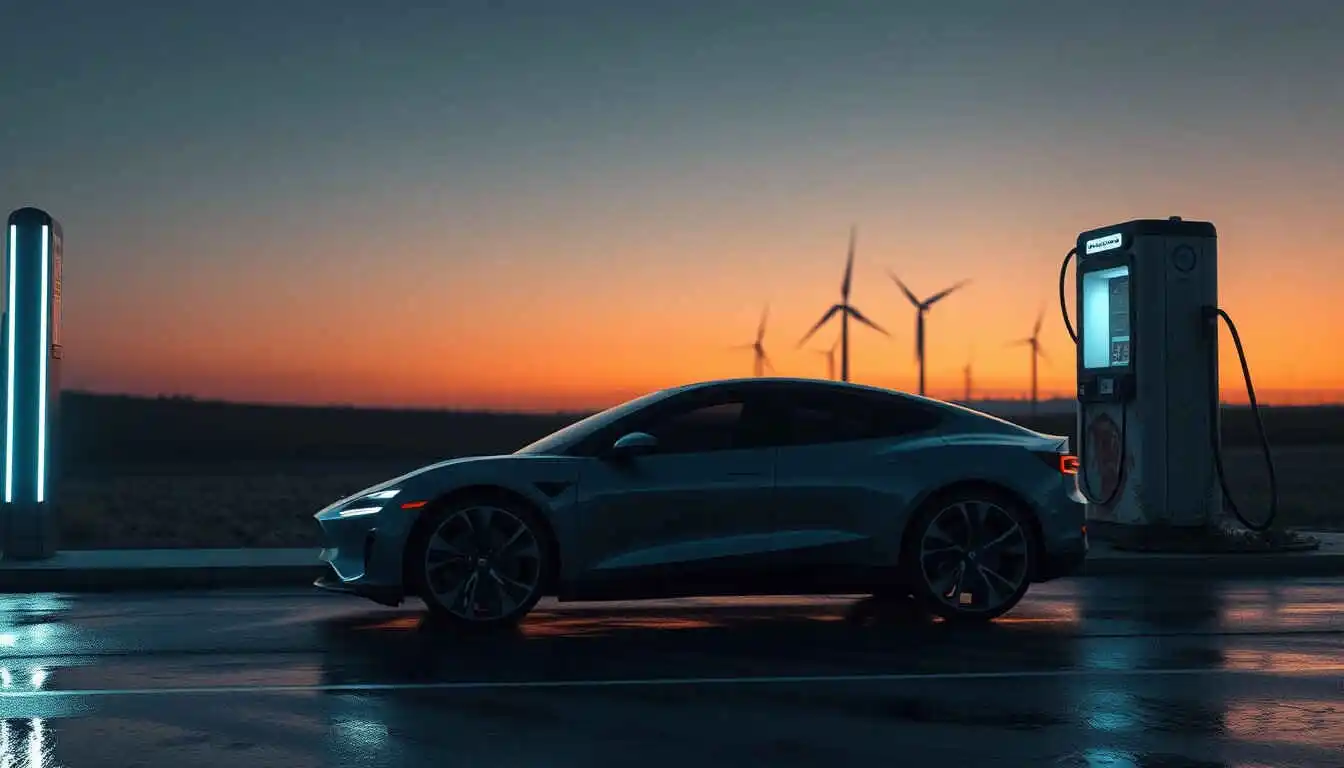
So, what does the world look like when the internal combustion engine finally breathes its last?
Vehicle-to-Everything (V2X): In the future, EVs will not just consume energy; they will store and distribute it. Through Vehicle-to-Grid (V2G) technology, millions of parked EVs will act as a decentralized mega-battery. When renewable energy production peaks during the day, they charge. When demand peaks at night, they feed power back into the grid, stabilizing the network and earning money for the car owner. Vehicle-to-Home (V2H) will allow EVs to power your house during a blackout, rendering generators obsolete.
The Shared Autonomous Fleet: The convergence of electrification and autonomous driving will fundamentally alter car ownership. In dense urban environments, owning a car that sits parked 95% of the time is highly inefficient. Autonomous EVs will likely form the backbone of robotic ride-hailing networks. You will summon a car on your phone, it will arrive silently, drive you to your destination, and move on to the next passenger. The cost per mile of transport will plummet, and the need for massive parking lots in city centers will vanish, freeing up millions of square feet for parks and housing.
The Hyper-Efficient Commuter: Not every EV needs to be a 5,000-pound SUV. We will see a resurgence of micro-mobility. Tiny, enclosed, ultra-lightweight electric vehicles designed for single-person commuting will dominate cities. These vehicles require a fraction of the materials and energy to build and operate, pushing the boundaries of efficiency.
Wireless Charging: While currently a luxury add-on, inductive wireless charging will become standard. Imagine pulling into your garage or a parking spot, and the car begins charging automatically without you ever plugging in a cable. Dynamic wireless charging—coils embedded in the road that charge your car as you drive—is currently being tested and could eventually eliminate the need for large battery packs altogether.
Conclusion: The End of the Combustion Era
The internal combustion engine is a marvel of human ingenuity. It connected continents, industrialized the world, and gave us unprecedented freedom. But its time has passed. The environmental cost, the geopolitical entanglements, and the mechanical inefficiencies are liabilities we can no longer afford.
The electric vehicle is not just a replacement; it is an evolution. It is faster, quieter, cleaner, and smarter. The transition will be messy. There will be bankruptcies, infrastructure bottlenecks, and political battles over minerals and subsidies. The grid will need to be rebuilt, and our habits of refueling will have to be unlearned.
But the momentum is irreversible. We are witnessing the death rattle of a 150-year-old technology and the birth of a new one. When you plug in an electric vehicle, you aren’t just recharging a battery; you are plugging into the future. The combustion engine is finally running out of gas, and the electric revolution is just getting started.
FAQS
1.Did electric vehicles exist before gas cars?
Yes, electric carriages were popular in the late 1800s and made up a third of US vehicles by 1900.
2.What killed the first electric car movement?
Mass production of cheap gas cars by Henry Ford, the discovery of cheap Texas crude oil, and the invention of the electric starter motor for gas engines.
3.Which company sparked the modern EV revolution?
Tesla Motors, with the release of the Tesla Roadster in 2008, proved electric cars could be fast, sexy, and have long-range.
4.How does an EV motor work?
It uses electromagnets to create a rotating magnetic field that spins the rotor and drives the wheels directly, without needing a multi-speed transmission.
5.Why do EVs accelerate faster than gas cars?
Electric motors deliver maximum torque instantly from zero RPM, eliminating the lag gas engines experience while revving up.
Maintenance & Mechanics
6.Do electric vehicles require a lot of maintenance?
No, EVs have exponentially fewer moving parts. You never need oil changes, spark plugs, transmission fluid, or exhaust system repairs.
7.What is regenerative braking?
When you lift your foot off the accelerator, the EV motor acts as a generator, capturing kinetic energy to recharge the battery while simultaneously slowing the car down.
- Do EVs need their brake pads replaced often?
Rarely. Because regenerative braking handles most of the deceleration, physical brake pads can last for hundreds of thousands of miles.
- What are the core components of an EV?
The three main components are the battery pack (stores energy), the inverter (converts DC to AC), and the electric motor (drives the wheels).
Battery Technology
- What kind of batteries do modern EVs use?
The industry standard is the Lithium-ion (Li-ion) battery due to its high energy density and lightweight properties.
- What is battery energy density?
It’s the amount of energy a battery can hold relative to its weight. Higher energy density means longer driving ranges without making the car excessively heavy.
- What is an LFP battery?
Lithium Iron Phosphate batteries use iron and phosphate instead of cobalt and nickel. They are cheaper, safer, last longer, and avoid the ethical concerns of cobalt mining, though they have slightly lower energy density.
- What are solid-state batteries?
They are the “holy grail” of EV tech, replacing the liquid electrolyte in current batteries with a solid material to double energy density, halve charging times, and eliminate fire risks.
- Will my EV battery degrade quickly and need replacement?
Modern EV batteries are designed to last the lifespan of the vehicle, typically retaining 70-80% of their capacity after 150,000 to 200,000 miles.
Types of EVs
- What is the difference between a BEV and a PHEV?
A BEV (Battery Electric Vehicle) runs entirely on electricity with no gas tank. A PHEV (Plug-in Hybrid Electric Vehicle) has a battery for short electric trips (20-50 miles) and a gas engine for longer drives.
- What is a Mild Hybrid (MHEV)?
It’s a traditional gas car with a small 48-volt battery that assists acceleration and powers electronics, but it cannot drive on electric power alone.
- Is a PHEV a good bridge to a full EV?
Yes, PHEVs eliminate range anxiety because they have a gas engine backup, making them great for drivers who aren’t ready to go fully electric but want electric benefits for daily commutes.
Charging & Range
- What is “Range Anxiety”?
The fear that an electric vehicle will run out of battery power before reaching a charging station, leaving the driver stranded.
- Can I charge an EV at a regular wall outlet?
Yes, this is Level 1 charging, but it is very slow, adding only about 3 to 5 miles of range per hour.
- What is Level 2 charging?
It uses a 240-volt outlet (like a clothes dryer) and a dedicated home station, adding 25-30 miles of range per hour—ideal for overnight home charging.
- How fast is DC Fast Charging (Level 3)?
It bypasses the car’s onboard charger to deliver direct current at massive voltages, allowing modern EVs to charge from 10% to 80% in 15 to 30 minutes.
- What is the North American Charging Standard (NACS)?
It is Tesla’s proprietary charging plug, which is now being adopted by nearly every major automaker to replace the older CCS standard, giving non-Tesla EVs access to the Supercharger network.
Environment & Sustainability
- Are EVs truly “zero emissions”? They have zero tailpipe emissions. However, their overall carbon footprint depends on the energy source used to charge them (coal vs. renewables).
- What is the “long tailpipe” myth?
The argument that EVs are worse for the environment because power plants burn coal. Studies show that even on a coal-heavy grid, EVs are more efficient and produce fewer emissions per mile than gas cars.
- Isn’t EV manufacturing bad for the environment?
Manufacturing an EV—specifically mining for battery minerals—has a higher upfront carbon footprint than making a gas car. However, an EV breaks even and becomes greener within 15,000 to 20,000 miles of driving. 26. Can EV batteries be recycled?
Yes. Up to 95% of critical minerals (lithium, cobalt, nickel) in EV batteries can be extracted and reused to build new batteries, creating a circular economy.
Economics & The Market
- Are electric vehicles cheaper to own than gas cars?
While upfront costs can be higher, the Total Cost of Ownership (TCO) is lower due to massive savings on fuel and maintenance over the vehicle’s life.
- Why are Chinese EVs dominating the global market?
Massive government subsidies, ruthless manufacturing efficiency, and total dominance over the battery mineral supply chain allow Chinese automakers like BYD to produce high-quality, low-cost EVs.
- Why are traditional car dealerships resisting the EV shift?
Dealerships make most of their profit from servicing gas cars and financing. EVs require far less maintenance, threatening their primary revenue stream.
The Future
- What is Vehicle-to-Grid (V2G) technology?
A system where parked EVs can feed stored energy from their batteries back into the public power grid during peak demand hours, helping to stabilize the network and earning money for the car owner.
Disclaimer: The content on this blog is for informational purposes only. Author’s opinions are personal and not endorsed. Efforts are made to provide accurate information, but completeness, accuracy, or reliability are not guaranteed. Author is not liable for any loss or damage resulting from the use of this blog. It is recommended to use information on this blog at your own terms.

