

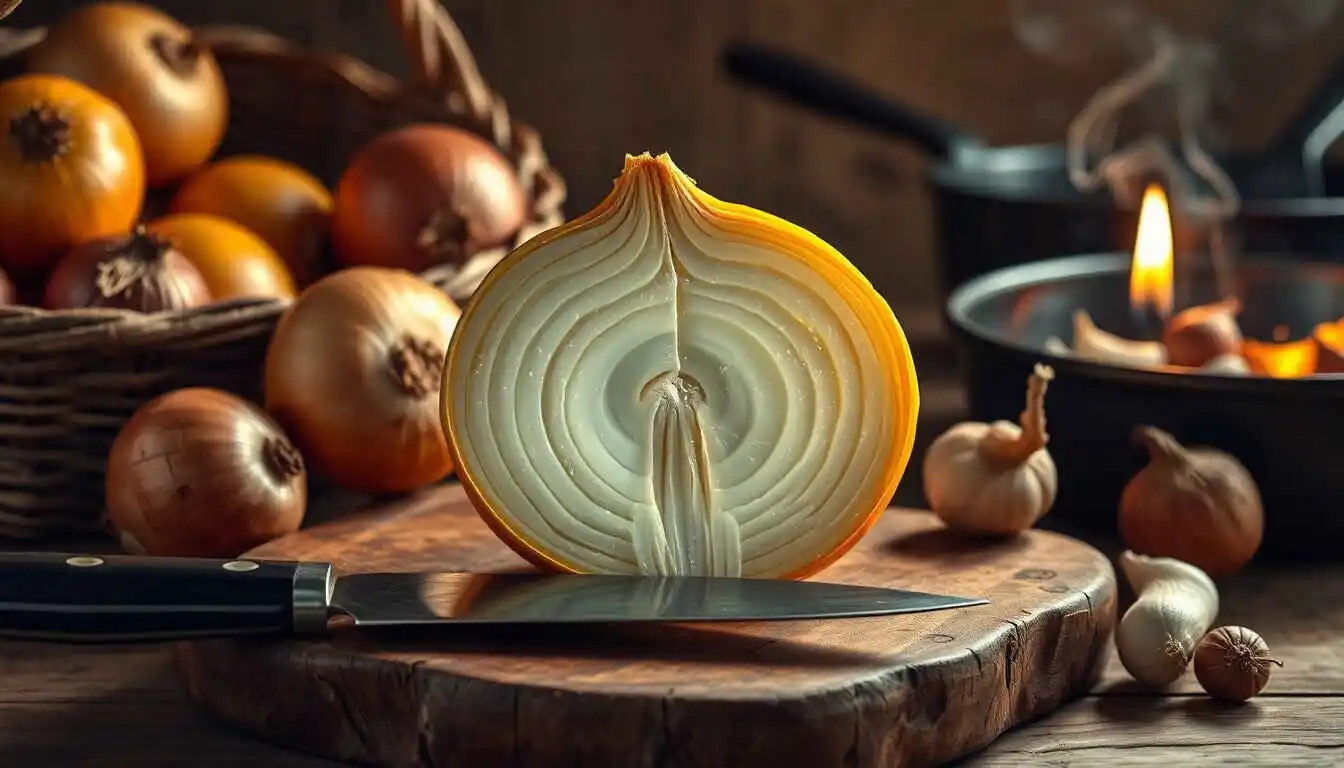
The Bulb That Built the World: The Tearful, Triumphant, and Tyrannical History of the Humble Onion
Close your eyes and imagine the most mouth-watering dish you have ever tasted. A rich, simmering Bolognese sauce. A fragrant, golden Indian curry. A deep, dark French onion soup topped with a crouton and molten cheese. A sizzling Mexican fajita platter. What is the invisible thread tying these global culinary masterpieces together? What is the foundational note upon which entire empires of flavor are built?
It is not the rare saffron, the expensive truffle, or the prime cut of meat. It is the humble, layered, unassuming, and utterly indispensable onion.
We take it for granted. It sits in a wire basket on our kitchen counters, a papery, unglamorous sphere. Yet, this pungent bulb has altered the course of human civilization, funded empires, built pyramids, triggered riots, and conquered the world’s palates from the dawn of agriculture. It makes us weep, yet we cannot stop eating it. It is a symbol of poverty and a cornerstone of haute cuisine.
To peel back the layers of the onion is to peel back the layers of human history itself. This is the sprawling, surprising, and deeply emotional story of the vegetable that built the world.
Part I: Roots in the Dust—The Ancient Origins
The story of the onion begins not in the manicured gardens of modern agriculture, but in the harsh, unforgiving soils of Central Asia. Botanically known as Allium cepa, the onion is a member of the lily family, a cousin to garlic, chives, and leeks. Its wild ancestors were small, bitter, and intensely pungent, growing in the rocky, arid regions that stretch from the Middle East to the Indian subcontinent.
Early hunter-gatherers likely encountered these wild alliums and recognized their potent, water-storing bulbs as a vital source of hydration and energy in a desolate landscape. Because the wild onion grew underground, it was shielded from the scorching sun, evolving to store concentrated sugars and moisture to survive long dormant periods. This inherent resilience is what first made it attractive to early humans.
The true transformation of the onion from a foraged weed to a cultivated crop occurred around 3000 BCE in the fertile valleys of Mesopotamia and Egypt. The ancient Sumerians were among the first to cultivate it, realizing that the onion was a botanical miracle. It was easy to grow, propagated easily from seed, and unlike leafy greens or berries, it could be pulled from the ground and stored for months without rotting. In a world before refrigeration, the onion was a lifeline.
The Divine Bulb of the Pharaohs
No ancient culture revered the onion quite like the Egyptians. To the builders of the pyramids, the onion was not merely food; it was a sacred object imbued with divine significance. The onion’s concentric rings, perfect and unbroken, were seen as a symbol of eternal life—a reflection of the cosmos, with no clear beginning and no end.
In the tomb of King Tutankhamun, archaeologists discovered roasted onions buried alongside the pharaoh’s body, meant to sustain him in the afterlife. Onions were frequently placed in the pelvic regions of mummies, in the thorax, and near the ears, perhaps as talismans against evil or as offerings to the gods. Egyptian priests were forbidden from eating onions, deeming them too sacred for mortal consumption on certain holy days, yet they were a staple for the working class.
The Greek historian Herodotus reported that the Great Pyramid of Giza was built by laborers who were fed a diet heavily reliant on onions. An inscription on the Great Pyramid records the vast sums spent on onions and radishes to feed the laborers. It wasn’t just about calories; the onions provided the necessary hydration and vital nutrients to keep the workforce alive and laboring under the brutal desert sun. The onion literally built the Pyramids.
Part II: The Chemistry of Tears—Why We Cry
No discussion of the onion is complete without addressing the elephant in the room: the tears. The onion is the only vegetable that physically punishes us for trying to eat it. But why does it make us cry? The answer is a fascinating tale of evolutionary warfare.
Onions grow underground, making them prime targets for hungry foragers—voles, insects, and wild boars. Because the onion cannot run away or fight back with claws, it developed a sophisticated chemical defense mechanism.
Inside the onion’s cells, there are two separate chemical compounds kept strictly apart: sulfur-containing amino acids (chiefly PRENCSO) and an enzyme called alliinase. When the onion is whole and undisturbed, these chemicals coexist peacefully. But the moment you slice into the bulb with a kitchen knife, you rupture the cell walls, violently mixing the enzyme with the amino acids.
This collision triggers an instantaneous chemical reaction. The alliinase acts on the amino acids, converting them into a highly unstable, volatile gas called syn-propanethial-S-oxide. This sulfuric gas is lighter than air; it wafts upward from the cutting board and floats directly into your eyes.
When the gas hits the moisture in your eyeballs, it dissolves, forming a mild solution of sulfuric acid. Your eyes’ nerve endings detect this corrosive acid and immediately send a distress signal to the brain. The brain responds by flooding the eyes with tears in a desperate attempt to flush out the toxic invader. You are quite literally crying to wash acid out of your eyes.
The irony is that this brilliant evolutionary defense, designed to stop animals from eating the bulb, is exactly what humans have come to crave. The very sulfur compounds that cause our tears are also responsible for the onion’s complex, savory, and deeply satisfying flavor. We endure the pain because the culinary payoff is immense.
Over the centuries, cooks have devised countless hacks to stop the tears: freezing the onion first, cutting it under running water, wearing swimming goggles, burning a candle near the cutting board (to draw the gas toward the flame), and using ultra-sharp knives to minimize cell rupture. Yet, the tears remain a rite of passage, a visceral reminder that cooking is an act of transformation that sometimes requires a little suffering.
Part III: The Culinary Alchemist—Maillard, Caramelization, and Flavor Building
If the raw onion is sharp and aggressive, the cooked onion is its gentle, sweet, and profound alter-ego. The true magic of the onion lies in its dramatic chemical transformations when exposed to heat. It is a culinary chameleon, capable of shifting from acrid to sweet, from crisp to meltingly soft.
The Maillard Reaction and Caramelization
When you place sliced onions in a hot pan with a little fat, two distinct chemical processes begin. The first is the Maillard reaction, a reaction between amino acids and reducing sugars that occurs at temperatures above 280°F (140°C). This reaction creates hundreds of new flavor compounds, giving the browned onions a nutty, roasted, and savory depth.
As the onions continue to cook over lower heat for a longer period, the second process takes over: caramelization. The onion is roughly 89% water and 9% carbohydrates (sugars). As the water evaporates, the natural sugars become concentrated. Slowly, the pyruvic acid—the compound responsible for the raw onion’s pungency—breaks down and dissipates. The sugars polymerize and break down into new, sweeter compounds. Over 30 to 45 minutes, the sharp, pale rings turn a deep, mahogany brown, transforming into a sweet, jammy, umami-rich delicacy.
A properly caramelized onion is one of the pinnacles of cooking. It is the soul of French Onion Soup, the heart of a good onion dip, and the secret weapon of burgers and pizzas.
The Holy Trinity, Mirepoix, and Sofrito
To understand the onion’s global dominance, one must look at how different cultures build flavor. Across the world, the onion serves as the foundational base for almost all savory cooking.
- France: The French use a mirepoix—a mixture of diced onions, carrots, and celery, usually in a 2:1:1 ratio. Sweated gently in butter, the onion provides the sweet, aromatic base upon which stews, sauces, and braises are built.
- Cajun and Creole Louisiana: Here, the Holy Trinity replaces the carrot with bell pepper (onions, celery, green peppers). Gumbo, jambalaya, and étouffée all begin with this onion-heavy foundation.
- Spain and Latin America: The sofrito is a slow-cooked blend of onions, garlic, and tomatoes (or peppers). It is the bedrock of Spanish paella, Cuban black beans, and countless South American stews.
- Italy: The soffritto of finely minced onions, carrots, and celery, gently coaxed in olive oil, is the non-negotiable starting point for a true Bolognese sauce or a Tuscan ribollita.
- India: In the subcontinent, the bhuna process involves frying onions until deeply golden before adding ginger, garlic, and spices. The sweetness of the fried onions balances the heat of the chilies and the earthiness of the turmeric and cumin.
Without the onion, these cuisines would collapse. It is the bass note in the symphony of cooking, providing the depth, sweetness, and complexity that allows other ingredients to shine.
Part IV: A Taxonomy of Taste—The Global Onion Family
When we say “onion,” we are usually referring to the standard yellow storage onion. But the Allium genus is vast and wildly diverse. To be a true cook, one must understand the nuances of the different varieties, each possessing its own chemical makeup, water content, and ideal culinary application.
- The Yellow Onion (The Workhorse) With its papery, golden-brown skin and stark white flesh, the yellow onion is the backbone of Western cooking. It has a high sulfur content and a strong, pungent flavor when raw, but when cooked, it yields the deepest, most complex sweetness. If a recipe says “onion,” this is what it means. It is the best choice for caramelizing, making soups, and long-simmered stews.
- The Red Onion (The Showman) Stunning with its deep magenta skin and purple-striated flesh, the red onion is milder and crisper than the yellow. Its high water content and lower sulfur levels make it ideal for raw applications where both crunch and color are desired. It is the king of the burger topping, the staple of the Greek salad, and the star of a quick vinegar pickle, which turns its edges a luminous fuchsia.
- The White Onion (The Clean Bite) Favored in Latin American cuisine, the white onion has a thinner skin, a higher water content, and a sharper, more aggressive bite than the yellow onion when raw, but it cooks down to a sweeter, more delicate puree. It is the definitive onion for Mexican salsas, pico de gallo, and chili con carne.
- The Sweet Onion (The Gentle Giant) Varieties like the Vidalia (from Georgia), Walla Walla (from Washington), and Maui (from Hawaii) are the sweethearts of the onion world. Grown in low-sulfur soils, they lack the harsh pyruvic acid of their cousins. They are incredibly mild, almost like an apple, and can be eaten like fruit. They are best sliced thick, grilled whole, or turned into deep-fried onion rings where their natural sugars can shine.
- The Shallot (The Aristocrat) The shallot grows in clusters like garlic but has the layered structure of an onion. It is smaller, with a coppery-pink skin. Its flavor is a sophisticated blend of onion and garlic—delicate, slightly vinous, and refined. Shallots are the cornerstone of French vinaigrettes, classic Béarnaise sauce, and Southeast Asian stir-fries. They burn easily due to their high sugar content, requiring a careful, gentle hand.
- Scallions/Green Onions (The Fresh Finale) Harvested before the bulb has a chance to swell, scallions offer a mild, grassy, and fresh allium flavor. The white bottoms are cooked to provide a soft base, while the hollow green tops are sliced raw to finish a dish with a pop of color and a crisp bite. They are essential in East Asian cuisine—think scallion pancakes, ramen toppings, and Korean pajeon.
- The Leek (The Winter Melancholic) The giant of the family, the leek looks like an oversized scallion. It is incredibly sandy, requiring meticulous cleaning between its layers, but it rewards the cook with a sweet, subtle, and earthy flavor. Leeks are the foundation of vichyssoise, the elegant potato-leek soup, and the Welsh national dish, cawl.
Part V: The Apothecary’s Bulb—Medicine and Myth
Long before the onion was relegated to the kitchen, it was a powerhouse of the apothecary. For millennia, humans recognized that the same pungent compounds that ward off bugs and cause tears also possess profound medicinal properties.
In ancient Greece, the physician Hippocrates prescribed onions as a diuretic and to heal wounds. The Greek athletes consumed massive quantities of onions, believing they would lighten the balance of the blood. Roman gladiators rubbed their muscles with onion juice to firm up their flesh before entering the arena.
During the Middle Ages in Europe, the onion was one of the three main vegetables (alongside beans and cabbage) that kept the population alive. It was used to treat everything from snakebites and hair loss to headaches and fertility issues. In the 14th century, when the Black Plague ravaged Europe, people stuffed their windows and doorways with onions, believing the strong sulfur fumes would ward off the miasma and the disease.
Modern Science Validates the Ancients
Today, modern nutritional science is catching up with folklore. Onions are surprisingly potent health boosters.
- Quercetin: Onions are one of the richest dietary sources of quercetin, a powerful antioxidant flavonoid. Quercetin has been shown to have anti-inflammatory, antiviral, and anti-carcinogenic properties. It helps lower blood pressure, reduce the risk of heart disease, and combat allergies.
- Prebiotics: Onions are rich in inulin and fructo-oligosaccharides, which act as prebiotics. These are nondigestible fibers that feed the beneficial bacteria in your gut (the microbiome), promoting digestive health and improving immune function.
- Blood Sugar Regulation: Sulfur compounds in onions, particularly S-methylcysteine, have been shown to lower blood glucose levels, making them an excellent dietary addition for managing diabetes.
- Bone Density: Studies have shown that frequent consumption of onions can increase bone density, particularly in postmenopausal women, reducing the risk of osteoporosis.
The old wives’ tale of placing a cut onion in a sick room to absorb flu viruses is scientifically dubious (onions don’t “absorb” viruses), but eating them when you’re sick is undeniably beneficial. The sulfur compounds act as natural expectorants, thinning mucus and helping to clear congested lungs.
Part VI: The Political Weapon—The Onion as an Economic Tyrant
While the onion is a humble vegetable in the West, in many parts of the developing world—particularly in South Asia—it is a political weapon of mass destruction. In India, the price of onions is not merely an economic indicator; it is a barometer of political stability. When onion prices soar, governments fall.
Why is this bulb so politically volatile in India? Onions are a staple of the Indian diet, forming the aromatic base for almost every curry, dal, and sabzi. They are the great equalizer—consumed by the richest billionaires and the poorest laborers alike. Unlike luxury items, demand for onions is inelastic; people must buy them regardless of the cost.
When the monsoon fails, or when unseasonal rains destroy the onion crop in major producing states like Maharashtra, the supply plummets, and prices skyrocket overnight. In 1998, a massive spike in onion prices was credited with bringing down the ruling Bharatiya Janata Party (BJP) government in the state of Delhi. In 2010, onion prices surged by over 300%, leading to nationwide protests, hoarding, and the imposition of export bans by the Indian government to stabilize domestic supply.
The “onion crisis” is so severe that Indian governments have at times threatened to invoke the Essential Commodities Act, allowing them to raid warehouses of hoarders and impose strict price caps. In 2019, India completely banned the export of all varieties of onions to control domestic prices, a move that caused severe shortages and price spikes in neighboring countries like Bangladesh and Nepal, who rely heavily on Indian imports.
The political power of the onion demonstrates its profound cultural significance. It is not just a flavoring agent; it is a fundamental human right in the eyes of the electorate. A politician who cannot keep onions affordable is a politician who will soon be out of a job.
Part VII: From Soil to Storage—The Agricultural Feat
Growing onions is an exercise in patience, precision, and an intimate understanding of the sun. Onions are photoperiodic, meaning their bulb development is triggered by the length of daylight they receive.
There are two main types: short-day onions, which begin forming bulbs when daylight reaches 10-12 hours (ideal for the southern US and tropical climates), and long-day onions, which require 14-16 hours of daylight to bulb (grown in northern latitudes with long summer days). If you plant a long-day onion in the deep south, it will grow leaves forever but never form a bulb. This strict geographical division explains why certain sweet onion varieties can only be grown in specific regions, like the Vidalia in Georgia.
Onions are typically grown from “sets” (tiny, dormant bulbs) or from seed. They have shallow root systems, meaning they require constant, careful irrigation and cannot compete with weeds.
The real magic of the onion harvest happens after the pulling. Onions must be “cured.” Once pulled from the ground, the bulbs are laid out in the sun for several days until the outer skin dries into a papery, rustling shell and the stem shrivels tight. This curing process seals the moisture inside, transitioning the onion from a perishable root into a storage crop that can survive for months in a cool, dark pantry.
The Fridge Fallacy
One of the greatest crimes in modern home kitchens is storing whole onions in the refrigerator. The fridge is a humid environment, and humidity is the onion’s worst enemy. Moisture penetrates the papery skin, causing the bulb to soften, rot, and turn moldy. Worse, the porous flesh of the raw onion will absorb the odors of the fridge—making your dessert taste like last night’s garlic—while off-gassing sulfur compounds that will taint your butter and milk. Whole onions belong in a cool, dry, dark basket, away from potatoes (which emit moisture and ethylene gas, causing onions to sprout). Once cut, the remaining half should be wrapped tightly and stored in the fridge, but used within a few days.
Part VIII: The Cultural Fabric—Folklore, Art, and Superstition
https://youtu.be/G1UofZdsLr8

