

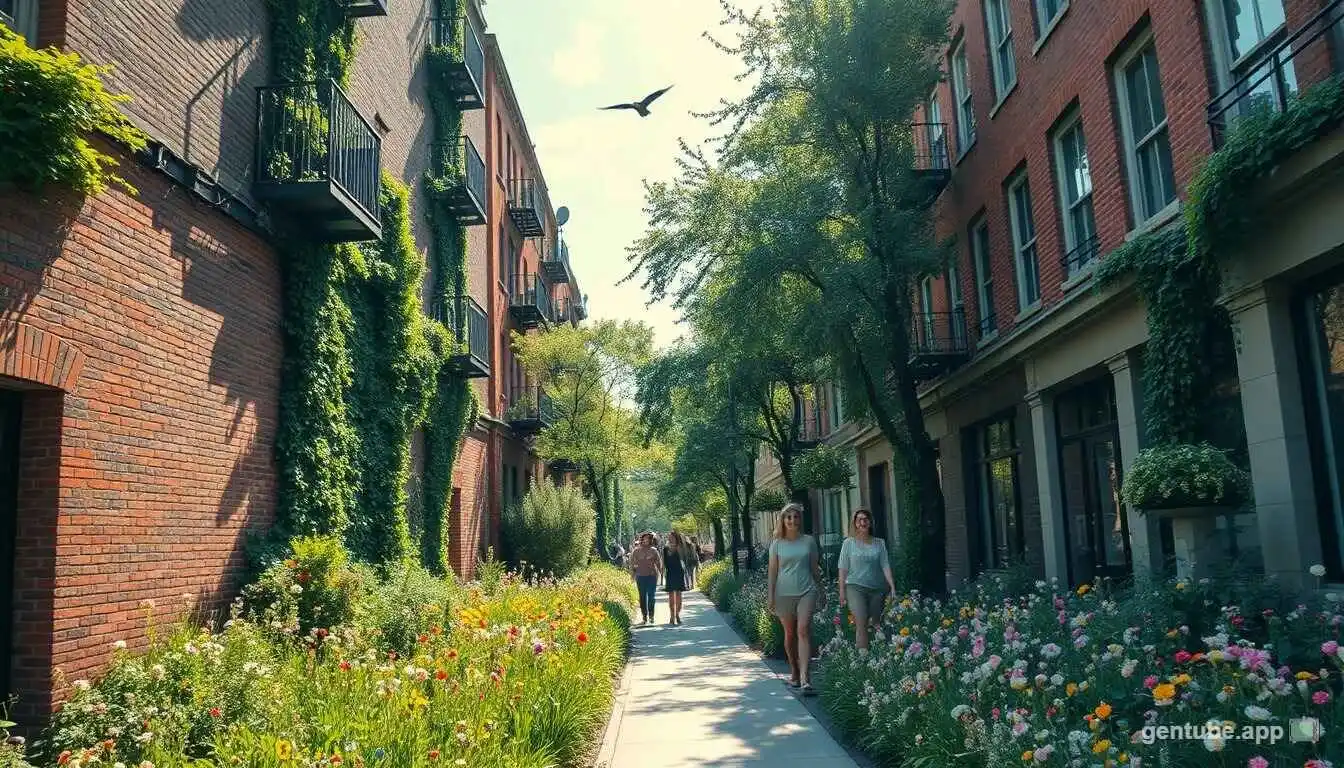
The Concrete Jungle Wakes Up: The Sound of Silence in the City
Have you ever stopped to listen to the wind? Not the rush of traffic, not the hum of the air conditioner, but the actual wind moving through leaves? I remember standing on a rooftop in downtown Chicago, twenty years ago, during the early days of my career as an ecologist. It was November. The city was a grid of gray steel and glass, hard angles against a hard sky. The air smelled of diesel and cold pavement. I was cold, tired, and feeling that specific kind of urban isolation that creeps into your bones when you are surrounded by millions of people but feel entirely alone.
But then, I saw it.
In the corner of a neglected, abandoned lot next to the abandoned factory, something was green. Not the manicured, chemically-fed green of a corporate plaza, but a wild, chaotic, messy green. Grasses were pushing through cracks in the asphalt. Dandelions were growing in the shadows of brick walls. A single, gnarled oak tree, left behind when the lot was paved over, was holding its ground. And in its branches, a red-tailed hawk was nesting.
I sat down on a broken piece of concrete and just watched. The hawk didn’t care about the stock market. The grass didn’t care about my deadlines. They just were. They were alive, thriving in the cracks of our human-made world. That moment changed me. It taught me that nature is not something we go to visit; it is something we are part of, even here, even in the heart of the concrete jungle. It is resilient. It is patient. And it is waiting for us to let it back in.
This is not just about planting flowers. This is about changing the soul of our cities. This is about Urban Rewilding: Bringing Nature Back to Cities.
Introduction: A Personal Journey into the Wild City
I have spent the last decade walking the edges of cities, from the streets of London to the back alleys of Tokyo, from the rooftops of New York to the riverbanks of Berlin. I have seen cities trying to force nature into submission—trimming trees into perfect spheres, paving over wetlands to build parking lots, and treating grass as a flat, green carpet to be mowed into oblivion.
But I have also seen the other side. I have seen neighbors in Detroit turning vacant lots into community food forests. I have seen engineers in Singapore letting vines take over skyscrapers. I have seen children in Seoul discovering that the concrete canyons are home to foxes and badgers.
This blog post is born from those walks. It is born from the mud on my boots and the dirt under my fingernails. It is born from the belief that our cities are not dead places. They are living ecosystems, just like any other. We have just forgotten how to look.
When we talk about Urban Rewilding: Bringing Nature Back to Cities, we are not talking about turning New York City into a rainforest. We are not talking about chasing away the humans. We are talking about creating a balance. We are talking about inviting the wild back into our daily lives. We are talking about healing the disconnect between the human heart and the natural world.
I remember a day in Berlin’s Tempelhof Field. The old airport had been turned into a massive public park. There were no fences. No rules. Just open space. People flew kites, rode bikes, and played football. But if you walked to the edges, you would see the dandelions and the clover growing tall. You would hear the buzz of bees. It was a place where humans and nature coexisted without a barrier. It felt like freedom. That is the feeling we are aiming for. That is the promise of urban rewilding.
What is Urban Rewilding: Bringing Nature Back to Cities?
So, what exactly is Urban Rewilding: Bringing Nature Back to Cities?
At its simplest, rewilding is the process of restoring natural processes and wildlife populations to an area. In the countryside, this often means bringing back wolves to Yellowstone or beavers to Scottish rivers. In the city, it looks different, but the principle is the same.
Urban Rewilding is the practice of allowing nature to take its course in urban environments, rather than strictly controlling it. It involves:
- Reducing Human Intervention: Instead of mowing every lawn every week, we let the grass grow. Instead of spraying every weed, we accept that “weeds” like dandelions are food for pollinators.
- Restoring Native Species: Planting trees, shrubs, and flowers that are native to the region, rather than exotic ornamentals that require constant care.
- Creating Habitats: Building spaces for wildlife to live, breed, and feed. This includes bird boxes, bee hotels, and small ponds.
- Connecting Fragmented Spaces: Linking parks, gardens, and green roofs so that animals and plants can move freely through the city.
It is not about chaos. It is about diversity. A monoculture lawn is a desert for insects. A wild meadow is a paradise.
Urban Rewilding: Bringing Nature Back to Cities is a movement that challenges the traditional idea of the city as a place of order and control. It argues that cities are more resilient, more healthy, and more beautiful when they embrace the messiness of nature.
Think about it. Why do we feel stressed in a sterile, concrete lobby? Why do we feel calm in a forest? Our brains are wired for nature. We need the fractal patterns of leaves, the smell of damp earth, the sound of running water. Urban rewilding brings those elements into our daily lives. It reduces stress, improves air quality, and cools down our overheating cities.
The Origin and Evolution of Urban Rewilding
To understand where we are going, we must look at where we came from. The concept of rewilding started in the late 20th century, primarily in large, wild places. Conservationists like Michael Soulé and Dave Foreman coined the term in the 1980s, focusing on restoring apex predators and large-scale ecological processes in national parks.
But the idea of bringing nature back to cities has an older history. In the 19th century, the Garden City movement in England proposed integrating nature into urban planning. In the 1960s, Rachel Carson’s Silent Spring alerted the world to the dangers of pesticides, sparking a movement to protect wild spaces.
In recent decades, the concept has evolved. We have moved from “greening” cities—just adding more trees and grass—to “rewilding” them—restoring ecological function.
Key Milestones in Urban Rewilding:
- 1970s: The rise of community gardens in New York and other cities, where residents reclaimed vacant lots to grow food and flowers.
- 1990s: The development of green roofs in Germany, showing that buildings could support plant life.
- 2000s: The emergence of “rewilding Europe” projects, which began applying rewilding principles to urban and peri-urban areas.
- 2010s-Present: The global spread of urban rewilding initiatives, from the “15-minute city” concept in Paris to the vertical forests of Milan.
The types of urban rewilding vary based on the context:
- Passive Rewilding: Leaving an area alone and letting nature take its course. Examples include abandoned lots, railway embankments, and post-industrial sites.
- Active Rewilding: Deliberately planting native species and introducing wildlife. Examples include creating wetlands, building bird nests, and planting wildflower meadows.
- Retrofitting: Integrating nature into existing infrastructure. Examples include green walls, pocket parks, and tree-lined streets.
Each type has its own benefits and challenges. Passive rewilding is low-cost and low-maintenance, but it can look messy to those used to order. Active rewilding is more structured and predictable, but it requires more labor. Retrofitting is essential for dense cities where space is limited.
The goal is always the same: to create a city that is alive. A city where humans and nature are not enemies, but partners.
The Heartbeat of the City
The Importance and Role in the Ecosystem
Why does Urban Rewilding: Bringing Nature Back to Cities matter? Why should we care about dandelions in the sidewalk or bees in the balcony?
The answer is simple: We need them to survive.
Cities are islands of heat, air pollution, and concrete. They are hostile environments for many species, and for humans, too. Urban rewilding turns these hostile islands into oases.
- Climate Regulation
Cities are hotter than the surrounding countryside. This is known as the Urban Heat Island effect. Concrete and asphalt absorb heat during the day and release it at night. Trees and plants cool the air through evapotranspiration. A single large tree can provide the cooling effect of ten home air conditioners. Rewilding creates a network of green corridors that break up the heat islands, making cities more livable during heatwaves. - Air and Water Quality
Plants are natural filters. They filter out particulate matter, nitrogen oxides, and sulfur dioxide from the air. They also absorb carbon dioxide, helping to mitigate climate change. When it rains, green spaces absorb water, reducing the risk of flooding. Concrete surfaces shed water quickly, overwhelming drainage systems. Wild soils act like sponges, slowing down runoff and filtering pollutants before they reach rivers. - Biodiversity Hotspots
Cities can be rich in biodiversity. Birds, insects, mammals, and plants find shelter in our cities. Rewilding provides the food and habitat they need. For example, native wildflowers provide nectar for bees and butterflies. Native trees provide seeds and berries for birds. Rewilding connects these habitats, allowing species to move and interact. This increases genetic diversity and makes the ecosystem more resilient. - Human Health and Well-being
There is a profound connection between humans and nature. Studies show that exposure to green spaces reduces stress, anxiety, and depression. It improves mental clarity and boosts creativity. Children who play in natural environments develop better motor skills and social skills. Rewilding brings these benefits to everyone, not just those who can afford access to parks. It makes nature accessible to all. - Social Cohesion
Green spaces are social hubs. They bring people together. Community gardens, wild parks, and street trees create opportunities for interaction. They foster a sense of place and community. When people care for their local green space, they care for each other. Rewilding is not just an ecological act; it is a social act.
Real-Life Case Study: The High Line and the Power of Post-Industrial Rewilding
Let’s talk about the High Line in New York City. It is perhaps the most famous example of urban rewilding, though it is also controversial.
The High Line is a 1.45-mile-long elevated freight line on Manhattan’s West Side. Built in 1934, it was abandoned in 1980. For decades, it stood empty, a rusting skeleton of steel and concrete, overgrown with weeds and grasses.
In 2004, two neighbors, Joshua David and Robert Hammond, founded the High Line Park. They didn’t want to demolish the structure. They wanted to preserve it and turn it into a park. They hired landscape architects James Corner Field Operations and planting designer Piet Oudolf.
Their approach was a form of active rewilding. They preserved the existing vegetation that had grown wild on the structure. They planted new native species that were adapted to the harsh conditions of the rooftop: strong winds, limited soil depth, and intense sun. The result is a garden that looks wild but is carefully curated.
The High Line has transformed the neighborhood. It has attracted millions of visitors, boosted local businesses, and inspired similar projects around the world. It has shown that a piece of industrial infrastructure can be turned into a living, breathing ecosystem.
However, it has also faced criticism. Some argue that it is too manicured, too expensive, and has contributed to gentrification. It is not a perfect example of rewilding, but it is a powerful one. It proves that nature can thrive in the most unexpected places.
Another example is the Cheonggyecheon Stream in Seoul, South Korea. In the 1950s, the stream was covered by a highway to accommodate the city’s growing car population. The area below was dark, polluted, and congested. In 2003, the city decided to remove the highway and restore the stream.
The result was stunning. The water flowed clear again. Trees and plants lined the banks. Birds returned. The temperature in the area dropped by several degrees. The stream became a popular public space, connecting communities and revitalizing the city.
These case studies show that Urban Rewilding: Bringing Nature Back to Cities is not just a theory. It is a practical, effective solution to urban problems.
Interesting Facts About Urban Nature
Let’s pause for a moment to appreciate the wonder of it all. Here are some facts that might surprise you:
- Foxes in London: London is home to over 40,000 foxes. They thrive in the city because of the abundance of food in gardens and bins. They have adapted to live alongside humans, often coming out at night to scavenge.
- Bees in Paris: Paris has over 200 hives in city parks. The honey produced is unique, reflecting the diverse flora of the city. It is a testament to the biodiversity of the urban environment.
- Trees in New York: New York City has nearly 6 million trees. They remove 1,200 tons of air pollution each year and absorb 10,000 tons of carbon dioxide.
- Wolves in Rome: In the 1990s, a pack of wolves moved into Rome. They live in the parks and suburbs, coexisting with humans. They are a reminder that nature is always with us, even when we don’t see it.
- Birds in Skyscrapers: Many birds nest in skyscrapers. Peregrine falcons, for example, have adapted to nest on the ledges of tall buildings, mimicking their natural cliff habitats. They hunt pigeons and starlings in the city air.
These facts show that nature is resilient. It finds a way. It adapts. And it enriches our lives in ways we often overlook.
The Challenges and the Path Forward
Threats and Challenges to Urban Rewilding
It is not all roses and daisies. There are significant challenges to Urban Rewilding: Bringing Nature Back to Cities.
- Gentrification
One of the biggest risks of urban rewilding is that it can lead to gentrification. When a neighborhood becomes greener and more attractive, property values rise. This can displace the very communities that lived there for generations. The High Line in New York is a prime example. The park made the area desirable, leading to rising rents and the displacement of low-income residents. We must ensure that rewilding benefits everyone, not just the wealthy. - Lack of Space
Cities are dense. Space is expensive. Finding large, contiguous areas for rewilding is difficult. We often have to work with small, fragmented patches of land. This can limit the biodiversity that can be supported. We need creative solutions, like green roofs, vertical gardens, and street trees, to make the most of every inch. - Maintenance and Cost
While rewilding can be low-maintenance in the long run, the initial setup can be expensive. Planting native species, building habitats, and designing green spaces require investment. Municipal budgets are often tight. We need to show that the long-term benefits—reduced energy costs, improved health, increased property values—justify the initial cost. - Human-Wildlife Conflict
As we bring nature back, we may see more wildlife. This can lead to conflicts. Raccoons in trash cans, deer in gardens, or wasps in picnic areas can annoy residents. We need to educate people about how to coexist with wildlife. We need to design spaces that minimize conflict, such as secure trash bins and buffer zones. - Climate Change
Climate change is altering the conditions in cities. Heatwaves are becoming more frequent, and rainfall patterns are changing. Native species may not be adapted to these new conditions. We need to be flexible and adaptive in our rewilding efforts, choosing species that are resilient to climate change.
Comparison Table: Traditional Landscaping vs. Urban Rewilding
To understand the difference, let’s look at a comparison between traditional landscaping and urban rewilding.
| Feature | Traditional Landscaping | Urban Rewilding |
| Goal | Aesthetics, order, control | Biodiversity, resilience, function |
| Plant Diversity | Low (monocultures, exotic species) | High (native species, meadows) |
| Maintenance | High (mowing, watering, spraying) | Low (once established) |
| Water Use | High (irrigation) | Low (rainwater harvesting) |
| Pesticides | Frequent use | Minimal or none |
| Wildlife | Limited | Abundant |
| Appearance | Manicured, uniform | Wild, diverse, seasonal |
| Cost | High ongoing labor | High initial, low ongoing |
| Carbon Footprint | High (machinery, transport) | Low (local materials) |
This table shows that rewilding is not just a different look; it is a different way of thinking. It shifts the focus from human desire to ecological health.

