

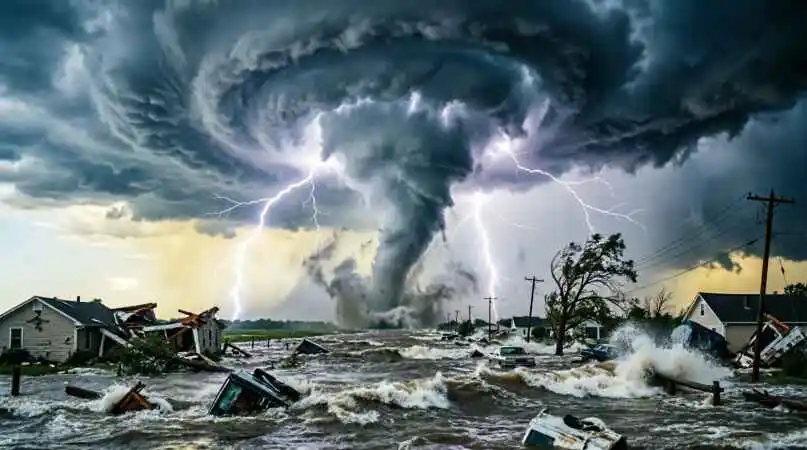
It is easy to look at the sheer scale of natural disasters and feel hopeless. The Earth is vast, its forces are primal, and our structures seem fragile by comparison. But the story of humanity is not one of perpetual victimhood; it is a story of profound resilience.
When the earth stops shaking, when the waters recede, and when the fires are extinguished, something miraculous happens. People don’t just rebuild; they adapt.
We see this in the seismic retrofitting of bridges in California. We see it in the massive seawalls constructed in Japan. We see it in the community-driven fire brigades in Australia and the mangrove restoration projects in Indonesia.
Every disaster leaves a scar, but it also leaves a lesson. We learn to respect the fault lines. We learn to give the river room to flood. We learn that nature is not our enemy to be conquered, but a powerful roommate whose moods we must learn to anticipate and accommodate.
Natural disasters are the planet’s way of reminding us that we are not apart from nature, but a part of it. The ground will shake again. The storms will spin. The fires will burn. But through science, preparation, and an unyielding will to survive, we will continue to rise from the ruins, rebuilding our world to be stronger, smarter, and more harmonious with the wild planet we call home.
FAQS
1.What causes an earthquake?
Earthquakes are caused by the sudden release of built-up energy when tectonic plates, which constantly jostle for position, suddenly snap past each other after being locked by friction.
- What are P-waves and S-waves?
P-waves (Primary waves) arrive first during an earthquake and compress and expand the ground like an accordion. S-waves (Secondary waves) follow and move up and down and side to side, causing the most structural damage.
- What is soil liquefaction?
Soil liquefaction occurs when violently shaken, water-saturated sandy soil loses its friction and behaves like a thick liquid, causing heavy buildings to sink and lighter underground structures to float to the surface.
- Why were the fires in the 1906 San Francisco earthquake so devastating?
The initial earthquake broke gas mains, which ignited fires. Because the city was largely built of wood, and the earthquake had destroyed the water pipes needed to fight the fires, the blazes burned uncontrollably for three days.
- How is a tsunami generated? A tsunami is created by a massive displacement of the entire water column, usually triggered by an underwater earthquake, volcanic eruption, or landslide.
- Why are tsunamis hard to spot in the open ocean?
In the deep ocean, a tsunami might only be a few feet high. Because it affects the entire water column, it doesn’t look like a towering wave on the surface, and ships can sail right over it without noticing.
- How fast does a tsunami travel in the open ocean?
In the deep ocean, a tsunami can travel at the speed of a jet airliner, up to 500 miles per hour.
- Why does the ocean water retreat before a tsunami hits?
The trough (the lowest part) of the tsunami wave often reaches the shore before the crest (the highest part). This pulls water away from the coast, exposing the seafloor before the massive wave strikes.
- Is the first wave of a tsunami the biggest?
No. A tsunami is a series of waves, and the first wave is rarely the largest. The subsequent waves can be much larger and more destructive.
- What was the significance of the 2004 Indian Ocean Tsunami?
It killed over 230,000 people across 14 countries because there was no early warning system in the Indian Ocean at the time. The disaster spurred the creation of a comprehensive warning system for the region.
- What is the difference between a hurricane, typhoon, and cyclone?
They are the same weather phenomenon. The name depends on the ocean where they form: hurricanes in the Atlantic/Northeast Pacific, typhoons in the Northwest Pacific, and cyclones in the South Pacific/Indian Ocean.
- What fuels a hurricane?
Hurricanes are massive heat engines powered by warm, moist air over tropical oceans. As warm air rises and condenses into clouds, it releases latent heat that fuels the storm further.
- What is the “eye” of a hurricane?
The eye is a circular area of calm, clear skies at the very center of the storm, surrounded by the eyewall where the most severe weather occurs.
- What is the deadliest part of a hurricane?
Water. Storm surges—where the hurricane’s winds and low pressure push a dome of ocean water onto the shore—are the most lethal hazard, not the high winds.
- Why was Hurricane Katrina so catastrophic?
While the storm was powerful, the real devastation occurred because the levee system in New Orleans failed, flooding 80% of the city and exposing massive flaws in infrastructure and emergency response.
- What causes a volcano to erupt?
Magma rises from deep in the Earth toward the surface. As it rises, dissolved gases (like water vapor and carbon dioxide) form bubbles. The expansion of these gases creates the pressure that drives the eruption.
- What is the difference between an effusive and an explosive eruption?
Effusive eruptions involve runny magma where gas escapes easily, resulting in gentle, oozing lava flows. Explosive eruptions involve thick, viscous magma that traps gas until the pressure causes a catastrophic explosion.
- What is a pyroclastic flow?
It is the deadliest volcanic hazard: a ground-hugging avalanche of hot ash, pumice, rock fragments, and volcanic gases that rushes down the side of a volcano at speeds up to 450 mph and temperatures over 1,800°F.
- How did the victims of Pompeii die in 79 AD?
Modern forensics shows they were not suffocated by ash, but killed instantly by the extreme heat of pyroclastic surges, which vaporized their brains and boiled their blood.
- What is a lahar?
A lahar is a destructive volcanic mudflow composed of pyroclastic material, rocky debris, and water. They flow down river valleys and harden like concrete once they stop.
- What is the main driving force behind a landslide?
Gravity is the driving force, pulling material down a slope. However, landslides are usually triggered by water saturation, which adds weight and reduces friction, or by earthquakes.
- How did the Armero tragedy in 1985 happen?
A volcanic eruption melted glaciers on the Nevado del Ruiz volcano in Colombia, generating massive lahars that buried the town of Armero in the middle of the night, killing over 20,000 people.
- Why are megafires becoming more common?
A century of aggressive fire suppression has allowed dead underbrush to build up. Combined with prolonged droughts and rising temperatures from climate change, forests have become overgrown tinderboxes.
- What is a pyrocumulus cloud?
It is a massive cloud of smoke and ash generated by the immense heat of a megafire. The updraft is so strong it creates its own weather and can spark lightning, igniting new fires miles away.
- How is climate change acting as a “threat multiplier” for natural disasters?
Climate change isn’t creating new hazards, but it is putting them on steroids. Warmer oceans fuel stronger hurricanes, warmer air holds more moisture causing worse floods, and shifting patterns exacerbate droughts.
- Why are natural disasters considered a “human construct”?
Natural hazards (like earthquakes) are geological events. They only become “disasters” when they strike densely populated, poorly constructed, or vulnerable human settlements.
- How does environmental degradation worsen disasters?
Destroying natural defenses—like cutting down mangrove forests (which buffer storm surges) or deforesting hillsides (which hold soil in place)—removes nature’s protection and guarantees worse damage.
- How do earthquake early warning systems work?
Sensors detect the harmless, fast-moving P-waves and send an alert to smartphones before the damaging, slower S-waves arrive. This gives people seconds to take cover and automated systems to shut off gas lines.
- What is base isolation in building construction?
It is a technique where buildings are constructed on flexible pads or bearings. When the ground shakes, the base moves, but the building above stays relatively stationary, similar to a building on roller skates.
- What is “optimism bias” in relation to disaster preparedness?
It is the psychological belief that bad things happen to other people, not us. This bias prevents people from preparing go-bags, making evacuation plans, or taking warnings seriously.
Disclaimer: The content on this blog is for informational purposes only. Author’s opinions are personal and not endorsed. Efforts are made to provide accurate information, but completeness, accuracy, or reliability are not guaranteed. Author is not liable for any loss or damage resulting from the use of this blog. It is recommended to use information on this blog at your own terms.
Keywords: Natural disasters ,Earthquakes, Tsunamis, Hurricanes ,Volcanic eruptions, Landslides, Droughts ,Climate change, Disaster, preparedness, Tectonic plates, Resilience
Hashtags: #NaturalDisasters #Earthquakes #Tsunami #Hurricanes #Volcanoes #Landslides #Wildfires #ClimateChange #DisasterPreparedness #TectonicPlates #Resilience

