

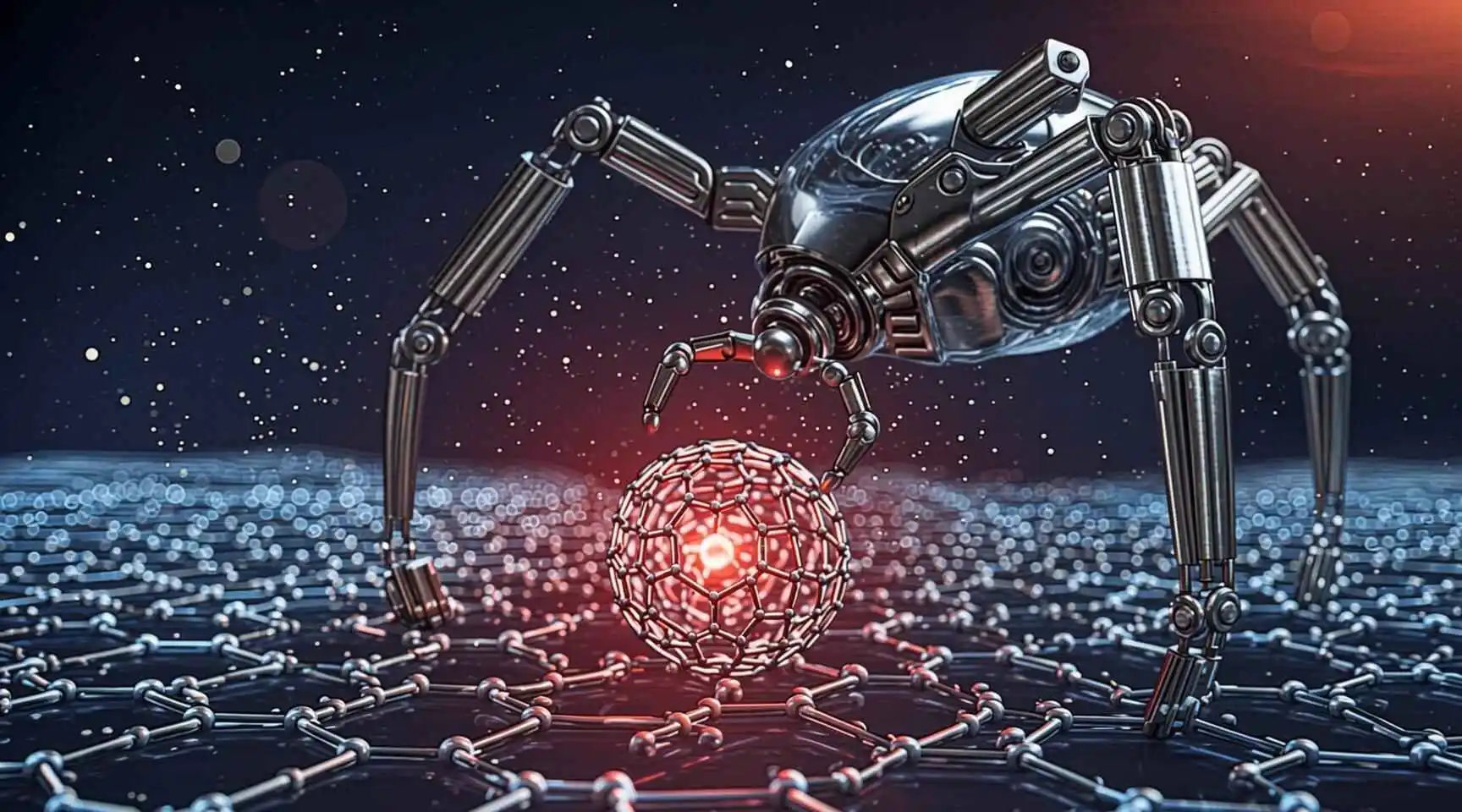
As we look to the horizon, the ultimate goal of nanotechnology is Molecular Manufacturing.
This concept, popularized by scientist K. Eric Drexler, proposes that we can build factories at the nanoscale. Instead of casting metal in a furnace and cutting it down, we would “grow” products atom by atom, like a biological cell grows a leaf.
In this future, you wouldn’t buy a pair of shoes from a store. You would download a file, and a “nanofactory” in your home would assemble the shoes from raw molecular feedstock (carbon, hydrogen, oxygen, etc.).
This would lead to:
- Zero Waste: We only use the atoms we need.
- Post-Scarcity: Goods become incredibly cheap to produce.
- Radical Customization: Products can be tailored to your specific biology or preferences at the molecular level.
We are still decades away from this level of sophistication, but the roadmap is clear. We are moving from discovering nanomaterials to manipulating them, and eventually to programming them.
Conclusion: The Atomic Renaissance
Nanotechnology is more than just a branch of science; it is a fundamental shift in how we interact with the physical world. For millennia, humanity has worked with materials as we found them. We cut stone, we shaped wood, we smelted ore. We have been the “machines” carving the world.
Now, we are becoming the architects of the atom.
We are learning that the properties of matter are not fixed; they are a matter of arrangement. By rearranging the atoms of carbon, we can make a diamond or a pencil. By rearranging silicon, we can build a brain for a computer.
As we stand on the precipice of this atomic renaissance, we are faced with incredible opportunities and daunting responsibilities. We could cure diseases that have plagued us for centuries, clean up the mess we have made of our planet, and build machines that are currently the stuff of dreams.
But we must tread carefully. We must study the impact of these invisible giants on our health and our environment. We must ensure that the benefits of this technology are shared by all of humanity, not just the few.
The next time you see a water bead roll off a raincoat, or look at the vibrant screen of your phone, remember: you are seeing the magic of the nanoscale. The future isn’t big. It’s small. And it is going to change everything.
FAQS
- What is nanotechnology in simple terms?
Nanotechnology is the branch of science and engineering dedicated to understanding and manipulating matter at the atomic and molecular scale, typically between 1 and 100 nanometers.
- Exactly how small is a nanometer?
A nanometer is one-billionth of a meter. To put it in perspective, a human hair is approximately 80,000 to 100,000 nanometers wide.
- Why do materials behave differently at the nanoscale?
At the nanoscale, the laws of quantum mechanics start to dominate over classical physics. This leads to changes in physical, chemical, and optical properties, such as gold becoming red or carbon becoming incredibly strong.
- Who first proposed the idea of nanotechnology?
The concept was famously introduced by physicist Richard Feynman in his 1959 lecture, “There’s Plenty of Room at the Bottom,” though the term “nanotechnology” was coined by Norio Taniguchi in 1974.
- What are carbon nanotubes used for?
Carbon nanotubes are used to strengthen materials (like concrete or tennis rackets), create lightweight electronics, and improve thermal conductivity due to their incredible strength and unique electrical properties.
- Why is graphene called a “wonder material”?
Graphene is a single layer of carbon atoms that is extremely strong, lightweight, transparent, and an excellent conductor of electricity and heat.
- How is nanotechnology used in medicine?
It is used for targeted drug delivery (sending medicine directly to cancer cells), regenerative medicine (scaffolds for tissue growth), and highly sensitive diagnostic tools (lab-on-a-chip).
- What are “nanobots”?
Nanobots are theoretical microscopic robots designed to perform specific tasks at the molecular level, such as performing microsurgery or unclogging arteries.
- Can nanotechnology cure cancer?
While not a “cure” in the traditional sense yet, nanotechnology allows for highly targeted chemotherapy that kills cancer cells with fewer side effects than traditional treatments.
- How does nanotechnology improve batteries?
By using nanomaterials like silicon nanowires in anodes, batteries can store more energy, charge much faster, and last longer.
- What is a “Quantum Dot”?
A quantum dot is a tiny semiconductor nanoparticle that glows with specific colors depending on its size when exposed to light. They are used in high-end TV displays (QLED) to produce pure, vibrant colors.
- Is modern sunscreen different because of nanotech?
Yes. Modern sunscreens use nanoparticles of zinc oxide or titanium dioxide, which are transparent (no white cast) but still effectively block UV rays.
- How can nanotechnology help solve the water crisis?
Nanotech can create advanced filtration membranes (like carbon nanotubes) that filter out salt and viruses much faster and more efficiently than traditional filters.
- What is the “Lotus Effect”?
The Lotus Effect refers to the superhydrophobic (water-repelling) properties of nanostructures on plant leaves, mimicked by nanotechnology to create self-cleaning fabrics and paints.
- What is “smart dust”?
“Smart dust” refers to tiny wireless microelectromechanical sensors (MEMS) that can detect light, temperature, or vibration, theoretically used for widespread surveillance or environmental monitoring.
- Are there health risks associated with nanoparticles?
Because they are so small, nanoparticles can enter the bloodstream and cross barriers like the blood-brain barrier. The long-term health effects are still being studied in the field of nanotoxicology.
- Can you see nanotechnology with a microscope?
No, standard light microscopes cannot see things at the nanoscale. Scientists use specialized tools like Scanning Tunneling Microscopes (STM) and Atomic Force Microscopes (AFM).
- How does nanotech relate to Moore’s Law?
As transistors in computer chips shrink to the nanoscale, nanotechnology allows us to continue Moore’s Law (doubling computing power) by using 3D stacking and new materials to overcome physical limits of silicon.
- What is nanoremediation?
Nanoremediation is the use of nanoparticles to clean up environmental pollution, such as using iron nanoparticles to break down toxic chemicals in groundwater.
- Will we be able to 3D print with nanotechnology?
Yes, molecular nanofactories (a form of 3D printing at the atomic level) are a theoretical future concept where we could build products atom by atom.
- Why does gold turn red at the nanoscale?
At the nanoscale, the interaction of light with gold particles changes due to surface plasmon resonance, causing them to reflect light in the red spectrum rather than yellow.
- How is nanotechnology used in the food industry?
It is used to create “smart packaging” that changes color if food spoils, and to add nanoparticles to food to improve texture without adding fat.
- What is the “Grey Goo” scenario?
It is a hypothetical doomsday scenario where self-replicating nanobots consume all biomass on Earth to fuel their replication, turning the planet into “grey goo.”
- Can nanotechnology make clothes stronger?
Yes, integrating nanofibers into fabrics can make them tear-resistant, waterproof, and stain-resistant without changing the feel of the material.
- What are aerogels?
Aerogels are lightweight, porous materials derived from gels, often using nanotechnology, that are excellent insulators and are sometimes called “frozen smoke.”
- How does nanotech affect drug half-life in the body?
Nanoparticles can protect drugs from being broken down by the body too quickly, allowing the medication to stay in the system longer and requiring fewer doses.
- Is nanotechnology expensive to produce?
Currently, research and production of high-quality nanomaterials can be expensive, but costs are expected to drop as the technology scales and becomes more widespread.
- What is the difference between “top-down” and “bottom-up” nanotech?
“Top-down” involves carving small structures out of large ones (like sculpting). “Bottom-up” involves building structures atom by atom or molecule by molecule (like stacking Lego blocks).
- How is nanotechnology used in sports equipment?
Tennis rackets, golf balls, and bicycles are often reinforced with carbon nanotubes to make them lighter, stronger, and more durable.
- What is the future of nanotechnology?
The future points toward molecular manufacturing (building complex products from scratch), advanced brain-computer interfaces, and widespread use in environmental sustainability and personalized medicine.
Disclaimer: The content on this blog is for informational purposes only. Author’s opinions are personal and not endorsed. Efforts are made to provide accurate information, but completeness, accuracy, or reliability are not guaranteed. Author is not liable for any loss or damage resulting from the use of this blog. It is recommended to use information on this blog at your own terms.

