

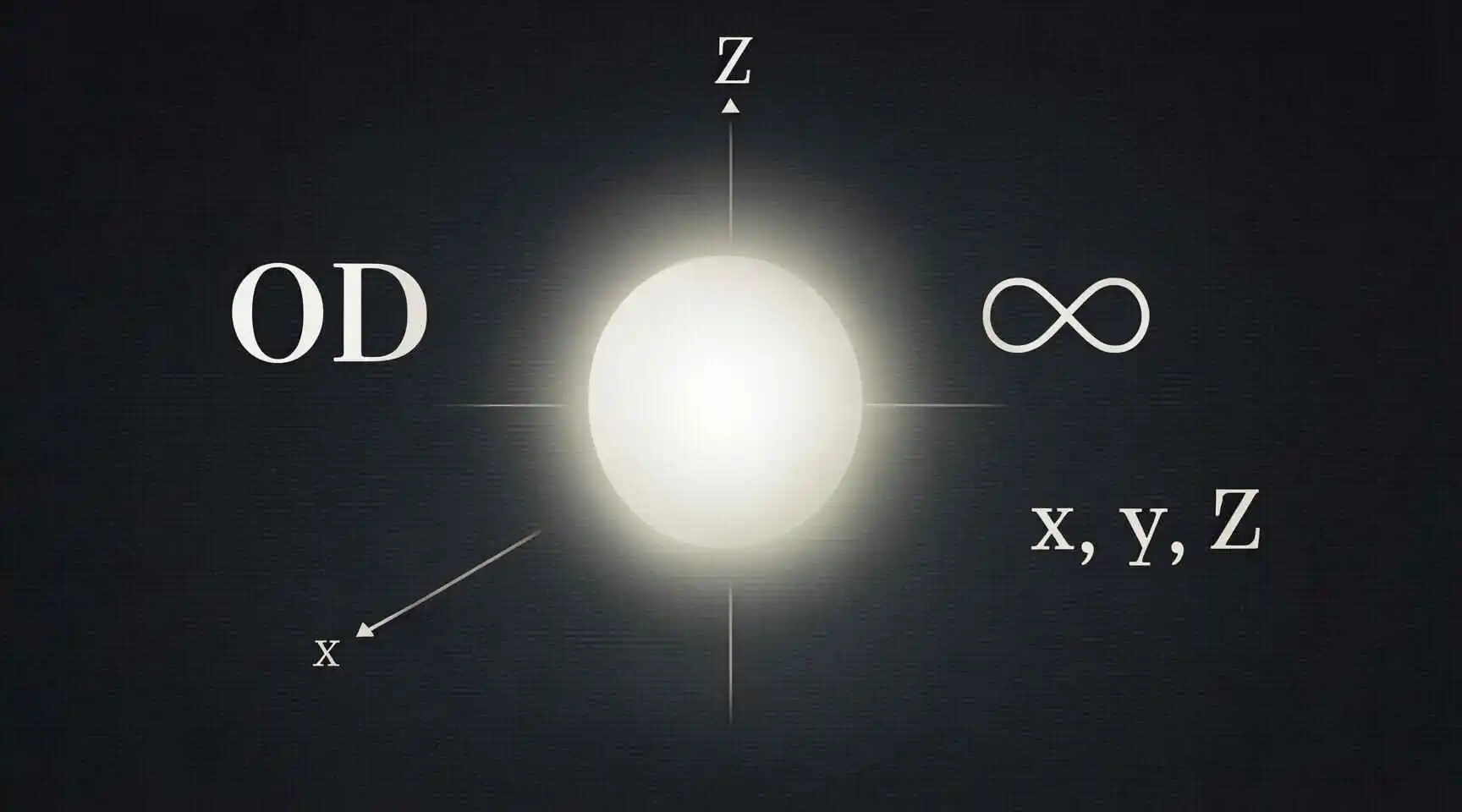
The Zero-Dimensional Universe: How the Humble Point Builds Reality
If I asked you to draw a dot on a piece of paper, you would likely pick up a pen and press the tip against the page. What you would see is a small circle of ink, perhaps a millimeter or two wide. It has a shape, a size, and a color.
But in the strict eyes of a mathematician, what you drew is not a point.
It is a blot. It is a circle. It is a physical object. A true mathematical point has no size. It has no width, no length, no depth. It has no inside and no outside. It is infinitely small—smaller than an atom, smaller than a photon, smaller than the Planck length. It is, effectively, nothing.
And yet, this “nothing” is the absolute bedrock of the universe. It is the seed from which all geometry grows, the anchor for every coordinate system, and the ghost that haunts the equations of modern physics.
In this exploration, we are going to zoom in—far past the limits of microscopes, past the limits of physics, and into the realm of pure abstraction—to understand the Point. We will trace its history from the ancient Greeks to the digital pixels on your screen. We will see how this zero-dimensional entity creates dimensions, how it defines infinity, and why understanding the point is the key to understanding reality itself.
Part 1: The Paradox of “That Which Has No Part”
The journey begins in ancient Greece, around 300 BCE, with a mathematician named Euclid. Euclid wrote The Elements, a series of books that served as the geometry textbook for the world for over 2,000 years.
Right at the very beginning, Euclid attempts to define the building blocks of his reality. His first definition is famously cryptic:
“A point is that which has no part.”
It’s a phrase that stops you in your tracks. How can something exist if it has no parts? How can you hold it, see it, or measure it?
For the Greeks, this was a profound philosophical struggle. They loved the idea of perfection, but they lived in a messy physical world. They realized that if you take a physical line segment and cut it in half, and then cut that half in half, and keep cutting, you can theoretically do that forever. But where does it end? Does it eventually become a “point” that cannot be cut further?
If that point has any size at all, you could cut it again. Therefore, the ultimate piece of matter must have zero size.
But if you add up an infinite number of things that have zero size… do they make a line? Or do you still just have nothing? This is the paradox of the point. It is the atom (in the original Greek sense of atomos, meaning “uncuttable”) of geometry. It is the ghost at the feast of reality. We cannot see it. We cannot draw it. We can only imagine it. And yet, without accepting that “location” is distinct from “object,” mathematics cannot exist. The point represents the idea of Pure Location. It is a “where,” not a “what.”
Part 2: The Cartesian Revolution – Giving the Point an Address
For nearly two millennia, the point remained a philosophical abstraction. Geometry was done with rulers and compasses, and points were just places where lines crossed.
Then, in the 17th century, a French philosopher and mathematician named René Descartes was lying in bed, watching a fly buzz around the corner of his room. He wondered: How can I describe exactly where that fly is at any given moment?
He realized he could describe the fly’s position by measuring its distance from the walls. From this simple observation, the Coordinate System was born.
Descartes merged the world of Algebra (numbers and equations) with the world of Geometry (shapes and space). He took the “point”—that featureless “that which has no part”—and gave it an address.
Suddenly, a point wasn’t just a dot on a page; it was a pair of numbers: (2,3) or (5,−7) . This was a revolution in human thought. It meant that any shape could be described as a list of numbers. A line became a relationship between x and y . A circle became an equation involving squares.
This is the birth of Coordinates. Before this, geometry was visual and static. After Descartes, geometry became dynamic and calculable. We could now use math to navigate the world. When you look at a GPS on your phone, turning your longitude and latitude (which are just points on a sphere) into a route on a map, you are using the intellectual legacy of Descartes.
The point, which had no parts, suddenly possessed infinite data. It became the bridge between the abstract world of numbers and the physical world of space.
Part 3: Dimensions and the Architecture of Space
Why do we care so much about points? Because points are the bricks we use to build the universe.
In standard Euclidean geometry, space is constructed hierarchically, like a Lego set:
- 0 Dimensions: A Point. It has no size. It only indicates a position.
- 1 Dimension: If you move a point along a path, it traces a Line. A line has length but no width.
- 2 Dimensions: If you drag a line sideways, it sweeps out a Plane. A plane has length and width but no thickness (like a sheet of paper with zero depth).
- 3 Dimensions: If you lift a plane up, it sweeps out a Space (or Volume). This is the world we live in—height, width, and depth.
But math doesn’t stop there. We can continue this logic. A point is the generator of all dimensions.
In modern data science and theoretical physics, we talk about 4th, 5th, or even 1,000th dimensions. It sounds like science fiction, but mathematically, it’s just adding more coordinates to a point.
- A point in 2D is (x,y) .
- A point in 3D is (x,y,z) .
- A point in 4D is (x,y,z,w) .
We can’t visualize a 4D point, but we can calculate it perfectly. This is how computers “think.” When a computer processes a complex image, it doesn’t see a picture; it sees a massive cloud of points in a high-dimensional space, each representing a pixel’s color, brightness, and contrast.
Every shape in the universe—from the pyramids of Giza to the orbit of the moon—is fundamentally a collection of points held together by rules. The point is the atomic dust of the cosmos.
Part 4: The Point in Physics – The Singularity Problem
While mathematicians love points, physicists often have a love-hate relationship with them. In physics, we treat particles like electrons and quarks as “point particles.” We assume they take up literally zero space.
This is mathematically convenient, but it leads to catastrophic problems.
Consider the concept of Density. Density is Mass divided by Volume.
D=VM
If an electron is a true point, its Volume ( V ) is zero. If you divide a non-zero mass by zero, you get Infinity.
This implies that the density of an electron is infinite. This creates a “singularity”—a point where the laws of physics break down. Gravity becomes infinite. The curvature of space-time becomes infinite. It’s a mathematical nightmare.
We see this most dramatically at the center of a Black Hole. According to General Relativity, a black hole collapses until all its mass is crushed into a single point—a singularity. At this point, space and time cease to have meaning.
This suggests that the “mathematical point” might be too perfect for the physical universe. Nature might have a limit to how small things can get (perhaps the Planck length). The mathematical point ( 0 size) might be a useful approximation, but reality might be made of “fuzzy” points or “strings” (as in String Theory) rather than zero-dimensional dots.
Nevertheless, the point remains our best model. It is the zero against which we measure the universe.
Part 5: Calculus – The Point of No Return
If geometry is the study of static points, Calculus is the study of moving points.
Before Isaac Newton and Gottfried Wilhelm Leibniz invented calculus, math was good at describing things that stood still. But the universe is constantly in motion. How do you describe the speed of a car at the exact split second it passes a signpost?
You can’t just measure the distance traveled over an hour, because the car might speed up or slow down. You need to know the speed at that precise point in time.
This requires the concept of a Limit. In calculus, we imagine zooming in on a curve closer and closer and closer until the curve looks like a straight line. We are essentially analyzing the behavior of the function at a single point.
This brings us back to the paradox. How can a curve have a slope at a single point? A slope requires two points to define a “rise over run.” Calculus solves this by using “infinitesimals”—numbers that are infinitely close to zero but not quite zero. It’s a magical dance around the point.
The Derivative is the slope at a single point. The Integral is the accumulation of infinite points to find an area.
Calculus taught us that points aren’t just static dots; they are moments in time. They are instantaneous events. Every time you calculate the fuel efficiency of your car or the trajectory of a rocket, you are relying on the mathematics of points in motion.
Part 6: Topology – The Rubber Sheet Geometry
As mathematics advanced into the 20th century, a new field emerged called Topology. Topology is often called “rubber sheet geometry.”
In standard geometry, a square and a circle are different. But in topology, they are the same. Why? Because you can deform a square into a circle without tearing it.
Topology cares less about the distance between points and more about how points are connected.
This leads to some bizarre definitions of “points” in abstract spaces. For example, consider the Line with Two Origins. Imagine a number line, but at the position of zero, there are two distinct points sitting exactly on top of each other. They are different points (let’s call them
01 and 02 ) that share the same coordinate.
In the physical world, this is impossible. But in topological spaces, this is a valid construct. It allows mathematicians to study spaces that are “branched” or “twisted” in ways standard Euclidean geometry cannot handle.
Topology deals with Neighborhoods—the cloud of other points surrounding a specific point. It asks questions like: Is this point isolated from the others? Is it a limit point (a point where other points get infinitely close to it)?
Understanding points in this high-level, abstract way is crucial for modern physics, specifically in understanding the shape of the universe (is it flat? is it a sphere? is it a torus?). The arrangement of the points determines the reality of the space.
Part 7: Fractals – The Cantor’s Dust
Let’s return to the idea of the “point” being infinitely small. Is it possible to have a shape that is made entirely of points but has no length? Yes. It’s called a fractal, and the most famous example is the Cantor Set.
Imagine a line segment of length 1. Step 1: Remove the middle third. You are left with two line segments. Step 2: Remove the middle third of those segments. Step 3: Repeat this forever.
What happens after an infinite amount of time? You have removed “everything” in the sense that there is no continuous line segment left. The total length of the remaining set is zero.
However, the set is not empty.
There are still points left! Specifically, the points at the very ends of the segments (like 0, 1, 1/3, 2/3, etc.) remain. In fact, there are uncountably infinite points left. This “dust” is called the Cantor Set.
It is a mathematical object that proves that a collection of points can be more than the sum of their lengths. It has dimension zero (it’s just dust), yet there are as many points in this dust as there are in the entire real number line.
This concept blew the minds of mathematicians in the 19th century. It showed that the number line isn’t just a smooth stream of water; it’s a bizarre, complex structure of points within points.
Part 8: The Digital Point – Pixels and Vectors
We live in the Digital Age. When you look at your screen, you are looking at points. Thousands, millions, or billions of them.
In computer graphics, there are two ways to think about points:
- Raster (Pixels): The image is a grid of points. Every pixel is a tiny square (or rectangle) that has a specific color. If you zoom in too much, you see the grid. This is how JPEGs and photos work. It’s an approximation of reality using a finite number of points.
- Vector (Paths): The image is defined by mathematical points and the lines between them. The computer remembers “start at point A, curve to point B.” No matter how much you zoom in, the line remains perfect. This is how fonts and logos work.
This distinction is crucial for Data Visualization. When scientists want to visualize massive datasets—like the spread of a virus or the movement of stars—they plot points in a multi-dimensional space.
A single point on a graph can represent a person. The X-coordinate might be their age, the Y-coordinate their income, and the Z-coordinate their location. Color could represent their health status.
Suddenly, a “point” is no longer a dot of ink; it is a human being, a star, or a stock market transaction. We use the zero-dimensional point to capture complex, high-dimensional data.
Part 9: Floating Point Arithmetic – The Computer’s Point
There is a hidden danger in how computers handle points. Computers have limited memory; they cannot store an infinite number of decimal places.
In standard math, π goes on forever. In a computer, π has to stop.
3.1415926535…
Computers use a system called Floating Point Arithmetic. They store points using “scientific notation” (e.g., 3.14×100 ).
Most of the time, this is fine. But sometimes, when points get incredibly small or incredibly large, the computer runs out of bits. It rounds up or down. This is called Precision Error.
Think about the Patriot Missile failure during the Gulf War. The tracking system relied on measuring time in tenths of a second. But the computer used binary (0s and 1s), and 1/10 cannot be represented perfectly in binary. It’s a repeating number, like 1/3 is in decimal 0.333……
Over time, this tiny error in the “point” of time accumulated. The tracking system was off by a fraction of a second, which translated to being off by hundreds of meters. The missile missed its target.
This is a stark reminder that while mathematical points are perfect, digital points are approximations. In the world of engineering, the point is often the place where errors occur.
Part 10: The Future – Points as Data Nodes
https://youtu.be/9t9MCi8rBfM

