

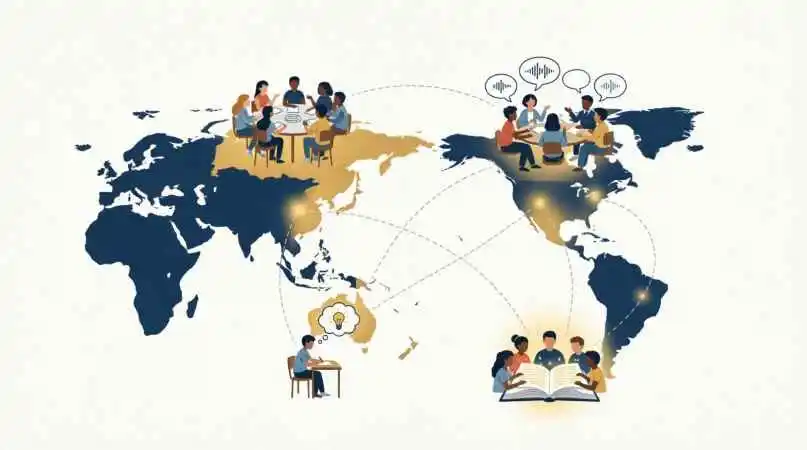
Perhaps the most fascinating insight to emerge from comparing global approaches to critical thinking isn’t simply which specific method works best, but what these different approaches reveal about how various cultures define the ultimate purpose of education itself. Individualist cultures often emphasize critical thinking as a tool for personal opinion formation and independent achievement. More collectivist cultures often frame it as a tool for collaborative problem-solving and social harmony. Nations with strong philosophical traditions, like France, treat it as a form of civic and moral responsibility.
None of these framings are inherently superior to the others; rather, they reflect deeply rooted cultural values about what it ultimately means to be a thoughtful, capable member of society. As global collaboration and cross-cultural communication become increasingly essential in both education and the workforce, understanding these different approaches offers valuable insight, not just into how people think, but into why they think the way they do.
Final Thoughts: A Universal Skill, Taught in Beautifully Diverse Ways
Critical thinking may be one of the closest things education has to a truly universal goal, yet the sheer diversity in how the world’s cultures cultivate this skill is a powerful reminder that there is no single “correct” path to becoming a thoughtful, reasoning individual. Whether through the rigorous philosophical debate of a French classroom, the collaborative discussion circles of a Japanese school, or the interdisciplinary exploration of a Finnish phenomenon-based lesson, students around the world are all ultimately working toward the same fundamental goal: learning to think clearly, question wisely, and reason well in an increasingly complex world.
As global challenges become more interconnected and information continues to grow more abundant and complex, this diversity of approaches may prove to be one of humanity’s greatest educational assets, offering a rich, varied toolkit of strategies that future educators and policymakers can continue to learn from, adapt, and blend across cultural boundaries.
FAQS
1.What exactly is critical thinking?
Critical thinking is the ability to analyze information objectively, question assumptions, evaluate evidence, and form well-reasoned judgments rather than accepting claims at face value or relying purely on emotion or authority.
2.Why do different countries teach critical thinking so differently?
Educational approaches to critical thinking are shaped by each country’s cultural values, history, philosophical traditions, and the overall goals of its schooling system, which is why methods can vary significantly from one nation to another.
3.Is critical thinking a Western concept?
No, while the term itself and much of its formal academic framing originated in Western philosophical traditions, questioning, reasoning, and reflective analysis have deep roots in many non-Western traditions, including Confucian, Islamic, and Indian philosophical schools.
4.How is critical thinking taught in the United States?
In the United States, critical thinking is often woven into subjects like English, social studies, and science through discussion-based learning, debate, essay writing, and assignments that ask students to evaluate multiple perspectives on an issue.
5.How is critical thinking taught in Finland?
Finland integrates critical thinking through a phenomenon-based learning approach, where students explore real-world topics across multiple subjects at once, encouraging them to connect ideas, ask questions, and think independently rather than memorize isolated facts.
6.How is critical thinking taught in Japan?
Japan often emphasizes critical thinking through collaborative problem-solving and structured group discussion, where students work together to analyze a problem from multiple angles before arriving at a shared conclusion.
7.How is critical thinking taught in Singapore?
Singapore has explicitly built critical thinking and inquiry-based learning into its national curriculum framework, encouraging students to ask probing questions and apply reasoning skills across mathematics, science, and humanities subjects.
8.How is critical thinking taught in the United Kingdom?
In the United Kingdom, critical thinking is often developed through essay writing, structured argumentation, and, particularly at the secondary level, dedicated critical thinking or philosophy courses that explicitly teach logical reasoning and argument evaluation.
9.Does China teach critical thinking in its classrooms?
Critical thinking is increasingly being incorporated into Chinese education, particularly in response to global education reforms, though traditional Chinese classrooms have historically placed more emphasis on memorization and mastery of foundational knowledge before analytical skills are introduced.
10.How is critical thinking taught in India?
India’s approach to critical thinking varies significantly between traditional rote-based schooling and newer progressive curricula, with more recent national education policy reforms placing growing emphasis on inquiry-based and experiential learning methods.
11.What role does the Socratic method play in teaching critical thinking?
The Socratic method, which involves teachers guiding students through a series of probing questions rather than simply delivering information, is widely used across many countries as a foundational tool for developing analytical and reflective thinking skills.
12.Are debate programs an effective way to teach critical thinking?
Yes, structured debate programs are widely regarded as highly effective, since they require students to research multiple sides of an issue, construct logical arguments, and respond critically to opposing viewpoints in real time.
13.How does philosophy education relate to critical thinking?
Philosophy education, which is a formal part of secondary schooling in countries like France, directly trains students in logical reasoning, argument analysis, and questioning underlying assumptions, making it one of the most direct academic pathways to critical thinking skill development.
14.Why is philosophy a mandatory subject in French high schools?
France has long viewed philosophy as essential to producing thoughtful, reasoning citizens, which is why it has been a compulsory subject for final-year high school students for well over a century, culminating in a rigorous written philosophy exam.
15.What is inquiry-based learning?
Inquiry-based learning is a teaching approach where students learn by asking questions, investigating problems, and drawing their own conclusions through exploration, rather than passively receiving information directly from a teacher or textbook.
16.How does rote memorization affect critical thinking development?
Heavy reliance on rote memorization, without complementary opportunities for analysis and application, can limit the development of critical thinking skills, since it emphasizes recalling information over evaluating, questioning, or applying it.
17.Can critical thinking be taught, or is it an innate trait?
Most educational researchers agree that critical thinking is a learnable skill that can be systematically developed through practice, structured instruction, and consistent exposure to reasoning-based tasks, rather than a fixed trait people either have or lack.
18.What is phenomenon-based learning?
Phenomenon-based learning, closely associated with Finland’s education system, organizes lessons around real-world topics or problems rather than separate subjects, encouraging students to apply reasoning and knowledge from multiple disciplines simultaneously.
19.How do international standardized tests measure critical thinking?
Assessments like the OECD’s PISA test increasingly include questions that measure applied reasoning and problem-solving rather than simple factual recall, reflecting a broader global shift toward valuing critical thinking as a measurable educational outcome.
20.Which countries perform best on international critical thinking or problem-solving assessments?
Countries such as Singapore, Finland, Estonia, and South Korea have consistently ranked highly on international assessments that measure applied reasoning and problem-solving skills, though rankings shift somewhat from year to year.
21.How does Confucian educational philosophy relate to critical thinking?
Confucian educational tradition places strong emphasis on discipline, respect for teachers, and mastery of foundational knowledge, which has sometimes been contrasted with more Western-style open questioning, though many contemporary East Asian systems now blend both approaches.
22.Does teaching critical thinking require a specific subject, or can it be integrated everywhere?
Most education experts agree that critical thinking is most effectively developed when integrated across multiple subjects, such as science, literature, and history, rather than being isolated into a single standalone class.
23.What is the role of teachers in fostering critical thinking?
Teachers play a central role by asking open-ended questions, encouraging respectful debate, modeling reasoning processes aloud, and creating classroom environments where students feel safe challenging ideas and each other’s assumptions.
24.How do project-based learning programs support critical thinking?
Project-based learning requires students to research, plan, evaluate options, and solve real or simulated problems over an extended period, naturally building critical thinking skills through sustained, applied practice.
25.Is technology helping or hurting critical thinking education?
Technology’s effect is mixed: tools like interactive simulations and research databases can strengthen critical thinking when used intentionally, while excessive passive content consumption or over-reliance on quick answers can potentially weaken independent reasoning if not balanced carefully.
26.How early should critical thinking be introduced in a child’s education?
Many educators argue that basic critical thinking skills, such as asking questions, comparing options, and explaining reasoning, can and should be introduced as early as preschool or early primary school, using age-appropriate activities.
27.What are some simple classroom activities that build critical thinking?
Common activities include structured debates, comparing multiple sources on the same topic, solving open-ended problems with more than one valid answer, and reflective writing that asks students to justify their reasoning.
28.How does critical thinking education differ between collectivist and individualist cultures?
In more individualist cultures, critical thinking is often taught with an emphasis on independent opinion formation and personal argumentation, while in more collectivist cultures, it is often taught with a greater emphasis on group consensus-building and considering the perspectives of others.
29.Are there global efforts to standardize how critical thinking is taught?
While there is no single global standard, international organizations and cross-country education research networks increasingly share best practices, and frameworks like those used in PISA assessments have encouraged some degree of alignment around core critical thinking competencies.
30.Why does the way we teach critical thinking matter for the future?
As students face an increasingly complex world filled with information overload, misinformation, and rapid technological change, strong critical thinking skills are widely considered essential for informed decision-making, civic participation, and long-term adaptability in both work and life.
Disclaimer: The content on this blog is for informational purposes only. The author’s opinions are personal and not endorsed. Efforts are made to provide accurate information, but completeness, accuracy, or reliability are not guaranteed. The author is not liable for any loss or damage resulting from the use of this blog. It is recommended to use the information on this blog at your own discretion.

