

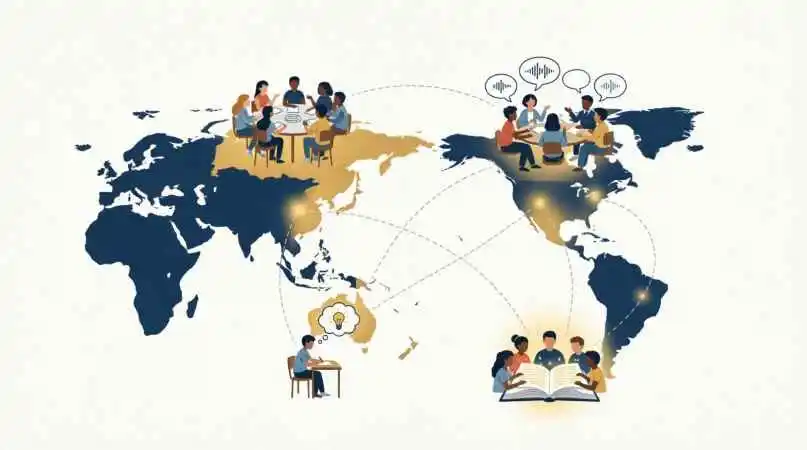
Thinking Across Borders: How Critical Thinking Is Taught Around the World
Ask a teenager in Paris to defend an argument, and they’ll likely reach for the structured logic of a philosophy essay, a skill drilled into French students for over a century. Ask a teenager in Helsinki the same question, and they might instead pull together threads from science, history, and ethics, having spent the semester exploring a single real-world phenomenon from every angle. Ask a student in Tokyo, and the answer might emerge not from a single voice, but from a carefully negotiated group consensus built through collaborative discussion.
Same underlying skill. Wildly different paths to get there.
Critical thinking, the ability to analyze, question, and reason through information rather than simply accepting it, is often treated as a universal, almost self-evident educational goal. Nearly every national curriculum on Earth claims to value it. Yet the way schools actually cultivate this skill varies dramatically depending on culture, history, philosophical tradition, and the broader purpose each society assigns to education itself.
This article takes a global tour through the fascinating, sometimes surprising ways different countries approach the teaching of critical thinking, from ancient philosophical roots to cutting-edge curriculum reforms, and explores what these differences reveal about how various cultures define a well-educated mind.
What Do We Actually Mean by Critical Thinking?
Before comparing global approaches, it helps to define the term itself, since critical thinking means slightly different things depending on who you ask. Broadly, it refers to the ability to objectively analyze information, question underlying assumptions, evaluate the strength of evidence, and construct well-reasoned conclusions rather than relying purely on intuition, authority, or emotional reaction.
This skill typically includes several interconnected components: the ability to identify bias, the capacity to weigh multiple perspectives, logical reasoning skills, the willingness to revise one’s own opinion in light of new evidence, and the ability to communicate a reasoned argument clearly. Educators generally agree these components can be taught and strengthened over time, much like a muscle, through consistent practice and the right kind of instructional environment.
What varies enormously from country to country isn’t the definition of critical thinking itself, but rather the pedagogical philosophy, cultural values, and classroom structures used to build it.
Ancient Roots: Where the Formal Idea of Critical Thinking Began
The formal, Western academic framing of critical thinking traces back to ancient Greece, particularly to Socrates, whose method of relentless questioning aimed to expose contradictions in a person’s reasoning and push them toward clearer, more justified beliefs. This approach, now known as the Socratic method, remains one of the most widely used critical thinking tools in classrooms around the world today, even far outside of Western philosophical traditions.
However, it’s a common misconception that structured reasoning and questioning are uniquely Western inventions. Long before and alongside Socratic philosophy, other civilizations developed their own rich traditions of formal reasoning and debate. Ancient Indian philosophical schools engaged in highly structured logical debate as far back as the first millennium BCE. Islamic scholars during the Golden Age of Islam made major contributions to formal logic, scientific reasoning, and structured argumentation. Confucian tradition, while often associated with respect for authority and hierarchy, also placed significant value on reflection, self-examination, and moral reasoning.
Understanding this broader, more global history helps explain why modern approaches to teaching critical thinking, while sharing a common underlying goal, look so different depending on which philosophical and cultural lineage a country’s education system draws from.
The United States: Discussion, Debate, and Independent Analysis
In the United States, critical thinking is generally woven throughout the curriculum rather than taught as an isolated subject. English and language arts classes frequently ask students to analyze texts, identify authorial bias, and construct persuasive essays defending a particular interpretation. Social studies classes often incorporate primary source analysis, asking students to compare conflicting historical accounts and draw independent conclusions.
Debate programs, both as extracurricular clubs and as classroom activities, are particularly prominent in American schools, and are widely credited with strengthening students’ ability to research multiple sides of an issue, construct logical arguments, and think quickly under pressure. The overall American approach tends to emphasize independent opinion formation, encouraging students to develop and defend their own personal viewpoint, even when it diverges from the perspectives of their teacher or peers.
Critics of the American approach sometimes point out that critical thinking instruction can vary enormously in quality and consistency from school to school, given the highly decentralized nature of the U.S. education system, where curriculum decisions are often made at the state or even individual district level.
Finland: Learning Through Real-World Phenomena
Finland’s education system, frequently cited as one of the world’s most effective, takes a notably different approach through what’s known as phenomenon-based learning. Rather than teaching subjects like history, science, and math in complete isolation, Finnish classrooms periodically organize instruction around a single real-world topic or phenomenon, such as climate change or a historical event, encouraging students to draw connections and apply reasoning skills across multiple disciplines simultaneously.
This interdisciplinary approach is designed specifically to mirror how critical thinking actually functions in real life, where problems rarely fit neatly into a single academic subject. Finnish classrooms also tend to emphasize student autonomy, minimal standardized testing, and a strong degree of trust placed in both teachers and students, all of which are thought to create an environment where genuine curiosity and independent reasoning can flourish naturally, rather than being forced through rigid instruction.
Japan: Collaborative Reasoning and Group Consensus
Japan’s approach to critical thinking reflects the country’s broader cultural emphasis on group harmony and collaborative problem-solving. Rather than prioritizing individual debate or personal argumentation, many Japanese classrooms use structured group discussion formats, where students work together to analyze a problem from multiple angles before arriving at a carefully reasoned, shared conclusion.
This method, sometimes referred to internationally as a form of collaborative or dialogic learning, still requires deep individual analytical engagement, but channels that reasoning through a communal process rather than an individual competitive debate. Proponents argue this approach builds not only analytical skill, but also the ability to genuinely listen to and incorporate other perspectives, a component of critical thinking that individualist, debate-heavy models can sometimes overlook.
Singapore: A National Framework Built Around Thinking Skills
Singapore has taken one of the most explicit, systematic approaches to critical thinking education in the world, embedding thinking skills directly into its national curriculum framework across nearly every subject. Mathematics lessons frequently emphasize multiple problem-solving strategies rather than a single correct method, while science classes are structured around inquiry-based investigation rather than pure fact memorization.
Singapore’s consistently high performance on international assessments measuring applied reasoning and problem-solving, including the OECD’s PISA test, has drawn significant global attention to its education model. Education researchers often point to Singapore’s deliberate, top-down curriculum design as a key factor, demonstrating that critical thinking can be successfully scaled and standardized across an entire national education system when explicitly prioritized by policymakers.
France: Philosophy as a Mandatory Discipline
Perhaps no country ties critical thinking as explicitly and formally to a single academic subject as France does with philosophy. Since the early nineteenth century, philosophy has been a compulsory subject for all final-year French high school students, culminating in a notoriously rigorous written exam known as the baccalauréat philosophy paper, where students must construct a structured, logical argument in response to a broad, open-ended question.
This deep institutional commitment to philosophy reflects a long-standing French cultural belief that reasoning, logical argumentation, and reflective questioning are essential components of responsible citizenship, not simply useful academic skills. French students are trained extensively in constructing formal arguments, identifying logical fallacies, and engaging with abstract, open-ended questions, a rigorous approach that stands in contrast to the more subject-integrated methods used in many other countries.
The United Kingdom: Structured Argumentation and Formal Debate
In the United Kingdom, critical thinking is cultivated through a combination of essay-based assessment, structured argumentation, and, at many secondary schools, dedicated critical thinking or general studies courses that explicitly teach logical reasoning, argument evaluation, and the identification of common reasoning fallacies.
British education has also long placed significant cultural value on formal debate, with school debating societies and competitive debate tournaments serving as prominent extracurricular traditions in many schools. This structured, argument-centered approach shares some similarities with the American model, though it often carries a more formalized, exam-oriented structure, reflecting the UK’s broader tradition of standardized subject-specific assessment.
China: Balancing Foundational Mastery With Emerging Reform
China’s education system has historically placed strong emphasis on rigorous foundational knowledge, discipline, and mastery of core content, often through extensive practice and memorization, an approach frequently associated with the broader Confucian educational tradition. Critics have sometimes argued that this heavy emphasis on memorization can come at the expense of independent analytical thinking.
However, in recent years, Chinese education policy has increasingly emphasized the need for stronger critical thinking and innovation skills, driven partly by a recognition that global economic competitiveness increasingly rewards creative problem-solving rather than pure content mastery alone. Ongoing curriculum reforms in China have introduced more project-based learning, open-ended assessment questions, and inquiry-focused teaching methods, representing a gradual but notable shift in how critical thinking is prioritized within Chinese classrooms.
India: A System in Transition
India’s vast and diverse education landscape includes a wide range of approaches to critical thinking, often varying significantly between traditional, exam-focused schools and newer, more progressive institutions. Historically, much of Indian schooling emphasized rote memorization in preparation for highly competitive standardized examinations, leaving comparatively less classroom time dedicated explicitly to open-ended analysis or independent reasoning.
India’s National Education Policy, introduced in recent years, explicitly calls for a stronger shift toward experiential, inquiry-based, and discussion-driven learning methods, aiming to reduce rote memorization in favor of deeper conceptual understanding and applied reasoning skills. This ongoing policy shift reflects a broader global trend, in which even education systems historically centered on content mastery are increasingly recognizing the long-term value of explicitly cultivated critical thinking skills.
South Korea: High Standards Meet a Push Toward Deeper Reasoning
South Korea’s education system is often internationally recognized for its rigor and consistently strong performance on global assessments, but it has also faced growing internal debate about the balance between intensive exam preparation and genuine analytical skill development. Traditional Korean classrooms have historically emphasized disciplined, high-volume study and mastery of tested content, driven partly by intense competition for university admission.
In response to concerns that this exam-centered culture might limit space for independent reasoning, South Korean education policy has increasingly encouraged project-based assignments, open-ended discussion formats, and creative problem-solving tasks, particularly in earlier grade levels. This ongoing evolution reflects a broader pattern seen in several high-performing Asian education systems, where strong foundational rigor is gradually being paired with more deliberate efforts to cultivate flexible, independent thinking alongside content mastery.
Germany: Structured Reasoning Through Dialectical Discussion
Germany’s education system incorporates critical thinking through a strong tradition of structured classroom discussion, often organized around dialectical reasoning, where students are asked to examine a thesis, consider a counterargument, and work toward a more nuanced synthesis. This method, rooted partly in German philosophical tradition, appears across subjects ranging from literature analysis to social studies and ethics classes.
German classrooms also frequently incorporate project weeks and interdisciplinary units, during which students research a topic in depth and present structured findings to their peers, further reinforcing skills in evidence evaluation and organized argumentation. This blend of philosophical structure and applied project work reflects Germany’s broader educational emphasis on producing well-rounded, methodically reasoning students.
What International Assessments Reveal
International assessments like the OECD’s Programme for International Student Assessment, commonly known as PISA, have played a significant role in shaping how countries think about critical thinking education, since these tests increasingly emphasize applied reasoning and problem-solving over simple factual recall.
Countries such as Singapore, Finland, Estonia, and South Korea have consistently performed strongly on these applied reasoning assessments, prompting other nations to study and sometimes adapt elements of their educational models. While rankings shift somewhat from year to year and comparing entire national education systems inevitably involves cultural nuance that numbers alone can’t fully capture, these assessments have nonetheless helped elevate critical thinking as a measurable, internationally recognized educational priority, rather than a vague, aspirational goal.
Common Threads Across Different Global Approaches
Despite their many differences, several common elements tend to appear across the most effective critical thinking education models worldwide, regardless of cultural or philosophical background.
- A strong emphasis on open-ended questioning rather than single, predetermined correct answers
- Opportunities for students to engage with real-world, applied problems rather than purely abstract exercises
- Teachers trained to facilitate discussion and guide reasoning, rather than simply deliver information
- Some form of structured argumentation practice, whether through debate, essay writing, or formal discussion
- A classroom culture that treats respectful disagreement and questioning as valuable rather than disruptive
These shared elements suggest that while cultural context significantly shapes the specific methods used, certain underlying pedagogical principles appear to genuinely support critical thinking development across a wide range of educational systems and traditions.
Challenges Facing Critical Thinking Education Globally
Despite widespread agreement on its importance, critical thinking education faces several persistent global challenges. Standardized testing systems in many countries still heavily reward memorization and quick factual recall, creating institutional incentives that can inadvertently work against deeper, slower analytical thinking. Large class sizes in many parts of the world make discussion-based, individualized reasoning instruction logistically difficult to implement consistently.
Additionally, measuring critical thinking itself remains notoriously difficult, since it’s a far more complex, multidimensional skill than a simple multiple-choice test can typically capture, leading to ongoing debate among researchers and policymakers about the best ways to assess whether critical thinking instruction is genuinely succeeding. Teacher training also varies enormously worldwide, and effectively facilitating open-ended discussion and reasoning-based instruction requires a very different skill set than delivering traditional lecture-based content.
The Role of Technology in Shaping Global Critical Thinking Education
As digital tools, artificial intelligence, and vast amounts of online information become increasingly embedded in classrooms worldwide, the role of technology in critical thinking education has become an increasingly urgent global conversation. On one hand, digital research tools, interactive simulations, and access to diverse global perspectives can meaningfully strengthen students’ ability to evaluate information critically.
On the other hand, educators across many countries have raised concerns that quick, easily accessible answers, whether through search engines or increasingly sophisticated AI tools, may reduce students’ motivation to engage in the slower, more effortful process of independent reasoning if not carefully balanced with intentional instruction. Many education systems are now actively grappling with how to integrate new technology in ways that enhance, rather than replace, genuine critical thinking development, a challenge likely to shape global education policy for years to come.
What Different Cultures Reveal About the Purpose of Education
https://youtu.be/sfdwOstKAVc

