

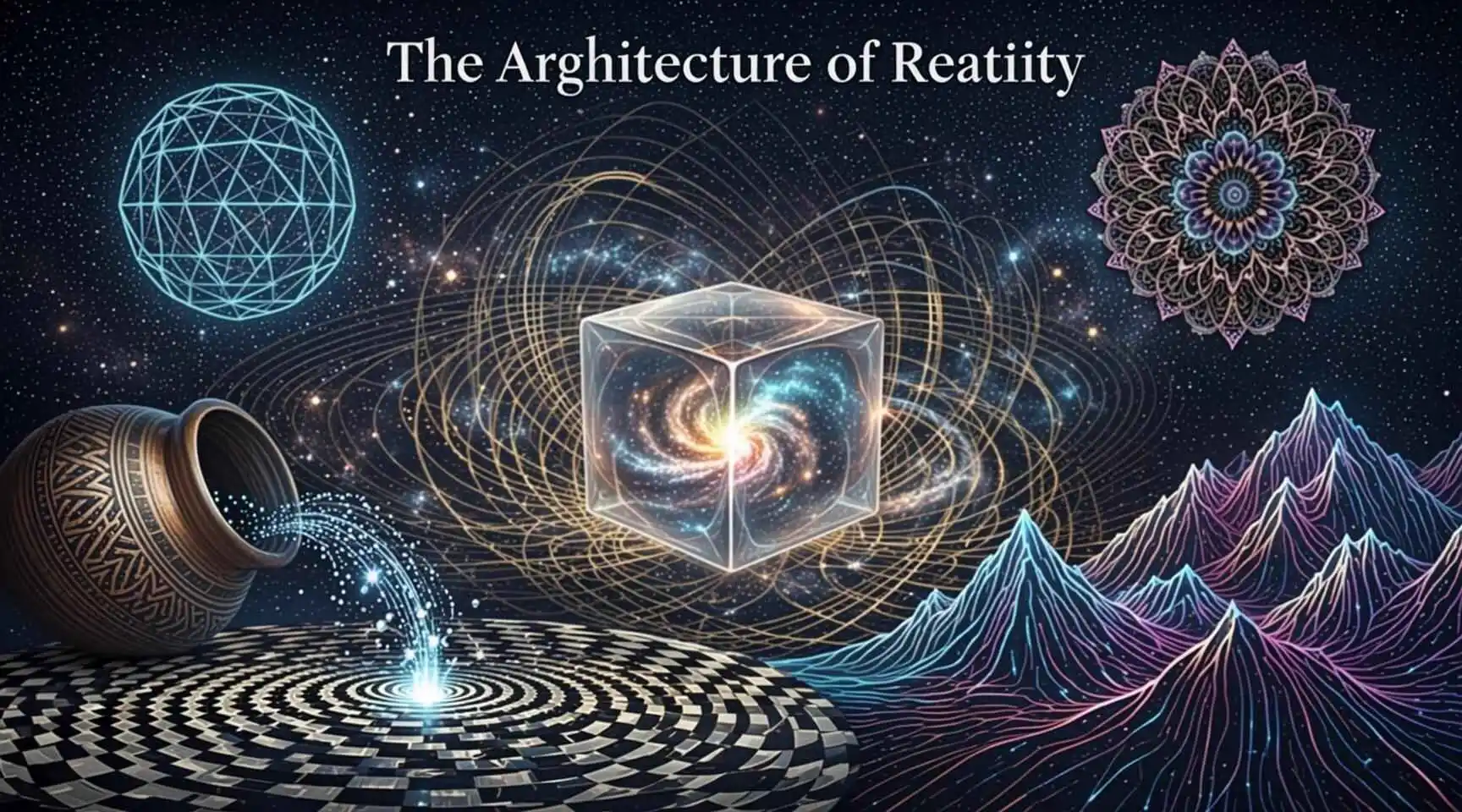
Shapes do not just exist in the physical world; they exist in our minds. Psychologists have studied how different shapes affect human perception and emotion.
Circles vs. Squares vs. Triangles Marketing and branding rely heavily on the psychology of shapes.
- Circles are associated with unity, community, and softness. Brands like Target, NASA, and BMW use circles to convey reliability and inclusivity.
- Squares and Rectangles represent stability, order, and logic. Think of Adobe, Microsoft, or the BBC. They tell the consumer, “We are solid and dependable.”
- Triangles imply energy, direction, and danger. Brands like Delta, Adidas, and Mountain Dew use triangles to suggest movement and excitement. Conversely, warning signs and hazard symbols are triangular because the shape cuts through visual clutter faster than any other.
Biophilia and Fractals Research suggests that looking at fractal patterns—specifically those with a “D” value (a measure of fractal complexity) similar to nature (around 1.3 to 1.5)—can reduce stress by up to 60%. This explains why we find walks in the forest or staring at the ocean so relaxing. Our visual systems have evolved to process the complex shapes of nature efficiently, and exposure to them triggers a physiological relaxation response.
Conclusion: The Shape of Things to Come
Mathematical shapes are far more than static figures in a textbook. They are dynamic, living concepts that weave together the fabric of reality. They dictate the structure of the atoms in our bodies, the orbit of the planets around our sun, the technology in our pockets, and the art that adorns our walls.
From the perfect symmetry of a snowflake to the infinite chaos of a fractal, from the rigid cube to the fluid Klein bottle, geometry provides us with a lens to understand the cosmos. As we venture further into the era of quantum computing and virtual reality, our reliance on these shapes will only deepen. We will build new worlds in the metaverse using polygon meshes, and we will decode the secrets of the universe using the non-Euclidean geometry of black holes.
The next time you look at a honeycomb, a brick wall, or the stars in the sky, remember: you are looking at a map. You are seeing the hidden code of the universe, a silent language of angles and curves that has been spoken since the dawn of time. By learning to recognize these shapes, we learn to see the world not just as it looks, but as it truly is.
We are all, in a way, geometers at heart, navigating the architecture of reality, one shape at a time.
FAQS
1.Why is mathematics often called the language of nature?
Mathematics describes the fundamental rules governing the universe, from the spiraling of galaxies to the arrangement of atoms in a snowflake. It acts as the code that dictates movement, growth, and structure.
- Why is the triangle considered the strongest shape in construction?
The triangle is the only rigid polygon. Unlike squares, which can skew and collapse under pressure, a triangle cannot change its shape without altering the length of one of its sides, providing inherent structural stability.
- What is the significance of Pi ( π ) regarding the circle?
Pi represents the ratio of a circle’s circumference to its diameter. It is an irrational number, meaning it has an infinite number of decimal places that never repeat, which challenged the ancient belief that the universe could be described solely by perfect integers.
4.What are the five Platonic Solids?
The five Platonic Solids are the Tetrahedron (4 faces), Cube/Hexahedron (6 faces), Octahedron (8 faces), Dodecahedron (12 faces), and the Icosahedron (20 faces). They are the only five 3D shapes where every face, edge, and angle is identical.
- How did Plato link geometry to the elements?
Plato assigned the Tetrahedron to Fire, the Cube to Earth, the Octahedron to Air, and the Icosahedron to Water. He assigned the Dodecahedron to the cosmos or “Aether,” considering it the shape of the universe itself.
- What is the Golden Ratio (Phi)?
The Golden Ratio is a mathematical ratio (approximately 1.618) found when a line is divided so that the ratio of the whole line to the larger section is the same as the ratio of the larger section to the smaller one.
- Where can the Golden Spiral be observed in nature?
The Golden Spiral can be seen in the arrangement of seeds in a sunflower, the shell of a nautilus, the pattern of pinecones, and the spiral arms of galaxies.
- Why do plants often grow in patterns based on the Golden Ratio?
Plants use these patterns for maximum efficiency. It allows them to pack the maximum number of seeds or leaves into the smallest space without blocking sunlight from reaching lower parts of the plant.
- What defines a fractal?
A fractal is a complex geometric shape defined by “self-similarity,” meaning the object looks the same (or similar) regardless of how much you zoom in on it.
- What is the Mandelbrot Set?
The Mandelbrot Set is a famous set of complex numbers visualized as a fractal. It is a “bug-like” shape surrounded by intricate swirls that reveal infinite copies of the original shape as you zoom deeper into the border.
- How are fractals used in modern technology?
Fractals are used in mobile phone antennas to receive a wide range of frequencies in a small space. They are also used in computer graphics to generate realistic terrain and in medical imaging to analyze blood vessels.
- What is the main concept of Topology?
Topology is often called “rubber sheet geometry.” It studies the properties of shapes that remain unchanged under continuous deformation like stretching or twisting, as long as you don’t tear or glue the object.
- Why do topologists say a coffee mug is the same as a donut?
In topology, both a coffee mug and a donut have exactly one hole. If a mug were made of soft clay, you could stretch the cup part to merge with the handle, forming a ring (donut) without breaking the surface.
- What is unique about a Möbius Strip?
A Möbius strip is a surface with only one side and one boundary. If an ant walks along the surface, it will traverse the entire length and return to the start without ever crossing an edge.
- What are the only three regular polygons that can tessellate a plane?
The only three regular polygons that can tile a floor without gaps or overlaps are the equilateral triangle, the square, and the regular hexagon, because their interior angles divide evenly into 360 degrees.
- What are Penrose Tiles?
Discovered by Roger Penrose, these are shapes that can tile a plane without ever repeating the pattern (non-periodic tiling), contrasting with the repetitive patterns of standard floor tiles.
- How is Non-Euclidean geometry different from standard geometry?
Standard (Euclidean) geometry assumes flat space where parallel lines never meet. Non-Euclidean geometry deals with curved spaces: Hyperbolic geometry (saddle-shaped) and Elliptic geometry (sphere-shaped).
- How did Einstein use Non-Euclidean geometry?
Einstein used Non-Euclidean geometry to describe General Relativity. He theorized that gravity is not just a force but the result of massive objects curving the fabric of space-time around them.
- What is a Tesseract?
A Tesseract is the four-dimensional analogue of a cube. Just as a square is a 2D shadow of a cube, a cube is a 3D shadow of a tesseract.
- What is the role of shapes in String Theory?
String Theory suggests the universe has 10 or 11 dimensions. The extra dimensions are “curled up” into complex shapes called Calabi-Yau manifolds, which determine the fundamental properties of particles.
- What is Group Theory in relation to shapes?
Group Theory is the branch of algebra used to study symmetry. It classifies shapes based on the transformations (like rotations or flips) that leave the shape looking unchanged.
- How are shapes used in branding and marketing?
Marketers use shape psychology: Circles imply unity and softness, Squares imply stability and logic, and Triangles imply energy, direction, or excitement (or sometimes danger).
- Why do fractal patterns reduce stress?
Research indicates that viewing fractal patterns with a complexity similar to nature (D value of 1.3 to 1.5) can reduce stress by up to 60% because our visual systems are evolutionarily tuned to process natural shapes efficiently.
- What is a Voronoi Diagram?
A Voronoi diagram is a partitioning of a plane into regions based on distance to points. Every point within a specific region is closer to its “seed” point than to any other. It looks like the irregular cells of a giraffe’s coat or dragonfly wings.
- What is a Geodesic Dome?
Popularized by Buckminster Fuller, a geodesic dome is a structure based on the geometry of an icosahedron, where the faces are subdivided into triangles. It is incredibly stable and strong for its weight.
- What did the discovery of Quasicrystals prove?
The discovery of quasicrystals proved that atomic structures can arrange themselves in non-repeating patterns (Penrose tilings), which revolutionized material science and crystallography.
- How are triangles used in video games?
3D models in video games are made of “meshes,” which are collections of thousands or millions of tiny polygons (usually triangles) that form the surface of the character or object.
- What is the “Parallel Postulate” of Euclid?
Euclid’s fifth postulate stated that given a line and a point, there is exactly one line through the point parallel to the original. Challenging this assumption led to the discovery of Non-Euclidean geometry.
- Why is the Dodecahedron often associated with the universe?
Historically, Plato assigned the Dodecahedron to the “cosmos” because it was the most complex of the solids, and its symmetry was seen as representative of the divine order of the heavens.
- What connects the Fibonacci sequence to the Golden Ratio?
If you take two consecutive numbers in the Fibonacci sequence (like 21 and 34) and divide the larger by the smaller, the result gets closer and closer to the Golden Ratio (1.618) as the numbers get larger.
Disclaimer: The content on this blog is for informational purposes only. Author’s opinions are personal and not endorsed. Efforts are made to provide accurate information, but completeness, accuracy, or reliability are not guaranteed. Author is not liable for any loss or damage resulting from the use of this blog. It is recommended to use information on this blog at your own terms.

