

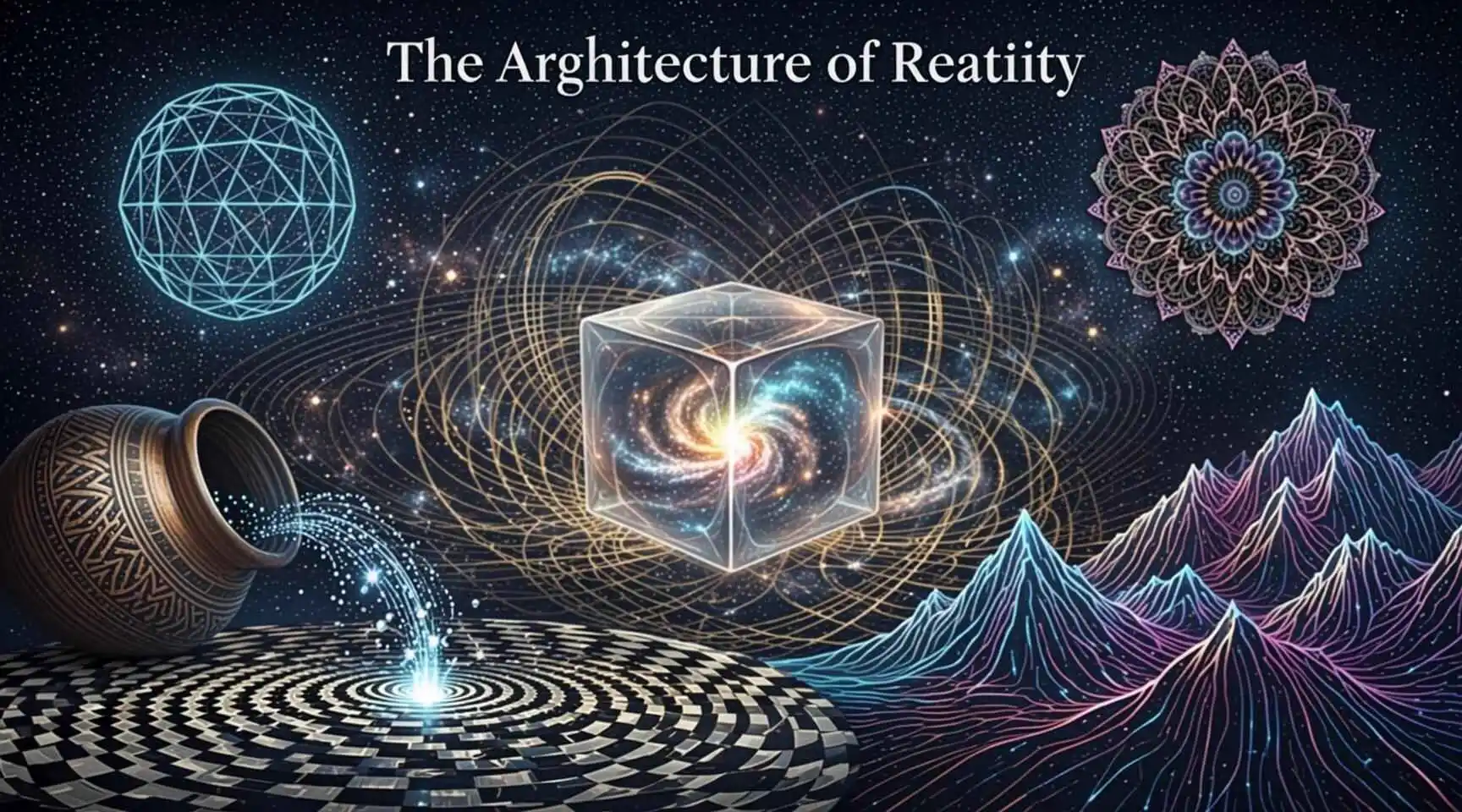
The Hidden Architecture of Reality: How Mathematical Shapes Rule the Universe
Introduction: The Silent Language of the Cosmos
From the spiraling galaxies that spin in the deep vacuum of space to the microscopic arrangement of atoms in a snowflake, the universe is built on a scaffold of invisible lines and precise angles. We often think of mathematics as a purely human invention—a set of rigid rules and frustrating equations confined to chalkboards and textbooks. However, mathematics is actually the discovered language of nature. It is the code that dictates how planets move, how flowers grow, and how music resonates in our ears. At the very heart of this code lies the study of shape: Geometry.
While most of us stopped exploring shapes after memorizing the formulas for the area of a rectangle or the circumference of a circle, the world of mathematical shapes extends far beyond simple polygons. It dives into the surreal landscapes of the fourth dimension, the infinite recursion of fractals, and the curved spaces of black holes. This blog post will take you on a comprehensive journey through the world of mathematical shapes, exploring their history, their properties, their occurrence in nature, and their profound applications in our modern technological world. We will peel back the layers of reality to see the hidden architecture that governs existence.
Chapter 1: The Foundations – Polygons and the Birth of Geometry
To understand the complex, we must first master the simple. The story of shape begins with the polygon. Derived from the Greek words poly (many) and gonia (angle), polygons are the closed, two-dimensional figures formed by straight lines.
The Triangle: The Keystone of Strength The triangle is the most fundamental polygon. It is the simplest shape that can exist in 2D space with straight lines, requiring only three points. But its simplicity belies its power. The triangle is the only rigid polygon. If you build a square from four beams connected by hinges, it can easily skew into a parallelogram and collapse. However, a triangle cannot change its shape without changing the length of one of its sides. This inherent structural integrity makes the triangle the cornerstone of architecture. From the massive pyramids of Giza to the intricate trusses of modern bridges, the triangle provides the stability that holds our world together.
The Square and Rectangle: The Logic of Order If the triangle represents dynamic stability, the square and rectangle represent order and standardization. They are the shapes of human organization—the bricks in our walls, the tiles on our floors, and the screens on our devices. The right angle (90 degrees) is the hallmark of Euclidean geometry, named after the Greek mathematician Euclid. For centuries, Euclid’s Elements, which established the rules of these shapes, was the second most printed book in the Western world after the Bible. The square represents the man-made grid, the imposition of logical structure upon the chaotic natural world.
The Circle: Perfection and Infinity Moving away from straight lines, we encounter the circle. Unlike polygons, which have sharp corners and distinct starting and stopping points, the circle represents continuity, infinity, and perfection. It has no beginning and no end. In mathematics, the circle is defined as the set of all points in a plane that are equidistant from a central point.
The relationship between a circle’s circumference and its diameter is one of the most famous numbers in history: Pi ( π ). This irrational number (approximately 3.14159…) never ends and never settles into a permanently repeating pattern. This discovery shattered the ancient Greek belief that the universe could be described entirely using perfect integers and fractions, opening the door to the vast, strange world of irrational numbers.
Chapter 2: The Platonic Solids – The Atoms of the Universe
Long before modern chemists discovered the atomic table, the Ancient Greek philosopher Plato believed that the entire universe was constructed from just five shapes. Known today as the Platonic Solids, these are the only five three-dimensional shapes that are perfectly regular. This means that for every solid:
- All faces are identical, regular polygons.
- All edges are of equal length.
- All angles between faces are equal.
These five shapes are the Tetrahedron (4 triangular faces), the Cube (Hexahedron – 6 square faces), the Octahedron (8 triangular faces), the Dodecahedron (12 pentagonal faces), and the Icosahedron (20 triangular faces).
The Classical Elements Association Plato assigned each solid to one of the classical elements. The Tetrahedron, with its sharp points and stability, was Fire. The Cube, the solid foundation of the earth, was Earth. The Octahedron, which rotates easily and flows like air, was Air. The Icosahedron, which most closely resembles a sphere and rolls with the least friction, was Water.
But the fifth solid, the Dodecahedron, was special. Plato assigned it to the cosmos itself, or “Aether.” He wrote, “There is a fifth figure, which is God’s instrument for arranging the constellations.” Even in ancient times, mathematicians recognized the Dodecahedron as a shape of unique, almost mystical complexity. Today, we see these shapes in nature, from the crystalline structures of minerals to the microscopic skeletons of radiolarians (marine protozoa), proving that nature favors these geometrically efficient forms.
Chapter 3: The Golden Ratio – Nature’s Favorite Number
No discussion of mathematical shapes is complete without mentioning the Golden Ratio, often denoted by the Greek letter Phi ( ϕ ). Approximately equal to 1.618, this ratio occurs when a line is divided into two parts such that the longer part divided by the smaller part is also equal to the whole length divided by the longer part.
The Golden Rectangle and Spiral When you construct a rectangle using the Golden Ratio, you can create a Golden Spiral by dividing the rectangle into a square and a smaller rectangle, and repeating the process infinitely. This specific spiral is ubiquitous in nature.
Look at the head of a sunflower. The seeds are arranged in spirals that curve outward. If you count the spirals going clockwise and counter-clockwise, you will almost always find two consecutive Fibonacci numbers (like 34 and 55). The Fibonacci sequence (1, 1, 2, 3, 5, 8, 13…) is intimately connected to the Golden Ratio, as the ratio between consecutive numbers converges on Phi as the sequence grows.
Biological Efficiency Why does nature love this shape? It is a matter of efficiency. The Golden Spiral allows plants to pack the maximum number of seeds into the smallest possible space without blocking sunlight from reaching the lower leaves. We see it in the nautilus shell, the curve of a fern frond unfurling, the proportions of the human body, and even the rotation of hurricanes. Artists and architects, from Le Corbusier to Salvador Dalí, have consciously used the Golden Ratio to create works that are aesthetically pleasing to the human eye, tapping into a subconscious preference for these specific mathematical proportions.
Chapter 4: Fractals – The Geometry of Roughness
For centuries, geometry focused on smooth shapes: lines, circles, and spheres. But nature is rarely smooth; it is rough, jagged, and complex. Mountains are not cones; coastlines are not circles; clouds are not spheres. To describe these, we need fractal geometry.
Self-Similarity The defining characteristic of a fractal is self-similarity. This means that an object looks the same (or similar) no matter how much you zoom in. Consider a tree. The trunk splits into large branches, which split into smaller branches, which split into twigs. The pattern of a twig often resembles the pattern of the whole tree. This repetition across scales is the essence of fractal geometry.
The Mandelbrot Set In the 1970s, mathematician Benoit Mandelbrot revolutionized the field by visualizing complex fractals using early computers. The most famous is the Mandelbrot Set—a blobby, black shape surrounded by swirling, psychedelic filigrees. As you zoom into the “border” of the Mandelbrot Set, you find infinite copies of the original shape, twisted and distorted, buried within the chaos.
Fractals in Technology Fractals are not just pretty pictures; they are practical tools. Mobile phone antennas often use fractal shapes because the repeating, jagged lines allow them to receive a wide range of frequencies within a compact physical space. Fractal geometry is also used in computer graphics to generate realistic terrain for movies and video games, and in medical imaging to analyze the complex branching structures of blood vessels and lungs to diagnose diseases like cancer.
Chapter 5: Topology – The Rubber Sheet Geometry
If geometry is the study of rigid shapes, topology is the study of flexible shapes. In topology, distance and angle do not matter. Instead, the focus is on the properties of a space that remain unchanged under continuous deformation—stretching, twisting, and crumpling, but not tearing or gluing.
This field is often jokingly described as “rubber sheet geometry.” To a topologist, a coffee mug and a donut (torus) are the same shape. If you have a coffee mug made of clay, you can smoothly stretch the “cup” part until it merges with the “handle,” forming a ring. Because there is one hole in the handle and one hole in the donut, they are topologically equivalent.
The Möbius Strip One of the most famous objects in topology is the Möbius Strip. It is created by taking a strip of paper, giving it a half-twist, and connecting the ends. The result is a surface with only one side and one boundary. If an ant walks along the surface of a Möbius strip, it will traverse the entire length of the shape and return to its starting point without ever crossing an edge. This concept is crucial in understanding non-orientable surfaces and has implications in physics and engineering, particularly in the design of conveyor belts that wear out evenly because both “sides” are used.
The Klein Bottle Even stranger is the Klein Bottle, a closed surface with no inside and no outside. In 3D space, it must intersect itself to exist, but in 4D space, it functions perfectly. Topology challenges our understanding of reality and is essential in the study of the universe’s shape, where the fabric of space-time can bend and loop in ways our 3D brains struggle to visualize.
Chapter 6: Tessellations – Tiling the Infinite Plane
A tessellation is a covering of the plane using one or more geometric shapes with no overlaps and no gaps. We see this every day in the tiling of bathroom floors or the honeycomb of a beehive.
Regular Tessellations There are only three regular polygons that can tessellate the plane by themselves: the equilateral triangle, the square, and the regular hexagon. Why? Because the interior angles of these shapes divide evenly into 360 degrees. For a hexagon, the interior angle is 120 degrees ( 120×3=360 ). A pentagon, with an interior angle of 108 degrees, cannot fit together without leaving gaps. This is why you never see a floor tiled purely with regular pentagons.
Islamic Art and Penrose Tiles In Islamic art, tessellations reach a level of spiritual complexity. Due to religious restrictions on depicting living figures, artists used geometric patterns to represent the infinite nature of God. They developed intricate patterns of stars and polygons that seem to extend forever.
In the 1970s, physicist Roger Penrose discovered non-periodic tiling patterns. Unlike bathroom tiles which repeat in a predictable cycle, Penrose tiles (usually two shapes, a “kite” and a “dart”) can cover an infinite plane without ever repeating the exact same pattern. This discovery was purely theoretical until 1982, when materials scientist Dan Shechtman discovered a quasicrystal—an alloy with an atomic structure arranged in a Penrose pattern. This changed the definition of crystallography and won Shechtman the Nobel Prize in Chemistry.
Chapter 7: Non-Euclidean Geometry – Curving Space
For 2000 years, Euclid’s fifth postulate (the Parallel Postulate) stated that given a line and a point not on that line, there is exactly one line through the point that is parallel to the original line. Everyone assumed this was an absolute truth. But in the 19th century, mathematicians began asking, “What if it’s not?”
Hyperbolic Geometry In hyperbolic geometry (the geometry of the saddle), space curves inward. Here, there are infinite lines through a point that are parallel to the original line. The angles of a triangle in hyperbolic geometry add up to less than 180 degrees. If you draw a triangle on a saddle, the sides curve inward. This geometry creates the famous “coral reefs” of mathematical art, where complex patterns flair out dramatically. This type of geometry describes the surface of a lettuce leaf or the flaring of a trumpet flower.
Elliptic Geometry In elliptic geometry, space curves outward like a sphere. Here, there are no parallel lines; all lines eventually meet. The angles of a triangle on a sphere add up to more than 180 degrees. Imagine drawing a triangle from the North Pole to the equator, along the equator for a quarter of the way around, and back to the pole. You have created a triangle with three right angles ( 270∘ ).
Einstein and Gravity Why does this matter? Because Albert Einstein realized that our universe does not follow Euclidean geometry. Massive objects like the sun and planets warp the fabric of space-time. Gravity is not just a force pulling you down; it is the result of space curving around mass. To navigate satellites or understand black holes, we must use Non-Euclidean geometry. The GPS in your phone relies on calculations that account for the curvature of space-time, proving that these abstract shapes are literally guiding your commute.
Chapter 8: Higher Dimensions – Beyond Perception
We live in a 3D world. We can move forward/backward, left/right, and up/down. But mathematics allows us to imagine shapes in four, five, or even eleven dimensions.
The Tesseract (Hypercube) Just as a square is a 2D version of a cube, a tesseract is a 4D version of a cube. It is hard to visualize because our brains are trapped in three dimensions. We can only see its “shadow” projected into 3D space, much like a 2D drawing of a cube is only a shadow of the 3D object. In a tesseract, all edges are the same length, and all angles are right angles, even though they look bent to us.
String Theory In theoretical physics, specifically String Theory, the universe is posited to have 10 or 11 dimensions. These extra dimensions are “curled up” or “compactified” to a tiny size (Planck length), which is why we don’t experience them in daily life. The mathematical shapes that describe these curled-up dimensions are called Calabi-Yau manifolds. These incredibly complex shapes determine the fundamental properties of the universe, such as the mass of particles and the strength of forces. Without these abstract higher-dimensional shapes, the laws of physics as we know them would not function.
Chapter 9: Symmetry and Group Theory – The Mathematics of Beauty
Symmetry is one of the most immediate ways we identify beauty in shapes. Symmetry is essentially about invariance—an object looks the same even after a transformation (rotation, reflection, or translation).
The Math of Snowflakes Snowflakes are famous for their hexagonal symmetry (6-fold rotational symmetry). This happens because water molecules bond together in a way that minimizes energy, naturally forming hexagonal lattice structures. As the crystal grows, the conditions of temperature and humidity are the same on all six arms, leading to near-perfect symmetry.
Group Theory Mathematicians use Group Theory to study symmetry. A “group” is a collection of symmetries for an object. For a square, the group includes 8 operations: you can rotate it 90, 180, 270, or 360 degrees, or you can flip it over four different axes. This abstract algebra is not just about shapes; it is the language of particle physics. The Standard Model of particle physics is based on symmetry groups. Subatomic particles are essentially grouped based on how they behave under symmetry transformations, revealing that at the deepest level, the universe is governed by mathematical symmetry.
Chapter 10: Mathematical Shapes in Modern Technology
As we advance into the digital age, the importance of mathematical shapes has only grown. We are no longer just stacking bricks; we are manipulating data.
Computer Graphics and Meshes Every 3D character in a video game or CGI movie is made of a “mesh”—a collection of tiny polygons (usually triangles) that form a surface. The more polygons, the smoother the shape. A modern high-end video game model might contain millions of polygons. Mathematical algorithms calculate how light bounces off these polygons (ray tracing) to create realistic reflections and shadows.
Voronoi Diagrams Have you ever looked at the pattern of a giraffe’s coat or the wings of a dragonfly and noticed the irregular, cell-like shapes? These are often Voronoi diagrams. In mathematics, a Voronoi diagram divides a plane into regions based on distance to points in a specific subset of the plane. Each region contains all points closer to that “seed” point than to any other. This pattern is used in architecture to create lightweight, strong structures (like the roof of the Beijing Water Cube), in epidemiology to map the spread of disease, and in robotics for path planning.
Geodesic Domes Buckminster Fuller popularized the geodesic dome—a structure based on the geometry of an icosahedron (or other polyhedra) where the faces are subdivided into smaller triangles. This creates a sphere-like structure that is incredibly stable relative to its weight. The principle of triangulation allows these domes to enclose a vast amount of space without internal supports. We see this in the design of the Epcot Center at Disney World and in radar stations. Even carbon molecules (Buckminsterfullerene or Buckyballs) take this shape, a discovery that won the Nobel Prize in Chemistry.
Chapter 11: The Psychological Impact of Shapes
https://youtu.be/eyhLK5yQYFs

