

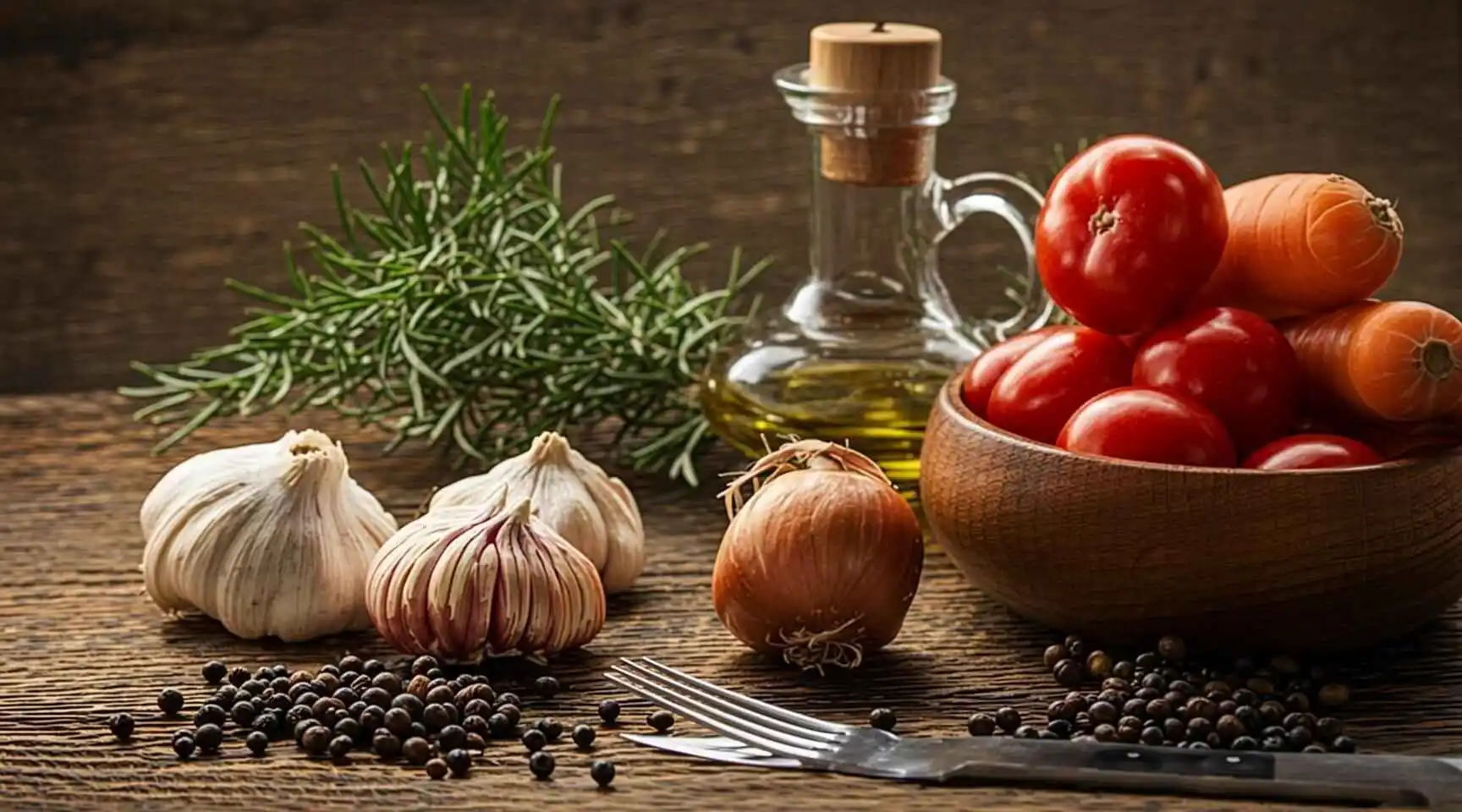
We have built the flavor, balanced it with fat and acid, constructed a foundation with aromatics, deepened it with umami, and given it structure. But a dish built entirely on heavy, cooked ingredients can feel dense and one-dimensional. It needs breath. It needs freshness. It needs herbs.
Herbs are the punctuation marks of the culinary world. They provide the bright, green, aromatic contrast that makes a heavy dish sing. But treating all herbs the same is a common novice mistake.
Herbs are broadly divided into two categories: hard (woody) and soft (tender). Hard herbs—like rosemary, thyme, oregano, and bay leaves—have tough stems and robust leaves that can withstand long cooking times. They should be added at the beginning of a braise or a stew, acting more like a spice than a vegetable. As the dish simmers for hours, their essential oils slowly leach into the liquid, providing an earthy, piney backbone.
Soft herbs—like basil, cilantro, parsley, mint, tarragon, and chives—are incredibly delicate. Their volatile oils are highly susceptible to heat. If you add chopped basil to a simmering pot of tomato sauce, it will turn black, lose its flavor, and become slimy. Soft herbs must always be added at the very end of the cooking process, or ideally, sprinkled over the finished dish as a garnish. The residual heat of the food is just enough to release their bright aromas without destroying them.
Parsley is the unsung hero of the herb world. Often relegated to a sad, wilted garnish on the side of a plate, flat-leaf (Italian) parsley actually possesses a fresh, slightly peppery flavor that cuts through richness beautifully. A heavily seasoned steak or a rich beef stew is vastly improved by a rough chop of parsley tossed in at the last second. It acts as a natural palate cleanser, allowing you to take another bite without feeling overwhelmed.
Cilantro is perhaps the most polarizing ingredient in the modern kitchen, thanks to a genetic variation that makes it taste like soap to a small percentage of the population. For those who love it, its bright, citrusy, almost soapy (in a good way) flavor is indispensable in Mexican, Thai, and Indian cuisines.
Mint offers a cool, refreshing contrast, particularly in Middle Eastern dishes like tabbouleh, or when paired with lamb, where its menthol properties cut through the gamy, heavy fat of the meat.
And then there is the zester. A microplane grater is a magical tool. Zesting a lemon, lime, or orange over a finished dish does not add sourness (which comes from the juice); it adds pure, highly concentrated essential oils from the skin. A shower of bright yellow lemon zest over a bowl of creamy pasta, or over a piece of pan-seared fish, adds an aromatic brightness that tricks the brain into perceiving the dish as lighter and fresher than it actually is.
Conclusion: The Symphony of the Everyday
The kitchen is not a place of rigid rules and mathematical equations; it is a place of intuition, sensory engagement, and continuous learning. When we look at our shelves not as storage spaces, but as an arsenal of potential, cooking transforms from a chore into an art form.
Every grain of salt, every drop of oil, every crushed clove of garlic holds a story of human history, botanical evolution, and chemical wonder. The true culinary secrets are not hidden in Michelin-starred restaurants or locked behind expensive paywalls; they are sitting right there in your pantry staples, waiting for you to understand them.
When you realize that salt controls biology, that heat transforms chemistry, that acid balances physics, and that time is the ultimate ingredient, you elevate your home cooking to heights you never imagined. You no longer need to follow a recipe step-by-step like a robot. Instead, you can taste a dish, diagnose what it is missing—Is it flat? Add acid. Is it dull? Add umami. Is it thin? Add a starch. Is it heavy? Add an herb—and fix it in real-time.
The alchemical pantry is accessible to everyone. It does not require a massive budget, just a willingness to pay attention. So the next time you find yourself in the kitchen, don’t just cook. Listen to the sizzle of the onions. Watch the color of the butter change. Smell the bloom of the toasted cumin. Engage with your kitchen ingredients. Respect the process. Because in the end, the most extraordinary magic is created not from the rarest, most expensive items in the world, but from the ordinary ones, handled with extraordinary care.
FAQS
Chapter 1: The Currency of Flavor — Salt and Spices
1.Why is salt considered the most important ingredient in the kitchen?
Salt is the ultimate flavor magnifier. It doesn’t just make food taste salty; it suppresses bitterness and amplifies the natural sweet and savory notes of the food, making it taste more like itself.
- What is the scientific reason behind brining meat?
Brining relies on osmosis. The saltwater solution draws salt into the meat, which unravels the protein coils. These unraveled coils then trap water, resulting in meat that remains incredibly juicy and well-seasoned during the cooking process.
- Where does the word “salary” come from? The word “salary” originates from the Latin word salarium, which was the allowance paid to Roman soldiers to purchase salt—a commodity so vital that it was used as currency.
- Why does ground cumin from a jar often taste like dust?
If ground spices sit in a cupboard for a long time, their volatile essential oils dissipate. To awaken the spice, you must “bloom” it by toasting it in a dry, hot skillet for about sixty seconds to release its natural oils and complex flavors.
- How does cinnamon affect our perception of food?
Cinnamon contains compounds that trick our brains into perceiving sweetness without the need to add any actual grams of sugar.
Chapter 2: Liquid Gold — Fats, Oils, and Acids
- When should I use extra virgin olive oil versus a neutral oil like grapeseed?
You should use robust extra virgin olive oil raw, as a finisher for dishes like tomatoes or beans, because it burns and turns bitter at high heats. Neutral oils (like grapeseed or avocado) have high smoke points and no flavor, making them ideal for high-heat searing and frying.
- What is “brown butter” (beurre noisette) and why does it taste nutty?
Brown butter is made by melting butter, which causes the water to evaporate and the milk solids to sink to the bottom of the pan. As the milk solids toast, the Maillard reaction occurs, creating a deep, nutty, and savory flavor.
- Why is acid described as the “great balancer” in cooking?
Fat coats the palate and makes food feel heavy or cloying. Acid (like vinegar or citrus) cuts through that fat, providing a sharp contrast that “wakes up” the dish and makes you want to take another bite.
- How does acid physically change our eating experience?
Acid literally stimulates the salivary glands, making your mouth water. This physical production of saliva helps break down food and enhances your overall perception of its flavor.
- What is a culinary emulsion?
An emulsion is the forced combination of two liquids that normally want to separate (like oil and vinegar). By introducing a mediator like egg yolks or mustard (which contain lecithin), you can bind them together into a creamy, stable sauce like mayonnaise or hollandaise.
Chapter 3: The Aromatic Foundation — Alliums and Roots
- What is a “mirepoix” and what is its purpose?
A mirepoix is the French foundational aromatic base consisting of onions, carrots, and celery. It provides the invisible, flavorful scaffolding upon which the rest of a dish (like a stew or sauce) is built.
- Why does chopping an onion make you cry?
Cutting an onion breaks its cells, releasing an enzyme called alliinase. This enzyme reacts with sulfenic acids in the onion to create a volatile gas that irritates the eyes.
- What happens chemically when you caramelize an onion?
Heat breaks down the onion’s complex carbohydrates into simple sugars, while the pungent sulfur compounds mellow out and recombine. This transforms a sharp, raw onion into a dark, sweet, and jammy ingredient.
- Why is it so easy to burn garlic compared to onions?
Garlic has a much smaller window for cooking. If cooked for just a few minutes too long in hot oil, it turns brown, acrid, and bitter, which can ruin the entire dish.
- What makes shallots different from onions in cooking?
Shallots have a lower water content and a flavor profile that sits between a sweet onion and pungent garlic, with a hint of floral notes. They caramelize faster and integrate more seamlessly into delicate sauces and vinaigrettes.
- How does the heat of ginger differ from the heat of a chili pepper?
Ginger contains gingerol, which provides a warm, pervasive heat that feels almost vaporous in the back of the throat. Chili peppers contain capsaicin, which hits the lips and the front of the tongue with a sharper, more direct heat.
Chapter 4: The Sweet Science — Sugars and Natural Alternatives
- Besides making things sweet, what does sugar do in baking?
Sugar provides structure. When creamed with butter, the sharp edges of sugar crystals cut air pockets into the fat. During baking, these pockets expand with steam, giving cakes a light, fluffy texture. Sugar also inhibits gluten formation, resulting in softer baked goods.
- What does it mean that honey is “hygroscopic”?
Being hygroscopic means honey absorbs moisture from the air. Because of this, baked goods made with honey stay moist for a significantly longer time than those made with granulated sugar.
- Can I swap honey for granulated sugar equally in a recipe?
No. Because honey contains water and is slightly acidic, you must reduce the other liquids in the recipe by about 20% and lower the oven temperature slightly, as honey browns and burns much faster than table sugar.
- How do chefs use sugar in savory dishes?
Sugar is used as a “shadow flavor” in savory cooking. A pinch of sugar can balance the acidity of a tomato sauce, while a dusting of sugar on pork belly accelerates the Maillard reaction to ensure a perfectly crispy, browned crust.
Chapter 5: The Fifth Dimension — Unlocking Umami Rich Foods
- What exactly is “umami”?
Umami is the fifth taste (alongside sweet, salty, sour, and bitter), translated as “a pleasant savory taste.” It is triggered by the presence of glutamate, an amino acid that signals to the brain that we are eating something nutrient-dense and protein-rich.
- How does fermentation create umami?
During fermentation, microorganisms like bacteria and mold break down complex proteins into simpler amino acids—specifically free glutamates. This is why fermented foods like soy sauce and miso are packed with umami.
- Will adding soy sauce to a beef stew make it taste like an Asian dish?
No. A small splash of soy sauce in a beef stew won’t make it taste Asian; it will simply introduce free glutamates that amplify the savory, meaty depth of the beef itself.
- What is a secret way to add umami to soups and stews?
Save the hard rinds of Parmesan cheese in the freezer. Dropping a rind into a simmering pot of soup or braising liquid infuses the liquid with an incredible, savory depth of flavor.
Chapter 6: The Structure — Flour, Starches, and the Miracle of Eggs
- What is a roux and how does it work?
A roux is a mixture of equal parts fat and flour cooked together. The heat cooks out the raw starch taste and causes the starch granules to swell. When liquid is whisked in, the starch absorbs the liquid, thickening it into a glossy sauce.
- When should I use cornstarch instead of flour to thicken a sauce?
Cornstarch is pure starch, unlike flour which contains proteins. Cornstarch can be mixed with cold water (a slurry) and added directly to a simmering liquid to thicken it almost instantly, yielding a clear, glossy finish ideal for stir-fries, rather than the opaque finish of flour.
- What are the four culinary functions of an egg?
An egg acts as an emulsifier (binding oil and water in mayo), a binder (setting mixtures like meatloaf), a leavening agent (whipped egg whites expanding with air for soufflés), and a thickener (coagulating gently to create custards).
- Why do custards sometimes turn grainy and curdled instead of silky?
Custards rely on the gentle coagulation of egg yolks. If the temperature gets too high, the proteins in the yolks seize up, squeezing out the water and resulting in a grainy, scrambled texture rather than a smooth one.
Chapter 7: The Final Breath — Herbs and Citrus
- What is the difference between “hard” and “soft” herbs?
Hard herbs (like rosemary, thyme, and bay leaves) have tough stems and robust leaves that can withstand long cooking times and should be added at the beginning of a dish. Soft herbs (like basil, cilantro, and parsley) are delicate, lose their flavor in heat, and must be added at the very end of cooking.
- Why do chefs use a zester on citrus fruits instead of just squeezing the juice?
Zesting a lemon or lime adds pure, highly concentrated essential oils from the skin to a dish, providing an aromatic brightness. It does not add sourness (which comes from the juice), but rather tricks the brain into perceiving the dish as lighter and fresher.
Disclaimer: The content on this blog is for informational purposes only. Author’s opinions are personal and not endorsed. Efforts are made to provide accurate information, but completeness, accuracy, or reliability are not guaranteed. Author is not liable for any loss or damage resulting from the use of this blog. It is recommended to use information on this blog at your own terms.

