

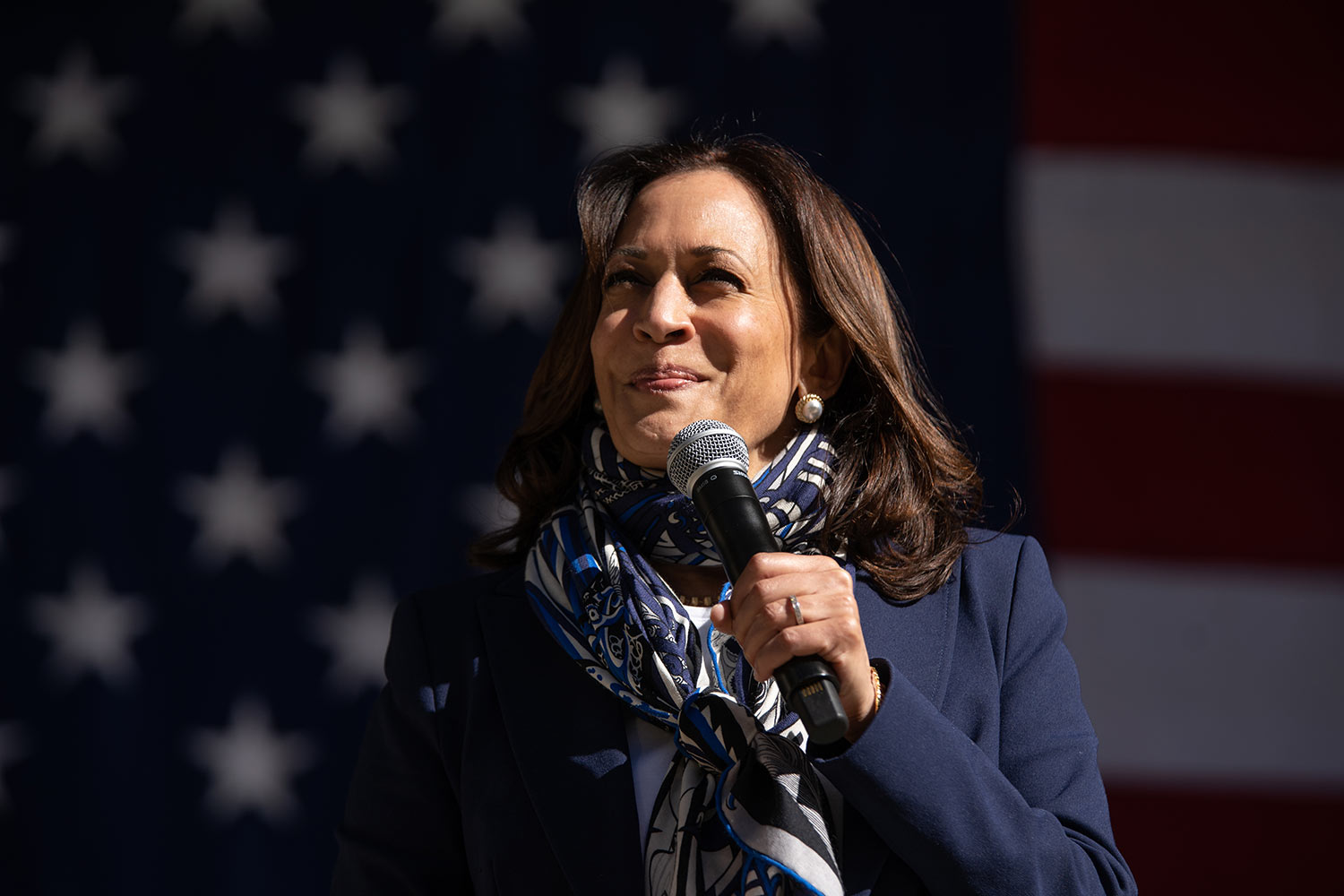
In an era of intense political polarization, almost no event is immune from political spin. The evacuation of Kamala Harris’s husband was no exception.
The Administration’s Response The White House and the Vice President’s office issued measured statements thanking the Secret Service and the MPD for their swift action and expressing relief that no one was harmed. Kamala Harris released a statement praising the resilience of the Dunbar students and condemning the disruption of a celebratory event. The focus was strictly on unity and public safety.
The Partisan Divide However, on social media and conservative talk radio, the narrative fractured. Some commentators immediately assumed, without evidence, that the threat was a “false flag” operation designed by the Democrats to garner sympathy or to push for stricter gun control or speech regulations.
Conversely, some liberal commentators used the event to point fingers at right-wing rhetoric, arguing that the normalization of political violence by certain factions of the GOP had directly contributed to an environment where threatening a school is acceptable.
The reality, as is often the case, was likely far more mundane and far more complex. False bomb threats are rarely highly coordinated political assassinations; they are often the work of isolated individuals seeking notoriety, or, as mentioned earlier, foreign bot networks trying to stir the pot. But the immediate rush to politicize the event highlighted how fractured the American public’s trust in institutions has become. When a bomb threat happens, a significant portion of the population’s first instinct is to assume it’s a hoax perpetrated by the “other side.”
Chapter 9: The Impact on the Second Gentleman’s Role
How does an event like this change the way Doug Emhoff does his job?
The fundamental challenge of executive protection is the tension between security and accessibility. A president or vice president who is locked in a bunker is safe, but they are no longer effectively leading or connecting with the public. The same applies to the Second Gentleman.
Visiting schools, community centers, and local businesses is the core of Emhoff’s portfolio. If those visits become too dangerous or too logistically complex due to the threat of swatting or bombings, the office of the Second Gentleman risks becoming isolated.
Changes in Protocol Following the Dunbar incident, it is highly likely that the Secret Service revised the protocols for Emhoff’s school visits. This could include:
- Stricter Advance Work: Requiring more time to sweep venues and establish perimeters.
- Reduced Public Access: Limiting the number of un-screened individuals who can get close to the protectee during a school visit.
- Enhanced Communications: Ensuring that local police and school resource officers have direct, encrypted lines of communication with the Secret Service detail before and during the event.
While these measures are necessary for physical safety, they inherently alter the vibe of the event. A school visit that feels like a militarized zone is not a successful public engagement. Emhoff and his team now face the difficult task of maintaining his approachable image while operating under an elevated security posture.
The Personal Toll We must also acknowledge the personal psychological toll on Emhoff himself. While he is a protected official, he is also a human being. Being told that the building you are in might contain an explosive device is a terrifying experience. For a man who left a lucrative private law practice to serve his country, facing the very real dangers of public service can cause profound reflection on the cost of civic duty.
Chapter 10: School Safety in America – A Sisyphean Task
The evacuation at Dunbar High School is a microcosm of the larger, seemingly intractable issue of school safety in the United States.
Since the Columbine High School massacre in 1999, American schools have spent billions of dollars attempting to “harden” their facilities. We have installed metal detectors, hired school resource officers (SROs), implemented single-point-of-entry systems, and trained students in lockdown procedures.
Yet, the threats persist. They persist because the root causes of violence—mental health crises, the proliferation of firearms, social alienation, and a fractured societal fabric—cannot be fixed by architectural changes or security guards.
The Cost of Hoaxes Every time a bomb threat is called into a school, it triggers a massive deployment of public resources. Police officers, bomb squads, firefighters, and emergency medical technicians are pulled away from other duties.
Furthermore, there is a severe financial cost. An evacuation disrupts a full day of learning, requiring make-up days. It necessitates psychological services for students. It damages the reputation of the school, which can impact enrollment and community support.
Prosecutors and law enforcement agencies struggle to track down the perpetrators of swatting and bomb threats, which are frequently made using burner phones, encrypted VoIP services, or anonymous internet relays. When perpetrators are caught, the legal penalties vary wildly by jurisdiction, but often fail to serve as a sufficient deterrent. A teenager making a prank call to get out of a math test might not realize they are committing a federal felony that triggers a Secret Service investigation.
Chapter 11: The Foreign Interference Angle
When analyzing threats against U.S. officials, one cannot ignore the shadow of foreign interference.
In early 2024, just weeks before the Dunbar incident, FBI Director Christopher Wray and other intelligence leaders testified before Congress, warning that Russia was running a sophisticated, multi-state campaign to send fake bomb threats to polling places, airports, and government buildings.
The goal of this campaign is asymmetrical warfare. Russia cannot match the U.S. military, but it can exploit the openness of American society. By making a simple phone call or sending an email, a foreign intelligence officer sitting in Moscow can cause the evacuation of a Washington, D.C., high school, tie up the city’s police force, and generate negative media coverage for the U.S. government. The return on investment for the adversary is astronomical.
While there is no public evidence explicitly linking the Dunbar High School threat to a foreign actor, the methodology—phoning in a threat to a location featuring a high-profile political figure to cause chaos—perfectly aligns with the playbook outlined by U.S. intelligence agencies. It underscores that the security of public officials is no longer just a domestic law enforcement issue; it is a front line in global information warfare.
Chapter 12: The Resilience of Dunbar and the Path Forward
In the days following the bomb threat, the administration of Dunbar High School worked tirelessly to restore a sense of normalcy. Principal Nadine Smith-Brown sent a letter to parents assuring them of the school’s commitment to safety and outlining the steps being taken in coordination with DCPS and the MPD.
When the school reopened, the focus shifted back to education, but the shadow of the event lingered. The incident became a teachable moment, albeit a painful one. Teachers used it to discuss civic responsibility, the consequences of making threats, and the importance of community resilience.
This resilience is perhaps the most important takeaway from the entire ordeal. The students of Dunbar High School, the descendants of the trailblazers who built one of the most important educational institutions in Black American history, were not cowed by the threat. They were annoyed, they were scared, but they were not broken.
For Doug Emhoff, the incident served as a stark reminder of the weight of his office. The role of the Second Gentleman is often mocked or dismissed as a ceremonial afterthought. But as the Dunbar evacuation proved, Emhoff moves through a world where the stakes are incredibly high, and where the line between normalcy and tragedy is terrifyingly thin.
Conclusion: The New Normal of Public Service
The day Kamala Harris’s husband was evacuated from Dunbar High School amid a bomb threat will not go down in history as a turning point in American politics. No one was hurt. No device was found. The news cycle moved on.
But it should be remembered. It should be remembered as a symptom of a deeply unwell society. A society where the celebration of Black history can be interrupted by the threat of mass murder. A society where public servants cannot visit a public school without a heavily armed security detail and a pre-planned evacuation route. A society where foreign adversaries can exploit our openness to sow domestic chaos with a phone call.
Doug Emhoff returned to work the next day. He continued his duties, continued his advocacy, and continued visiting schools and community centers. That is the requirement of public service: you must carry on, even when the threats are real, even when the anxiety is justified.
But as a nation, we must ask ourselves how long we can sustain this “new normal.” How long can we ask our children to stand on athletic fields in the cold, wondering if their school is going to explode? How long can we ask our public officials to fortress themselves away from the very people they are sworn to serve?
The evacuation at Dunbar High School was a success in terms of physical security. The protocols worked; the Secret Service did its job; the police swept the building. But in terms of the broader health of our democracy, it was a failure. It was a reminder that our public square is increasingly a hostile environment, and that restoring safety will require much more than bulletproof glass and bomb-sniffing dogs. It will require a fundamental shift in how we communicate, how we govern, and how we treat one another.
Until then, the motorcades will keep moving, the sweeps will keep happening, and the students will keep practicing their evacuations, waiting for the day when the all-clear isn’t just an absence of a bomb, but the presence of true peace.
Disclaimer: The content on this blog is for informational purposes only. Author’s opinions are personal and not endorsed. Efforts are made to provide accurate information, but completeness, accuracy, or reliability are not guaranteed. Author is not liable for any loss or damage resulting from the use of this blog. It is recommended to use information on this blog at your own terms.

