

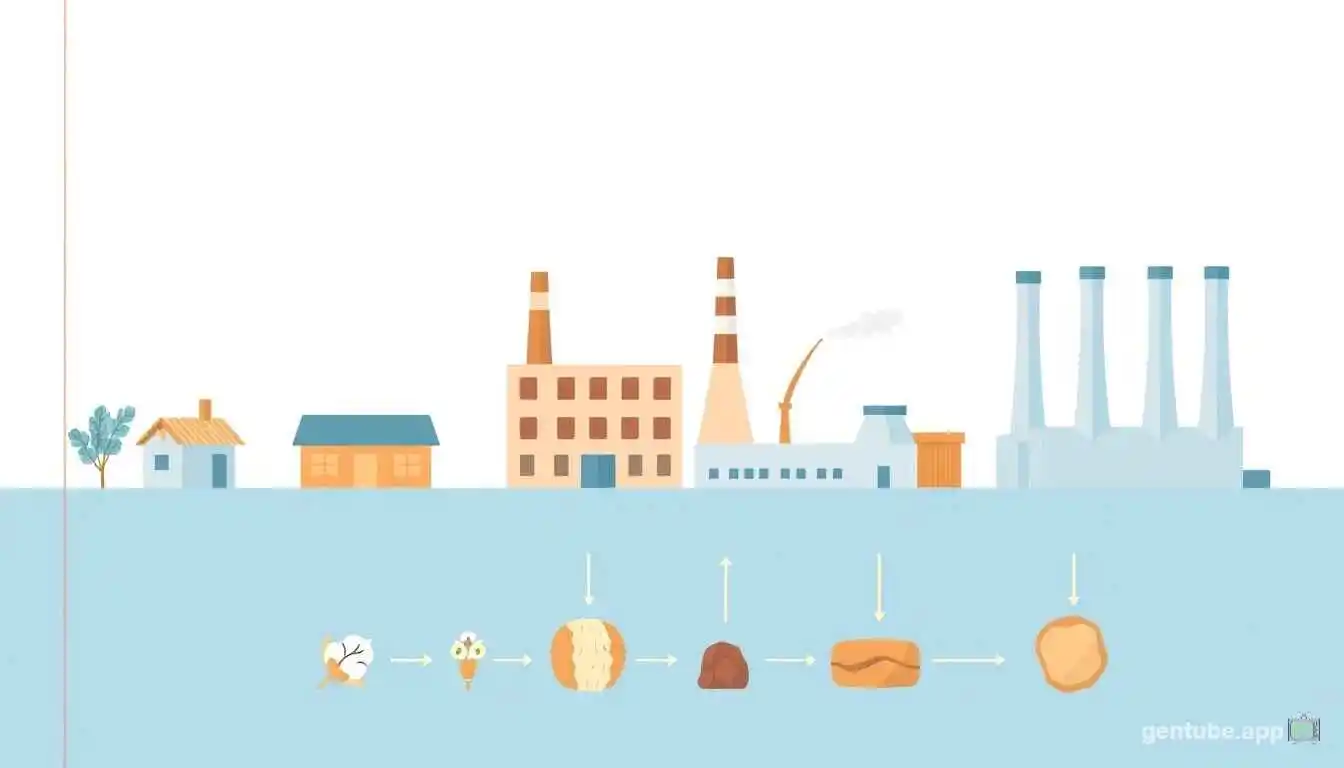
Why Does Your Phone Get Mined in One Country and Assembled in Another? The Industrial Economy Story Every Student Must Know
A Story From My Classroom
A few years back, I had a student named Ananya who raised her hand halfway through a lesson on manufacturing and asked, “Sir, isn’t industry just… industry? Why do we need five different ways to classify it?” It was a fair question, and honestly, one that almost every student asks in some form, even if they don’t say it out loud.
The textbook definition she’d memorized said an industrial economy is one where manufacturing and production activities form a major part of the country’s output and employment. She could recite that sentence perfectly. But when I asked her to explain why a small handloom weaving unit in a village and a giant steel plant in Jamshedpur are both called “industries” despite looking nothing alike, she went quiet.
That’s the exact gap we’re going to close today. Industrial economy isn’t one single idea; it’s a whole family of related ideas, each answering a different question: What raw material is used? Who owns it? How big is it? How much capital versus labor does it need? Once you see industry through these different lenses, the classifications stop feeling like a memorization chore and start feeling like a set of useful tools you can apply to any factory, workshop, or economy you come across.
By the end of this post, you’ll be able to look at almost any industry, anywhere in the world, and correctly sort it by raw material, ownership, size, and capital intensity, the same way Ananya eventually could, just two weeks before her final exam.
If you’re someone who’s been staring at a list of industry types wondering why there are so many overlapping labels, you’re not alone, and you’re not behind. Most students hit exactly this wall the first time this chapter is taught, because textbooks tend to present all four classifications one after another without ever explaining that they’re independent lenses, not competing definitions. Once that one idea clicks, the rest of this chapter gets dramatically easier, and that’s exactly where we’re headed.
What Is an Industrial Economy, and What Are Its Types?
Let’s build this from the ground up. An industrial economy is an economy in which the secondary sector, meaning manufacturing, processing, and construction activities that convert raw materials into finished or semi-finished goods, contributes a large and significant share to national income and employment, rather than agriculture or services dominating instead.
Every country’s economy generally moves through stages. It usually starts out agrarian, where most people work on farms and most output is agricultural produce. As factories, machines, and processing units grow, the economy shifts toward becoming industrial, with manufacturing taking center stage. Later still, many economies shift again toward being service-based, where banking, IT, healthcare, and similar sectors dominate. Britain during the Industrial Revolution is the classic historical example of a country making that first big shift from agrarian to industrial.
Now, within any industrial economy, industries themselves aren’t all the same, and that’s where classification comes in. Economists and geographers typically sort industries using four major lenses: the raw material they use, who owns them, how large they are, and how much capital versus labor they depend on. Think of these four lenses the way you’d think of four different filters on a camera. The factory doesn’t change, but each filter reveals a different, useful truth about it.
Here’s a quick, concrete example to make this real before we go any further. Picture a large automobile factory and a small village pottery workshop. Both are, technically, “industries.” But the automobile factory is mineral and metal based, privately owned, large-scale, and heavily capital-intensive, relying on assembly-line machinery. The pottery workshop is agro-or-earth based, often a cottage industry, and almost entirely labour-intensive, relying on the potter’s own hands and skill. Same broad label, completely different profile once you run both through the four lenses. That’s the entire point of this classification system, and it’s what we’re about to unpack properly.
Why This Topic Actually Matters
Students often ask, “Sir, why do we need to classify industries at all? Why not just call them all factories and move on?” It’s a reasonable question, and the answer matters more than most people realize.
Governments use these classifications to design policy. A government trying to protect small local weavers needs to know the difference between a cottage industry and a large-scale one, because the support each needs is completely different. A government trying to attract foreign investment needs to understand capital-intensive versus labor-intensive industries, because each brings different kinds of jobs and different amounts of money into the country.
It matters for your exams too, and this is where I speak from years of correcting answer sheets. Questions on industrial classification are exam favorites because they test whether a student can actually apply a concept to a new, unfamiliar example, rather than just repeating a memorized list. An examiner might describe a completely fictional factory and ask you to classify it. If you understand the logic behind each category, you’ll get it right every time, even for an example you’ve never seen before.
Beyond exams, this topic explains the world around you. It explains why your phone’s rare metals might be mined in one country, its chips manufactured in another, and the final device assembled in a third. It explains why a small pottery workshop near your home and a massive automobile plant are both technically “industries,” yet operate on completely different scales, with completely different needs.
It also connects directly to bigger economic conversations you’ll hear about later in life, such as why some countries are called “industrialized” and others “developing,” or why certain regions inside the same country grow much faster than others. Almost all of these conversations trace back, at least partly, to which kinds of industries dominate a particular place, how they’re owned, and how much employment they generate. Understanding the classifications now gives you a genuine head start on understanding those bigger debates later.
Core Concepts, Types, and How It Actually Works
This is where we go through each classification lens carefully, one at a time, the same way I build it up on the whiteboard for my own students.
Classification by Raw Material: Agro-Based and Mineral-Based Industries
The first and most natural way to classify industries is by asking where their raw material comes from.
Agro-based industries use raw materials that come from agriculture or related activities like farming, plantations, and animal rearing. Cotton textiles, sugar mills, food processing units, dairy industries, and jute manufacturing all fall into this category. These industries usually spring up close to farming regions, since transporting bulky, perishable raw material over long distances is expensive and often reduces quality.
Mineral-based industries, on the other hand, use minerals extracted from the earth as their primary raw material. Iron and steel, cement, and Aluminium industries are classic examples. These industries usually locate themselves near mining regions or along transport routes that can move heavy raw material efficiently, because minerals like iron ore are extremely heavy and costly to transport far from their source.
Notice the underlying logic here: this classification is really about the source and nature of the input material, and it heavily influences where an industry physically sets up. That’s a detail examiners love to test, so it’s worth remembering clearly.
A quick way to check yourself: ask whether the raw material was grown or reared, or whether it was dug out of the ground. Cotton, sugarcane, milk, and jute were all grown or produced by living organisms, which places them firmly in the agro-based category. Iron ore, limestone, and bauxite were all extracted from the earth’s crust, placing them just as firmly in the mineral-based category. This one question resolves almost every raw-material classification question you’ll ever face.
Classification by Ownership: Public, Private, Joint, and Cooperative Sector Industries
The second lens asks a completely different question: who owns and runs the industry?
Public sector industries are owned and managed by the government. They’re usually set up to serve broader national goals, such as building infrastructure, ensuring strategic self-reliance in defense or energy, or providing essential goods at fair prices, even in situations where private companies might not find it profitable enough to bother.
Private sector industries are owned and operated by individuals or private companies, primarily driven by profit. Most of the consumer brands you interact with daily, from clothing companies to smartphone manufacturers, fall under this category.
Joint sector industries are run jointly by the government and private individuals or companies together, combining public oversight with private efficiency and investment.
Cooperative sector industries are owned and operated by the very producers or suppliers who depend on the industry, such as farmers or workers, who pool together raw material, labor, and other resources for their shared benefit. Sugar cooperatives and dairy cooperatives, where farmers jointly own the processing unit that turns their raw produce into a finished, sellable product, are strong real-world examples of this category.
A useful way to remember all four is to ask one simple question: whose name is on the ownership papers, and whose interest is the industry primarily built to serve? Government interest points to public sector. Private profit points to private sector. A shared arrangement between the two points to joint sector. And the producers themselves owning their own processing unit points to cooperative sector. That one question sorts almost every ownership-based example you’ll ever encounter.
Classification by Size: Large-Scale, Small-Scale, and Cottage Industries
The third lens looks at scale: how big is the operation, in terms of capital invested, number of workers, and volume of production?
Large-scale industries involve massive capital investment, employ large numbers of workers, and produce goods in huge volumes, often for national or even global markets. Automobile manufacturing and steel production are typical examples.
Small-scale industries operate with comparatively limited capital and a smaller workforce, usually serving local or regional markets. Many countries offer special financial and policy support to this category, because small-scale industries are major sources of employment, especially in developing economies.
Cottage industries sit at the smallest end of the scale, often run from within homes using family labor, traditional tools, and locally available raw material. Handloom weaving, pottery, and traditional handicrafts commonly fall into this category. These industries carry enormous cultural and heritage value alongside their economic role, often preserving traditional skills passed down across generations.
It’s worth noting that size classification is usually measured using fairly concrete indicators, such as the amount of capital invested in machinery and equipment, or the number of workers employed, rather than just a vague impression of “how big it looks.” Different countries set their own specific thresholds for what counts as small-scale versus large-scale, but the underlying idea stays consistent everywhere: scale is about investment and workforce, not about how famous or well-known the industry’s products happen to be.
Classification by Capital and Labor Intensity
The fourth lens asks a slightly more technical, but very important, question: does this industry rely more heavily on machinery and capital, or on human labor?
Capital-intensive industries depend heavily on machinery, automation, and large financial investment, while employing relatively fewer workers compared to the scale of output. Oil refining and large-scale steel production are good examples, where enormous machinery does most of the heavy lifting.
Labor-intensive industries, in contrast, rely more heavily on manual human effort than on machines, and typically employ a much larger number of workers relative to their capital investment. Garment manufacturing and handicraft production are common examples of this category.
This particular classification matters enormously for developing economies, because labour-intensive industries tend to create far more jobs per unit of investment, which is often a national priority in countries with large working-age populations looking for employment.
A simple mental test works well here too: if you removed all the machines from this industry tomorrow, could it still function reasonably well using mostly human effort? If yes, it’s leaning labor-intensive. If the entire operation would grind to a halt without its machinery, it’s leaning capital-intensive. This test won’t give you an exact technical answer in every borderline case, but it builds the right intuition quickly, which is exactly what you need under exam time pressure.
A Real Student Success Story
Let’s return to Ananya. After that quiet moment in class, I gave her a simple assignment: pick any two industries she could actually see or visit in real life, and classify each one using all four lenses, raw material, ownership, size, and capital or labour intensity. She chose a large steel plant near her uncle’s workplace and her grandmother’s small handloom weaving setup at home.
For the steel plant, she worked out that it was mineral-based, since it depended on iron ore; privately owned, since it belonged to a private company; large-scale, given its massive workforce and output; and capital-intensive, since it relied heavily on expensive machinery. For her grandmother’s handloom setup, she found it was agro-based, since it used cotton; a cottage industry by size; and labor-intensive, since it depended entirely on her grandmother’s own manual skill and effort rather than machines.
Suddenly, the four classifications weren’t abstract definitions anymore. They were a practical checklist she could run through for any industry she encountered, whether in a textbook question or in real life. By the time her exam arrived, a question describing an unfamiliar, fictional factory no longer scared her. She simply ran it through her four-lens checklist and answered with full confidence, scoring complete marks on that question.
What made the real difference for Ananya wasn’t extra revision time. It was choosing two examples she could actually picture clearly in her mind, rather than trying to memorize a distant textbook example she’d never actually seen. I’ve since asked many other students to try the exact same exercise, pick two real, visible industries from their own surroundings, and every single time, the classifications stop feeling like abstract theory and start feeling like observations about the world they already live in.
The Benefits of Truly Understanding This Topic
- You can correctly classify any industry, even one you’ve never studied before, because you understand the underlying logic rather than a memorized list of named examples.
- You develop a genuine, practical understanding of how national economies actually function, which makes related topics like trade, employment patterns, and economic development far easier to grasp.
- You start noticing these classifications in everyday life, from news reports about a new steel plant to labels on food products, which makes economics feel far less abstract and far more connected to the real world.
- Your exam answers become sharper and better structured, since you can justify your classification with clear reasoning instead of a vague or uncertain guess.
- You build transferable analytical thinking skills, the ability to sort any object or system using multiple independent criteria at once, which is genuinely useful well beyond just economics class.
- You gain a practical head start on later, more advanced topics like industrial policy, regional development, and international trade, since all of them build directly on the same classification foundation you’re learning right now.
Common Mistakes and Challenges Students Face
Where Students Typically Go Wrong
- Confusing size classification with ownership classification: Students often assume a large-scale industry must automatically be a public sector industry, and a small-scale one must be private. In reality, size and ownership are two completely separate lenses, and any combination is possible, such as a large private company or a small government-run unit.
- Treating cottage and small-scale industries as the same category: These two are related but genuinely different. Cottage industries are typically home-based and use family labor with traditional tools, while small-scale industries may involve a small factory setup outside the home with hired workers and modern, if modest, machinery.
- Mixing up capital-intensive with large-scale: A large-scale industry isn’t automatically capital-intensive, and a small industry isn’t automatically labor-intensive. Capital versus labor intensity is about the ratio of machinery to workers, not the overall size of the operation, so these two classifications need to be judged independently.
- Forgetting that one industry can belong to multiple categories at once: Students sometimes try to force an industry into just one classification, when in reality a single industry is simultaneously classified by raw material, ownership, size, and capital intensity, all four at the same time, from four different angles.
- Ignoring location logic behind raw-material-based classification: Many students memorize the difference between agro-based and mineral-based industries without connecting it to why these industries are located where they are. Understanding that heavy, bulky raw material pulls an industry toward its source explains a large share of real-world industrial location patterns.
- Assuming heavy industry and capital-intensive industry mean the same thing: These two terms often overlap in practice, but they’re technically answering different questions: heavy industry is about the bulk and weight of the product and raw material, while capital intensity is about the ratio of machinery to workers. Treating them as identical can lead to incorrect answers in more detailed exam questions.
Heavy Industry vs Light Industry: A Quick Comparison
Alongside the four major classifications above, students often also come across the terms heavy industry and light industry, another useful way to compare industries based on product weight and the scale of machinery involved. Here’s a clear side-by-side comparison.
| Property | Heavy Industry | Light Industry |
| Nature of raw material used | Bulky, heavy raw materials such as iron ore or coal | Relatively lightweight raw materials such as textiles or plastics |
| Scale of machinery required | Large, expensive, heavy-duty machinery | Smaller, comparatively simpler machinery |
| Typical products | Steel, heavy machinery, shipbuilding, cement | Consumer electronics, garments, food products, stationery |
| Capital investment needed | Very high initial capital investment | Comparatively lower initial capital investment |
| Common location pattern | Near raw material sources due to transport cost | More flexible, often near markets or labor supply |
| Typical employment size | Fewer workers relative to output, often capital-intensive | Can be either labor-intensive or capital-intensive depending on the product |
5 Proven Study Strategies That Actually Work
1. Use the four-lens checklist on every example
Whenever you encounter any industry, in your textbook, in the news, or around your own neighbourhood, run it through the four lenses: raw material, ownership, size, and capital or labour intensity. Doing this consistently turns classification from a memorised list into an automatic habit.
2. Build a simple table of real, local examples
Instead of only relying on textbook examples, list two or three real industries you actually know from your own town or city, and classify each one yourself. Local, familiar examples stick in memory far better than distant, abstract ones.
3. Separate the four classifications with different colors
When making notes, use one color for raw-material-based categories, another for ownership, another for size, and another for capital or labor intensity. This visual separation helps prevent the common mistake of mixing categories together in your head.
4. Practize with unfamiliar, made-up examples
Ask a friend, teacher, or even yourself to invent a fictional factory with a few made-up details, and try classifying it using all four lenses. This is exactly the kind of application-based question examiners love to ask, so practizing it directly builds real exam confidence.
5. Connect each classification to a real-world reason
Don’t just memorise that mineral-based industries locate near mining regions; understand why, because transporting heavy minerals over long distances is expensive. Attaching a reason to every fact makes it far easier to recall under exam pressure, since you’re reconstructing logic rather than searching your memory for an isolated fact.
None of these strategies demand extra hours of study. What they demand is consistency, running the same four-lens checklist every time an industry comes up, until it becomes second nature rather than effortful. That’s exactly how Ananya turned a confusing chapter into one of her most confident exam topics, and the same path is fully open to you.
Bringing It All Together
An industrial economy isn’t one single, uniform thing, and that’s exactly what makes this topic so useful once you understand it properly. Every factory, workshop, or manufacturing unit you come across can be examined through four independent lenses: what raw material it uses, who owns it, how large it is, and how much it depends on machinery versus human labour. Once you can apply all four lenses confidently, industrial classification stops being a list to memorise and becomes a genuine analytical skill.
Ananya didn’t master this topic by memorising more definitions. She mastered it by picking two real, visible examples from her own life and working through the logic herself, one lens at a time. That same approach is available to you, right now, with whatever industries exist around your own home, town, or city.
The next time you walk past a factory, a workshop, or even see a product’s “Made in” label, take ten seconds to classify it in your head using these four lenses. That small, repeated habit is exactly how a chapter full of definitions turns into a genuine, lasting understanding of how economies actually work.
You don’t need to visit a steel plant or a mining site to practise this. Your own kitchen, your school stationery, even the clothes you’re wearing right now all came from some industry that fits neatly into these four lenses. Start there, keep the checklist handy, and this topic will stop being something you revise under pressure and start being something you simply understand.
FAQS
Q1. What is an industrial economy in simple words?
It’s an economy where manufacturing and production activities contribute a major share of national income and employment. It usually develops as a country shifts away from being mainly agricultural.
Q2. What are the main ways industries are classified?
Industries are commonly classified by raw material used, ownership, size, and capital or labour intensity. Each classification looks at the same industry from a different, independent angle.
Q3. What is the difference between agro-based and mineral-based industries?
Agro-based industries use raw material from farming or animal rearing, such as cotton or sugarcane. Mineral-based industries use materials extracted from the earth, such as iron ore or limestone.
Q4. What is a public sector industry?
A public sector industry is owned and managed by the government, often to serve national goals rather than pure profit. Railways and many energy or defence-related industries commonly fall into this category.
Q5. What is a private sector industry?
A private sector industry is owned and run by individuals or private companies, primarily aiming for profit. Most everyday consumer brands and manufacturers belong to this category.
Q6. What is a joint sector industry?
A joint sector industry is jointly owned and operated by both the government and private parties together. This combines public oversight with private capital and management efficiency.
Q7. What is a cooperative sector industry?
A cooperative sector industry is owned and run by the producers or suppliers who depend on it, such as farmers. Sugar and dairy cooperatives are common real-world examples of this category.
Q8. What is the difference between large-scale and small-scale industries?
Large-scale industries involve heavy capital investment, large workforces, and high production volumes, often serving national or global markets. Small-scale industries operate with comparatively limited capital and workers, usually serving local or regional markets.
Q9. What is a cottage industry?
A cottage industry is typically run from within a home using family labour, traditional tools, and locally available raw material. Handloom weaving and traditional handicrafts are classic examples.
Q10. Is a cottage industry the same as a small-scale industry?
No, they are related but distinct categories. Cottage industries are home-based with family labour, while small-scale industries may operate outside the home with hired workers and modest machinery.
Q11. What does capital-intensive mean?
A capital-intensive industry relies heavily on machinery, automation, and large financial investment relative to the number of workers it employs. Oil refining and large steel plants are typical examples.
Q12. What does labour-intensive mean?
A labour-intensive industry relies more heavily on manual human effort than on machinery, employing a larger number of workers relative to its capital investment. Garment manufacturing and handicrafts are common examples.
Q13. Is a large-scale industry always capital-intensive?
No, size and capital intensity are separate classifications judged independently. A large-scale industry can still rely heavily on labour depending on the nature of its production process.
Q14. Why do labour-intensive industries matter for developing economies?
They tend to create far more jobs per unit of investment than capital-intensive industries do. This makes them especially valuable in countries with large working-age populations seeking employment.
Q15. What is the difference between heavy industry and light industry?
Heavy industry uses bulky raw materials and large, expensive machinery to produce goods like steel or cement. Light industry uses comparatively lighter raw materials and simpler machinery to produce goods like garments or electronics.
Q16. Why are mineral-based industries usually located near mining areas?
Minerals like iron ore are extremely heavy and expensive to transport over long distances. Locating the industry near the source significantly reduces transportation costs.
Q17. Why are agro-based industries usually located near farming regions?
Agricultural raw materials are often bulky or perishable and lose quality or value if transported too far. Being close to the source keeps raw material fresh and transport costs low.
Q18. Can one industry belong to more than one classification category at the same time?
Yes, every industry is classified simultaneously by raw material, ownership, size, and capital or labour intensity. These four lenses work independently and all apply to the same industry at once.
Q19. What stage comes before an industrial economy in a country’s development?
Most economies start out as agrarian economies, where agriculture is the main source of income and employment. Industrial growth typically develops afterward as manufacturing expands.
Q20. What usually comes after an industrial economy in a country’s development?

