

You don’t need to study for hours. You need to study smart.
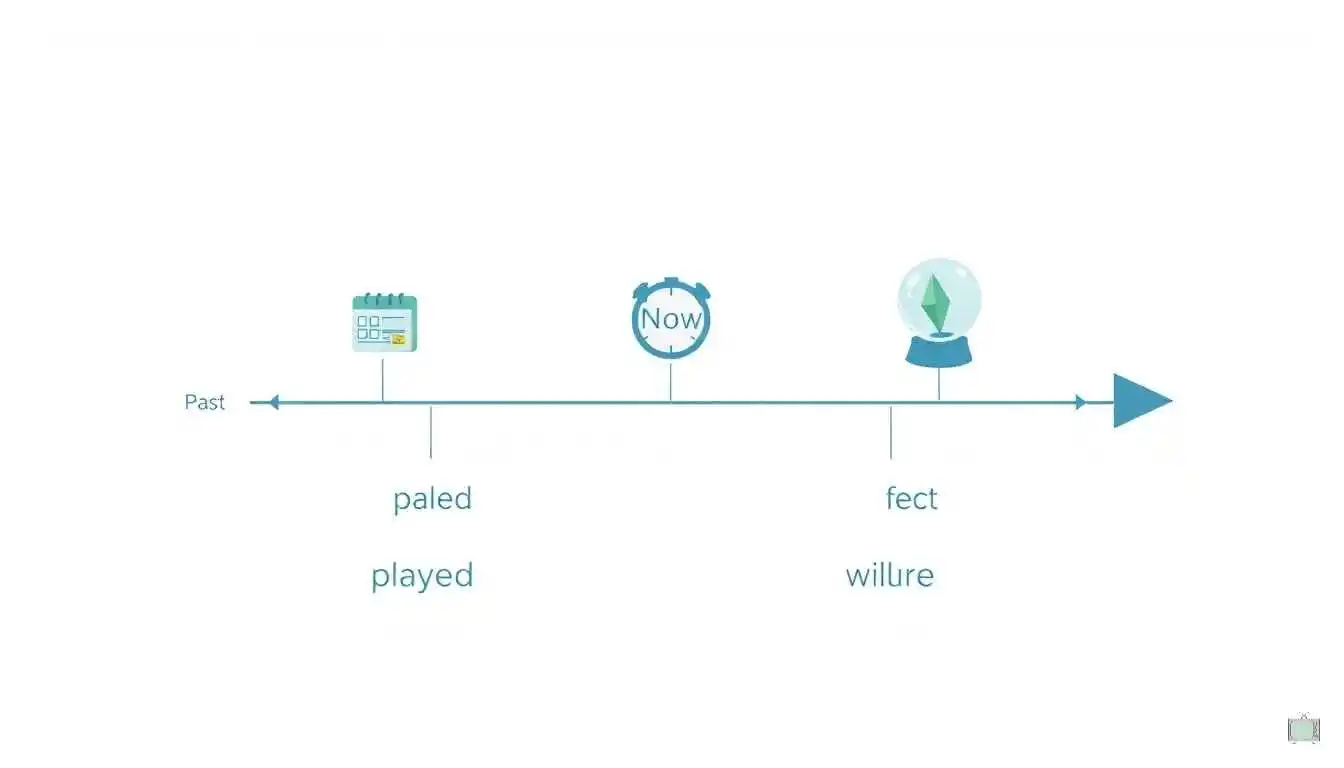
- The Timeline Drawing Method: Don’t just read rules. Draw a line. Mark “Now” in the middle. Put an X for past, an arrow for future. Visually placing the action helps your brain understand the logic.
- Learn Verbs in Groups: Don’t memorize random verbs. Learn irregular verbs in groups (e.g., sing-sang-sung, ring-rang-rung). Patterns make memory easier.
- Use Signal Words as Anchors: Create flashcards with signal words. “Yesterday” = Simple Past. “Since 2010” = Present Perfect. Let the word trigger the tense.
- Keep a “Tense Journal”: Write 3 sentences every day: one about what you did (Past), one about what you are doing (Present), and one about what you will do (Future). Consistency beats intensity.
- Listen for Tenses in Songs/Movies: Pick a song. Listen to the lyrics. Identify the tenses. Why did the singer use “I loved you” vs “I love you”? Context is king.
Conclusion: You Are the Author of Your Time
Learning tenses isn’t about passing a test. It’s about claiming your voice. It’s about being able to say, “This is who I was, this is who I am, and this is who I will become.”
Remember Mark from the beginning? He eventually mastered his tenses. A year later, he ordered coffee perfectly: “I’ll have a latte, please. I had one yesterday, and it was great, so I’m having another today.”
He wasn’t just ordering coffee. He was telling a story. And he was understood.
You can do this too. Start small. Focus on the Simple Present and Simple Past. Then add the Continuous. Then the Perfect. Build your time machine brick by brick. Don’t worry about perfection. Worry about communication. Every mistake is a step forward.
So, what will you do next? Will you practice today? Will you have practiced by tomorrow? The choice—and the tense—is yours.
FAQS
1.What is the most important tense to learn first?
Simple Present and Simple Past are the most important. They cover most daily conversations and basic storytelling.
2.Why do we use Present Perfect instead of Simple Past?
Use Present Perfect when the time is not specified or the result matters now. Use Simple Past when you mention a specific time (e.g., yesterday).
3.Can I use “will” for all future plans?
No. For fixed arrangements, use Present Continuous (“I am meeting him”). For predictions or promises, use “will.”
4.What are stative verbs?
Stative verbs describe states, not actions (e.g., know, love, believe). They are rarely used in continuous tenses (no “I am knowing”).
5.How do I know when to use Past Continuous?
Use it to set the scene or describe an action that was interrupted by another action in the past.
6.Is “gonna” correct English?
“Gonna” is informal spoken English for “going to.” It is fine in conversation but avoid it in formal writing.
7.What is the difference between “for” and “since”?
“For” is used with a duration (for two hours). “Since” is used with a starting point (since 9 AM). Both are used in Perfect tenses.
8.Why is English tense system so complicated?
It seems complex, but it’s logical. It combines time (3) with aspect (4). Focus on the most common ones first.
9.Can I use Simple Present for future events?
Yes, for scheduled events like timetables. “The train leaves at 5 PM.”
10.What is the Past Perfect used for?
It shows which of two past actions happened first. “I had eaten before he arrived.”
11.Do all verbs have regular past forms?
No. Irregular verbs change completely (go-went, see-saw). You must memorize the common ones.
12.Is it okay to mix tenses in one sentence?
Yes, if the logic requires it. “I know (present) that he left (past) yesterday.”
13.How can I practice tenses alone?
Write a daily diary. Describe your day using Past, your current feelings using Present, and your plans using Future.
14.What is the Future Continuous tense?
It describes an action that will be in progress at a specific future time. “At 8 PM, I will be sleeping.”
15.Why do natives use contractions like “I’ve”?
It’s natural speech flow. “I have” becomes “I’ve.” It’s standard in spoken and informal written English.
16.What is the difference between “used to” and Simple Past?
“Used to” implies a past habit that no longer exists. Simple Past just states a fact.
17.Can I use Present Continuous for future plans?
Yes, for personal arrangements. “I am flying to Paris next week.”
18.What is the Passive Voice?
It focuses on the action, not the doer. “The cake was eaten.” It uses “be” + Past Participle.
19.How do I improve my irregular verbs?
Group them by sound patterns (sing-sang-sung) and use flashcards. Practice them in sentences, not lists.
20.Is “shall” still used?
Rarely in American English. It’s mostly used in British English for formal suggestions or offers. “Shall we go?”
21.What is the Present Perfect Continuous?
It emphasizes the duration of an action that started in the past and continues now. “I have been waiting for hours.”
22.Why do we say “I wish I were”?
It’s the subjunctive mood, used for hypothetical situations. “Were” is correct for all subjects in this structure.
23.Can I use “will” in if-clauses?
Generally, no. Use Simple Present in the if-clause. “If it rains, I will stay home.”
24.What is the difference between “been” and “gone”?
“Been” means you went and returned. “Gone” means you are still there. “He has gone to Spain.”
25.How do I express habitual past actions?
Use “used to” or “would.” “I used to play soccer.”
26.Is grammar more important than vocabulary?
Both are essential. Vocabulary gives you words; grammar gives them structure. You need both to be understood.
27.What is the best way to learn tenses?
Context. Learn them through stories and conversations, not just isolated rules.
28.Why do some verbs look the same in past and present?
Some verbs are invariant (e.g., put, cut). Context tells you the time. “I put it there yesterday.”
29.Can I skip learning Perfect tenses?
No. They are very common in native speech. Ignoring them will make your English sound unnatural.
30.How long does it take to master tenses?
It varies. With consistent practice, you can feel comfortable in 3-6 months. Mastery takes years of exposure.
Disclaimer: The content on this blog is for informational purposes only. The author’s opinions are personal and not endorsed. Efforts are made to provide accurate information, but completeness, accuracy, or reliability are not guaranteed. The author is not liable for any loss or damage resulting from the use of this blog. It is recommended to use the information on this blog at your own discretion.

