

The Hidden Force in Every Machine :How Electromagnets Quietly Power Your Entire World
Introduction: The Magnet You Can Turn Off
Close your eyes and picture a magnet. Chances are you’re imagining a small, permanently magnetic chunk of metal — the kind that sticks to your refrigerator door and never lets go. But there is another, far more powerful kind of magnet hiding inside almost every piece of modern technology you touch, and it has a superpower that ordinary magnets simply don’t have: you can switch it on, switch it off, make it stronger, make it weaker, and even flip its poles, all with nothing more than a wire, a battery, and a little bit of electrical current.
This is the electromagnet — arguably one of the most underappreciated inventions in the history of technology. It doesn’t get the glamour of the smartphone or the electric car, yet it is the silent workhorse inside both. Every time your phone rings and the tiny speaker inside it vibrates, an electromagnet is at work. Every time a hard drive spins up, an MRI machine scans a patient, a scrapyard crane lifts a car, or an electric motor turns a wheel, an electromagnet is doing the heavy lifting — sometimes literally.
In this comprehensive guide, we’re going to pull back the curtain on this deceptively simple invention. We’ll explore what an electromagnet actually is, the elegant physics that makes it work, the history of how it was discovered, the different types that exist, the countless ways it shapes your daily life, and where this 200-year-old technology is headed next. Whether you’re a student trying to understand electromagnetism for an exam, a hobbyist wanting to build your own coil, or simply someone curious about the invisible forces running the modern world, this article will give you a complete, easy-to-understand picture.
What Exactly Is an Electromagnet?
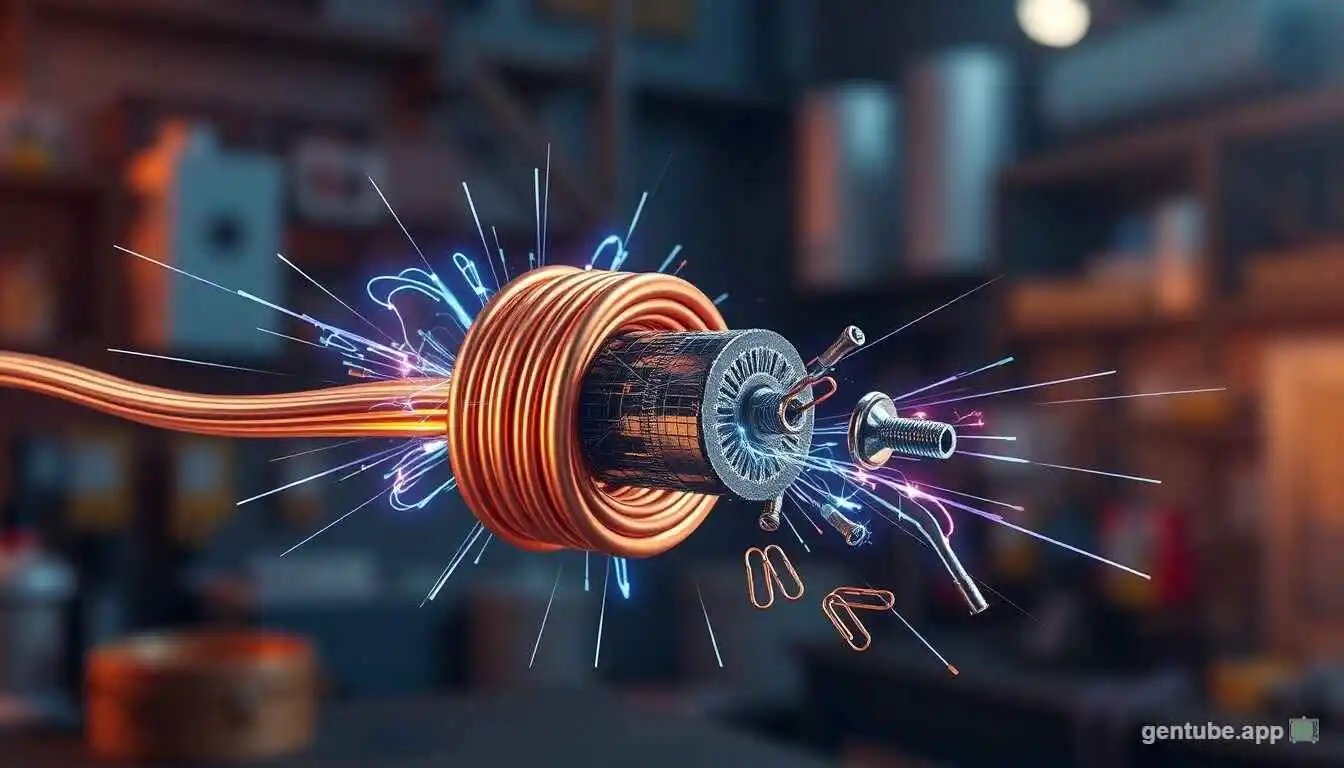
At its core, an electromagnet is a magnet whose magnetic field is created by an electric current rather than by the permanent alignment of atoms inside a material. It typically consists of a coil of insulated wire — often copper — wound around a core made of a ferromagnetic material such as iron or steel. When electricity flows through the coil, it generates a magnetic field. Because the core is made of a material that magnetizes easily, this field becomes concentrated and dramatically amplified, turning what would otherwise be a weak magnetic effect into a genuinely powerful, usable force.
The beauty of this arrangement lies in its controllability. A bar magnet you buy at a hardware store is magnetic all the time, whether you want it to be or not. An electromagnet, on the other hand, is magnetic only when current flows through its coil. Cut the power, and the magnetism all but disappears within a fraction of a second. This on-demand nature is precisely why electromagnets, rather than permanent magnets, are used in the vast majority of electrical and mechanical systems that require precise control.
It’s also worth understanding what makes an electromagnet different from a simple coil of wire carrying current. A coil alone does produce a magnetic field — this is true of any current-carrying conductor — but the field is relatively weak. The addition of a ferromagnetic core is what transforms a modest field into an industrial-strength force, because the core’s own magnetic domains align with the applied field and add their own magnetism on top of it, sometimes multiplying the total field strength by a factor of hundreds or even thousands.
A Brief History: From Sturgeon’s Coil to Modern Superconductors
The story of the electromagnet begins in the early nineteenth century, a period of explosive discovery in the young science of electromagnetism. In 1820, the Danish physicist Hans Christian Ørsted made a landmark observation: an electric current flowing through a wire deflected a nearby compass needle. This simple experiment proved, for the first time, that electricity and magnetism were fundamentally linked — two sides of the same physical phenomenon.
Building on this discovery, the English inventor William Sturgeon took the concept a giant leap forward in 1824. Sturgeon wound bare copper wire around a horseshoe-shaped piece of iron and passed current through it, creating what is widely credited as the first practical electromagnet. His device could lift about nine times its own weight in iron — a modest feat by today’s standards, but a revolutionary demonstration at the time. It proved that magnetism could be manufactured, amplified, and controlled at will, rather than simply found in naturally magnetic stones.
Just a few years later, the American scientist Joseph Henry refined Sturgeon’s design significantly. Henry insulated the wire itself, rather than relying on the core for insulation, which allowed him to wrap far more turns of wire tightly around the core without the coils short-circuiting against one another. This innovation dramatically increased the strength of electromagnets and paved the way for their use in telegraphy, one of the first major commercial applications of the technology. Henry’s electromagnets could lift thousands of times their own weight, and his work directly enabled Samuel Morse’s development of the electric telegraph.
From those humble beginnings, electromagnet technology advanced steadily through the industrial age, powering the rise of electric motors, generators, and telephones. In the twentieth century, the discovery and engineering of superconducting materials opened an entirely new chapter, allowing scientists to build electromagnets so powerful they could bend the paths of subatomic particles in accelerators or peer inside the human body with astonishing clarity in MRI machines. What started as a nine-pound lifting horseshoe two centuries ago has evolved into a technology capable of generating magnetic fields hundreds of thousands of times stronger than Earth’s own.
The Science Behind the Magic: How Electromagnets Actually Work
Electric Current Creates a Magnetic Field
The foundational principle behind every electromagnet is a simple but profound fact of physics: moving electric charge creates a magnetic field. Whenever electrons flow through a wire as electric current, they generate a magnetic field that circles around the wire. This relationship was mathematically formalized by French physicist André-Marie Ampère shortly after Ørsted’s discovery, and it remains one of the cornerstones of classical electromagnetism today.
If you were to run current through a single straight wire, you would find a weak, circular magnetic field wrapping around it. On its own, this field is far too feeble to be of much practical use. But something remarkable happens when that wire is coiled.
Coiling the Wire Concentrates the Field
When a wire is wound into a tight coil — technically called a solenoid — the circular magnetic fields produced by each individual loop of wire begin to overlap and reinforce one another. Instead of many weak, separate fields, you get one much stronger, unified field running through the center of the coil, with distinct north and south poles forming at either end, just like a bar magnet. The more loops, or turns, the coil has, the stronger this combined field becomes, because each loop adds its own contribution to the total.
Adding a Ferromagnetic Core Amplifies Everything
The final ingredient is the core. Materials like iron are called ferromagnetic because they contain tiny regions called magnetic domains, each of which behaves like a microscopic magnet. In an unmagnetized piece of iron, these domains point in random directions and cancel each other out. But when the iron core is placed inside a current-carrying coil, the coil’s magnetic field pushes these domains into alignment, all pointing in roughly the same direction. Suddenly, the core itself becomes strongly magnetic, and its field adds to the coil’s field, often multiplying the overall strength dramatically. This is why a coil wrapped around an iron core can be vastly more powerful than the same coil wrapped around, say, a wooden dowel or nothing at all.
The Right-Hand Rule: Predicting Direction
Physicists and engineers use a handy trick called the right-hand rule to predict the direction of the magnetic field produced by a current. If you curl the fingers of your right hand in the direction that current flows around the coil, your extended thumb points toward the magnetic north pole of the electromagnet. This simple rule allows engineers to design devices with precisely the polarity they need, and it explains why reversing the direction of current flow instantly reverses which end of the electromagnet is north and which is south.
What Determines the Strength of an Electromagnet?
Not all electromagnets are created equal. A tiny electromagnet inside a doorbell buzzer might generate a field just strong enough to click a lever, while an electromagnet inside an MRI machine can generate a field powerful enough to yank a wrench across a room. Several key factors determine just how strong an electromagnet will be.
- Number of coil turns: More loops of wire around the core mean a stronger combined magnetic field, since each turn contributes its own field.
- Amount of current: Magnetic field strength is directly proportional to current, so increasing the amps flowing through the coil increases the field, up to the point where the wire begins to overheat.
- Core material: Materials with high magnetic permeability, such as soft iron or specialized alloys, amplify the field far more than air or nonmagnetic materials.
- Core shape and geometry: A horseshoe or closed-loop shape concentrates the field between two nearby poles, producing stronger localized attraction than a straight bar core.
- Coil length and winding density: Tightly wound, densely packed coils generally produce stronger and more uniform fields than loosely spaced windings.
- Distance from the object: Magnetic field strength drops off rapidly with distance, so an object very close to the core experiences a much stronger pull than one farther away.
Engineers juggle all of these variables when designing an electromagnet for a specific purpose. A small relay might need only a few hundred turns of thin wire and a modest current, while an industrial lifting magnet might use heavy-gauge copper wire, thousands of turns, a massive steel core, and hundreds of amps of current to lift several tons of scrap metal.
Electromagnets vs. Permanent Magnets: What’s the Difference?
It’s easy to lump all magnets into one category, but electromagnets and permanent magnets differ in fundamental ways, and each has its own set of strengths and ideal applications.
Controllability
The single biggest difference is control. A permanent magnet, made from materials like neodymium, ferrite, or alnico, is magnetized once during manufacturing and stays magnetic indefinitely without needing any external power. An electromagnet, by contrast, is magnetic only while current flows through it. This makes electromagnets ideal for any application where magnetism needs to be turned on, turned off, reversed, or adjusted in strength — things a permanent magnet simply cannot do on its own.
Maximum Strength
While permanent magnets have improved dramatically with modern materials, electromagnets still hold the crown for sheer maximum strength. Because an electromagnet’s field can be scaled up by increasing current and coil turns, engineers can build enormous, extraordinarily powerful electromagnets for industrial or scientific use that would be impractical or impossible to replicate with a fixed permanent magnet of reasonable size.
Energy Consumption
Permanent magnets require no ongoing energy to maintain their field, making them efficient for applications like refrigerator magnets, magnetic clasps, or compass needles. Electromagnets, however, continuously consume electrical energy as long as they are switched on, and this energy is partly lost as heat due to the electrical resistance of the coil wire — an important trade-off engineers must consider.
Cost and Complexity
A simple permanent magnet is inexpensive and requires no circuitry, batteries, or wiring. An electromagnet requires a power source, wiring, insulation, and often control circuitry, making it more complex and costly to implement — but that complexity buys the enormous benefit of adjustability.
Types of Electromagnets
Solenoid Electromagnets
A solenoid is a simple, straight cylindrical coil of wire, often used with a movable iron plunger. When energized, the plunger is pulled into the coil, creating a linear pushing or pulling motion. Solenoids are found in door locks, valves, starter motors in cars, and countless other devices that need a quick, controlled mechanical push.
Horseshoe or U-Shaped Electromagnets
By bending the core into a horseshoe shape, engineers bring the two magnetic poles close together, concentrating the field in a small gap. This design produces very strong, localized attraction and is commonly used in lifting devices and demonstration magnets in classrooms.
Toroidal Electromagnets
A toroidal electromagnet wraps the coil around a donut-shaped, closed-loop core. Because the magnetic field is largely contained within the ring itself, this design minimizes field leakage into the surrounding area, making it valuable in transformers and precision instruments where stray magnetic fields could cause interference.
Electromagnets in Rotating Machinery
Electric motors and generators use carefully arranged sets of electromagnets, often working in tandem with permanent magnets, to create rotating magnetic fields. These rotating fields either convert electrical energy into mechanical rotation, as in a motor, or convert mechanical rotation into electrical energy, as in a generator.
Superconducting Electromagnets
At extremely low temperatures, certain materials become superconductors, meaning they conduct electricity with essentially zero resistance. Coils made of these materials can carry enormous currents without generating significant heat, allowing them to produce magnetic fields many times stronger than conventional electromagnets. These are the powerhouses behind MRI machines, particle accelerators like the Large Hadron Collider, and cutting-edge maglev train systems.
Real-World Applications: Where You’ll Find Electromagnets
In Your Home and Pocket
Electromagnets are everywhere in consumer electronics. The speakers in your phone, television, and headphones use a small electromagnet coil interacting with a permanent magnet to vibrate a diaphragm and produce sound. Doorbells use an electromagnet to pull a striker against a chime. Electric door locks, washing machine solenoid valves, and even some kitchen appliances rely on electromagnetic components to function.
In Transportation
Electric motors, which power everything from electric cars to cordless drills to elevators, rely fundamentally on electromagnets. In more futuristic applications, maglev — magnetic levitation — trains use powerful electromagnets to lift the train slightly above its track and propel it forward without any physical contact, dramatically reducing friction and enabling extremely high speeds.
In Medicine
Magnetic Resonance Imaging, or MRI, is one of the most important diagnostic tools in modern medicine, and it depends entirely on an enormous superconducting electromagnet to generate the strong, stable magnetic field needed to align hydrogen atoms in the body and produce detailed internal images without any invasive surgery.
In Industry
Scrapyards and recycling facilities use massive electromagnets suspended from cranes to lift, sort, and move tons of ferrous metal at a time. Manufacturing plants use electromagnetic separators to remove metal contaminants from raw materials, and magnetic chucks use electromagnets to hold metal workpieces securely in place during machining.
In Power Generation and Renewable Energy
Generators inside wind turbines, hydroelectric dams, and conventional power plants all use electromagnets to convert mechanical rotation into electrical current, forming the backbone of how most of the world’s electricity is produced. As renewable energy expands, efficient electromagnet design remains central to improving generator performance.
In Scientific Research
Particle accelerators use arrays of powerful electromagnets to steer and focus beams of subatomic particles traveling near the speed of light, enabling groundbreaking discoveries in physics. Electromagnets are also essential in mass spectrometers, magnetic resonance research, and various laboratory instruments.
Advantages and Disadvantages of Electromagnets
Advantages
- Magnetism can be turned on and off instantly, offering precise control unmatched by permanent magnets.
- Strength can be adjusted simply by varying the current, allowing fine-tuned control over the force produced.
- Polarity can be reversed by reversing current direction, a feature essential for motors and many electronic devices.
- Can be engineered to produce extremely powerful magnetic fields far beyond what most permanent magnets can achieve.
- Highly versatile and adaptable across countless industries, from consumer electronics to heavy industry and medicine.
Disadvantages
- Requires a continuous power supply to maintain magnetism, unlike permanent magnets which need none.
- Generates heat due to electrical resistance in the coil, which can reduce efficiency and require cooling systems.
- More complex and often more expensive to design, build, and maintain compared to simple permanent magnets.
- Can pose safety risks if not properly insulated, shielded, or managed, particularly in high-power industrial or medical settings.
Safety Considerations When Working With Electromagnets
While small electromagnets used in everyday electronics pose little to no risk, larger and more powerful units demand careful safety practices. Strong electromagnetic fields can erase data from magnetic storage media, interfere with pacemakers and other medical implants, and attract loose metal objects with startling and sometimes dangerous force. Industrial electromagnets often require warning signage, restricted access zones, and strict protocols to keep personnel and sensitive equipment safe.
Heat management is another crucial consideration. Because coil wire has electrical resistance, passing large currents through it generates significant heat over time, a phenomenon known as resistive or Joule heating. High-power electromagnets, such as those used in industrial lifting or scientific research, often require active cooling systems, such as circulating water or specialized coolants, to prevent the coil from overheating and failing.
Finally, anyone building or experimenting with electromagnets, even on a small hobbyist scale, should use properly insulated wire, avoid exceeding safe current limits for the wire gauge being used, and be mindful of pinch points and moving parts in devices like solenoids, which can move with surprising force when energized.
Building a Simple Electromagnet: The Basic Idea
One of the most popular classroom science experiments involves building a simple electromagnet from just a few household items: an iron nail, a length of insulated copper wire, and a battery. Wrapping the wire tightly around the nail many times and then connecting the two ends of the wire to the battery’s terminals creates a small but genuine electromagnet, capable of picking up small metal objects like paperclips or pins.
This simple demonstration beautifully illustrates every principle discussed in this article: current flowing through the coiled wire generates a magnetic field, the iron nail concentrates and amplifies that field, and disconnecting the battery causes the magnetism to disappear almost instantly. It’s a hands-on reminder that the same basic physics scaling up from a nail and a battery is what powers MRI machines, electric trains, and industrial cranes.
The Future of Electromagnet Technology
https://youtu.be/yZgSZRvzrYc

