

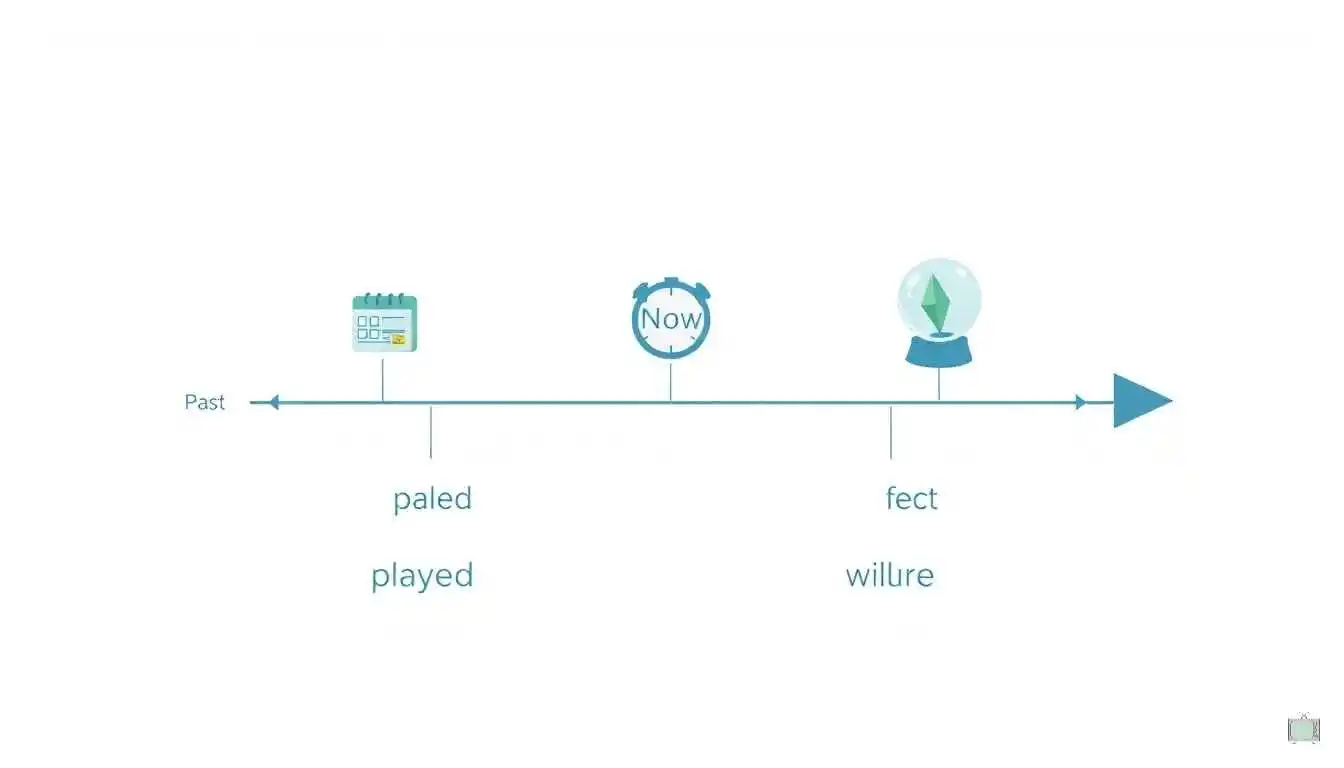
The Time Traveler’s Guide to English: Mastering Tenses Without the Headache
Introduction: The Day Mark Ordered “Yesterday” Coffee
Let me take you back to a rainy Tuesday in my intermediate English class. The room was quiet, save for the sound of rain against the window and the scratching of pens. We were doing a simple role-play exercise: ordering coffee at a busy café.
Mark, a bright and enthusiastic student from Brazil, stepped up to the front. He was confident. He smiled at his partner, who was playing the barista, and said with great enthusiasm, “Hello! I want coffee yesterday.”
The class went silent for a split second, then erupted in gentle laughter. Mark looked confused. “What? Is it wrong?”
I stopped the class and asked, “Mark, did you drink the coffee yesterday, or do you want it now?”
Mark’s eyes widened. “Now! I want it now!”
“Then why say yesterday?” I asked.
“Because… I had coffee yesterday too?” he shrugged.
That moment was a lightbulb moment not just for Mark, but for everyone in the room. We realized that tenses aren’t just grammar rules to memorize for a test. They are time machines. They tell our listeners when something happened. If you mix up the time, you mix up the reality. Mark didn’t just make a grammar mistake; he accidentally claimed he was drinking coffee in the past while standing there thirsty in the present.
For years, students have feared tenses. They see charts with twelve different boxes and panic. But here is the secret I’ve learned after 15 years of teaching: You don’t need to memorize every single rule at once. You just need to understand the logic of time. Once you see how English views the past, present, and future, the pieces fall into place.
In this guide, we are going to break down English tenses. No confusing jargon, no boring lectures. Just clear, simple explanations that will help you speak with confidence. Whether you are writing an essay, chatting with friends, or ordering coffee, you’ll know exactly which tense to use. Let’s start our journey through time.
What Are Tenses and Why Do They Matter?
At its simplest level, a tense is a form of a verb that shows when an action happens. In English, verbs change their shape to tell us if something is happening now, happened before, or will happen later.
Think of tenses like timestamps on a photo. If you look at a photo without a date, you might guess when it was taken based on the clothes or technology, but it’s not clear. A tense is the date stamp. It removes the guesswork.
Why Should You Care?
You might think, “People will understand me even if I get the tense wrong.” And often, they will. Context helps. But relying on context is exhausting for both you and the listener. Here is why mastering tenses is crucial:
- Clarity and Precision: If you say, “I live in London,” it means you live there now. If you say, “I lived in London,” it means you don’t live there anymore. That is a huge difference! One sentence describes your current life; the other describes your history. Tenses prevent misunderstandings.
- Professionalism: In job interviews or academic writing, incorrect tenses can make you seem less proficient or careless. Using the correct tense shows that you have control over the language. It builds trust.
- Storytelling Power: Humans love stories. But a story needs a timeline. If you jump between past and present randomly, your listener gets lost. Tenses allow you to paint a clear picture: “I was walking (past continuous) when I saw (simple past) the dog.”
- Confidence: When you stop worrying about whether you’re using the right form, you can focus on what you want to say, not how to say it. This reduces anxiety and makes speaking more enjoyable.
So, let’s look at how English organizes time. Unlike some languages that have very complex verb changes, English relies heavily on helper verbs (like do, have, will) and simple endings (like -ed or -ing).
Core Concepts: The Three Times and Four Aspects
This is where most students get stuck. They try to memorize 12 separate tenses. But there is a better way. Think of it as a grid.
There are 3 Times:
- Past (Before now)
- Present (Now)
- Future (After now)
And there are 4 Aspects (or “ways” of viewing the action):
- Simple (Just the fact)
- Continuous (In progress)
- Perfect (Completed/Connected)
- Perfect Continuous (Duration leading up to a point)
When you combine 3 Times x 4 Aspects, you get the 12 Tenses. But don’t panic! We don’t use all 12 equally. Some are rare. Let’s break them down by Time, which is how our brains naturally process information.
- The Present Tenses
- Simple Present
- Use: For facts, habits, and general truths.
- Example: “I play tennis.” (It’s a hobby I have.)
- Key Idea: It’s not happening right this second, but it’s true in my life.
- Present Continuous
- Use: For actions happening right now or temporary situations.
- Example: “I am playing tennis.” (I am on the court right now.)
- Key Idea: It’s in progress. You can usually add “now” to these sentences.
- Present Perfect
- Use: For actions that happened at an unspecified time in the past but matter now. Or experiences.
- Example: “I have played tennis.” (At some point in my life, I did this. It’s part of my experience.)
- Key Idea: Connects the past to the present. No specific time mentioned.
- Present Perfect Continuous
- Use: For actions that started in the past and are still continuing now.
- Example: “I have been playing tennis for two hours.” (I started 2 hours ago, and I’m still playing.)
- Key Idea: Focuses on the duration.
- The Past Tenses
- Simple Past
- Use: For completed actions at a specific time in the past.
- Example: “I played tennis yesterday.”
- Key Idea: It’s done. Finished. Over.
- Past Continuous
- Use: For actions that were in progress at a specific moment in the past.
- Example: “I was playing tennis when it started to rain.”
- Key Idea: Sets the scene. Something was happening when another thing interrupted it.
- Past Perfect
- Use: For an action that happened before another action in the past.
- Example: “I had played tennis before I went home.”
- Key Idea: The “past of the past.” It clarifies the order of events.
- Past Perfect Continuous
- Use: For an action that was ongoing up until another point in the past.
- Example: “I had been playing tennis for an hour when he arrived.”
- Key Idea: Duration before a past moment.
- The Future Tenses
- Simple Future
- Use: For predictions, promises, or spontaneous decisions.
- Example: “I will play tennis tomorrow.”
- Key Idea: A plan or prediction.
- Future Continuous
- Use: For actions that will be in progress at a specific time in the future.
- Example: “At 5 PM tomorrow, I will be playing tennis.”
- Key Idea: Imagine yourself in the future, in the middle of doing something.
- Future Perfect
- Use: For actions that will be completed before a specific time in the future.
- Example: “By 6 PM, I will have played my match.”
- Key Idea: Looking back from a future point.
- Future Perfect Continuous
- Use: For actions that will continue up until a specific future time.
- Example: “By 6 PM, I will have been playing for three hours.”
- Key Idea: Duration leading up to a future moment.
Note: In daily conversation, Simple Present, Simple Past, Present Continuous, and Simple Future are used 80% of the time. Master these first!
Real-Life Case Study: Elena’s Job Interview
Let’s look at Elena, a former student of mine. Elena was brilliant technically but struggled with English tenses during her job interview for a marketing role.
In her first mock interview, she said: “I work at Company X for three years. I manage the social media. I will launch a campaign last month.”
Her interviewer looked confused. Was she still working there? Did she launch it or will she? The timeline was messy.
We worked on fixing her tenses to tell a clear story:
- Past Experience: “I worked at Company X for three years.” (Simple Past – it’s finished.)
- Current Relevance: “I have managed several successful campaigns.” (Present Perfect – these are achievements she still holds.)
- Specific Past Action: “Last month, I launched a new campaign.” (Simple Past – specific time.)
- Future Goal: “In this role, I will create engaging content for your brand.” (Simple Future – promise/prediction.)
The difference was night and day. In her real interview, she used these corrected forms. She got the job. The hiring manager later told her, “Your communication was very clear. We knew exactly what you had done and what you could do.”
Tenses didn’t just fix her grammar; they clarified her professional value.
Benefits and Common Challenges
Understanding tenses brings freedom, but there are hurdles.
Benefits:
- Better Listening: You’ll understand movies and news better because you’ll catch the time clues.
- Clearer Writing: Your essays and emails will be logical and easy to follow.
- Social Connection: You can share stories about your past and dreams for your future accurately.
Common Mistakes/Challenges:
- Mixing Simple Past and Present Perfect: This is the #1 error. Remember: Simple Past needs a specific time (yesterday, in 2010). Present Perfect has no specific time (ever, never, already).
- Overusing Continuous: Saying “I am knowing him” instead of “I know him.” Stative verbs (like, know, love, believe) usually don’t take the -ing form.
- Ignoring Signal Words: Words like since, for, already, yet, just are huge clues. Ignoring them leads to wrong tense choices.
- Fear of Making Mistakes: Many students stay silent rather than risk using the wrong tense. But practice makes perfect. It’s better to try and correct than to stay silent.
Comparison Table: Quick Reference Guide
| Tense | Formula | Example | Key Use |
| Simple Present | Subject + V1 | I eat lunch. | Habits, facts |
| Present Continuous | Sub + am/is/are + V-ing | I am eating lunch. | Happening now |
| Simple Past | Subject + V2 | I ate lunch. | Completed past |
| Past Continuous | Sub + was/were + V-ing | I was eating lunch. | Past progress |
| Present Perfect | Sub + has/have + V3 | I have eaten lunch. | Past experience |
| Future Simple | Subject + will + V1 | I will eat lunch. | Future plan |
(V1 = Base form, V2 = Past form, V3 = Past Participle)
5 Proven Study Tips/Strategies
https://studio.youtube.com/video/TCmHZ94GI9A/edit

