

What Is a Parallelogram? The Shape Hiding in Plain Sight That Most Students Get Wrong
A Classroom Story That Changes Everything
Let me tell you about Arjun, a curious seventh-grader who sat right in front of my desk every single day. He was sharp with numbers, but the moment geometry chapters began, his confidence dropped. One day, while checking his homework, I found him staring at a slanted four-sided shape, completely stuck. He said, “Sir, this looks like a rectangle that someone pushed sideways. Is it even a real shape, or is it a mistake in the textbook?”
That question made me smile, because it was not a silly question at all. It was actually one of the smartest observations a student can make about a parallelogram. Arjun had noticed something true: a parallelogram really does look like a rectangle that has been gently pushed to one side, and understanding that single idea unlocks almost everything you need to know about this shape.
Over the next few classes, Arjun and I worked through parallelograms together, piece by piece, using real drawings, real measurements, and real everyday objects he could relate to. His marks improved, but more importantly, his fear of geometry disappeared. This post is written the same way I taught him: simple, visual, and step by step, so that by the end, you will look at a parallelogram and immediately understand exactly what makes it what it is.
Whether you are a student preparing for an exam, a parent helping with homework, or a teacher looking for a fresh way to explain this topic, this guide will walk you through everything about parallelograms in plain, friendly English.
What Is a Parallelogram?
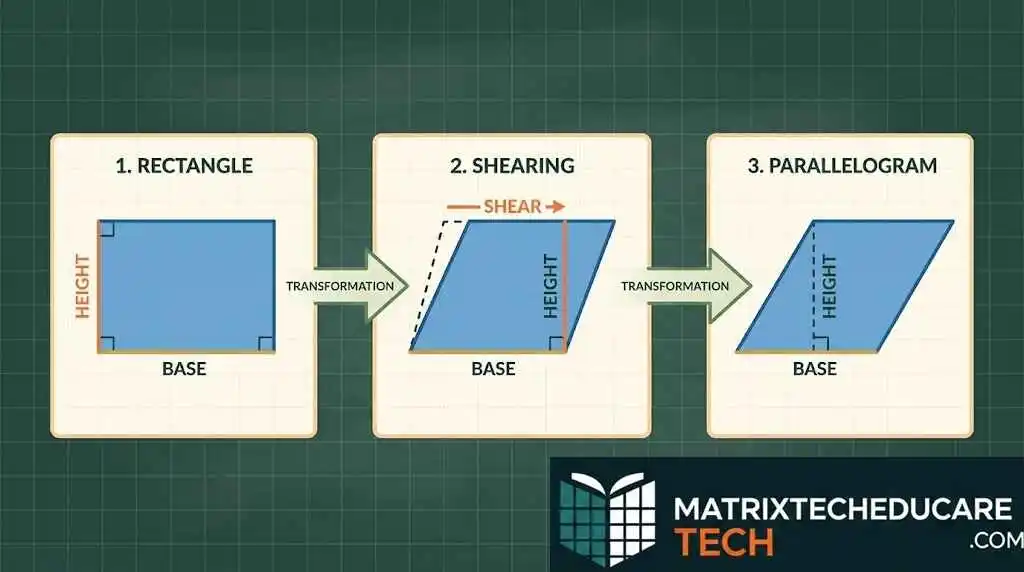
A parallelogram is a four-sided flat shape, known as a quadrilateral, where both pairs of opposite sides are parallel to each other and equal in length. Picture a rectangle, then gently push the top side sideways while keeping it the same length. The shape leans, the corners are no longer perfect right angles, but the opposite sides are still running in the same direction and are still the same length. That leaning shape is a parallelogram.
The Simple Definition
In plain terms: a parallelogram is a quadrilateral with two pairs of parallel sides. That is the entire definition. Everything else you learn about parallelograms, their angles, their diagonals, their area, all grows out of that one simple idea.
How to Recognize One Instantly
You can usually spot a parallelogram by checking three quick things:
- Does it have exactly four sides?
- Do the opposite sides look like they are running in the same direction, never meeting even if extended?
- Are the opposite sides equal in length?
If the answer to all three is yes, you are looking at a parallelogram, even if it is leaning, stretched, or drawn at an unusual angle.
Why Parallelograms Actually Matter
Students sometimes assume shapes like this exist only inside a textbook, but parallelograms show up constantly in the real world and in higher-level maths.
- Exams: Parallelogram properties, area formulas, and proofs appear in nearly every school geometry chapter and in most competitive maths papers.
- Engineering and architecture: Bridges, roof trusses, and support beams often use parallelogram shapes because of how evenly they distribute force.
- Everyday objects: Folding tables, scissors lifts, book stands, and even some phone stands rely on the parallelogram principle to move smoothly while keeping sides parallel.
- Foundation for advanced maths: Understanding parallelograms builds the base for learning vectors, coordinate geometry, and later, concepts in physics like force diagrams.
In short, once you truly understand this one shape, you are not just passing a maths test, you are building a mental tool that keeps showing up for years.
Core Concepts, Types, and How Parallelograms Work
Let’s break this shape down the way I broke it down for Arjun: properties first, then types, then the formulas that tie everything together.
The Five Key Properties of a Parallelogram
- Opposite sides are equal and parallel: This is the defining property. If a shape fails this test, it is not a parallelogram.
- Opposite angles are equal: The two angles facing each other across the shape are always identical in measure.
- Adjacent angles add up to 180 degrees: Any two angles that sit next to each other, sharing a side, always sum to a straight line, 180 degrees.
- Diagonals bisect each other: The two diagonals of a parallelogram always cross at their exact midpoints, cutting each other into two equal halves.
- Each diagonal divides the parallelogram into two congruent triangles: Drawing one diagonal splits the shape into two triangles that are exact mirror copies of each other in size and shape.
Types of Parallelograms
A parallelogram is actually a family name. Several familiar shapes are simply special members of that family, each adding one extra condition.
- Rectangle: A parallelogram where all four angles are exactly 90 degrees.
- Rhombus: A parallelogram where all four sides are equal in length, though the angles are not necessarily 90 degrees.
- Square: A parallelogram that is both a rectangle and a rhombus, meaning all sides are equal and all angles are 90 degrees.
- General or oblique parallelogram: A parallelogram with unequal adjacent sides and angles that are not 90 degrees, the classic leaning shape most people picture first.
This means every rectangle, every rhombus, and every square is technically a parallelogram, but not every parallelogram is a rectangle, rhombus, or square. Keeping this family tree in mind avoids a lot of exam confusion.
How the Area Formula Works
The area of a parallelogram is calculated as base multiplied by height, written simply as Area equals base times height. The base is any one side you choose, and the height is the perpendicular, straight up and down, distance from that base to the opposite side, not the length of the slanted side itself.
This is exactly where students like Arjun get confused. They often multiply the base by the slanted side instead of the true vertical height, which gives a wrong, larger answer. Always picture dropping a straight vertical line from the top side down to the base, that vertical line is your height.
How the Perimeter Formula Works
Since opposite sides are equal, the perimeter of a parallelogram is calculated as two times the sum of the base and the adjacent side, written as Perimeter equals 2 times (base plus side). You simply add one base length and one adjacent side length together, then double the result, because each pair of opposite sides contributes equally.
Step-by-Step: Proving a Shape Is a Parallelogram
- Check if one pair of opposite sides is both equal in length and parallel. If true, that alone is enough to prove the shape is a parallelogram.
- Alternatively, check if both pairs of opposite sides are equal in length.
- Alternatively, check if both pairs of opposite angles are equal.
- Alternatively, check if the diagonals bisect each other.
You only need to confirm one of these four conditions, not all of them, since each one automatically guarantees the others are also true.
A Real Student Success Story
Back to Arjun. After struggling with that first leaning shape, we tried something different. Instead of only drawing parallelograms on paper, we cut strips of cardboard, joined them loosely at the corners with paper pins, and pushed the frame sideways to actually watch it turn from a rectangle into a leaning parallelogram in real time. He could physically see the opposite sides staying parallel and equal while the angles changed.
From there, we practiced the area formula using grid paper, counting squares to double-check his calculations, which quickly showed him why using the slanted side instead of the vertical height gave the wrong answer. Within four weeks, Arjun went from consistently losing marks on parallelogram questions to solving multi-step problems involving diagonals and angle relationships with full confidence. His exam score on that geometry unit jumped from 58 percent to 91 percent, and just as importantly, he stopped dreading geometry class altogether.
Benefits of Mastering Parallelograms
- Stronger exam performance: Parallelogram questions appear repeatedly across school assessments and competitive maths exams.
- Sharper spatial reasoning: Understanding how sides and angles relate to each other trains your brain to visualize shapes more clearly.
- A smoother path into advanced topics: Vectors, coordinate geometry, and trigonometry all lean on the properties you learn here.
- Practical real-world understanding: You start noticing parallelogram structures in furniture, architecture, and engineering designs around you.
- Better problem-solving confidence: Once you master one reliable family of shapes, tackling new, unfamiliar geometry problems feels far less intimidating.
Common Mistakes and Challenges Students Face
- Using the slanted side as height: The height must always be the perpendicular distance to the base, never the length of the slanted side.
- Assuming all angles are 90 degrees: Only rectangles and squares have right angles; a general parallelogram usually does not.
- Confusing a parallelogram with a trapezium: A trapezium has only one pair of parallel sides, while a parallelogram has two pairs.
- Forgetting that diagonals are usually unequal: Unlike a rectangle, the two diagonals of a general parallelogram are not the same length, even though they do bisect each other.
- Mixing up perimeter and area formulas: Students sometimes multiply two sides together for perimeter, or add sides together for area, when the two formulas serve completely different purposes.
- Believing one property alone is not enough proof: Many students think you need to check every single property to confirm a shape is a parallelogram, when in fact just one condition, such as one pair of sides being equal and parallel, is sufficient.
Every one of these mistakes fades quickly once you practice with actual measurements and drawings instead of only memorizing formulas in the abstract.
Parallelogram vs Other Quadrilaterals: Quick Comparison Table
| Property | Parallelogram | Rectangle | Rhombus | Trapezium |
| Opposite sides parallel | Yes, both pairs | Yes, both pairs | Yes, both pairs | Only one pair |
| Opposite sides equal | Yes | Yes | Yes | Not required |
| All sides equal | Not required | Not required | Yes | Not required |
| All angles 90 degrees | Not required | Yes | Not required | Not required |
| Diagonals bisect each other | Yes | Yes | Yes | Not usually |
| Diagonals equal in length | Not usually | Yes | Not usually | Not usually |
| Area formula | base times height | length times width | half times diagonal 1 times diagonal 2 | half times sum of parallel sides times height |
5 Proven Study Tips and Strategies
1. Build a Physical Model
Cut four cardboard strips, pin the corners loosely, and push the frame into different shapes. Watching a rectangle turn into a leaning parallelogram with your own hands makes the properties impossible to forget.
2. Always Draw Before You Solve
Never attempt a parallelogram problem purely with numbers. Sketch the shape first, label the base and the perpendicular height separately, and the correct formula usually becomes obvious immediately.
3. memorize the Family Tree, Not Just Definitions
Instead of memorizing rectangle, rhombus, and square as separate unrelated shapes, remember them as special versions of a parallelogram. This single mental shortcut solves a huge number of exam questions instantly.
4. Practice Proofs with the One-Condition Rule
When proving a shape is a parallelogram, practice identifying just one sufficient condition, such as equal and parallel opposite sides, rather than trying to check every property every time. This saves time and builds real understanding.
5. Solve a Mixed Problem Set Weekly
Set aside time each week to solve a mix of area, perimeter, angle, and proof-based parallelogram questions together, rather than practicing each type in isolation. This mixed practice mirrors how exam papers are actually structured.
A parallelogram is simply a rectangle that has learned to lean, a four-sided shape held together by one elegant rule: both pairs of opposite sides stay parallel and equal, no matter how the shape tilts. Once that single idea clicks, everything else, the equal opposite angles, the bisecting diagonals, the area and perimeter formulas, falls neatly into place.
Just like Arjun, you do not need to fear this shape or memorize dozens of disconnected rules. You need one clear picture in your mind, a little hands-on practice, and the confidence to sketch before you calculate. Keep that leaning rectangle image with you, and parallelograms will quickly become one of the most comfortable, confidence-building topics in your entire geometry journey.
FAQs
- What is a parallelogram in simple words?
A parallelogram is a four-sided shape where both pairs of opposite sides are parallel and equal in length. Think of a rectangle that has been gently pushed sideways.
- Is a square always a parallelogram?
Yes, a square meets every condition of a parallelogram and adds two more, equal sides and right angles.
- Is every parallelogram a rectangle?
No, only parallelograms with all four angles equal to 90 degrees are rectangles. Most parallelograms have slanted angles.
- What is the area formula for a parallelogram?
The area is calculated as base multiplied by height, where height is the perpendicular distance between the two parallel bases.
- What is the perimeter formula for a parallelogram?
The perimeter equals two times the sum of the base and the adjacent side length, since opposite sides are always equal.
- Do the diagonals of a parallelogram bisect each other?
Yes, the two diagonals always cross at their exact midpoint, dividing each other into two equal parts.
- Are the diagonals of a parallelogram always equal?
No, only in special cases like rectangles and squares are the diagonals equal in length.
- What are opposite angles in a parallelogram?
Opposite angles are the two angles that face each other across the shape, and they are always equal in measure.
- What do adjacent angles in a parallelogram add up to?
Adjacent angles, which share a side, always add up to 180 degrees, since they sit along a straight line.
- How is a rhombus different from a parallelogram?
A rhombus is a parallelogram where all four sides are equal in length, though its angles are not necessarily 90 degrees.
- How is a trapezium different from a parallelogram?
A trapezium has only one pair of parallel sides, while a parallelogram always has two pairs of parallel sides.
- Can a parallelogram have all equal sides and angles?
Yes, when this happens the shape is specifically called a square, a special type of parallelogram.
- What is the minimum condition to prove a shape is a parallelogram?
Showing that just one pair of opposite sides is both equal and parallel is enough to prove the shape is a parallelogram.
- Why is height different from the side length in area calculations?
Height is the straight perpendicular distance between the bases, while the side length is often slanted, so using the side gives an incorrect area.
- Can a parallelogram have right angles without being a rectangle?
No, if all four angles are 90 degrees, the shape is automatically classified as a rectangle.
- Is a kite a type of parallelogram?
No, a kite has two pairs of adjacent equal sides rather than opposite parallel sides, so it does not qualify as a parallelogram.
- How many pairs of parallel sides does a parallelogram have?
A parallelogram always has exactly two pairs of parallel sides, which is the defining feature of the shape.
- What real-life objects are shaped like parallelograms?
Folding tables, certain roof trusses, scissor lifts, and some phone or laptop stands often use parallelogram structures.
- Do all four sides of a parallelogram have to be different lengths?
No, only opposite sides must be equal, so a parallelogram typically has two pairs of equal side lengths.
- What happens when you draw one diagonal in a parallelogram?
Drawing one diagonal splits the parallelogram into two congruent triangles that are identical mirror images of each other.
- Can the angles of a parallelogram be obtuse?
Yes, a general parallelogram commonly has two obtuse angles and two acute angles, unless it is a rectangle or square.
- Is a parallelogram a regular polygon?
No, a regular polygon requires all sides and all angles to be equal, which only happens in a square among parallelograms.
- How do coordinate points help identify a parallelogram?
By checking that the midpoints of both diagonals are the same point, or that opposite side vectors are equal, you can confirm a parallelogram on a coordinate plane.
- What is the sum of interior angles in a parallelogram?
Like any quadrilateral, the interior angles of a parallelogram always add up to 360 degrees.
- Why do engineers use parallelogram shapes in structures?
Parallelogram frames distribute force evenly along parallel sides, which is useful for creating movable, stable mechanical linkages.
- Can a parallelogram be concave?
No, a parallelogram is always a convex shape, meaning all interior angles are less than 180 degrees.
- What mistake do students make most with parallelogram height?
Students often use the slanted side length as the height instead of measuring the perpendicular distance between the bases.
- Is a rhombus always a rectangle?
No, a rhombus is only a rectangle when its angles are also 90 degrees, which makes it a square instead.
- How can I quickly identify a parallelogram in a diagram?
Check if opposite sides appear equal and never meet even when extended, along with equal opposite angles.
- What is the best way to practice parallelogram problems?
Mix area, perimeter, angle, and proof-based questions weekly, and always sketch the shape before calculating any values.
Disclaimer: The content on this blog is for informational purposes only. The author’s opinions are personal and not endorsed. Efforts are made to provide accurate information, but completeness, accuracy, or reliability are not guaranteed. The author is not liable for any loss or damage resulting from the use of this blog. It is recommended to use the information on this blog at your own discretion.

