

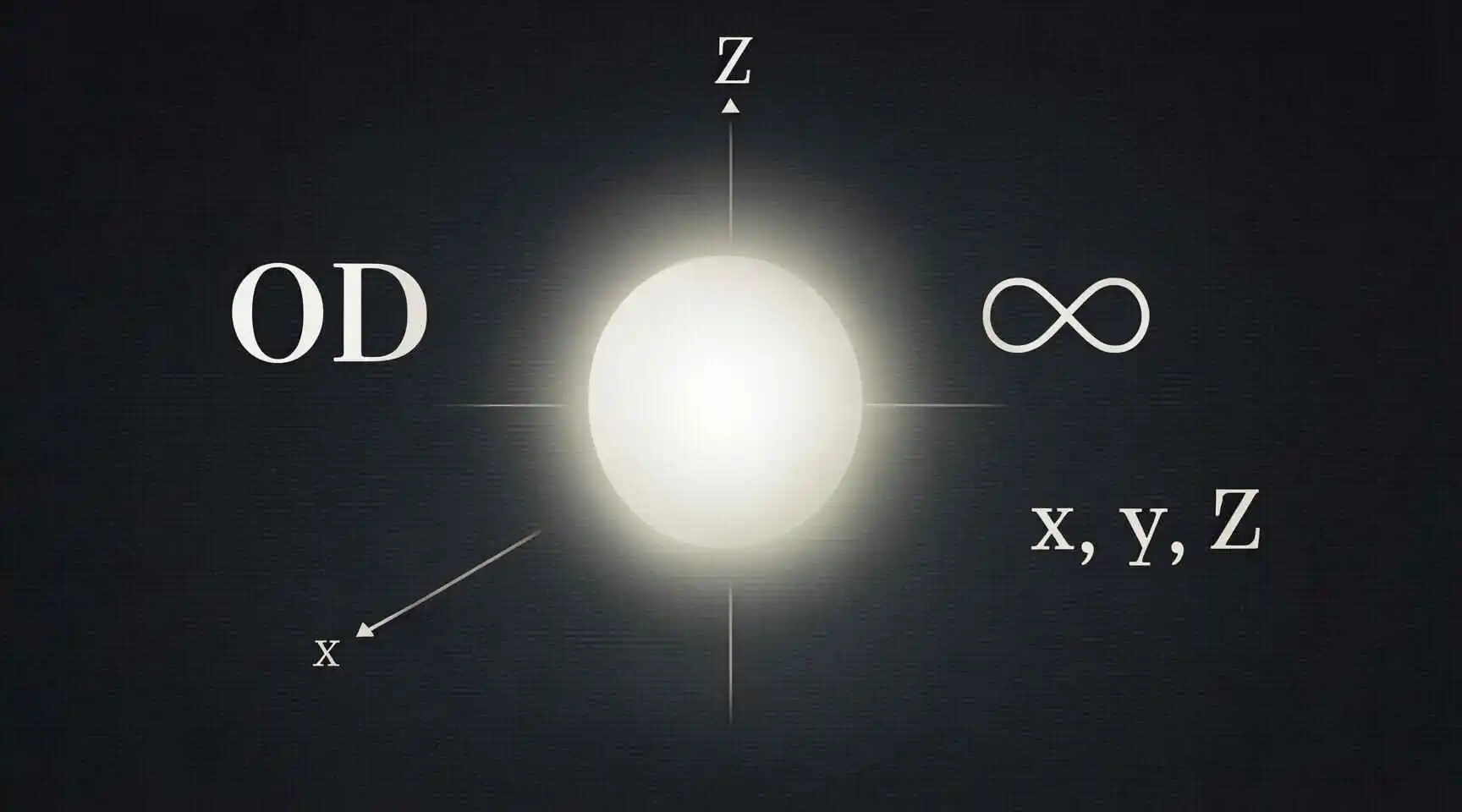
As we move into the future, our relationship with points is evolving. In the era of Big Data and AI, we are increasingly treating the entire world as a graph of points.
Social media is a network of points (people) connected by lines (friendships). The internet is a network of points (servers) connected by lines (cables). Your brain is a network of points (neurons) connected by lines (synapses).
A new field called Graph Theory treats these structures as mathematical objects. It doesn’t matter what the point is—whether it’s a protein, a person, or a webpage. It only matters how it is connected to other points.
In this context, the point becomes a node. It is a decision-making unit. It is a repository of information.
We are also moving toward Quantum Computing. In a quantum computer, the “bit” (a point that is either 0 or 1) is replaced by a “qubit.” A qubit is a point that exists in a “superposition”—it is a vector that can point in any direction on the Bloch Sphere. It is a point with a “spin.”
The point is becoming active. It is becoming smart.
Conclusion: The Hero of the Story
When we started, we said a point is “that which has no part.” It sounds insignificant. It sounds like nothing.
But look at what we have built with this nothing:
- It is the anchor for the Coordinates that map our planet.
- It is the origin of Dimension, creating length, area, and volume.
- It is the focal point of Singularities in black holes.
- It is the variable in Calculus that lets us understand motion.
- It is the pixel in your Data Visualization.
- It is the node in the Network of human knowledge.
The point is the invisible hero of mathematics and science. It is the perfect balance between existence and non-existence. It is the alpha and the omega of structure.
The next time you look at a map, check the weather, or simply tap your finger on a glass screen, remember the point. It is the zero-dimensional seed from which the complexity of our universe blooms.
FAQS
Fundamentals & Definition
1.What is the standard mathematical definition of a point?
A point is a zero-dimensional object that represents a specific location in space. It has no size, no length, no width, and no depth.
2.How did Euclid define a point?
Euclid, often called the “father of geometry,” famously defined a point as “that which has no part.”
3.Is a dot on a piece of paper a true mathematical point?
No. A dot made with ink or pencil has a physical size (width and diameter). A true mathematical point is infinitely small and cannot be seen.
4.What does “zero-dimensional” mean?
It means the object does not extend in any direction. It occupies a single location but takes up no volume or area.
5.Does a point have an inside or an outside?
No. Because it has no size or boundary, it cannot have an interior or an exterior.
Geometry & Coordinates
6.How did René Descartes change the way we view points?
Descartes invented the coordinate system, merging algebra and geometry. He gave points “addresses” (numerical coordinates) rather than just treating them as abstract locations.
7.What are Cartesian coordinates?
Cartesian coordinates are a system that uses numbers (like x, y, and z) to uniquely define the position of a point in space
- What is the “bridge” between numbers and shapes?
The point serves as the bridge. By assigning coordinates to points, we can turn geometric shapes (like circles and squares) into algebraic equations.
- How do you build a line from a point?
Mathematically, a line is generated by moving a point along a specific path. The point provides the position; the movement provides the dimension.
- Can a point have more than three coordinates?
Yes. In data science and theoretical physics, points can have 4, 5, or even thousands of coordinates (dimensions), though humans cannot visually represent beyond three dimensions.
Dimensions & Physics
- How are dimensions constructed from points? Dimensions are built hierarchically: A moving point creates a 1D line; a moving line creates a 2D plane; a moving plane creates a 3D space.
- How does physics define “point particles”?
In physics, particles like electrons and quarks are often treated as point particles—objects with mass but zero volume.
- What is the “Density Paradox” regarding points?
If a point has zero volume, then the density (Mass divided by Volume) of a point particle should be infinite. This highlights the conflict between mathematical points and physical reality.
- What is a singularity?
A singularity is a point, usually found at the center of a black hole, where density and gravity become infinite, and the laws of physics break down.
- Does nature allow for true mathematical points?
Likely not. Theoretical limits like the “Planck length” suggest nature might have a minimum size, meaning “points” in the real world might actually be tiny strings or loops rather than zero-dimensional dots.
Calculus & Movement
- What role do points play in Calculus?
Calculus studies change. It analyzes the behavior of a function at a specific, instantaneous point in time.
- What is a “Limit” in calculus?
A limit is the value that a function approaches as the input gets infinitely close to a specific point.
- How do you calculate speed at a single point?
You use derivatives. A derivative finds the slope of a curve at a single instant point by zooming in infinitely close.
- Why can’t you measure speed using just two points?
Two points only give you an average speed over a distance. To know the exact speed right now, you must look at the behavior at a single point.
Topology & Fractals
- What is Topology?
Topology is “rubber sheet geometry.” It studies the properties of space that are preserved under deformation, focusing on how points are connected rather than their distance apart.
- What is the “Line with Two Origins”?
It is a topological space where two distinct points occupy the exact same coordinate. It’s impossible in the physical world but valid in abstract mathematics.
- What is the Cantor Set?
The Cantor Set is a fractal created by repeatedly removing the middle third of a line segment.
- Does the Cantor Set have any length?
No. The total length of the Cantor Set is zero.
- Is the Cantor Set empty?
No. Despite having zero length, it contains an “uncountably infinite” number of points. It is a “dust” of points.
Digital & Data
- What is the difference between a Raster and a Vector point?
A Raster point (pixel) is a grid of fixed squares that loses quality when zoomed. A Vector point is a mathematical coordinate that remains perfect at any zoom level.
- How do computers store points?
Computers store points using “Floating Point Arithmetic,” a system of scientific notation that approximates real numbers.
- What is “Precision Error”?
Precision error occurs when a computer rounds a number because it doesn’t have enough memory to store the infinite decimals of a true mathematical point.
- How did a “point” error cause the Patriot Missile failure?
The computer tracked time in tenths of a second, but binary cannot represent 1/10 perfectly. This tiny floating-point error accumulated, causing the missile to miss its target.
- What is Graph Theory?
Graph theory is the study of networks, where “points” (called nodes) represent entities (like people or computers) and lines represent the connections between them.
- What is a “Qubit”?
A qubit is a quantum point used in quantum computing. Unlike a standard bit which is at one point (0 or 1), a qubit is a vector that can point in any direction, representing multiple states simultaneously.
Disclaimer: The content on this blog is for informational purposes only. Author’s opinions are personal and not endorsed. Efforts are made to provide accurate information, but completeness, accuracy, or reliability are not guaranteed. Author is not liable for any loss or damage resulting from the use of this blog. It is recommended to use information on this blog at your own terms.

