

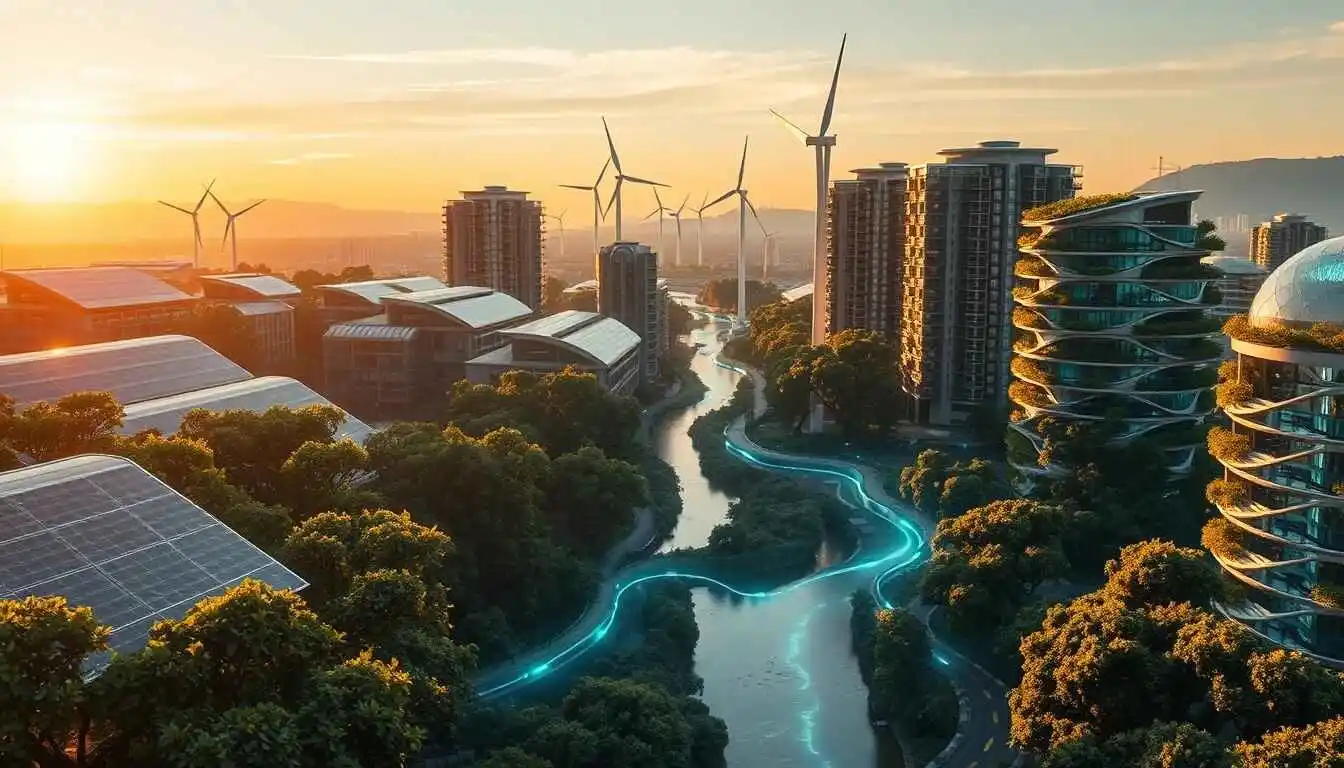
The Green Renaissance: How Technology is Hacking the Climate Crisis and Rebooting Our Planet
We stand at the most critical juncture in human history. For over a century, we powered our progress by digging up the past—burning ancient, fossilized sunlight in the form of coal, oil, and gas. We built empires on carbon, but the invoice for that progress has finally come due. It arrived in the form of melting ice caps, suffocating smog, unprecedented wildfires, and rising seas.
For a long time, the narrative surrounding the environment was one of sacrifice. To save the planet, we were told, we must regress. We must use less, travel less, build less, and accept a diminished quality of life. But what if that paradigm is fundamentally flawed? What if the ultimate key to saving the Earth isn’t turning back the clock to the Stone Age, but leaning forward into the Silicon Age?
Enter Green Technology—the audacious, brilliant, and rapidly evolving arsenal of innovations designed to heal the planet while simultaneously propelling human civilization forward. Green tech is not just about solar panels and wind turbines anymore; it is a sprawling, multi-trillion-dollar revolution encompassing artificial intelligence, synthetic biology, quantum computing, and advanced materials science. It is the marriage of human ingenuity and ecological necessity.
In this exhaustive, 4,000-word exploration, we will dive deep into the world of green technology. We will uncover how we are reimagining our power grids, revolutionizing transportation, redesigning our cities, and even hacking the very atmosphere itself. The Green Renaissance is here, and it is rewriting the rules of what is possible.
Chapter 1: The Genesis of Green — From Counterculture to the Mainstream
The concept of “green” technology wasn’t born in a corporate boardroom; it was born in the counterculture movements of the 1960s and 70s. When the 1973 oil crisis struck, the world saw the fragility of its fossil fuel addiction. Suddenly, the idea of harnessing the sun and wind wasn’t just for eccentric hobbyists—it was a matter of national security.
Early solar panels were clunky, wildly expensive, and highly inefficient. Wind turbines were small and unreliable. But the seed was planted. Over the next four decades, driven by a mix of environmental legislation, global climate agreements, and the relentless march of Moore’s Law, green tech evolved from a niche curiosity into an economic juggernaut.
Today, sustainable innovation is the primary driver of global economic growth. The cost of solar energy has plummeted by over 90% in the last two decades. Wind power is now the cheapest form of new electricity in most of the world. We have shifted from an era of scarcity—where clean energy was too expensive—to an era of abundance, where the limiting factor is no longer the cost of the technology, but the speed at which we can deploy it.
Chapter 2: The Power Shift — Unplugging from the Fossil Fuel Matrix
The cornerstone of the green tech revolution is the complete overhaul of how we generate, store, and distribute power. The old, centralized grid—a one-way street from massive, polluting power plants to passive consumers—is dying. In its place, a dynamic, decentralized, and intelligent energy web is emerging.
The Solar Revolution: Beyond Silicon
Solar photovoltaic (PV) technology has been the undisputed champion of the energy transition, but we are reaching the theoretical limits of traditional silicon cells. The next frontier is Perovskite solar cells. These synthetic materials are cheaper to manufacture, flexible, and can be “printed” like newspaper ink. Imagine windows that generate electricity, or electric cars whose paint acts as a solar panel. Perovskites could make every sunlit surface a micro-power plant.
Wind Power: Floating Leviathans
While onshore wind is well-established, the future of wind energy is offshore. Ocean winds are stronger and more consistent. Today, engineering marvels like the Haliade-X turbine stand taller than the Eiffel Tower and can power a home for two days with a single rotation.
But the real game-changer is floating wind farms. By mounting turbines on massive, buoyant platforms moored to the ocean floor, we can access deep-water wind corridors that were previously inaccessible, unlocking enough wind energy to power the entire globe several times over.
The Holy Grail: Grid-Scale Energy Storage
The sun doesn’t always shine; the wind doesn’t always blow. The Achilles’ heel of renewables has always been intermittency. To run a world on green energy, we need massive, clean tech batteries capable of storing gigawatts of power.
Lithium-ion batteries have done wonders for electric vehicles, but they are too expensive and resource-intensive for grid storage. Enter the era of alternative battery chemistries:
- Iron-Air Batteries: Using one of the most abundant elements on Earth, these batteries “breathe” oxygen from the air to convert iron to rust (discharging) and then reverse the process (charging), providing dirt-cheap, long-duration storage.
- Solid-State Batteries: Replacing liquid electrolytes with solids, these batteries pack more energy, charge in minutes, and eliminate fire risks.
- Flow Batteries: Storing energy in large tanks of liquid electrolytes, flow batteries can scale up infinitely simply by building bigger tanks, making them perfect for holding city-sized amounts of solar power for the night.
Chapter 3: The Electric Revolution — When Rubber Meets the Regenerative Road
Transportation accounts for nearly a quarter of global CO2 emissions. The internal combustion engine is a relic of the 19th century, and its expiration date has arrived. The electrification of transport is accelerating at a breakneck pace, reshaping not just how we drive, but the very fabric of our cities.
The EV Surge and the Solid-State Horizon
Electric vehicles (EVs) have gone from luxury novelties to mainstream necessities. However, the next leap in EV tech relies on solid-state batteries, which will double the range of current vehicles, reduce charging times to the time it takes to pump gas, and eliminate the rare-earth cobalt that taints the current supply chain.
Furthermore, the concept of Vehicle-to-Grid (V2G) technology will turn millions of parked EVs into a decentralized mega-battery. While you sleep, your car will sell excess power back to the grid during peak demand, and recharge when electricity is cheap and abundant, turning a depreciating asset into a revenue stream.
Taking Flight: Sustainable Aviation
Aviation is one of the hardest sectors to decarbonize. Batteries are simply too heavy to push a jumbo jet across the Atlantic. But green tech is tackling this through Sustainable Aviation Fuels (SAFs) made from municipal waste, algae, and even captured CO2.
Furthermore, the resurgence of airship technology—modern zeppelins powered by solar and hydrogen—could revolutionize cargo transport, moving goods slowly but with near-zero emissions. Meanwhile, short-haul electric planes and eVTOLs (electric vertical takeoff and landing vehicles) are poised to launch urban air mobility, turning traffic jams into a thing of the past.
Hydrogen: The Missing Link
For heavy transport—container ships, freight trains, and long-haul trucks—batteries don’t pack enough energy density. The answer is Green Hydrogen. By using excess renewable electricity to split water into oxygen and hydrogen (electrolysis), we can create a clean, combustible fuel. When used in a fuel cell, hydrogen combines with oxygen to produce electricity, with the only byproduct being pure water. Green hydrogen is the “Swiss Army knife” of the energy transition, capable of decarbonizing steel manufacturing, heavy transport, and long-term energy storage.
Chapter 4: Building Tomorrow — The Concrete Jungle Gets a Green Makeover
Our cities are massive carbon sinks, and the buildings we inhabit are responsible for nearly 40% of global emissions. The materials we use to build them, and the energy we use to heat and cool them, must be radically reimagined.
The Menace of Cement and the Bio-Brick Revolution
Cement production alone accounts for 8% of global CO2 emissions. It is the glue of modern civilization, but it is an environmental nightmare. Green tech is fighting back with eco-friendly materials.
Companies are developing bio-bricks made from bacteria, sand, and urea, which grow at room temperature and actually absorb CO2 rather than emit it. Others are creating concrete infused with graphene, making it vastly stronger and requiring significantly less material. Furthermore, “green cement” is being formulated using industrial waste products like fly ash and slag, closing the loop on industrial waste.
Net-Zero Architecture and Biophilic Design
The buildings of the future won’t just use less energy; they will produce more than they consume. Passive House standards, utilizing ultra-thick insulation, airtight construction, and smart orientation, can reduce heating and cooling needs by 90%.
Dynamic glass that tints automatically based on the sun’s angle eliminates the need for blinds and reduces air conditioning loads. Building-Integrated Photovoltaics (BIPV) turn entire facades and roofs into seamless solar generators. Coupled with biophilic design—integrating living walls, indoor forests, and natural ventilation—tomorrow’s skyscrapers will act more like living, breathing trees than inert steel towers.
The Smart City and the IoT Nervous System
A city can only be as green as its operating system. The integration of the Internet of Things (IoT) and smart grid technology is turning cities into intelligent, responsive organisms.
Smart streetlights adjust brightness based on pedestrian traffic. AI-driven traffic lights eliminate idling, slashing urban emissions. Sensors in water pipes detect leaks instantly, saving millions of gallons of treated water. Buildings communicate with the grid in real-time, shifting non-essential power usage to times when renewable energy is abundant. The smart city doesn’t just optimize resources; it fundamentally redefines urban living.
Chapter 5: The Circular Economy — Waste is a Design Flaw
For centuries, humanity has operated on a linear economic model: Take, Make, Dispose. We extract resources, manufacture products, and dump them in a landfill. This model is fundamentally incompatible with a finite planet. Green tech is ushering in the Circular Economy, a system where waste is entirely eliminated, and every product is designed to be endlessly recycled, repaired, or composted.
Chemical Recycling: Alchemy for the 21st Century
Mechanical recycling—melting down plastic bottles—is limited; the plastic degrades with each cycle until it becomes useless. Chemical recycling, however, breaks plastics down to their molecular building blocks, allowing them to be rebuilt into virgin-quality plastic infinitely. This technology has the potential to solve the global plastic crisis, turning our oceans of waste into a valuable resource reservoir.
The Internet of Trash and AI Sorting
One of the biggest hurdles in recycling is contamination—putting the wrong item in the wrong bin. AI-powered robotic sorting systems are changing the game. Using computer vision and machine learning, these robots can identify and sort different types of plastics, metals, and paper at superhuman speeds, ensuring pure material streams that can be effectively recycled.
Lab-Grown Everything: Ending Resource Extraction
The most effective way to deal with waste is to not create it in the first place. Biotechnology is allowing us to “grow” the materials we need rather than extracting them.
- Lab-Grown Leather: Produced by fermenting yeast cells, bio-leather mimics the real thing without the massive methane emissions, land use, and cruelty of animal agriculture.
- Mycelium Packaging: Made from mushroom roots, this biodegradable material is replacing Styrofoam. It can be grown in molds to fit any shape and decomposes in your garden in weeks.
- Cellular Agriculture: We are now growing real meat, dairy, and seafood in bioreactors, decoupling food production from land degradation and deforestation.
Chapter 6: Agri-Tech — Feeding the World Without Eating the Planet
Agriculture is arguably humanity’s most destructive endeavor. We use 70% of the world’s freshwater and clear vast swaths of forest to grow food, often inefficiently. Green technology is rewriting the agricultural playbook, moving from “farming” to “food production engineering.”
Precision Agriculture: Data as Fertilizer
The era of blanketing fields with water, pesticides, and fertilizers is ending. Precision agriculture uses drones, satellite imagery, and soil sensors to treat every square inch of a field individually. AI algorithms analyze this data to tell farmers exactly when and how much to water, and exactly where pests are, reducing chemical usage by up to 90% and vastly increasing yields.
Vertical Farming: Skyscrapers of Salad
By moving crops indoors and stacking them vertically, we can grow food in the middle of megacities, eliminating the carbon footprint of transportation. Vertical farms use hydroponics or aeroponics (growing plants in mist), requiring up to 95% less water than traditional farming. Because the environment is perfectly controlled—light, temperature, and nutrients—crops grow twice as fast and require zero pesticides. A 30-story vertical farm can produce the same amount of food as 2,000 acres of traditional farmland.
Cultured Meat: The Post-Slaughter Protein
Livestock is a massive driver of carbon footprint and deforestation. The advent of cultured meat—real animal meat grown from stem cells in a bioreactor—could be the most consequential food innovation in history. It requires a fraction of the land and water, produces a fraction of the emissions, and eliminates the ethical concerns of animal slaughter. As costs plummet, lab-grown meat is poised to disrupt the trillion-dollar agricultural industry.
Chapter 7: The Big Fix — Hacking the Atmosphere with Carbon Capture
Even if we were to halt all global emissions today, the carbon already trapped in the atmosphere guarantees decades of continued warming. To truly stabilize the climate, we must not only stop emitting; we must remove what we’ve already dumped. This requires climate change mitigation on a planetary scale.
Direct Air Capture (DAC): Vacuuming the Sky
Direct Air Capture is exactly what it sounds like: massive fans pull in atmospheric air, and chemical filters bind to the CO2, stripping it from the air. The captured carbon can then be pumped deep underground for permanent storage in geological formations, or used to make carbon-neutral fuels and building materials. While currently expensive, economies of scale and new sorbent technologies are rapidly driving costs down, making DAC a vital tool in the climate arsenal.
Bioenergy with Carbon Capture and Storage (BECCS)
BECCS is the only energy technology that results in net-negative emissions. We grow fast-growing biomass (like switchgrass or bamboo), which absorbs CO2 as it grows. We then burn this biomass for energy, but instead of letting the smoke go into the air, we capture the CO2 and bury it. The result is power generation that actively removes carbon from the atmosphere.
Enhanced Weathering: Speeding Up Nature
Nature already removes CO2 from the air through the weathering of rocks. Rain combines with CO2 to form carbonic acid, which dissolves rocks, eventually washing the carbon into the ocean where it is stored as limestone. However, this process takes millennia. Enhanced weathering grinds up basalt rock and spreads it on farmland. This massively increases the surface area, accelerating the reaction to lock away carbon in a matter of years, while simultaneously fertilizing the soil.
Chapter 8: The Digital Ecosystem — Green Computing and the AI Overlord
It is a great irony that the technology helping us save the physical world is exacting a massive toll on it. Data centers—the physical muscle of the cloud—consume about 1% of global electricity. Training a single large AI model can emit as much carbon as five cars over their entire lifetimes. The digital world is deeply physical, and green computing is the only way to prevent our tech addiction from frying the planet.
Underwater and Subterranean Data Centers
To cool servers, data centers use immense amounts of energy. Microsoft’s Project Natick tested the concept of underwater data centers, using the freezing ocean as a natural coolant, drastically reducing energy consumption and eliminating the need for land use. Similarly, companies are moving data centers into deep, abandoned mines in Scandinavia, utilizing the geothermal cooling and 100% renewable energy.
Immersion Cooling and Neuromorphic Chips
Instead of blowing cold air through server rooms, immersion cooling submerges entire servers in specialized, non-conductive liquids that absorb heat thousands of times more efficiently than air. On the hardware side, neuromorphic computing—chips that mimic the architecture of the human brain—promises to reduce the energy required for AI processing by orders of magnitude.
AI for Earth: The Ultimate Optimization Engine
Despite its carbon footprint, AI is perhaps our most powerful weapon against climate change. AI algorithms are being deployed to optimize power grids, predict extreme weather events, discover new battery materials, and track deforestation via satellite in real-time. When the savings generated by AI optimization vastly outweigh its energy cost, AI transitions from a climate liability to a climate savior.
Chapter 9: The Blue Economy — Tech Beneath the Waves
The ocean covers 70% of the Earth, absorbs 30% of our CO2, and provides the primary protein source for billions. Yet, it is the most over-exploited and under-protected ecosystem on the planet. Green tech is finally turning its gaze to the deep.
Ocean Energy: Riding the Waves
The ocean is a massive, untapped battery of kinetic energy. Technologies like oscillating water columns, point absorbers, and tidal turbines are capturing the relentless energy of waves and tides. Unlike wind and solar, tidal energy is 100% predictable, providing a stable baseload power that doesn’t require battery backup.
Sustainable Aquaculture and Kelp Farming
Overfishing is decimating marine life. Highly controlled, offshore aquaculture farms are using AI and robotics to farm fish sustainably, without the disease, pollution, and habitat destruction associated with coastal fish farms.
Even more promising is the rise of kelp farming. Kelp grows inches a day without the need for fresh water, fertilizer, or land. It sequesters massive amounts of carbon, creates habitat for marine life, and can be harvested to make biodegradable plastics, biofuels, and nutrient-rich food.
Chapter 10: The Green Wallet — ESG Investing and the Business of Survival
For decades, the business world viewed environmentalism as an expensive externality. Today, the math has flipped. The cost of inaction is becoming greater than the cost of transition. The financial world is waking up to the reality that sustainable business is the only business that will survive the 21st century.
The Rise of ESG
ESG investing—evaluating companies based on their Environmental, Social, and Governance practices—has moved from the margins to the mainstream. Trillions of dollars are now managed under ESG criteria. Investors realize that companies heavily reliant on fossil fuels or unsustainable practices carry massive stranded-asset risks. Capital is flowing toward green tech at an unprecedented rate, fueling an explosion of innovation.
Carbon Pricing and Green Bonds
To truly incentivize green tech, we must make pollution expensive. Carbon pricing—whether through a carbon tax or cap-and-trade systems—forces the market to internalize the environmental cost of emissions. When carbon is expensive, clean tech becomes the cheaper alternative, driving rapid adoption.
Furthermore, the proliferation of Green Bonds is financing the transition. These fixed-income instruments are specifically earmarked to raise money for climate and environmental projects, funneling billions into renewable energy, clean transport, and sustainable agriculture.
Chapter 11: The Dark Side of Green — The Hidden Costs and Challenges
To herald green tech as a flawless savior would be disingenuous. The transition to a green economy carries its own significant environmental and social risks that we must navigate carefully.
The Resource Curse: Mining for the Future
EVs and renewable energy require massive amounts of lithium, cobalt, nickel, and rare earth elements. Mining these materials often involves horrific environmental degradation, water contamination, and human rights abuses, particularly in the Democratic Republic of Congo and parts of South America. The green transition cannot be built on the back of ecological and social exploitation. We must develop deep-sea mining regulations, improve recycling of electronic waste, and find alternative chemistries that rely on abundant, benign materials.
Greenwashing: The Illusion of Action
As green tech has become profitable, “greenwashing” has become rampant. Corporations and governments frequently tout minor, superficial green initiatives to mask their continued reliance on fossil fuels. We must remain vigilant, demanding rigorous, transparent, and scientifically verified data to ensure that promises of net-zero are backed by actual emissions reductions.
The Jevons Paradox
In 1865, William Stanley Jevons observed that as technology improves the efficiency of a resource, the cost of using that resource drops, leading to an increase in total consumption. If we make energy vastly cheaper and more efficient through green tech, we risk simply using more of it, negating the environmental benefits. True sustainability requires not just green tech, but a cultural shift toward sufficiency—knowing when enough is enough.
Conclusion: Rebooting the Operating System of Earth
The Green Renaissance is not a gentle, incremental upgrade; it is a radical overhaul of the operating system of human civilization. It is the recognition that the economy is a wholly-owned subsidiary of the environment, and that if the environment collapses, the economy will follow.
Green technology offers us a bridge between the world we have and the world we want. It proves that we do not have to choose between prosperity and preservation. We can have thriving economies, abundant energy, and advanced societies without destroying the only home we have.
But technology alone will not save us. It is merely a tool. The outcome depends entirely on the wielder. We need the political will to enact bold policies, the financial courage to redirect capital, and the cultural humility to respect the boundaries of nature. We are the first generation to feel the sting of climate change, and the last generation that can do anything about it. The tools are in our hands. The time to build the future is now.
FAQS
The Basics of Green Technology
1.What exactly is green technology?
Green technology (greentech) is the application of environmental science and technology to conserve the natural environment and its resources, while mitigating the negative impacts of human activity.
- What is the difference between green tech, clean tech, and environmental tech?
While often used interchangeably, “greentech” historically encompassed regulatory compliance and remediation, “cleantech” specifically refers to commercially viable tech that reduces environmental impact (heavily focused on energy and efficiency), and “environmental tech” is a broader academic term for tech used to study and protect the environment.
- Why is green technology so important for our future?
It is crucial for mitigating climate change, reducing pollution, conserving finite natural resources, and transitioning society to a sustainable, carbon-neutral economy before environmental damage becomes irreversible.
- When did the green technology movement begin?
While early conservation efforts existed for centuries, the modern green tech movement emerged in the 1970s, spurred by the environmental movement, the creation of the Environmental Protection Agency (EPA), and the 1973 oil crisis.
- What are the primary goals of green technology?
The main goals are sustainability (meeting present needs without compromising future generations), source reduction (reducing waste and consumption), innovation (creating alternatives to harmful practices), and viability (making green solutions economically practical).
Types and Examples
- What are the most common examples of green technology today?
Common examples include solar panels, wind turbines, electric vehicles (EVs), LED lighting, smart thermostats, and advanced water purification systems.
- How do solar panels and photovoltaic cells work?
Photovoltaic (PV) cells are made of semiconductor materials like silicon. When sunlight hits them, it knocks electrons loose from their atoms. This flow of electrons creates an electrical current that is then harnessed to power grids.
- What are the latest advancements in wind turbine technology?
Advancements include floating offshore wind farms that access stronger, consistent deep-sea winds, bladeless wind turbines that generate energy through vibration, and AI-driven blade pitching that optimizes efficiency in changing winds.
- What is a “smart grid” and how does it make energy use more efficient?
A smart grid uses digital communication technology to monitor and manage the transport of electricity from generation sources to consumers. It reduces waste, prevents blackouts, integrates renewable energy smoothly, and balances demand in real time.
- How do electric vehicles (EVs) reduce carbon footprints?
EVs produce zero tailpipe emissions. While their overall carbon footprint depends on the electricity grid that charges them, as grids become more renewable, EVs become increasingly cleaner than internal combustion engine vehicles over their lifespan.
- What is green hydrogen and why is it considered a game-changer?
Green hydrogen is hydrogen fuel produced using renewable energy to split water into hydrogen and oxygen (via electrolysis). It’s a game-changer because it can decarbonize heavy industries—like steel manufacturing and shipping—that are difficult to run on electricity or batteries.
- How is artificial intelligence used in green tech?
AI optimizes smart grids, predicts weather patterns for renewable energy generation, improves supply chain efficiency to reduce waste, monitors deforestation via satellite, and accelerates the discovery of new sustainable materials.
- What role does biotechnology play in creating sustainable materials?
Biotech is used to develop biofuels from algae, create biodegradable bioplastics from plant starches, and engineer microbes that can break down environmental pollutants or manufacture chemicals without toxic byproducts.
- Are biodegradable plastics really an effective green technology?
They can be, but with caveats. Many biodegradable plastics only break down under specific industrial composting conditions, not in the ocean or a backyard. True green bioplastics made from renewable biomass that decompose safely in natural environments are the more effective goal.
Environmental and Economic Impact
- How does green technology help combat climate change?
It reduces greenhouse gas emissions by replacing fossil fuels with renewables, improving energy efficiency, and capturing carbon from the atmosphere, thereby slowing the greenhouse effect and global warming.
- Can green technology actually reverse existing environmental damage?
Some technologies, like carbon capture and storage (CCS), direct air capture, and bioremediation (using microbes to clean polluted soil/water), can help reverse damage, but they must be paired with emission reductions to be truly effective.
- Does the green tech industry create more jobs than it phases out?
Yes. The transition to a green economy is generally a net job creator. Renewable energy sectors (like solar and wind installation and maintenance) are more labor-intensive than the highly automated fossil fuel extraction industries.
- Is green technology more expensive than traditional technology?
Historically, yes, but costs have plummeted. Solar and wind are now the cheapest sources of new electricity in most of the world. While upfront costs for things like EVs or heat pumps can be higher, lower operational costs make them cheaper over the lifespan of the product.
- How does green tech improve public health globally?
By reducing the burning of fossil fuels, green tech drastically cuts air and water pollution. This leads to lower rates of asthma, cardiovascular disease, and other pollution-related illnesses, particularly in urban areas.
- What is the “circular economy” and how does green tech support it?
A circular economy minimizes waste by keeping products and materials in use for as long as possible through reuse, repair, and recycling. Green tech supports this via advanced recycling methods, biodegradable materials, and digital tracking of product lifecycles.
Challenges and Limitations
- What are the biggest barriers to adopting green technology worldwide?
Major barriers include high initial capital costs, lack of supporting infrastructure (like EV charging stations or updated grids), political resistance from fossil fuel industries, and the technical challenges of scaling new technologies.
- Are there hidden environmental costs to green tech (e.g., mining for lithium)?
Yes. Manufacturing EV batteries and solar panels requires mining rare earth elements and metals like lithium, cobalt, and copper. This mining can cause habitat destruction, water pollution, and human rights issues if not strictly regulated.
- Why is energy storage such a major hurdle for renewable power?
Solar and wind are intermittent—the sun doesn’t always shine, and the wind doesn’t always blow. Without large-scale, affordable energy storage (like grid-scale batteries), it is difficult to maintain a consistent power supply to meet demand at all times.
- How reliable is green energy during extreme weather conditions?
It can be vulnerable (e.g., solar panels under heavy snow, turbines in extreme cold). However, diversified grids combining wind, solar, geothermal, and hydropower, backed by robust battery storage and connected via smart grids, ensure high reliability even in extreme weather.
- Is it difficult to recycle green technology components like solar panels and batteries?
Currently, yes. Recycling these items is complex and expensive because they contain small amounts of valuable materials mixed with hazardous ones. However, new recycling technologies and regulations are rapidly emerging to handle the coming wave of end-of-life green tech.
Consumers and Business
- How can the average person incorporate green technology into their daily life?
Individuals can install smart thermostats, switch to LED bulbs, purchase renewable energy from their utility provider, drive hybrid or electric vehicles, and use smart home energy monitors to reduce consumption.
- What government incentives or tax credits are available for residential green tech?
Many governments offer incentives such as tax credits for installing solar panels and EV chargers, rebates for purchasing electric vehicles, and grants for improving home energy efficiency (like the Inflation Reduction Act in the US).
- How can businesses benefit financially from investing in green technology?
Businesses save money through reduced energy and water consumption, gain tax incentives, improve brand reputation to attract eco-conscious consumers, and future-proof themselves against rising carbon taxes and fossil fuel volatility.
- What is LEED certification in green building technology?
LEED (Leadership in Energy and Environmental Design) is a globally recognized rating system for the design, construction, and operation of highly efficient green buildings. It scores buildings on metrics like energy use, water efficiency, and indoor air quality.
- What is the single most promising green technology to watch in the next decade?
While it’s hard to pick just one, green hydrogen and advanced grid-scale energy storage (like solid-state batteries) are widely considered the most critical breakthroughs needed to fully decarbonize the global economy, particularly in heavy industry and transportation.
Disclaimer: The content on this blog is for informational purposes only. Author’s opinions are personal and not endorsed. Efforts are made to provide accurate information, but completeness, accuracy, or reliability are not guaranteed. Author is not liable for any loss or damage resulting from the use of this blog. It is recommended to use information on this blog at your own terms.

