

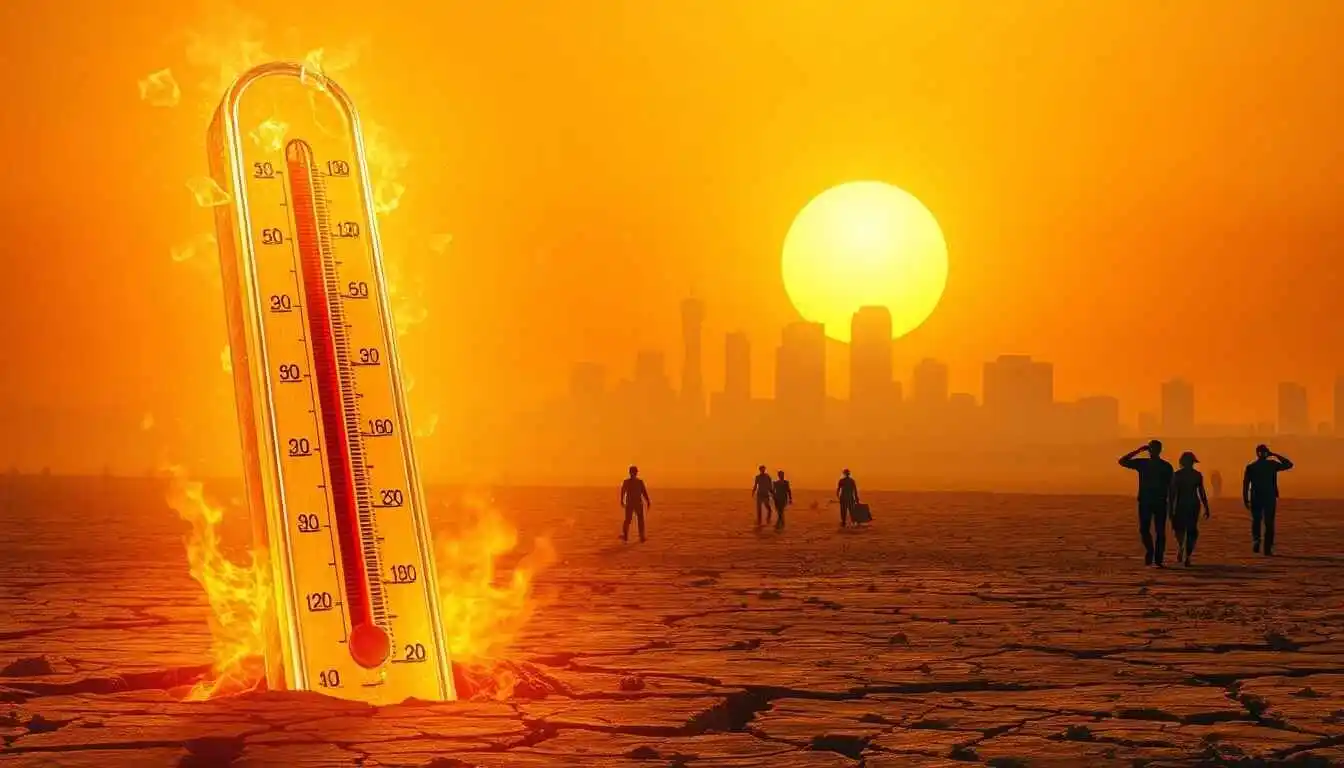
Inside the UN’s Chilling Warning That the Next Five Years Will Shatter Heat Records
Close your eyes and think of the hottest day you have ever felt in your life. Remember the way the sun seemed to bore into your skin, how the air felt thick and suffocating in your lungs, how the pavement shimmered with waves of radiant heat. Now, imagine being told that this day—this unbearable, record-breaking day—will soon be considered a cool afternoon in comparison to what is coming.
This is not the plot of a dystopian novel. It is the stark, scientifically backed reality presented by the United Nations and the World Meteorological Organization (WMO). In a report that sent shockwaves through the global community, climate scientists have issued a red-alert warning: the next five years are almost certain to be the hottest period in human history.
We are no longer staring at the climate crisis through a telescope; it has breached the walls of our reality. The Earth is running a fever, and the prognosis is alarming. The UN’s warning isn’t merely about uncomfortable summers; it is a clarion call about the cascading, catastrophic collapse of the delicate systems that make our planet habitable.
As we stand on the precipice of this thermal abyss, we must understand the science, absorb the implications, and most importantly, figure out how to navigate the inferno. Let us dive deep into the UN’s chilling forecast, the mechanics behind the rising mercury, the devastating human and ecological toll, and the flickering flame of hope that still remains if we choose to act.
The Verdict is In: Decoding the UN’s Stark Warning
In mid-2023, the World Meteorological Organization released a report that stripped away any remaining climate complacency. The findings were unequivocal: there is a 98% likelihood that at least one of the next five years, and the five-year period as a whole, will be the warmest on record. Furthermore, there is a 66% likelihood that the annual average near-surface global temperature will temporarily exceed pre-industrial levels by more than 1.5°C in at least one of the next five years.
To the uninitiated, 1.5°C might sound like a negligible shift—barely enough to notice when adjusting the thermostat in your living room. But in the context of the planet’s climate, it is a monumental leap. The difference between the global average temperature today and during the Ice Age was only about 5°C. A 1.5°C shift is enough to rewrite the geography of coastlines, alter weather patterns permanently, and push ecosystems past the point of no return.
The 1.5°C threshold is not arbitrary. It is the ambitious target set by the 2015 Paris Agreement, a globally recognized guardrail designed to prevent the most severe and irreversible impacts of climate change. The UN’s warning does not mean we have permanently breached this limit—natural variability means temperatures can temporarily spike and dip—but it signals that we are rapidly exhausting our carbon budget. We are knocking on the door of the point of no return, and the planet is starting to push back.
The Greenhouse Gas Trap: The Engine of the Inferno
To understand why the next five years will be so brutal, we must look at the primary driver of this crisis: the relentless accumulation of greenhouse gases (GHGs) in our atmosphere.
Since the dawn of the Industrial Revolution, humanity has been running a massive, uncontrolled experiment on the Earth’s atmosphere. By burning fossil fuels—coal, oil, and natural gas—we have released hundreds of billions of tons of carbon dioxide (CO2) and methane into the air. These gases act like a thick, planetary blanket. Sunlight passes through them to warm the Earth, but the heat radiating back from the surface is trapped, steadily raising the global temperature.
The accumulation is cumulative. Even if we were to stop all emissions today, the gases already released would continue to trap heat for decades, if not centuries. This climate lag means that the record-breaking emissions of the past few years are only now fully manifesting their heating potential.
We have pumped so much CO2 into the atmosphere that concentrations are now over 420 parts per million (ppm)—a level not seen in over 3 million years, during the Pliocene epoch, when sea levels were up to 25 meters higher than they are today. We are essentially reconstructing the atmosphere of an ancient, much warmer world, but doing it in the span of a few centuries, giving nature no time to adapt.
El Niño: The Climate Accelerator
While greenhouse gases are the long-term engine of global warming, natural climate patterns act as accelerators or brakes. For the past three years, we benefited from a natural brake: La Niña. This phase of the El Niño-Southern Oscillation (ENSO) is characterized by cooler-than-average sea surface temperatures in the central and eastern Pacific Ocean, which has a temporary cooling effect on the global atmosphere. It masked the true extent of the underlying warming, leading some to mistakenly believe the crisis was stabilizing.
But the brake is off, and the accelerator has been slammed. The world has transitioned into an El Niño phase. During El Niño, warm water is pushed eastward across the Pacific, releasing massive amounts of heat from the ocean into the atmosphere.
The timing is terrifying. We are entering a period where the long-term warming trend of greenhouse gases is being supercharged by the cyclical warming of El Niño. This double whammy is precisely why the UN is so confident the next five years will shatter records. The last major El Niño in 2016 resulted in what was then the hottest year on record; the incoming El Niño is occurring on top of nearly a decade of additional greenhouse gas accumulation. We are about to witness an unprecedented thermal synergy.
The Frontlines: How Record Heat Reshapes the Planet
The UN’s warning of rising temperatures is not an abstract statistic. It is a harbinger of physical destruction on a scale that is difficult to comprehend. The coming heat will manifest in ways that will fundamentally alter life on Earth.
The Oceans on the Boil
The oceans have long been our planetary savior, absorbing more than 90% of the excess heat trapped by greenhouse gases. But this buffering comes at a catastrophic cost. Ocean heatwaves are intensifying, leading to mass bleaching events in coral reefs, which are the rainforests of the sea. Reefs support a quarter of all marine life; their collapse would trigger a marine mass extinction.
Furthermore, warmer oceans expand, driving sea-level rise, and they provide the thermal energy that fuels supercharged hurricanes and typhoons. The recent unprecedented warming of the North Atlantic, where temperatures skyrocketed off the charts, is a glaring red flag that our oceans are reaching their limit to absorb heat.
The Disappearing Cryosphere
The Earth’s ice caps and glaciers are the planet’s air conditioning system. The next five years of extreme heat will accelerate their demise at breakneck speed. In the Arctic, temperatures are rising four times faster than the global average. The loss of sea ice exposes darker ocean water, which absorbs more sunlight rather than reflecting it (the albedo effect), creating a vicious feedback loop of further warming.
The melting of the Greenland and Antarctic ice sheets threatens to unleash meters of sea-level rise over the coming decades, threatening coastal megacities and island nations with permanent inundation. Mountain glaciers, which provide freshwater for billions of people in regions like the Himalayas and the Andes, are retreating so fast that many will vanish within this century, creating unprecedented water crises.
Land Under Siege: Wildfires and Desertification
On land, the rising heat is baking the soil and vegetation. We are witnessing the transition from seasonal fire risks to year-round infernos. The wildfires that engulfed Canada in 2023, the catastrophic blazes in Australia and California in recent years, and the fires in Siberia are all symptoms of a world drying out.
These fires release massive amounts of stored carbon back into the atmosphere, turning forests from carbon sinks into carbon sources. Meanwhile, in the tropics and subtropics, desertification is advancing. Vital agricultural lands are turning into dust bowls, driven by erratic rainfall and punishing heat, threatening global food security.
The Human Cost: Surviving the Heatwave Era
While the ecological collapse is devastating, the immediate, visceral impact of the UN’s warning will be felt in human bodies. Extreme heat is a silent, invisible killer. It is the deadliest weather-related phenomenon on Earth, killing more people annually than hurricanes, tornadoes, and floods combined.
The Danger of Wet-Bulb Temperatures
As the planet warms, we are rapidly approaching the limits of human physiological survival. Scientists use a metric called “wet-bulb temperature” to measure this limit. It combines heat and humidity. When the wet-bulb temperature hits 35°C (95°F), the human body can no longer cool itself by sweating. Even in the shade, with unlimited water, a healthy person will die within hours.
Parts of South Asia, the Middle East, and the Americas are already flirting with these lethal thresholds. The next five years will push these regions closer to the edge, rendering outdoor labor—farming, construction, delivery—lethal during peak daylight hours. The economic impact will be staggering, as working hours are slashed to save lives.
Nighttime Heat: The Unseen Assassin
Perhaps the most insidious impact of global warming is the rise in nighttime temperatures. Historically, even during severe heatwaves, the night offered a reprieve, allowing the human body to recover. But a warming atmosphere holds more moisture and heat, trapping the warmth after the sun goes down.
When nighttime temperatures remain above 25°C, the cardiovascular system is placed under prolonged stress without respite. This disproportionately affects the elderly, the infirm, and those who cannot afford air conditioning. The result is a creeping, cumulative mortality that spikes silently during prolonged heat events.
Climate Apartheid
The UN’s warning must also be viewed through the lens of global inequality. The coming heat crisis will not be distributed evenly. The wealthy will retreat to air-conditioned sanctuaries, insulated from the baking world outside. The poor, who live in urban heat islands (concrete jungles with no tree cover), who work outdoors, and who lack access to reliable electricity, will bear the brunt.
UN experts have warned of a looming “climate apartheid,” where the survival of the rich is purchased at the expense of the poor. Developing nations, which contributed the least to the greenhouse gas emissions causing the crisis, are the ones positioned in the crosshairs of extreme heat, lacking the infrastructure and financial resilience to adapt.
The Tipping Points: Are We on the Brink?
The most terrifying aspect of the UN’s five-year forecast is what it implies for the long term. The Earth’s climate is not a linear system where a little more CO2 equals a little more heat. It is a complex, interconnected web of systems that can suddenly and irreversibly flip. These are known as climate tipping points.
Think of a pencil balancing on its tip. You can push it slightly, and it will wobble but stay upright. But push it just a millimeter too far, and it falls over completely, impossible to push back up. The next five years of record-breaking heat risk pushing our climate system over several of these critical thresholds.
- The Amazon Rainforest: Often called the lungs of the planet, the Amazon is currently emitting more carbon than it absorbs in some years due to drought and fire. The fear is that prolonged heat will push the forest past a tipping point, turning it into a degraded savanna, releasing billions of tons of carbon into the atmosphere.
- Permafrost Thaw: The Arctic permafrost holds nearly twice as much carbon as is currently in the atmosphere. As heat intensifies, this ground thaws, releasing methane—a greenhouse gas 80 times more potent than CO2 in the short term. This creates a feedback loop: warming causes thaw, which releases methane, which causes more warming.
- The Atlantic Meridional Overturning Circulation (AMOC): This ocean current brings warm water from the tropics to the North Atlantic, keeping Europe relatively mild. The influx of cold freshwater from melting Greenland ice is slowing the AMOC down. A full collapse would radically alter global weather patterns, leading to catastrophic cooling in Europe and shifted monsoons in the tropics.
If we trigger these tipping points, the climate crisis will spiral out of our control. The UN’s warning is not just about a hot five years; it is about the risk of permanently destabilizing the planet’s operating system.
The Economic Meltdown: Counting the Cost of the Heat
The climate crisis is often framed as an environmental issue, but it is fundamentally an economic one. The next five years of extreme heat will inflict trillions of dollars in damage, shattering global supply chains and bankrupting unprepared economies.
Agriculture and Food Inflation: Heat stresses crops and livestock. Major breadbasket regions—the American Midwest, the Punjab in India, the plains of Ukraine—are vulnerable to crop failures caused by heat and drought. This will lead to skyrocketing food prices, fueling inflation and triggering social unrest in vulnerable nations.
Infrastructure Failure: Our modern infrastructure was built for a climate that no longer exists. Asphalt melts on runways, railways buckle, and power grids fail precisely when demand for electricity (for cooling) peaks. The economic cost of blackouts during heatwaves is astronomical, paralyzing businesses and hospitals.
Insurance Uninsurability: The insurance industry is the canary in the economic coal mine. As extreme heat fuels disasters—fires, floods, storms—insurers are hiking premiums or pulling out of high-risk areas entirely. In places like Florida and California, finding affordable property insurance is becoming impossible. When homes and businesses become uninsurable, the local economy collapses.
The Path Forward: Mitigation, Adaptation, and the Fight for 1.5°C
The UN’s warning is dire, but it is not a death sentence. It is a final, desperate alarm. We still have agency over how bad this gets. Our actions over the next five years—the very years the UN says will break records—are the most consequential in human history.
The strategy must be a two-pronged attack: aggressive mitigation (stopping the bleeding) and robust adaptation (treating the wound).
Mitigation: The Radical Energy Transition
We cannot adapt to a world that is 3°C or 4°C warmer. The primary focus must remain on slashing greenhouse gas emissions by almost half by 2030 to keep the 1.5°C goal alive. This requires a wartime mobilization:
- Fossil Fuel Phase-Out: We must end new fossil fuel exploration and accelerate the closure of existing coal, oil, and gas infrastructure.
- The Renewable Revolution: The cost of solar and wind power has plummeted below fossil fuels in many regions. We must triple renewable capacity by 2030 and modernize our electrical grids to handle distributed energy.
- Electrifying Everything: From internal combustion engines to gas boilers, we must transition to electric vehicles and heat pumps, powered by a clean grid.
- Methane Reduction: Because methane is so potent in the short term, plugging leaks in oil and gas infrastructure and reducing agricultural methane can buy us crucial time to decarbonize.
Adaptation: Surviving the Inevitable
Because a certain amount of warming is already locked in, we must adapt to the coming heat. This is where the concept of “climate justice” becomes paramount; the most vulnerable must be protected.
- Cooling as a Human Right: We must provide passive cooling solutions—green roofs, reflective paints, urban tree canopies—to reduce the urban heat island effect. For active cooling, we need energy-efficient air conditioning powered by renewables, ensuring the poor are not left to die in the heat.
- Water Management: As glaciers melt and droughts intensify, water conservation, rainwater harvesting, and desalination will become vital lifelines.
- Early Warning Systems: The UN is pushing for every person on Earth to be covered by an early warning system for extreme weather within five years. Knowing a heatwave is coming allows communities to prepare, saving thousands of lives.
- Heat Action Plans: Cities must implement comprehensive heat action plans that include public cooling centers, adjusted working hours for outdoor labor, and hospital preparedness for heatstroke surges.
The Psychological Battle: Climate Anxiety and Agency
https://youtu.be/jrBW_kF7YBE
https://youtu.be/jrBW_kF7YBE
As we process the UN’s warning, it is vital to acknowledge the psychological toll. A growing epidemic of “eco-anxiety” and “climate grief” is sweeping the globe, particularly among the youth who feel their future has been stolen. It is entirely normal to feel overwhelmed, angry, or paralyzed by the sheer scale of the crisis.
However, despair is a luxury we cannot afford. Despair breeds inaction, and inaction guarantees the worst-case scenarios. The antidote to climate anxiety is action.
When you feel powerless, remember that the future is not written in stone; it is written by our choices. Every solar panel installed, every tree planted, every policy advocated for, and every conversation started chips away at the inevitability of the worst outcomes. We must channel our fear into fierce, determined action.
The UN’s warning about the next five years is a harsh reality check, but it is also a call to arms. We are the first generation to fully understand the crisis, and the last generation with the power to stop it. The thermometer is rising, but so must we. The fight for a livable planet is the fight of our lives, and it is a fight we cannot afford to lose.
FAQS
The UN Warning & The 1.5°C Threshold
1.What is the main warning issued by the UN and WMO?
The UN warns that the next five years are almost certain to be the hottest five-year period in human history, with a 98% likelihood of shattering existing records.
2.What does the 66% likelihood regarding 1.5°C mean?
It means there is a two-thirds chance that the annual average global temperature will temporarily exceed 1.5°C above pre-industrial levels in at least one of the next five years.
3.Is the 1.5°C threshold an arbitrary number?
No, it is the ambitious target set by the 2015 Paris Agreement to prevent the most severe and irreversible impacts of climate change.
4.Does temporarily exceeding 1.5°C mean we have permanently failed the Paris Agreement?
No, natural variability means temperatures can spike and dip. However, it signals that we are dangerously close to making the 1.5°C limit a permanent reality.
5.Why is a 1.5°C increase a big deal if it’s hard to notice in daily weather?
Because it is a global average. During the Ice Age, the global average was only about 5°C cooler. A 1.5°C shift is enough to rewrite coastlines, alter weather patterns, and destroy ecosystems.
The Science Behind the Heat
6.What is the primary driver of this unprecedented warming?
The relentless accumulation of greenhouse gases (like CO2 and methane) from burning fossil fuels, which trap heat in the Earth’s atmosphere.
7.What are current CO2 levels in the atmosphere?
Concentrations are now over 420 parts per million (ppm), a level not seen in over 3 million years (the Pliocene epoch).
- If we stop emissions today, will the warming stop?
No. There is a “climate lag.” The gases already released will continue to trap heat for decades or centuries, meaning past emissions are only now fully manifesting their heating potential.
- What is the El Niño-Southern Oscillation (ENSO)?
It is a natural climate pattern involving changes in sea surface temperatures in the central and eastern Pacific Ocean that affects global weather.
- How does El Niño act as a “climate accelerator”?
El Niño pushes warm water eastward across the Pacific, releasing massive amounts of heat from the ocean into the atmosphere, temporarily spiking global temperatures.
- How did La Niña previously mask global warming?
La Niña is the cool phase of ENSO. Over the past three years, it acted as a natural brake, temporarily cooling the atmosphere and hiding the true extent of the underlying warming caused by greenhouse gases.
Ecological Impacts
- How are the oceans absorbing the excess heat?
The oceans have absorbed more than 90% of the excess heat trapped by greenhouse gases, acting as a planetary buffer.
- What is the cost of the oceans absorbing this heat?
It leads to ocean heatwaves, mass coral bleaching, sea-level rise (as water expands when warmed), and provides fuel for supercharged hurricanes.
- What is the albedo effect in the Arctic?
White sea ice reflects sunlight back into space. As the ice melts, it exposes dark ocean water, which absorbs the sunlight and heat, creating a feedback loop that accelerates warming.
- How does the melting of mountain glaciers threaten human populations?
Mountain glaciers provide essential freshwater for billions of people. Their rapid retreat threatens to create unprecedented water crises in regions dependent on them.
- How does extreme heat fuel wildfires?
Rising temperatures bake the soil and vegetation, turning forests and scrublands into kindbox. This shifts the risk from seasonal fires to year-round infernos.
- How do wildfires worsen climate change?
Burning forests release massive amounts of stored carbon back into the atmosphere, turning forests from carbon sinks (absorbers) into carbon sources (emitters).
The Human Cost
- What is a wet-bulb temperature?
It is a measurement that combines heat and humidity. It indicates how effectively the human body can cool itself through sweating.
- Why is a wet-bulb temperature of 35°C (95°F) lethal?
At this threshold, the human body can no longer cool itself by sweating. Even in the shade with unlimited water, a healthy person will die within hours.
- Why is nighttime heat so dangerous?
Historically, nights offered a reprieve for the body to recover from daytime heat. Now, a warmer atmosphere traps heat after dark, placing prolonged cardiovascular stress on the body without respite.
- Who is most at risk from the rising heat?
The elderly, the infirm, outdoor workers, and those who cannot afford air conditioning or live in urban heat islands.
- What is “climate apartheid”?
A term used by UN experts to describe a future where the wealthy can insulate themselves from extreme heat (via AC and resources), while the poor, who contributed least to the crisis, suffer the brunt of the impacts.
Economic Consequences & Tipping Points
- How will extreme heat impact global food security?
Heat stresses crops and livestock in major agricultural breadbaskets, leading to lower yields, crop failures, and skyrocketing food prices.
- Why are power grids at risk during heatwaves?
As demand for electricity (specifically for air conditioning) peaks during heatwaves, grids are prone to failing—exactly when cooling is needed most.
- What is happening to the insurance industry due to climate change?
Insurers are facing massive payouts from climate disasters, leading them to hike premiums or completely pull out of high-risk areas, making homes and businesses uninsurable.
- What is a climate tipping point?
A critical threshold in the climate system that, once crossed, leads to irreversible and self-sustaining changes, much like a pencil falling over after being balanced on its tip.
- What is the Amazon rainforest tipping point?
Prolonged heat, drought, and fire threaten to push the Amazon past a point where it degrades into a dry savanna, releasing billions of tons of stored carbon into the atmosphere.
- Why is permafrost thawing so dangerous?
Permafrost holds nearly twice as much carbon as the current atmosphere. Thawing releases methane—a greenhouse gas 80 times more potent than CO2 in the short term—creating a dangerous warming feedback loop.
- What happens if the AMOC (Atlantic Meridional Overturning Circulation) collapses?
This vital ocean current keeps Europe relatively mild. Its collapse would radically alter global weather patterns, leading to catastrophic cooling in Europe and shifted monsoons in the tropics.
Solutions & Psychology
- What is the difference between climate mitigation and climate adaptation?
Mitigation involves stopping the root cause by slashing greenhouse gas emissions (e.g., transitioning to renewable energy). Adaptation involves adjusting our infrastructure and behaviors to survive the warming that is already locked in (e.g., urban tree canopies, early warning systems).
Disclaimer: The content on this blog is for informational purposes only. Author’s opinions are personal and not endorsed. Efforts are made to provide accurate information, but completeness, accuracy, or reliability are not guaranteed. Author is not liable for any loss or damage resulting from the use of this blog. It is recommended to use information on this blog at your own terms.

