

Fractions Demystified: The Complete Guide to Mastering Math’s Most Misunderstood Concept
If you asked a hundred adults to name the math topic that confused them most in school, fractions would win by a landslide. Something about splitting a whole into parts — and then adding, subtracting, multiplying, and dividing those parts — trips up students more consistently than almost any other early math concept. Yet fractions aren’t just a classroom hurdle to clear and forget. They’re everywhere: in recipes, in construction measurements, in financial interest rates, in music timing, in medical dosages, and in the probability calculations that shape everything from weather forecasts to insurance premiums.
This guide takes fractions apart piece by piece (pun intended), starting from the absolute basics and building all the way up to real-world applications, so whether you’re a student trying to finally make sense of denominators, a parent helping with homework, or an adult brushing up on math you haven’t touched in decades, you’ll walk away with genuine understanding rather than memorized tricks.
What Exactly Is a Fraction?
At its core, a fraction represents a part of a whole. It’s written as two numbers stacked with a line between them: the numerator on top and the denominator on the bottom. The denominator tells you how many equal parts the whole has been divided into, and the numerator tells you how many of those parts you’re talking about.
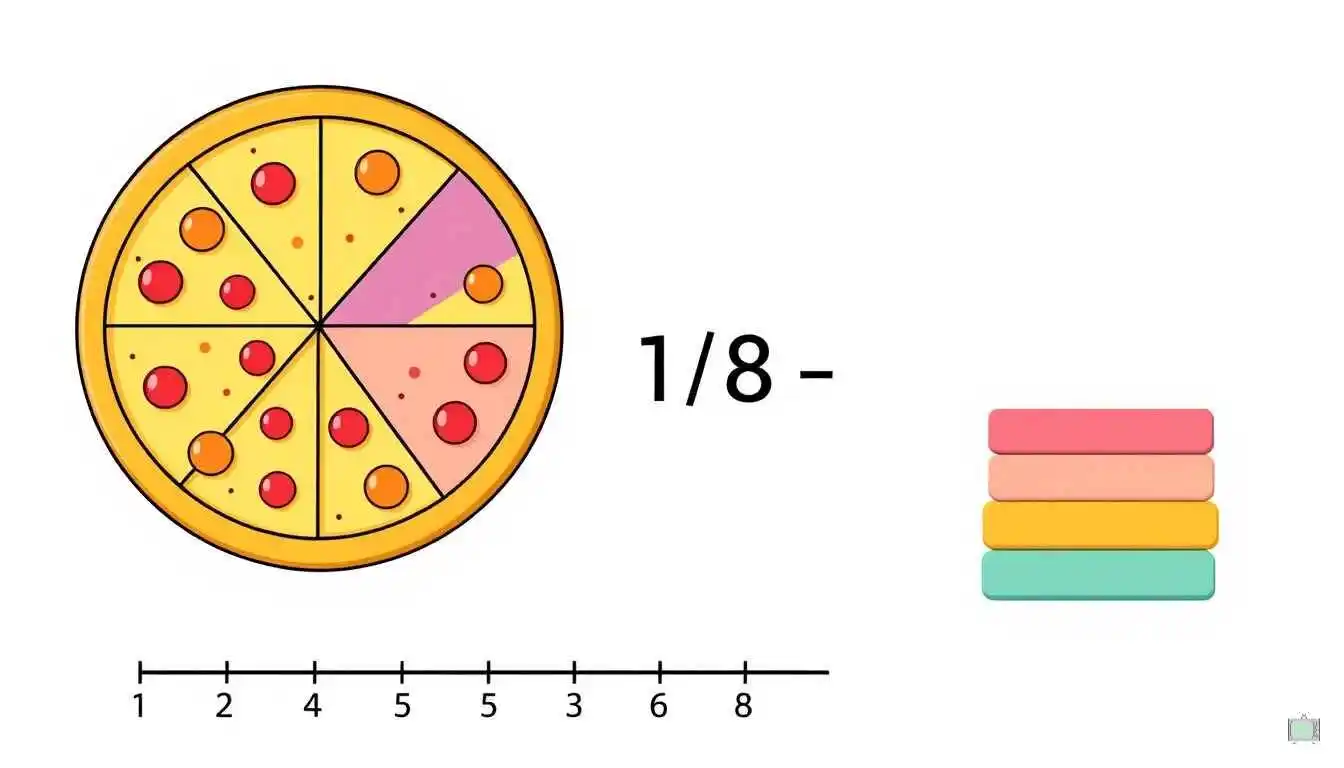
Think of a pizza cut into eight equal slices. If you eat three slices, you’ve eaten 3/8 of the pizza. The denominator, 8, tells you the pizza was divided into eight pieces. The numerator, 3, tells you how many of those pieces you consumed. This simple mental image — parts of a whole — is the foundation every other fraction concept builds on, and returning to it whenever a calculation feels confusing is often the fastest way back to clarity.
Fractions aren’t just about pizza slices, though. They represent division itself. The fraction 3/8 literally means 3 divided by 8. This connection between fractions and division becomes critical once you start converting fractions to decimals, a skill that bridges two number systems students often treat as unrelated.
The Different Types of Fractions
Not all fractions look or behave the same way, and understanding the categories makes future calculations far more intuitive.
Proper fractions have a numerator smaller than the denominator, like 3/8 or 1/2. These represent a value less than one whole.
Improper fractions have a numerator equal to or larger than the denominator, like 9/8 or 5/5. These represent a value equal to or greater than one whole, even though they might look unusual at first glance.
Mixed numbers combine a whole number with a proper fraction, like 1 ⅛. This is often the most intuitive way to express quantities greater than one, since 1 ⅛ clearly communicates “one whole plus an eighth” rather than the more abstract 9/8.
Unit fractions have a numerator of 1, like 1/4 or 1/10. These are the building blocks of more complex fractions and are especially useful when teaching fraction concepts to beginners.
Equivalent fractions are different fractions that represent the same value, like 1/2, 2/4, and 4/8. Understanding equivalence is essential for comparing fractions and performing operations with different denominators.
Like fractions share the same denominator, such as 2/9 and 5/9, while unlike fractions have different denominators, such as 1/3 and 1/4. This distinction matters enormously once you start adding and subtracting, since like fractions can be combined directly while unlike fractions require an extra preparatory step.
Why Fractions Feel So Hard
Before diving into operations, it’s worth addressing why fractions trip up so many learners in the first place. Whole numbers behave predictably — bigger numbers are always bigger, and multiplying always makes things larger. Fractions break both of those intuitions. A fraction with a bigger denominator, like 1/10, is actually smaller than one with a smaller denominator, like 1/2, because the whole has been split into more pieces. And multiplying two fractions together, like 1/2 × 1/2, produces a smaller result (1/4), not a larger one.
This conceptual shift — from “operations make things bigger” to “operations on fractions can make things smaller” — is genuinely one of the biggest leaps in elementary math education, and acknowledging that the confusion is normal (not a sign of poor math ability) often helps learners relax enough to actually absorb the logic.
Adding and Subtracting Fractions
Adding and subtracting fractions follows a simple rule with one important catch: the denominators must match before you can combine the numerators.
When fractions already share a denominator, the process is straightforward. To add 2/9 and 4/9, you simply add the numerators and keep the denominator the same, giving you 6/9, which simplifies to 2/3.
When denominators differ, you first need to find a common denominator, typically the least common multiple (LCM) of the two denominators. For example, to add 1/3 and 1/4, you’d find that 12 is the smallest number both 3 and 4 divide into evenly. Converting both fractions to twelfths gives you 4/12 and 3/12, which can then be added to get 7/12.
Subtraction works identically — find a common denominator first, then subtract the numerators while keeping the denominator unchanged.
A common mistake students make is adding or subtracting both the numerators and denominators directly (incorrectly turning 1/3 + 1/4 into 2/7). Remembering that the denominator represents the size of the pieces, not a quantity to be combined, helps avoid this error.
Multiplying Fractions
Multiplication is actually one of the more forgiving fraction operations because, unlike addition and subtraction, you don’t need a common denominator. To multiply two fractions, simply multiply the numerators together and the denominators together.
For example, 2/3 × 3/4 becomes (2×3)/(3×4), which simplifies to 6/12, or 1/2.
A helpful technique called cross-cancellation can simplify the process before multiplying. If a numerator and a denominator share a common factor, you can simplify them first, making the final multiplication easier and the resulting fraction already partially reduced.
Multiplying fractions also reinforces an important conceptual point: multiplying by a fraction less than one always produces a smaller result, since you’re essentially taking “a part of a part.”
Dividing Fractions
Dividing fractions tends to confuse people most, largely because the standard method — “flip the second fraction and multiply” — feels like a magic trick rather than a logical process.
Here’s why it works: dividing by a number is the same as multiplying by its reciprocal (the flipped version of that number). So dividing 1/2 by 1/4 is the same as multiplying 1/2 by 4/1 (the reciprocal of 1/4), giving you 4/2, which simplifies to 2.
This makes intuitive sense if you think about it conceptually: “How many quarters fit into a half?” The answer is two, which matches the calculation. Reconnecting the abstract rule to a real-world question like this is often the key to making division of fractions finally click.
Simplifying Fractions
A fraction is considered simplified, or in its “lowest terms,” when the numerator and denominator share no common factors other than 1. Simplifying makes fractions easier to read, compare, and use in further calculations.
To simplify a fraction, find the greatest common factor (GCF) of the numerator and denominator, then divide both by that number. For example, 8/12 has a GCF of 4, so dividing both numbers by 4 gives you the simplified fraction 2/3.
Simplifying isn’t just a cosmetic step — in real-world contexts like cooking or construction, an unsimplified fraction like 4/8 cup versus the simplified 1/2 cup can cause confusion when reading a recipe or following instructions.
Comparing Fractions
Determining which of two fractions is larger requires either a common denominator or a technique called cross-multiplication.
With a common denominator, comparison is simple: whichever fraction has the larger numerator is the larger fraction, since the pieces are the same size.
Without a common denominator, cross-multiplication offers a shortcut. To compare 3/4 and 5/7, multiply 3 by 7 (giving 21) and 5 by 4 (giving 20). Since 21 is greater than 20, 3/4 is the larger fraction.
Visual models, like fraction bars or pie charts, are especially useful for comparison, particularly for younger learners who benefit from seeing the relative sizes rather than just calculating them.
Converting Between Fractions, Decimals, and Percentages
Fractions, decimals, and percentages are three different ways of expressing the same underlying value, and fluency in converting between them is one of the most practically useful math skills a person can develop.
To convert a fraction to a decimal, divide the numerator by the denominator. For example, 3/4 becomes 0.75 because 3 divided by 4 equals 0.75.
To convert a decimal to a fraction, write the decimal as a fraction with a denominator based on its place value (tenths, hundredths, thousandths), then simplify. For example, 0.6 becomes 6/10, which simplifies to 3/5.
To convert a fraction to a percentage, convert it to a decimal first, then multiply by 100. So 3/4 becomes 0.75, then 75%.
To convert a percentage to a fraction, write the percentage over 100 and simplify. So 75% becomes 75/100, which simplifies to 3/4.
This triangle of conversions shows up constantly in everyday life — calculating a tip, understanding a discount, reading nutrition labels, or interpreting statistics in the news all rely on smooth movement between these three formats.
Fractions in Everyday Life
It’s easy to dismiss fractions as an abstract school subject, but they quietly run through daily life far more than most people realize.
Cooking and baking rely heavily on fractions, from measuring 2/3 cup of flour to doubling or halving a recipe, which requires multiplying or dividing every fraction in the ingredient list.
Construction and carpentry use fractions constantly, particularly in measurements like 3/8-inch screws or 5/16-inch plywood, where precision genuinely matters for structural integrity.
Finance involves fractions in interest rates, stock price changes (historically quoted in fractions before decimalization), loan terms, and budgeting percentages.
Music uses fractions to represent time signatures and note values — a quarter note, an eighth note, and a sixteenth note are literally fractional divisions of a measure.
Medicine depends on fraction-based dosage calculations, where errors in fraction math can have serious consequences, underscoring just how high the stakes of fraction fluency can be outside the classroom.
Sports statistics frequently use fractions and their decimal equivalents, from batting averages to win percentages to race times measured in fractions of a second.
Common Fraction Mistakes and How to Avoid Them
Even adults who use fractions regularly fall into predictable traps. Recognizing these patterns helps prevent them.
Adding denominators directly instead of finding a common denominator is one of the most frequent errors, often stemming from over-applying the multiplication rule (where denominators are multiplied) to addition, where they should not be.
Forgetting to simplify the final answer can lead to technically correct but awkward results that are harder to interpret or compare with other values.
Misapplying the “flip and multiply” rule for division, such as flipping the wrong fraction or forgetting to flip at all, is another common pitfall, which is why understanding the reciprocal concept conceptually (rather than just memorizing the rule) pays off in the long run.
Confusing the numerator and denominator’s roles, particularly when converting mixed numbers to improper fractions, can throw off an entire calculation from the very first step.
Treating a larger denominator as automatically meaning a larger fraction is a leftover misconception from whole-number thinking, since the opposite is often true — a larger denominator typically means smaller individual pieces.
Tips and Tricks for Mastering Fractions
Visualize whenever possible. Pie charts, fraction bars, and number lines turn an abstract symbol into something the brain can actually picture, which dramatically improves both understanding and retention.
Practice with real objects. Measuring cups, pizza slices, or even folding paper into equal parts gives fractions a tangible, hands-on dimension that pure symbol manipulation can’t replicate.
Master multiplication tables first. Since simplifying, finding common denominators, and comparing fractions all rely on quickly identifying factors and multiples, strong multiplication fluency makes every fraction operation faster and less error-prone.
Always double-check by estimating. Before finalizing an answer, ask whether it makes logical sense — if you’re adding two fractions that are each less than one, the answer should be a reasonable sum, not something wildly off.
Use the “common denominator first” rule as a checkpoint. Before adding or subtracting any fractions, pause and confirm the denominators match; this single habit eliminates a huge share of common errors.
Teach it to someone else. Explaining fraction concepts out loud, even to an imaginary audience, forces a level of clarity that passive review rarely achieves.
The History of Fractions
Fractions have a surprisingly long and global history. Ancient Egyptians used unit fractions almost exclusively, expressing values like 3/4 as a sum of distinct unit fractions (1/2 + 1/4), a system that, while cumbersome by modern standards, allowed for remarkably sophisticated calculations used in architecture and land surveying.
The Babylonians developed a base-60 system for fractions, remnants of which still survive today in how we divide hours into 60 minutes and minutes into 60 seconds.
The modern fraction notation, with a numerator stacked over a denominator separated by a horizontal line, has roots in Hindu and Arabic mathematical traditions before being refined and popularized in Europe during the medieval period. The fraction bar itself, sometimes called a vinculum, became standardized over centuries of mathematical communication across cultures.
Understanding that fractions evolved gradually, across many civilizations solving real practical problems, can help reframe them as a genuinely useful human invention rather than an arbitrary set of classroom rules.
Why Fraction Fluency Matters Beyond the Classroom
Educational research consistently identifies fraction understanding in late elementary and middle school as one of the strongest predictors of overall math achievement in high school, more so than even early skills like whole-number arithmetic. Students who struggle with fractions often carry that struggle into algebra, since algebraic expressions and equations frequently involve fractional coefficients and operations.
Beyond academics, fraction fluency supports financial literacy, practical problem-solving, and confident decision-making in everyday situations — reading a map scale, interpreting a poll result, calculating a fair split of a bill among friends, or understanding a doctor’s prescribed dosage all draw on the same underlying skill set.
Investing time in genuinely understanding fractions, rather than just memorizing procedures, pays dividends across nearly every quantitative task a person encounters for the rest of their life.
Bringing It All Together
Fractions aren’t a single skill — they’re a cluster of interconnected concepts, from basic part-whole reasoning to equivalence, comparison, and the four core operations. The good news is that once the foundational idea (a fraction represents parts of a whole) is solid, every other rule becomes a logical extension rather than an arbitrary procedure to memorize. Whether you’re helping a child with homework, prepping for a standardized test, or just trying to feel more confident the next time a recipe calls for 2/3 of a cup, returning to that core idea — parts of a whole — is the thread that ties the entire topic together.
FAQS
1.What is a fraction in simple terms?
A fraction represents a part of a whole, written as a numerator (the part) over a denominator (the total number of equal parts the whole is divided into).
2.What’s the difference between a numerator and a denominator?
The numerator is the top number, showing how many parts you have, while the denominator is the bottom number, showing how many equal parts make up the whole.
3.What is a proper fraction?
A proper fraction has a numerator smaller than its denominator, meaning it represents a value less than one whole, like 3/5.
4.What is an improper fraction?
An improper fraction has a numerator equal to or greater than its denominator, representing a value of one or more, like 7/4.
5.What is a mixed number?
A mixed number combines a whole number with a proper fraction, such as 2 ⅓, and is often used to express improper fractions in a more intuitive form.
6.How do you convert an improper fraction to a mixed number?
Divide the numerator by the denominator; the quotient becomes the whole number, the remainder becomes the new numerator, and the denominator stays the same.
7.How do you convert a mixed number to an improper fraction?
Multiply the whole number by the denominator, add the numerator, and place that result over the original denominator.
8.What are equivalent fractions?
Equivalent fractions are different fractions that represent the same value, such as 1/2, 2/4, and 3/6, created by multiplying or dividing the numerator and denominator by the same number.
9.How do you simplify a fraction?
Divide both the numerator and denominator by their greatest common factor until no common factor remains other than 1.
10.How do you add fractions with different denominators?
Find a common denominator (usually the least common multiple), convert each fraction accordingly, then add the numerators while keeping the denominator the same.
11.How do you subtract fractions with different denominators?
Just like addition, first find a common denominator, convert each fraction, then subtract the numerators while keeping the denominator unchanged.
12.How do you multiply two fractions?
Multiply the numerators together and the denominators together, then simplify the result if possible.
13.How do you divide two fractions?
Multiply the first fraction by the reciprocal (flipped version) of the second fraction.
14.Why do you flip the second fraction when dividing?
Dividing by a number is mathematically equivalent to multiplying by its reciprocal, which is why “flip and multiply” works for fraction division.
15.How do you compare two fractions?
Convert them to a common denominator and compare numerators, or use cross-multiplication to determine which fraction is larger.
16.How do you convert a fraction to a decimal?
Divide the numerator by the denominator using long division or a calculator.
17.How do you convert a decimal to a fraction?
Write the decimal over a power of 10 based on its place value, then simplify the resulting fraction.
18.How do you convert a fraction to a percentage?
Convert the fraction to a decimal first, then multiply by 100 and add a percent sign.
19.What is a unit fraction?
A unit fraction has a numerator of 1, such as 1/3 or 1/8, representing a single equal part of a whole.
20.What is the reciprocal of a fraction?
The reciprocal is the fraction flipped upside down, so the reciprocal of 2/5 is 5/2.
21.Can a fraction have a denominator of zero?
No, division by zero is undefined, so a fraction cannot have zero as its denominator.
22.What is a complex fraction?
A complex fraction has a fraction in its numerator, denominator, or both, such as (1/2)/(3/4), and is simplified by treating it as a division problem.
23.How do you find the least common denominator?
Identify the least common multiple of the two denominators, which becomes the smallest number both denominators can evenly divide into.
24.Why can’t you add fractions without a common denominator?
Because the denominator represents the size of each piece; without matching piece sizes, the numerators can’t be meaningfully combined.
25.What real-world jobs use fractions the most?
Chefs, carpenters, engineers, nurses, pharmacists, and financial analysts all use fraction-based calculations regularly in their daily work.
26.Why are fractions important for learning algebra?
Algebraic expressions and equations frequently involve fractional coefficients and operations, so strong fraction skills make algebraic manipulation far more manageable.
27.What’s the easiest way to teach fractions to kids?
Using visual and hands-on tools like fraction bars, pie charts, measuring cups, and paper folding helps make the abstract concept of “parts of a whole” tangible and concrete.
28.Are fractions and ratios the same thing?
They’re related but not identical — a fraction represents a part of a whole, while a ratio compares two separate quantities, though ratios are often written in fraction form.
29..What is the difference between like and unlike fractions?
Like fractions share the same denominator, while unlike fractions have different denominators and require conversion before being added or subtracted.
30.How can adults improve their fraction skills as a refresher?
Practicing real-world applications like cooking measurements, budgeting calculations, and recipe scaling, combined with visual aids and gradual review of core operations, helps rebuild fraction fluency efficiently.
Disclaimer: The content on this blog is for informational purposes only. Author’s opinions are personal and not endorsed. Efforts are made to provide accurate information, but completeness, accuracy, or reliability are not guaranteed. Author is not liable for any loss or damage resulting from the use of this blog. It is recommended to use information on this blog at your own terms.

