

Medicine and Antibiotics
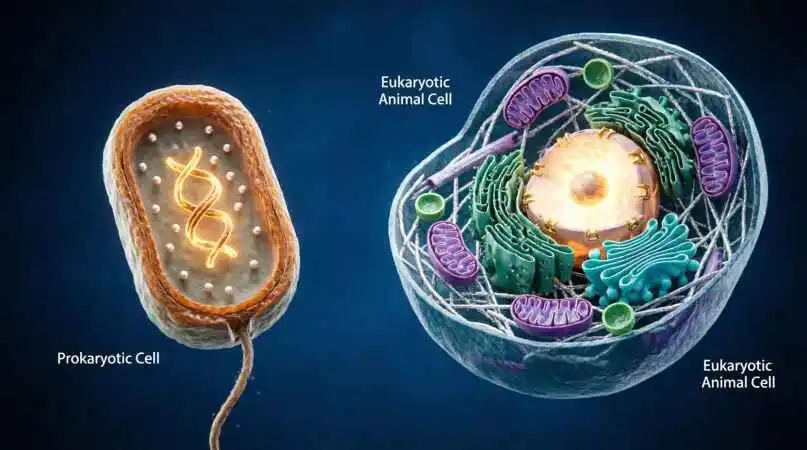
The prokaryote-eukaryote distinction is the biological foundation of antibiotic medicine. Because prokaryotes and eukaryotes differ fundamentally in their cell wall composition, ribosome size, and membrane chemistry, drugs can be designed that selectively kill bacteria without harming human cells. Penicillin targets the bacterial peptidoglycan cell wall — eukaryotic cells have no cell wall, so they are unaffected. This structural selectivity is why antibiotics work at all.
Understanding the difference also explains why antibiotics are useless against viruses (which are not cells at all) and why antifungal drugs (which must kill eukaryotic fungal cells without harming the patient’s eukaryotic cells) are far more difficult and toxic to develop.
Biotechnology and Genetic Engineering
Prokaryotes — particularly E. coli — are workhorses of biotechnology. Their rapid reproduction, simple genetics, and ability to take up foreign DNA make them ideal for producing recombinant proteins: insulin, human growth hormone, clotting factors, and countless research proteins are produced in bacterial bioreactors. Understanding prokaryotic cell biology made this possible.
Eukaryotic cells are used when the protein product requires the kind of post-translational modification (glycosylation, proper folding) that only eukaryotic machinery can perform. Many biologic drugs are produced in Chinese Hamster Ovary (CHO) eukaryotic cells for this reason.
Evolution and the Tree of Life
The prokaryote-to-eukaryote transition represents the most significant evolutionary jump in the history of life. All the biodiversity we see with the naked eye — every plant, animal, and fungus — is the consequence of this single innovation: the nucleus and the organelle system. Understanding when and how this happened is central to understanding the deepest questions in evolutionary biology.
The Origin of Life and Astrobiology
When scientists search for life on other planets, prokaryotic life is the first thing they look for — because it is simpler, more robust, more ancient, and can survive in extreme conditions. The discovery of extremophilic archaea on Earth has dramatically expanded our sense of where life might exist in the universe. Prokaryotes are life’s default mode.
Conclusion: Two Designs, One Magnificent Story
The distinction between prokaryotic and eukaryotic cells is not merely a taxonomic convenience. It is the deepest structural boundary in the living world — a divide that separates 4 billion years of evolution, two entirely different strategies for building and running a living system, and two kingdoms of organisms whose combined activities maintain the biosphere we inhabit.
Prokaryotes are the ancient masters — small, fast, metabolically versatile, nearly indestructible, and absolutely essential. Eukaryotes are the complex inheritors — larger, slower to reproduce, built on a foundation of prokaryotic endosymbiosis, and capable of the multicellular complexity that produced everything from seaweed to Shakespeare.
Together, they are not competitors but co-authors — writing, in chemistry and structure, the ongoing story of life on Earth.
FAQS
Q1. What is the single most important difference between prokaryotic and eukaryotic cells?
The most fundamental difference is the presence or absence of a true, membrane-enclosed nucleus. Prokaryotic cells lack a true nucleus — their DNA floats in the cytoplasm in a region called the nucleoid. Eukaryotic cells have a membrane-bound nucleus that encloses and protects their DNA. This distinction drives nearly all other structural and functional differences between the two cell types.
Q2. Which came first evolutionarily — prokaryotes or eukaryotes?
Prokaryotes came first by a very wide margin. The earliest prokaryotic fossils date to approximately 3.5–3.8 billion years ago. Eukaryotes did not appear until roughly 1.5 to 2 billion years ago — meaning prokaryotes had already been evolving for over 1.5 billion years before the first eukaryotic cell arose. Eukaryotes almost certainly evolved from prokaryotic ancestors through a series of evolutionary events including endosymbiosis.
Q3. What is the endosymbiotic theory?
The endosymbiotic theory, developed primarily by Lynn Margulis in the 1960s, proposes that mitochondria and chloroplasts in eukaryotic cells were originally free-living bacteria that were engulfed by a host cell and evolved into permanent, interdependent organelles rather than being digested. Evidence includes the fact that mitochondria and chloroplasts have their own circular DNA, their own 70S ribosomes (the prokaryotic type), and reproduce by binary fission — all vestiges of their bacterial ancestry.
Q4. Are viruses prokaryotes or eukaryotes?
Neither. Viruses are not cells at all — they lack cell membranes, cytoplasm, ribosomes, and the ability to reproduce independently. They are essentially packages of genetic material (DNA or RNA) enclosed in a protein coat that can only replicate by hijacking a host cell’s machinery. The prokaryote/eukaryote classification applies only to cellular organisms.
Q5. What is the nucleoid region in a prokaryotic cell?
The nucleoid is the region within the prokaryotic cytoplasm where the cell’s genetic material — typically a single circular chromosome — is concentrated. Unlike the eukaryotic nucleus, it has no surrounding membrane. The DNA in the nucleoid is supercoiled and compacted with the help of proteins, but it is directly accessible to the cellular machinery for transcription and replication.
Q6. What are plasmids and why are they important?
Plasmids are small, circular, double-stranded DNA molecules found in many prokaryotic cells (and some eukaryotes) that exist separately from the main chromosome. They often carry genes for antibiotic resistance, toxin production, or other survival advantages. They can be transferred between bacterial cells through conjugation — a key mechanism for the spread of antibiotic resistance. In biotechnology, engineered plasmids are used as vectors to introduce foreign genes into host cells.
Q7. Why are prokaryotic ribosomes medically important?
Prokaryotic ribosomes are 70S in size (composed of 50S and 30S subunits), while eukaryotic cytoplasmic ribosomes are 80S. This size difference means that many antibiotics can be designed to specifically bind to and disable the 70S ribosome, stopping bacterial protein synthesis, without affecting the patient’s 80S eukaryotic ribosomes. Examples include streptomycin, tetracycline, erythromycin, and chloramphenicol.
Q8. What is binary fission?
Binary fission is the primary method of reproduction in prokaryotes. The cell replicates its circular chromosome, grows in size, and then divides into two genetically identical daughter cells. The process does not involve mitotic spindles or complex chromosome segregation machinery. It is far faster than eukaryotic cell division — some bacteria can complete a round of binary fission in as little as 20 minutes under optimal conditions.
Q9. What are the two domains of prokaryotes?
The two domains of prokaryotes are Bacteria and Archaea. Though both lack a true nucleus and were once classified together as “prokaryotes,” molecular analysis reveals they are profoundly different at the biochemical and genetic level. Archaea are in many ways more closely related to eukaryotes than to bacteria, particularly in their transcription machinery and certain aspects of their genetic code. The three domains of life are therefore Bacteria, Archaea, and Eukarya.
Q10. What makes Archaea different from Bacteria?
Archaea differ from bacteria in several key ways: their cell membranes contain ether-linked lipids (rather than the ester-linked lipids in bacteria and eukaryotes), they lack peptidoglycan in their cell walls, their transcription machinery is more similar to eukaryotes than to bacteria, and they often inhabit extreme environments (though they are not limited to them). Archaea also include the methanogens — organisms that produce methane as a metabolic byproduct and are found in swamps, guts, and deep-sea sediments.
Q11. Do prokaryotes have any internal membrane structures at all?
While prokaryotes lack true membrane-bound organelles, some do have internal membrane structures. For example, photosynthetic bacteria have internal membranes called thylakoids where photosynthesis occurs. Nitrifying bacteria have extensive internal membrane systems for their oxidation reactions. These are simpler than eukaryotic organelles and are not enclosed in a separate lipid bilayer in the organelle sense.
Q12. What is the function of the mitochondria in eukaryotic cells?
Mitochondria are the energy-producing organelles of eukaryotic cells. They carry out aerobic cellular respiration — using oxygen to break down glucose and other nutrients through a series of reactions (the citric acid cycle and oxidative phosphorylation) to produce ATP, the cell’s primary energy currency. They also play roles in calcium signaling, apoptosis (programmed cell death), heat production, and various biosynthetic pathways. Their abundance in a cell correlates directly with that cell’s energy demands.
Q13. How do plant cells differ from animal cells, even though both are eukaryotic?
Both are eukaryotic but differ in several key structures. Plant cells have a rigid cellulose cell wall, a large central vacuole for water storage and turgor pressure, chloroplasts for photosynthesis, and plasmodesmata (cytoplasmic channels between cells). Animal cells lack a cell wall, central vacuole, and chloroplasts, but have centrioles (used in cell division), lysosomes (for intracellular digestion), and sometimes specialized structures like flagella or cilia.
Q14. What is the cytoskeleton and why is it uniquely eukaryotic?
The cytoskeleton is a dynamic network of protein filaments in eukaryotic cells that provides structural support, enables cell movement and shape changes, facilitates cell division, and serves as a transport highway for vesicles and organelles. It is composed of three main types of filaments: microtubules (made of tubulin), actin filaments (made of actin), and intermediate filaments (made of various proteins). While rudimentary cytoskeletal proteins exist in prokaryotes, the complex, multi-component eukaryotic cytoskeleton is a defining innovation of that cell type.
Q15. What is the function of the Golgi apparatus?
The Golgi apparatus functions as the cell’s post office and packaging center. Proteins synthesized by the rough endoplasmic reticulum are transported to the Golgi in vesicles, where they are modified (glycosylated, phosphorylated, cleaved), sorted according to their destination, and packaged into new vesicles for delivery. These vesicles travel to the plasma membrane for secretion, to lysosomes, or to other organelles. It is particularly abundant in cells with high secretory activity, such as pancreatic cells and mucus-secreting cells.
Q16. What are histones and why do eukaryotes need them?
Histones are positively charged proteins around which negatively charged DNA wraps to form nucleosomes — the basic packaging unit of eukaryotic chromatin. Eukaryotic cells have vastly more DNA than prokaryotes (human cells contain about 2 meters of DNA per cell), and histones are essential for compacting this DNA to fit inside the nucleus. Beyond packaging, histones play a major regulatory role: modifications to their chemical groups (acetylation, methylation) change how tightly DNA is wound, directly controlling gene accessibility and expression.
Q17. Why can’t antibiotics treat viral infections?
Antibiotics work by targeting structures or processes unique to bacterial cells — the peptidoglycan cell wall, the 70S ribosome, or bacterial DNA replication enzymes. Viruses have none of these structures. They are not cells; they are essentially genetic material inside a protein shell. They replicate by hijacking the host cell’s own machinery, so any drug that disrupts their replication would also disrupt the host cell’s function. Antiviral drugs do exist, but they must be far more targeted and are generally harder to develop than antibiotics.
Q18. What is horizontal gene transfer and why is it unique to prokaryotes?
Horizontal (or lateral) gene transfer (HGT) is the movement of genetic material between cells other than through parent-to-offspring inheritance. Prokaryotes practice HGT through three main mechanisms: transformation (uptake of free DNA from the environment), transduction (gene transfer by bacteriophage viruses), and conjugation (direct DNA transfer via a pilus between cells). HGT allows bacteria to share adaptive genes — including antibiotic resistance genes — across species boundaries, driving rapid evolutionary adaptation. Eukaryotes very rarely engage in HGT.
Q19. What are the sizes of prokaryotic vs. eukaryotic cells, and why does size matter?
Prokaryotic cells typically range from 1–10 micrometers in diameter, while eukaryotic cells are typically 10–100 micrometers. Size matters because larger cells have lower surface-area-to-volume ratios, meaning they cannot rely on simple diffusion to move nutrients and waste across their surfaces and through their interiors. Eukaryotes solved this problem with organelles (which create internal surfaces) and cytoskeletal transport systems. Prokaryotes stay small precisely because their simple diffusion-based transport can only work at small scales.
Q20. Do eukaryotic cells have cell walls?
It depends on the organism. Plant cells have rigid cell walls made of cellulose. Fungal cells have cell walls made of chitin. Algae have cell walls made of various polysaccharides. Animal cells do not have cell walls — which is why animal cells can change shape so dynamically, why animal tissues can heal and remodel, and why animal cells can be engulfed (as in immune cells engulfing pathogens) in ways that walled cells cannot. The absence of a cell wall in animal cells is a significant structural and functional distinction.
Q21. What is the nuclear pore complex and what does it do?
Nuclear pore complexes (NPCs) are large protein structures embedded in the nuclear envelope, each composed of about 30 different proteins (nucleoporins) assembled into an approximately 120-megadalton structure — one of the largest protein assemblies in the cell. They function as selective gates: allowing small molecules to pass freely, actively transporting specific proteins (like transcription factors) into the nucleus, and exporting processed RNA and ribosomal subunits out of the nucleus. A typical eukaryotic nucleus contains thousands of nuclear pores.
Q22. How does gene expression differ between prokaryotes and eukaryotes?
In prokaryotes, transcription (DNA → RNA) and translation (RNA → protein) occur simultaneously in the cytoplasm — as soon as an mRNA begins to be transcribed, ribosomes can begin translating it. In eukaryotes, transcription occurs in the nucleus and translation occurs in the cytoplasm, separated in space and time. This separation allows eukaryotic cells to extensively process mRNA before translation — adding a 5′ cap, a poly-A tail, and splicing out non-coding introns — creating opportunities for sophisticated regulation that prokaryotes cannot achieve.
Q23. What are operons and why do prokaryotes have them?
Operons are clusters of functionally related genes in prokaryotes that are transcribed together as a single mRNA under the control of a single promoter. The classic example is the lac operon in E. coli, which controls the enzymes needed to metabolize lactose. This organization allows prokaryotes to coordinate the expression of related genes efficiently — turning on an entire metabolic pathway with a single regulatory switch. Eukaryotic genes are not organized into operons; each gene has its own separate promoter and regulatory sequences.
Q24. What is chromatin and how does it differ from prokaryotic DNA packaging?
Chromatin is the complex of DNA and proteins (primarily histones) that makes up eukaryotic chromosomes. It exists in two forms: euchromatin (loosely packed, transcriptionally active) and heterochromatin (tightly packed, transcriptionally silent). Prokaryotic DNA is also compacted — using histone-like proteins (HU, H-NS) and supercoiling — but the system is far less elaborate and regulated. Eukaryotic chromatin organization is a major level of gene regulation: changes in chromatin structure (epigenetic modifications) can activate or silence entire chromosomal regions without changing the underlying DNA sequence.
Q25. Can prokaryotic and eukaryotic cells communicate with each other?
In a functional sense, yes — and this is fundamental to health and disease. The trillions of bacterial cells in the human gut communicate with gut epithelial cells (eukaryotic) through chemical signals, surface molecules, and metabolites. Some bacteria use quorum sensing (chemical communication between bacterial cells) to coordinate behaviors that then affect eukaryotic host cells. Many pathogens have evolved molecular tools to inject proteins directly into eukaryotic cells to manipulate their behavior. The communication between prokaryotic microbiome members and our eukaryotic cells is now recognized as central to immune function, metabolism, and even neurology.
Q26. What is quorum sensing in bacteria?
Quorum sensing is a bacterial communication mechanism in which individual bacteria secrete small chemical signaling molecules (autoinducers). As bacterial population density increases, the concentration of autoinducers rises. When it crosses a threshold, the bacteria collectively sense that a “quorum” has been reached and switch on specific genes — for biofilm formation, toxin production, or luminescence (as in Vibrio fischeri). It is a form of population-level decision-making that allows bacteria to coordinate multicellular-like behaviors without being multicellular.
Q27. Why is studying eukaryotic cell biology important for cancer research?
Cancer is fundamentally a disease of eukaryotic cell regulation. It arises when mutations in genes controlling cell division (proto-oncogenes, tumor suppressors), DNA repair, or apoptosis cause cells to divide uncontrollably, ignore normal growth signals, and evade immune destruction. Every chemotherapy drug, every targeted cancer therapy, and every understanding of how tumors form and spread depends on understanding eukaryotic cell biology — the cell cycle, signal transduction, the cytoskeleton, and the mechanisms of mitosis and apoptosis.
Q28. What are extremophilic prokaryotes and what do they tell us about life?
Extremophilic prokaryotes (mostly archaea) thrive in conditions that would destroy all other known life: temperatures above 121°C (hyperthermophiles like Pyrolobus fumarii), highly acidic environments (pH < 2), extreme salinity, intense radiation, or crushing deep-sea pressure. Their existence demonstrates that life is far more robust and adaptive than previously imagined, has fundamentally reshaped our understanding of the limits of habitability, and has driven the search for life in extreme environments on other planets and moons — particularly Europa, Enceladus, and Mars.
Q29. What is the rough endoplasmic reticulum and why is it “rough”?
The rough endoplasmic reticulum (rough ER) is a network of membrane-enclosed tubules and sacs studded with ribosomes on its cytoplasmic surface — giving it its characteristic rough appearance under electron microscopy. It is the site of synthesis for proteins destined for secretion (hormones, digestive enzymes), insertion into cell membranes, or delivery to the Golgi apparatus and lysosomes. As proteins are synthesized by the ribosomes, they are threaded directly into the lumen of the rough ER, where they are folded and undergo initial quality control checks.
Q30. Could life exist that is neither prokaryotic nor eukaryotic?
This is one of the most exciting open questions in biology. Some scientists propose that there may be a third cellular architecture waiting to be discovered — perhaps in deep-sea environments, extreme ecosystems, or even on other worlds. The discovery that archaea and eukaryotes share more molecular machinery than previously thought has also prompted the “two-domain” model, suggesting eukaryotes may have emerged directly from within the archaeal domain rather than as a separate lineage. As genomics and single-cell sequencing explore previously uncultivated microbes, surprising new cell architectures continue to emerge, suggesting our current two-category system, while profoundly useful, may yet be revised.
Disclaimer: The content on this blog is for informational purposes only. Author’s opinions are personal and not endorsed. Efforts are made to provide accurate information, but completeness, accuracy, or reliability are not guaranteed. Author is not liable for any loss or damage resulting from the use of this blog. It is recommended to use information on this blog at your own terms.

