

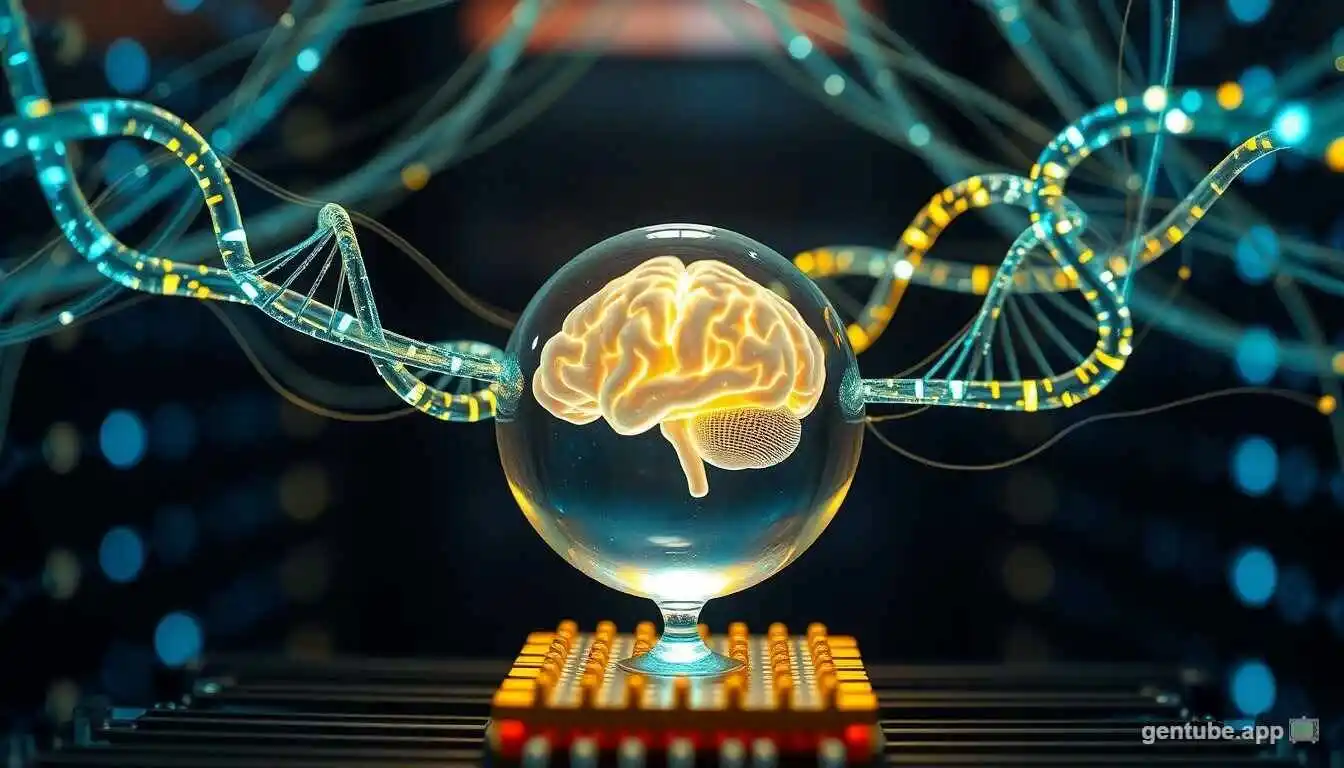
Flesh, Fluids, and Firmware: The Dawn of the Biocomputer Age
Imagine holding the entirety of the internet’s data—not in a sprawling, energy-guzzling server farm the size of a city block, but in a droplet of liquid no larger than a teardrop. Imagine a computer that doesn’t generate enough heat to warm a room, but instead heals itself when damaged, evolves to solve new problems, and processes information using the very same chemistry that makes you a living, breathing human being.
For the last eighty years, the architecture of computing has remained fundamentally unchanged: we push electrons through silicon. We’ve etched transistors down to the size of a few atoms, pushing the absolute physical limits of matter. But as the silicon era gasps its final breaths, a radical, visceral new paradigm is emerging from the petri dish.
Welcome to the era of the biocomputer.
We are standing at the precipice of a technological revolution where the hardware is alive, the software is organic, and the boundary between the digital and the biological dissolves completely. This is not science fiction. This is the science of wetware. In this deep dive, we will explore how humanity is harnessing DNA, proteins, and living brain cells to build the computers of tomorrow—machines that don’t just calculate, but think, grow, and adapt.
Chapter 1: The Silicon Straitjacket – Why Our Current Computers Are Hitting a Wall
The Heat Death of the Digital Age
To understand why we need biocomputers, we must first understand the fatal flaw of our current silicon overlords. For decades, the tech industry has been propelled by Moore’s Law—the observation that the number of transistors on a microchip doubles roughly every two years, making computers exponentially faster and cheaper.
But Moore’s Law is dying.
We have shrunk transistors down to a mere three nanometers. At this scale, we encounter the bizarre, unbreakable laws of quantum mechanics. Electrons begin to “tunnel” through solid barriers, making it impossible to reliably control the flow of current. We have reached the physical limit of how small silicon switches can be.
Furthermore, silicon computing is an ecological disaster. Modern data centers are ravenous beasts. They consume gigawatts of electricity, rivaling the energy usage of entire nations. The simple act of training a massive AI model like GPT-4 requires enough energy to power a small town for a year, and generates thousands of tons of carbon emissions. The human brain, by contrast, operates on roughly 20 watts of power—just enough to dimly light a lightbulb—yet it performs calculations that would bring a supercomputer to its knees.
Silicon is fast, but it is rigid, fragile, and incredibly inefficient. It computes through brute force, blasting electrons through glass and metal. It’s time to trade the rock for the cell.
Chapter 2: The Alchemy of Life – What Exactly IS a Biocomputer?
Trading Silicon for Cytoplasm
A biocomputer, at its core, is a computational device that uses biologically derived molecules—such as DNA, RNA, proteins, and living cells—to perform mathematical and logical calculations. Instead of binary digits (0s and 1s) represented by electrical voltages, biocomputers use the chemical alphabet of life.
Think about how a standard computer works. It has a processor (to calculate), a hard drive (to store data), and logic gates (AND, OR, NOT gates that route the electrical signals). Biocomputers have exact equivalents, but they operate in a “wet” environment.
- The Biological Hard Drive: DNA is the densest data storage medium known to humanity. A single gram of DNA can theoretically store 215 petabytes (215 million gigabytes) of information. The entire internet could fit into a shoebox.
- The Biological Logic Gates: Enzymes and other proteins naturally act as logic gates. For example, an enzyme might only bind to a specific DNA strand (an AND gate) if two specific chemical conditions are met.
- The Biological Processor: In the cutting-edge realm of “organoid intelligence,” the processors are literal clusters of living brain cells (neurons) that form networks and compute via electrical spikes, exactly like the brain inside your skull.
The shift from “dry” silicon to “wet” biology represents a fundamental change in how we compute. Traditional computers are serial—they do one thing at a time, incredibly fast. Biocomputers are inherently parallel. A test tube containing trillions of DNA molecules can attempt trillions of calculations simultaneously. They don’t race down a single highway; they flood the entire landscape.
Chapter 3: The Code of Life – DNA Computing and the Data Storage Revolution
Turning the Double Helix into a Hard Drive
The biocomputer revolution began in 1994 with a man named Leonard Adleman. Adleman, a computer scientist and co-creator of the RSA encryption algorithm, realized that DNA is essentially a massive, molecular tape. The nucleotide bases—Adenine (A), Thymine (T), Cytosine (C), and Guanine (G)—are just biological letters. You can assign them binary values (A=00, C=01, G=10, T=11) and encode digital data into a strand of DNA.
Adleman proved this by solving the “Hamiltonian Path Problem”—a notoriously difficult mathematical puzzle similar to the Traveling Salesman Problem. He encoded cities and flight paths into short strands of DNA, mixed them in a test tube, and let the natural laws of chemistry (DNA’s desire to pair with its complementary strand) assemble the correct route. By extracting and reading the resulting DNA, he found the solution. It took a week, but it proved that biology could compute.
The Magic of DNA Data Storage
Today, the real breakthrough in DNA computing isn’t just calculation; it’s storage. We are generating data at a rate that outpaces our ability to store it. Magnetic tapes degrade in a few decades; hard drives crash. DNA, however, is immortal. We have successfully sequenced the DNA of woolly mammoths and Neanderthals, preserving information for tens of thousands of years in the permafrost.
Imagine archiving humanity’s entire cultural heritage—the Library of Congress, every movie ever made, the human genome—encoded into synthetic DNA, locked in a vault, and preserved for millennia. In 2019, researchers at the University of Washington and Microsoft demonstrated the first fully automated system to store and retrieve data in DNA.
How it works: You take your digital file (say, a photo), convert the binary code (0s and 1s) into DNA code (A, C, T, G). A DNA synthesizer prints out short strands of DNA matching that code. You put the liquid in a vial. When you want to read the data, a DNA sequencer reads the letters, and software translates it back into binary. It is the ultimate cold storage—dense, stable, and requiring no electricity to maintain.
Chapter 4: Logic in a Liquid – Protein and Enzymatic Computing
Chemical Switches and Microscopic Machines
While DNA is fantastic for storage and massive parallel processing, it is relatively slow. It takes time to mix, wait for binding, and sequence the results. To build faster, more responsive biocomputers, scientists look to the workhorses of the cell: proteins.
Proteins are nature’s nanomachines. Enzymes catalyze reactions in fractions of a second. Researchers have learned to harness the highly specific ways proteins interact to create biological logic gates.
Imagine an enzyme that modifies a specific molecule, but only if a secondary “co-factor” molecule is present. That is a biological AND gate. The output (the modified molecule) only happens if Input A (the target) AND Input B (the co-factor) are present.
The Bacterial Calculator
In 2013, researchers at Stanford University created the “biological transistor,” which they named the “transcriptor.” They used enzymes called integrases to physically cut and flip segments of DNA inside living E. coli bacteria. By controlling the flow of RNA polymerase along the DNA, they could turn genes on or off, creating reliable AND, OR, NOT, and NAND logic gates inside living organisms.
Why is this revolutionary? Because a computer made of bacteria can go places a silicon chip cannot. You could program a living cell to act as a microscopic doctor. Imagine swallowing a pill containing millions of programmed E. coli. These “bacterial computers” would patrol your bloodstream, monitoring your chemistry. If they detect a tumor marker (Input A) AND a specific inflammatory protein (Input B), the biological AND gate triggers an output: the bacteria produce a cancer-fighting drug directly at the site of the tumor.
This is not computation for the sake of math; this is computation as a cure.
Chapter 5: The Cyborg Brain – Organoid Intelligence (OI)
Growing Processors in a Dish
The most awe-inspiring and vaguely unsettling frontier of biocomputing is Organoid Intelligence (OI). If we want to build a machine that truly thinks, learns, and adapts, why not start with the only machine we know does that perfectly: the human brain?
Brain organoids are three-dimensional, miniature organs grown in a lab from stem cells. Under the right conditions, these stem cells differentiate into neurons, forming a “mini-brain” about the size of a pea. While they lack a blood supply and sensory input, they spontaneously form complex neural networks. They exhibit electrical activity. They fire.
In 2022, a company called Cortical Labs in Australia made global headlines with a system called “DishBrain.” They grew a layer of human and mouse neurons on top of a microelectrode array—a chip that can both read the electrical signals of the neurons and stimulate them.
Playing Pong with a Petri Dish
The researchers connected the living neural network to a simulated game of Pong. The neurons acted as the paddle, and the computer sent electrical pulses to the cells indicating where the ball was. If the neurons moved the paddle to hit the ball, they received a predictable, regular electrical stimulus. If they missed, they received a chaotic, random burst of noise.
Within five minutes, the living cells learned. They reorganized their synaptic connections to hit the ball more often, minimizing the chaotic noise and seeking the predictable reward. They weren’t programmed with rules; they experienced a feedback loop and adapted. They played a video game using nothing but living flesh and electricity.
This is Organoid Intelligence. Researchers envision scaling these organoids up, creating “bioprocessors” that interface with traditional silicon. Because neurons compute using sparse, event-driven spikes (spiking neural networks), they consume a fraction of the power of deep-learning AI algorithms running on GPUs. An OI system could process voice, vision, and complex decision-making in real-time, using less energy than a laptop charger.
Chapter 6: Wiring the Wetware – Microfluidics and the Motherboard of Life
Plumbing the Depths of Biological Calculation
You can’t plug a USB cable into a brain organoid, and you can’t solder a wire to a strand of DNA. To turn these biological miracles into functional computers, we have to reinvent the motherboard. The solution is microfluidics.
Microfluidics is the science of manipulating tiny amounts of fluids (nanoliters or picoliters) through microscopic channels etched into glass, silicon, or rubber. If a biocomputer uses molecules instead of electrons, then microfluidic channels are the wires, and tiny valves are the switches.
The Lab-on-a-Chip
A biocomputer requires a “Lab-on-a-Chip” (LOC). This chip contains a labyrinth of microscopic plumbing. Need to mix two DNA strands to perform an AND gate? Pumps push the liquids into a tiny chamber where they mix by diffusion. Need to separate the output? A specialized channel uses electrophoresis to pull molecules based on their size or charge.
For Organoid Intelligence, the interface relies on microelectrode arrays (MEAs). These are grids of tiny electrodes that sit beneath the brain organoid. They act as bidirectional translators, converting digital signals from a traditional computer into electrical zaps the neurons understand, and translating the neurons’ firing patterns back into digital data.
Maintaining the “hardware” of a biocomputer is also an entirely new challenge. Silicon chips just need electricity. Brain organoids need oxygen, nutrients, and waste removal. The microfluidic systems must continually pump a nutrient-rich “culture medium” over the organoid, acting as an artificial circulatory system. The computer doesn’t just run; it has to be fed.
Chapter 7: From Sci-Fi to Reality – The World-Changing Applications
How Wetware Will Reshape Humanity
Biocomputers are not just a parlor trick for molecular biologists; they are poised to fundamentally disrupt multiple industries. When computation becomes alive, the applications become deeply personal.
- The Ultimate Medical Smart Pill As mentioned, bacterial or cellular computers could revolutionize medicine. We are currently developing “smart cells” that can patrol the body. Imagine a cell engineered to detect the specific metabolic signature of a heart attack hours before tissue damage occurs. The cell computes the danger and automatically synthesizes and releases a clot-busting drug. This is targeted, autonomous medicine, driven by a biological algorithm.
- Infinite, Sustainable Archiving The data centers of the future won’t hum with the sound of cooling fans; they will hum with the quiet bubbling of DNA synthesizers. As we sequence and synthesize DNA faster and cheaper, DNA storage will become the gold standard for cold data. It eliminates the e-waste of obsolete hard drives and the energy drain of server farms, offering a truly sustainable way to archive human knowledge for centuries.
- The New AI Hardware (Biological Machine Learning) Training large language models like ChatGPT costs millions of dollars in electricity and requires warehouses of GPUs. OI systems, utilizing living neural networks, could potentially learn complex tasks with a fraction of the data and a fraction of the energy. We could see the rise of “bio-AI”—systems that possess the pattern-recognition capabilities of a biological brain, interfaced with the vast memory of digital systems.
- Environmental Biosensors Biocomputers made of engineered algae or bacteria could be deployed into oceans, rivers, and soil. These living sensors could “compute” the presence of pollutants, heavy metals, or toxins, and respond by glowing a specific color or breaking down the contaminant. They act as a living, distributed early-warning system for the planet.
Chapter 8: The Frankenstein Dilemma – The Ethics and Perils of Living Machines
When Does Hardware Become a Being?
The leap from silicon to wetware is not just a technological shift; it is a philosophical earthquake. When your computer is made of living human brain cells, unplugging it takes on a horrifying new dimension.
The Sentience Question The most pressing ethical concern surrounding Organoid Intelligence is the question of consciousness. Currently, brain organoids are not conscious. They lack sensory input, the sheer scale of the human brain, and the feedback loops that generate awareness. But as we scale them up—as we give them artificial eyes, ears, and complex environments to learn from—at what point do they cross the threshold into sentience? If a biocomputer composed of human neurons can feel pain or experience distress, is it ethical to force it to perform computations?
We will need a new field of “neuro-ethics” long before OI becomes mainstream. We may need to establish “biological rights” for our hardware. Deleting a program is one thing; killing a living neural network is another.
The Threat of Biological Malware Computer viruses are a nuisance; biological viruses are deadly. If a biocomputer is operating inside a human body to deliver medicine, what happens if a malicious actor introduces a biological malware—a physical virus designed to rewrite the DNA logic gates inside the smart cells? The consequences of “hacking” a biocomputer could be fatal. Security in the age of wetware won’t just be about protecting data; it will be about protecting lives from biological cyber-warfare.
The Unpredictability of Life Silicon is predictable. A transistor behaves the same way every time. Biology, however, is messy. Cells mutate, die, or behave unpredictably. DNA synthesis has error rates. While the body has mechanisms to correct these errors, engineered biocomputers might be prone to biological “glitches” that are far harder to debug than a software crash.
Chapter 9: The Hybrid Horizon – Where Carbon Meets Silicon
The Cyborg Computing Era
Pure biocomputers—machines made entirely of wetware—are likely decades away. DNA computing is too slow for real-time processing, and brain organoids are currently too fragile and difficult to scale.
The immediate future of biocomputing is hybrid. It is the fusion of carbon and silicon, the digital and the biological.
In the coming decade, we will see silicon chips augmented with biological components. A traditional computer might handle the heavy lifting of user interfaces and memory, while a small, integrated organoid chip handles complex pattern recognition, voice interpretation, or ethical decision-making, drawing on the power of spiking neural networks.
We are already seeing the beginnings of this with “neuromorphic chips”—silicon chips designed to mimic the neural architecture of the brain. But the ultimate leap will be replacing those silicon mimics with the real thing: a tiny, living brain integrated directly onto a circuit board.
Imagine a supercomputer that doesn’t need a climate-controlled data center, but a life-support system. Imagine a laptop that doesn’t have a fan, but a tiny pump circulating nutrients through a biological processing core. The interface between human thought and digital data will dissolve, not just through brain-computer interfaces (BCIs) like Neuralink, but through the very architecture of the machines we build.
Chapter 10: The Undeniable Destiny of Computation
The Machine That Breathes
https://youtu.be/pq0JDMxqcWE
https://youtu.be/pq0JDMxqcWE
For a century, we have imposed our rigid, mechanical logic onto the world. We built machines of glass and metal, forcing the universe to conform to the binary of 0 and 1. It brought us the modern world, but it has reached its limit.
Biocomputing represents a humbling, awe-inspiring pivot. Instead of forcing our logic onto nature, we are learning to borrow nature’s logic. We are taking the molecular machinery that evolved over four billion years—the DNA, the proteins, the neurons—and repurposing them to calculate, store, and think.
It is a paradigm shift from manufacturing to gardening. We are no longer just engineers; we are cultivators. We are growing our computers in the lab, coaxing neural networks to learn, and encoding our deepest knowledge into the double helix.
The transition from silicon to wetware will not happen overnight. The challenges—scientific, ethical, and logistical—are mountainous. But the promise is too vast to ignore. Computers that heal themselves, data storage that outlasts civilizations, and medical treatments that compute at the cellular level.
The digital age, defined by the cold hum of the microchip, is approaching its twilight. The biological age is dawning. Soon, the most powerful computers on Earth won’t be found in sterile, air-conditioned rooms. They will be found in a petri dish, pulsing with the ancient, electric rhythm of life itself.
FAQS
The Basics & The End of Silicon
1.What exactly is a biocomputer?
A biocomputer is a computational device that uses biologically derived molecules—such as DNA, RNA, proteins, and living cells—instead of silicon and electrons, to perform mathematical and logical calculations.
2.Why is the current silicon computing era coming to an end?
We have shrunk silicon transistors down to just a few nanometers. At this microscopic scale, quantum mechanics take over, and electrons begin “tunneling” through solid barriers, making it impossible to reliably control the flow of electrical current.
3.What is Moore’s Law, and why is it failing?
Moore’s Law is the observation that the number of transistors on a microchip doubles roughly every two years. It is failing because we have reached the absolute physical limit of how small silicon switches can be made.
4.How much energy does the human brain use compared to a supercomputer?
The human brain operates on roughly 20 watts of power (enough to dimly light a bulb), whereas training a massive AI model on silicon servers requires gigawatts of electricity and massive cooling systems.
5.What is the difference between “dry” and “wet” computing?
“Dry” computing refers to traditional silicon-based hardware that uses electrons. “Wet” computing (or wetware) refers to biocomputers that operate in a liquid environment using chemical and biological reactions.
DNA Computing & Data Storage
6.Who pioneered DNA computing?
Leonard Adleman, a computer scientist and co-creator of the RSA encryption algorithm, pioneered the field in 1994 by solving the Hamiltonian Path Problem using DNA.
7.What was the Hamiltonian Path Problem that Adleman solved?
It is a complex mathematical puzzle (similar to the Traveling Salesman Problem) where the goal is to find a route that visits every city exactly once. Adleman encoded the cities and routes into DNA strands and let the chemical reactions find the solution.
8.How is digital data translated into DNA?
Digital binary code (0s and 1s) is converted into the four nucleotide bases of DNA: Adenine (A), Thymine (T), Cytosine (C), and Guanine (G). For example, A=00, C=01, G=10, T=11. A DNA synthesizer then prints out physical strands matching that code.
9.How much data can a single gram of DNA hold?
A single gram of DNA can theoretically store up to 215 petabytes (215 million gigabytes) of information—meaning the entire internet could theoretically fit into a shoebox.
10.Why is DNA considered a better medium for long-term data storage than hard drives?
DNA is essentially immortal. We have sequenced DNA from woolly mammoths and Neanderthals that survived for tens of thousands of years. Unlike magnetic tapes or hard drives that degrade in decades and require constant power, DNA stores data passively for millennia.
11.How do you retrieve data stored in DNA?
To read the data, a DNA sequencer reads the sequence of the nucleotide bases (A, C, T, G), and software translates the biological alphabet back into digital binary code.
Protein & Enzymatic Computing
12.Why are proteins and enzymes used for computing instead of just DNA?
While DNA is incredible for storage and parallel processing, it is relatively slow because it relies on mixing and binding. Enzymes and proteins act as nature’s nanomachines, catalyzing chemical reactions in fractions of a second, making them faster for logic operations.
13.What is a biological logic gate?
A biological logic gate works just like a digital one (AND, OR, NOT), but uses molecules instead of electricity. For example, an enzyme might only modify a target molecule (the output) if two specific chemical co-factors (the inputs) are present—acting as an AND gate.
14.What is a “transcriptor”?
Created by researchers at Stanford, a transcriptor is the biological equivalent of a digital transistor. It uses enzymes called integrases to physically cut and flip segments of DNA inside living bacteria, controlling the flow of genetic information to create reliable logic gates.
15.How could a “bacterial computer” be used in medicine?
You could program living E. coli cells with biological logic gates, swallow them in a pill, and have them patrol your bloodstream. If they detect a tumor marker (Input A) AND an inflammatory protein (Input B), they trigger an output: synthesizing a cancer-fighting drug directly at the site.
Organoid Intelligence (OI)
16.What is Organoid Intelligence (OI)?
OI is a new field of computing that uses brain organoids—three-dimensional clusters of living human or animal brain cells grown in a lab—to process information and act as biological processors.
17.What exactly is a brain organoid?
It is a miniature, lab-grown organ (about the size of a pea) created from stem cells. Under the right conditions, the stem cells differentiate into neurons that spontaneously form complex neural networks and exhibit electrical activity.
18.What is “DishBrain”?
DishBrain is a system created by Cortical Labs where a layer of human and mouse neurons was grown on top of a microelectrode array and connected to a computer.
19.How did DishBrain prove that living cells can compute?
The neurons were connected to a digital game of Pong. The cells received electrical feedback based on whether they hit or missed the virtual ball. Within five minutes, the living neural network learned to play the game, altering its connections to improve its score.
20.Why is Organoid Intelligence potentially better for AI than silicon?
Living neurons compute using sparse, event-driven electrical spikes, much like spiking neural networks. This mimics biological learning and requires a fraction of the energy consumed by deep-learning AI running on silicon GPUs.
Infrastructure & Interfacing
21.How do you plug a cable into a brain organoid?
You don’t. The interface relies on Microelectrode Arrays (MEAs)—grids of tiny electrodes that sit beneath the organoid. They act as bidirectional translators, converting digital signals into electrical zaps for the neurons, and reading the neurons’ firing patterns back into digital data.
22.What is microfluidics?
Microfluidics is the science of manipulating tiny amounts of fluids (nanoliters or picoliters) through microscopic channels. It acts as the “plumbing” or “motherboard” of a biocomputer.
23.Why are microfluidics essential for biocomputers?
Because biocomputers use molecules and cells instead of electrons, they require physical movement of liquids to mix reagents, separate outputs, and supply oxygen and nutrients to living organoids.
24.How do you keep a biocomputer “alive”?
Unlike silicon chips that just need electricity, living processors like brain organoids require an artificial circulatory system. Microfluidic pumps must continually push a nutrient-rich culture medium over the cells to feed them and remove waste.
Applications, Ethics & The Future
25.What are the most promising real-world applications of biocomputers?
Key applications include infinite/eco-friendly data storage (DNA), autonomous medical smart pills (bacterial computing), ultra-efficient machine learning hardware (OI), and living environmental biosensors that detect and neutralize pollutants.
26.What is the biggest ethical concern surrounding Organoid Intelligence?
The question of consciousness. As brain organoids are scaled up and given sensory input, at what point might they become sentient or capable of feeling distress? Unplugging a biocomputer could theoretically raise profound moral issues.
27.What is “biological malware”?
Just as hackers write computer viruses, bad actors could introduce physical viruses or engineered biological agents designed to rewrite the DNA logic gates inside a biocomputer. If a biocomputer is inside a human body delivering medicine, this could be fatal.
28.Why are biocomputers less predictable than silicon computers?
Silicon is rigid and mechanical; biology is “messy.” Cells can mutate, die, or behave unpredictably. DNA synthesis has error rates, meaning biological “glitches” are much harder to debug than a software crash.
29.Will biocomputers completely replace silicon computers?
Not in the near future. Pure biocomputers are currently too slow or fragile for general computing. The immediate future lies in hybrid systems.
30.What does a hybrid biocomputer look like?
A hybrid system fuses carbon and silicon. A traditional silicon computer would handle standard tasks, memory, and user interfaces, while an integrated biological chip (like an organoid) would handle complex pattern recognition, voice interpretation, and decision-making using a fraction of the power.
Disclaimer: The content on this blog is for informational purposes only. Author’s opinions are personal and not endorsed. Efforts are made to provide accurate information, but completeness, accuracy, or reliability are not guaranteed. Author is not liable for any loss or damage resulting from the use of this blog. It is recommended to use information on this blog at your own terms.

