

Hyperloop: The 1,200 km/h Dream That Went Bankrupt, and Why Engineers Are Still Building It
A practitioner’s honest look at vacuum tube transport in 2026 — what the physics allows, what the balance sheets killed, and where the technology quietly survived
The Slide That Changed a Decade of Transport Talk
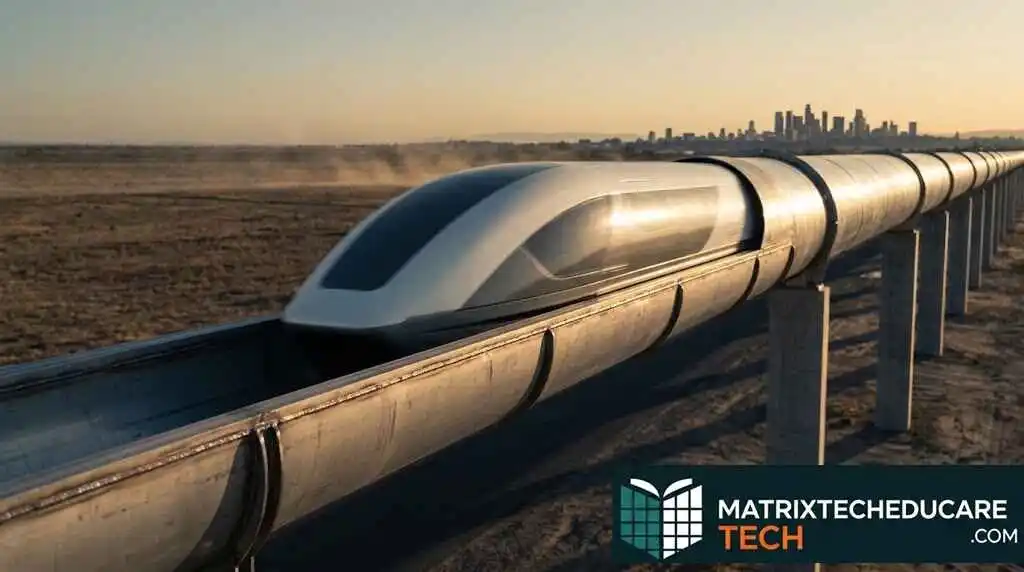
Picture a planning meeting in almost any transport ministry between 2014 and 2020. Somebody has a deck. Slide four is a rendering: a white tube on slim pylons, curving through a desert or over farmland, with a caption promising a journey that used to take five hours will now take twenty-eight minutes. Everyone in the room leans forward. The chief engineer in the corner, the one who has actually costed a rail viaduct, folded his arms and said nothing. He is the only person who has read past slide four.
That tension — between the rendering and the cost sheet — is the whole story of hyperloop. It is one of the few technology narratives of the last fifteen years that has already run its full arc in public: the white paper, the hype cycle, the record funding rounds, the test track, the bankruptcy filings, and then the quiet afterlife where a handful of labs keep working because the underlying physics never stopped being interesting.
I want to walk you through that arc without cheerleading and without dunking on it either. Both of those are lazy. What follows is how the system actually works, what specifically broke, what is still running in 2026, and how to read the next press release about a vacuum tube train without getting fooled. If you work anywhere near infrastructure, mobility, logistics or deep tech investment, this is a case study worth carrying around.
The interesting question about hyperloop was never whether the physics works. It was whether anyone could afford the physics.
Where the Idea Came From, and What the Original Paper Actually Claimed
In August 2013, Elon Musk published a document called Hyperloop Alpha. It was roughly fifty-seven pages, it was free, and it was explicitly offered as an open-source starting point rather than a company. The framing was a complaint: California was about to spend an enormous amount of money on a high-speed rail line that would be slower than a plane and more expensive than a bus. Musk argued there ought to be a fifth mode of transport sitting between rail and aviation — faster than a train, cheaper than a plane, immune to weather, and powered by electricity.
The proposal was a steel tube held at low pressure, roughly one-thousandth of atmospheric pressure, with passenger capsules riding on air bearings and pushed along by linear induction motors spaced at intervals. Solar panels on top of the tube would supply the energy. The headline number for a Los Angeles to San Francisco run was about thirty-five minutes, at a construction cost the paper put at around six billion dollars for a passenger-only version.
Two things about that document matter more than the speed figure. First, the cost estimate was the aggressive part, not the velocity. Moving a pod at 1,200 km/h in a near-vacuum is comfortably within known engineering. Building six hundred kilometres of pressure vessel across seismic terrain for six billion dollars was the fantasy. Second, the paper invited everyone in. Musk said he was too busy to build it, which converted a single idea into a decade-long open competition involving startups, universities, steel companies and at least four national governments.
| KEY TAKEAWAY Read the numbers in any hyperloop pitch in this order: cost per kilometer first, throughput second, speed last. Speed is the easy part. The other two are where projects die. |
How Does Hyperloop Work? The Four Systems Under the Skin
Strip away the renderings and a hyperloop is four engineering problems stacked on top of each other. Each one is solved, individually, somewhere in the world today. The difficulty is that they have to be solved simultaneously, at scale, for decades, with people inside.
1. The tube and the vacuum
Air resistance rises with the square of velocity. At 1,000 km/h in normal atmosphere, a vehicle spends almost all its energy shoving air out of the way, which is precisely why aircraft climb to eleven kilometers where the air is thin. A hyperloop brings that thin air down to ground level by sealing it in a tube and pumping most of it out.
Target pressures usually sit around 100 pascals, roughly one-thousandth of sea level. That is not a hard vacuum by laboratory standards, and the pumps to achieve it are ordinary industrial equipment. The hard part is the tube: hundreds of kilometers of welded steel or concrete that must hold that pressure differential, stay leak-tight through daily thermal cycling, survive ground settlement, and remain alignable to millimeter tolerances while expanding and contracting by meters across a summer day.
2. Levitation
Something has to keep the pod off the track. The original paper used compressed-air skis, similar to an air hockey table. Almost every serious team since has moved to maglev transportation principles instead, because magnets do not need a working fluid and a near-vacuum is a terrible place to rely on air.
Three approaches dominate. Electromagnetic suspension uses actively controlled magnets that pull the pod up toward a rail, requiring constant sensing and correction. Electrodynamic suspension uses permanent magnets in a Halbach array that generate lift passively once the pod is moving above a few tens of km/h. Superconducting systems generate far stronger fields but need cryogenic cooling on board. Passive Halbach arrays became the favorite among startups for the simple reason that they fail gracefully: lose power and the pod settles onto auxiliary wheels rather than dropping.
3. Propulsion
A linear induction motor is essentially a rotary electric motor unrolled and laid flat along the guideway. The stator sits on the track, the reaction plate sits on the pod, and a travelling magnetic wave drags the vehicle forward. Because the expensive, heavy motor components stay on the ground, the pod itself is mostly structure, seats and batteries for onboard systems.
Crucially, propulsion does not need to run continuously. In a near-vacuum there is very little drag, so a pod can be accelerated in bursts at stations and at intervals along the route, then coast for long stretches. This is genuinely elegant and it is the strongest energy-efficiency argument the technology has.
4. Braking, control and safety
Regenerative braking through the same linear motors handles normal deceleration and returns energy to the grid. Eddy-current brakes and friction backups handle the rest. Control is the harder half: pods running at 300 meters per second need headway management, switching, and a plan for every failure mode in a sealed tube with no roadside.
| Subsystem | Typical approach | Maturity | Where it gets hard |
| Low-pressure tube | Welded steel, ~100 Pa, vacuum pump stations | Proven at short scale | Thermal expansion and leak rate over hundreds of km |
| Levitation | Passive Halbach maglev, auxiliary wheels | Demonstrated | Cost per km of magnetic guideway |
| Propulsion | Linear induction motors, intermittent | Mature technology | Power electronics along the full corridor |
| Braking | Regenerative plus eddy-current plus friction | Demonstrated | Emergency stop distances at 1,000 km/h |
| Switching | Electromagnetic track switching, no moving rails | Prototype | Throughput depends entirely on this |
| Life support | Sealed pressurized cabin, onboard air | Borrowed from aviation | Certification with no precedent |
The Physics Bill Nobody Wanted to Read
Here is where I stop being polite about the renderings. There are four constraints that every hyperloop programme eventually collides with, and none of them are secrets. They were all raised by engineers within months of the 2013 paper.
Thermal expansion is not a detail
Steel expands about 12 parts per million per degree Celsius. A 500 km steel tube swinging through a 40-degree day-night range wants to change length by roughly 240 meters. You can absorb that with expansion joints, sliding supports and bellows — bridges do versions of this every day — but every joint is a potential vacuum leak, and you need thousands of them, maintained for fifty years, across terrain that is also moving underneath you.
The Kantrowitz limit squeezes your tube diameter
When a vehicle moves fast inside a tube, the air it cannot push aside has to squeeze through the gap between the pod and the wall. Past a certain speed-to-clearance ratio the flow chokes and drag spikes violently. The fixes are a wider tube, a compressor on the nose of the pod to swallow air and blow it out the back, or a slower pod. A wider tube is the most reliable answer and also the most expensive one, because tube cost scales roughly with the square of the diameter while the pressure requirements get worse.
Comfort constrains your route more than speed does
Passengers tolerate lateral acceleration of about 0.5 g before a ride stops feeling premium. At 1,000 km/h, holding that limit requires curve radii in the range of fifteen to twenty kilometers. Practically, that means near-perfectly straight alignments, which means elevated structures, tunnels, and land acquisition through whatever happens to be in the way. The corridors where hyperloop speeds genuinely payoff — 400 to 1,000 km city pairs — are usually the corridors with the most expensive land.
Safety engineering has no template
A sealed steel tube at low pressure containing a pressurized capsule of people is a combination no regulator has ever certified. What happens during a breach at speed? How do you evacuate someone forty kilometers from the nearest access point? How do you handle a fire, or a stalled pod with forty pods behind it? These questions have answers, but producing them costs years and a great deal of money, and no insurer or transport authority will permit a commercial service without them. That regulatory vacuum became a financial roadblock long before anyone poured concrete.
| KEY TAKEAWAY The pattern to notice: every hyperloop cost overrun traces back to a physical constraint that was visible in 2013 and was treated as a detail to be optimized later. |
The Collapse: What Actually Happened Between 2023 and 2026
For about eight years, the sector looked genuinely credible. Hyperloop One, later Virgin Hyperloop, built a 500-metre test track in the Nevada desert and in November 2020 ran two employees along it at 172 km/h — the first human passengers in a hyperloop pod anywhere. Hyperloop Transportation Technologies built a test loop in Toulouse and signed agreements across Europe and the Gulf. Hardt Hyperloop in the Netherlands opened a European test facility. Zeleros in Spain raised serious money on a different architecture that put more of the system on board the vehicle.
Then the funding climate changed and the arithmetic surfaced. Hyperloop One pivoted away from passengers toward cargo, shed staff, and shut down at the end of December 2023, selling off equipment. That was the most heavily capitalized effort in the field. By early 2026, Hardt Hyperloop had gone bankrupt and Zeleros had entered insolvency with its assets sold. The commercial hyperloop sector, as a venture-funded category, is essentially finished.
It is worth being precise about the cause of death, because the popular summary — that the physics was fake — is wrong and unhelpful. Three things killed it:
- Capital intensity with no revenue staircase. A rail operator can open one segment and collect fares. A hyperloop has almost no useful short version; the value only appears when the corridor is long, and the corridor only gets built with billions committed up front.
- No certification pathway. Without standards, governments cannot permit and insurers cannot price the risk, so even willing public partners had nothing to sign.
- A ten-to-one gap between promised and probable cost. Serious independent estimates of tube infrastructure landed in the range of twenty to forty million dollars per kilometer and upward, against a founding paper that implied roughly ten.
There is a fourth, more uncomfortable factor. Several proposed hyperloop corridors functioned, intentionally or not, as political competition for conventional rail projects. Announcements arrived precisely when rail funding decisions were being made. When the hyperloop companies folded, some of those rail projects had already lost years. That is a real cost, and it belongs in the ledger.
Where the Technology Is Still Alive in 2026
Now the part most coverage misses. The startups died. The engineering did not.
India kept building
The most substantial active hyperloop programme in the world right now sits on a university campus south of Chennai. At the IIT Madras Discovery Campus in Thaiyur, the student-led Avishkar Hyperloop team, working with Indian Railways, the incubated startup TuTr, and industrial partners including ArcelorMittal, built a vacuum tube test track of roughly 410 to 450 meters — described as Asia’s largest student-run hyperloop facility. Union Railway Minister Ashwini Vaishnaw announced its completion and the Ministry of Railways has backed it through a formal memorandum of understanding.
The team, around seventy-six students, uses the facility to test levitation, propulsion, braking and control in near-vacuum conditions rather than renting time overseas. IIT Madras hosted the first Global Hyperloop Competition in February 2025, drawing roughly four hundred participants from the United States, Europe and Turkey, and the team demonstrated a working pod at European Hyperloop Week in 2026.
The roadmap that has been publicly discussed runs in two phases: an 11.5 km test track to validate and certify the technology, then extension toward one hundred kilometers if trials succeed. The long-term corridor everyone names is Mumbai to Pune, a route where the pitch is a journey of roughly twenty-five minutes. Treat the corridor timeline as aspiration and the test track as the real news. The genuine value here is capability building — vacuum engineering, magnetic systems, control algorithms and safety practice developed domestically, all of which transfer to conventional high-speed rail whether or not a single commercial pod ever carries a fare-paying passenger.
The student ecosystem became the R&D layer
European Hyperloop Week, run in rotation by Delft Hyperloop, HYPED, Hyperloop UPV and Swissloop, now gathers roughly 450 participants annually and has effectively replaced corporate labs as the field’s development engine. It is slower and poorer than a venture-backed startup, and also far more honest, because a student team that overstates its results gets found out in a week by forty rival teams.
Freight is the quieter, better-shaped opportunity
Cargo does not need life support, emergency egress, comfort-limited curve radii or passenger certification. It tolerates higher accelerations and does not complain about a windowless capsule. Several analysts have argued for years that if any vacuum tube system reaches commercial service, it will move containers between a port and an inland terminal over a short, high-value, dedicated link — not people between cities. That version is unglamorous, and it is the version with a plausible business case.
The components escaped into other industries
Halbach array magnetics, linear motor control, low-pressure systems engineering and composite pressure vessel work all found homes elsewhere: conventional maglev, launch assist research, industrial automation, and vacuum-based manufacturing. A decade of funded work on those subsystems is not wasted just because the product did not ship.
Hyperloop vs High-Speed Rail vs Maglev vs Flying
Any honest assessment of hyperloop has to answer a blunt question: compared to what? The technology was never competing against the status quo in the abstract. It was competing against specific, funded, already-working alternatives on specific corridors.
| Factor | Hyperloop (proposed) | High-speed rail | Commercial maglev | Short-haul aviation |
| Cruise speed | 1,000-1,200 km/h | 250-350 km/h | 430-600 km/h | 800-900 km/h |
| Infrastructure cost per km | $25-60M+ (estimated) | $15-50M | $50-100M | Airports only |
| Proven at scale | No | Yes, 60+ years | Yes, limited routes | Yes |
| Weather resilience | Very high | High | High | Low |
| Energy per passenger-km | Potentially lowest | Low | Moderate | Highest |
| Throughput | Unproven, switching-limited | Very high | High | Moderate |
| Certification status | None | Complete | Complete | Complete |
Look at that table the way a transport minister does. High-speed rail is slower, but it is buildable this decade, financeable by institutions that already understand it, certifiable under existing rules, and capable of moving very large numbers of people per hour. Japan has been running Shinkansen services since 1964 with an extraordinary safety record. China built tens of thousands of kilometers of it inside twenty years. Against that, a system with no certification pathway and an unproven throughput model has to be not just faster but dramatically better on total cost, and it never was.
The comparison with commercial maglev is even more instructive, because maglev is the closest living relative to hyperloop and it tells you exactly what happens to expensive, technically successful transport systems. Shanghai has run a maglev link from the airport since 2004. It works beautifully. Almost nobody copied it, because the cost per kilometer was hard to justify against conventional rail. Hyperloop asked the world to accept maglev-level costs plus a vacuum system on top.
Against aviation the argument was stronger and still is. Short-haul flights are the least efficient, most weather-exposed and most carbon-intensive way to move a person 500 kilometers, and the airport experience adds two hours of overhead to a fifty-minute flight. A ground-based system that puts you in a pod in the city center genuinely wins that comparison on door-to-door time. That is the corridor logic that made hyperloop compelling — and it is the same logic that already justifies high-speed rail, which is why rail keeps winning the decision.
How to Read the Next Hyperloop Announcement Without Getting Fooled
You will see more of these. The concept is too photogenic to die, and market research firms still publish forecasts projecting the hyperloop technology market into the tens of billions by the mid-2030s — forecasts that quietly assume commercial deployment nobody has demonstrated. Here is the checklist I use on every announcement, and it generalizes well beyond this one technology.
Ask what was actually demonstrated, in what units
- A pod moving at 40 km/h on a 400 m track is a real result and not evidence of a 1,000 km/h system. Both can be true.
- Check whether the test ran under vacuum or in atmosphere. Atmospheric runs are far easier and far less meaningful.
- Distinguish a levitation demonstration from a propulsion demonstration from a full-system run. Press releases blur these deliberately.
- Ask about the test track length, because acceleration distance caps achievable speed. You cannot reach 600 km/h in half a kilometer without crushing your passengers.
Follow the money, not the memorandum
A memorandum of understanding commits nobody to anything. A feasibility study is a purchase of paper. The signals that matter is land acquisition begun, environmental clearance granted, a certification framework opened by a national regulator, and construction finance closed with named institutions carrying the risk. When you see a route announcement with a date attached but none of those four, you are reading marketing.
Interrogate throughput, because nobody does
This is the question that quietly destroys most hyperloop business models. A pod carrying twenty-eight passengers has to depart with extreme frequency to match a train carrying a thousand. That means pods separated by seconds, which means switching and merging at speed, which means the switching technology — not the tube, not the magnets — is the real bottleneck. When a proposal quotes capacity, work out the implied headway and ask whether anyone has demonstrated switching at that interval. Usually nobody has.
Separate the corridor from the technology
A programme can be genuinely valuable as research and completely implausible as a route. The IIT Madras work is a good example: the test facility, the student pipeline and the Indian Railways partnership are real, measurable and useful, while the Mumbai-Pune corridor remains a long-horizon possibility. Judging the first by the second is a mistake in both directions — it either oversells a test track or dismisses good engineering because the marketing overreached.
| KEY TAKEAWAY Four questions that cut through any hyperloop pitch: What pressure was the test run at? How long is the track? What is the demonstrated headway between pods? Who has closed construction finance? |
What Hyperloop Got Right, and What It Costs to Get Things Wrong Loudly
It would be easy to file this whole episode under cautionary tale and move on. I think that misses several things worth keeping.
The open-sourcing of the original proposal was genuinely unusual and genuinely productive. Instead of one company grinding through a decade of confidential development, dozens of teams attacked the problem in parallel and published. We now know far more about low-pressure transport, passive levitation and linear propulsion than we did in 2013, and that knowledge is public. Very few failed technologies leave that kind of residue.
The concept also dragged transport ambition back into public conversation at a moment when most countries had stopped imagining new infrastructure at all. A generation of engineering students joined a hyperloop team, learned vacuum systems and control theory, and went to work on rail, aerospace and energy. The teams at Delft, Zurich, Valencia, Edinburgh and Chennai are a training pipeline whose output outlives every startup that folded.
But there is a bill for making promises this loudly. Public trust in transport innovation is not infinite. When a heavily publicized project fails after a decade of route announcements, the next credible proposal — electrified freight corridors, regional rail revival, a genuinely fundable maglev link — arrives to a more cynical audience. Some of the skepticism aimed at hyperloop is now aimed at anything ambitious, which is a worse outcome than the money lost.
Hype is a loan against future credibility. Hyperloop borrowed heavily and the whole sector is servicing the interest.
The practitioner’s takeaway
- Sequence your risk. Build the version that generates revenue in phase one, even if it is smaller and less exciting than the vision.
- Certification is a design constraint, not a paperwork phase. Engage regulators in year one, because a system nobody can permit is a system nobody can sell.
- Cost estimates that assume novel methods at scale are not estimates. Benchmark against what similar structures actually cost to build today, then justify every deviation.
- Freight before passengers whenever the physics is aggressive. Cargo is a forgiving first customer.
- Publish your failures. The student teams advanced faster than the startups partly because they had no share price to protect.
So, Will You Ever Ride One?
My honest read, and you should weigh it against your own: a commercial passenger hyperloop carrying ticketed riders between two cities before 2040 is unlikely. The venture funding that would have paid for it is gone, the certification work has barely started, and the corridors that make sense are the same corridors where conventional high-speed rail is already cheaper and permittable today.
A short freight or shuttle link using vacuum tube technology in that window is plausible. It would probably be state-backed rather than venture-backed, probably between ten and fifty kilometers, probably connecting a port or an industrial cluster, and probably announced with far less fanfare than any of the passenger corridors that never got built. India is the most likely place for it, because it is the only jurisdiction currently pairing a national rail operator with an active test program and a domestic industrial base willing to fabricate the tube.
And the honest possibility worth holding open: the hyperloop decade may end up mattering most as the thing that pushed magnetic levitation, linear propulsion and low-pressure engineering forward far enough that some future system — which may not look like a tube at all, and probably will not be called a hyperloop — becomes buildable. Technologies rarely fail cleanly. They usually dissolve into their components and reappear somewhere unexpected.
The chief engineer with his arms folded in that meeting was right about the cost sheet. He was not right about everything, though, and it is worth saying so. The students in Chennai and Delft running pods down vacuum tubes on a weekend are doing exactly what he did thirty years ago: learning how hard things behave by building them. The renderings were always the least interesting part of hyperloop. The tooling, the magnets, the control code and the people who learned to build them are the part that survives.
Judge the technology on the physics and the finance, not the animation. That habit will serve you on the next six things the industry gets excited about too.
FAQs
- What exactly is a hyperloop?
A proposed transport system where passenger or cargo pods travel through a sealed tube held at very low air pressure, levitated magnetically or on-air bearings and driven by linear motors. Removing most of the air removes most of the drag, which is what allows very high speeds at relatively low energy use.
- Who invented hyperloop?
The modern concept was popularized by Elon Musk in a 2013 open white paper called Hyperloop Alpha. The underlying idea of vacuum tube transport is far older, dating back to nineteenth-century pneumatic tube proposals and twentieth-century vactrain concepts from researchers including Robert Goddard.
- How fast can a hyperloop actually go?
Design targets are typically 1,000 to 1,200 km/h. The fastest hyperloop pod run with passengers on board reached about 172 km/h at the Nevada test track in 2020. Test tracks have been too short to approach design speed.
- Is hyperloop technology real or just a concept?
The component technologies are real and demonstrated. A complete commercial system carrying paying passengers between cities does not exist anywhere and none is currently under construction.
- Why did Hyperloop One shut down?
It closed at the end of December 2023 after pivoting from passengers to cargo, failing to secure a buildable commercial corridor, and running out of investor appetite for a project with enormous capital requirements and no certification pathway.
- Are any hyperloop companies still operating?
The venture-funded sector has largely collapsed. Hardt Hyperloop went bankrupt and Zeleros entered insolvency by early 2026. Activity now concentrates in university programmes, state-backed research such as the IIT Madras work, and a few surviving firms with reduced ambitions.
- Is India building a hyperloop?
India is running the most active public programme. IIT Madras, with Indian Railways and the startup TuTr, built a vacuum test track of roughly 410 to 450 meters at its Discovery Campus in Thaiyur. A full commercial corridor has not been approved or financed.
- What is the Mumbai-Pune hyperloop?
A long-proposed corridor that would cut travel between the two cities to roughly twenty-five minutes. It has been studied repeatedly but has not reached construction. Treat announced timelines as aspirational.
- How much does a hyperloop cost to build?
Independent estimates generally land between twenty and sixty million dollars per kilometer, with tunneled or urban sections far higher. The original white paper implied roughly ten million per kilometer, which is the single biggest gap between the pitch and reality.
- Why not just build high-speed rail instead?
That is precisely the argument that has won in most countries. High-speed rail is slower but proven, certifiable, financeable, and capable of very high passenger throughput. Hyperloop had to beat it on total cost, not just speed, and never demonstrated that it could.
- Is hyperloop the same as maglev?
Not quite. Most hyperloop designs use maglev for levitation, but conventional maglev runs in open air at 400 to 600 km/h. Hyperloop adds a low-pressure tube around the guideway to cut air drag and push speeds higher.
- How is a hyperloop pod propelled?
By linear induction motors built into the guideway. A travelling magnetic wave pulls the pod forward. Because drag is minimal in the tube, propulsion can be applied in bursts rather than continuously, with the pod coasting in between.
- What happens if the tube loses vacuum?
Air rushes in, drag rises sharply, and pods must decelerate. Designs handle this with sectional isolation valves, pressure sensors, and braking systems sized for emergency stops. Proving these behaviors to a regulator is one of the unsolved certification tasks.
- Would riding a hyperloop feel uncomfortable?
At constant cruising speed it would feel similar to a smooth aircraft cruise, with no windows in most designs. Comfort limits actually constrain the route: staying under about 0.5 g lateral acceleration at 1,000 km/h requires curve radii of roughly fifteen to twenty kilometers.
- What is the Kantrowitz limit?
A choked-flow condition that occurs when a vehicle moving through a tube cannot push enough air around itself. Past a certain speed-to-clearance ratio, drag rises dramatically. Solutions are a wider tube, an onboard compressor, or a lower speed.
- Is hyperloop environmentally friendly?
In principle yes, since it is fully electric and extremely aerodynamically efficient at cruise. The counterweight is embodied carbon: manufacturing and installing hundreds of kilometers of steel tube and magnetic guideway is carbon-intensive, and that debt takes many years of operation to repay.
- How many passengers can a hyperloop carry?
Pods are typically designed for twenty-four to twenty-eight people. Matching a high-speed train’s hourly capacity therefore requires departures every few seconds, which depends on switching and headway technology that has not been demonstrated at scale.
- Could hyperloop work for freight instead of people?
This is widely considered the more realistic application. Cargo needs no life support, no emergency egress and no comfort limits, and tolerates higher accelerations. A short port-to-inland-terminal link is the most plausible first commercial use.
- Has anyone ever ridden in a hyperloop?
Yes. In November 2020, two Virgin Hyperloop employees rode a pod at the Nevada test site, reaching about 172 km/h over a 500-metre track. That remains the only human passenger test of its kind.
- What is European Hyperloop Week?
An annual competition and conference organized in rotation by student teams including Delft Hyperloop, HYPED, Hyperloop UPV and Swiss loop. It draws roughly 450 participants and has become the main development forum for the technology since the commercial sector contracted.
- What is Team Avishkar?
The student hyperloop team at IIT Madras, formed at the Centre for Innovation and numbering around seventy-six students. It built Asia’s largest student-run vacuum test track with support from Indian Railways and industrial partners, and competes internationally.
- Is the Boring Company building a hyperloop?
No. The Boring Company operates the Las Vegas Loop, which runs Tesla vehicles through conventional tunnels at ordinary road speeds. It is a tunneling and shuttle project, not a vacuum tube system, despite occasional statements about future hyperloop work.
- What safety systems would a hyperloop need?
Sectional pressure isolation, emergency braking sized for full-speed stops, pod-level life support and pressurization, access points for evacuation, fire suppression, and a certified control system managing headway. None of this has an existing regulatory template.
- Why is thermal expansion such a problem?
Steel expands roughly 12 parts per million per degree Celsius. A 500 km tube across a wide daily temperature swing wants to change length by hundreds of meters. Absorbing that requires thousands of expansion joints, each one a possible vacuum leak to maintain for decades.
- Do hyperloops need solar panels?
The original proposal put photovoltaic panels along the top of the tube to offset operating energy. It is technically reasonable but it is an operating-cost improvement, not a solution to the capital cost problem that actually stopped the projects.
- How does hyperloop compare to flying?
On 400 to 1,000 km city pairs, a ground system with city-center stations beats a short flight on door-to-door time and energy use. The same argument, however, already supports high-speed rail, which can be built and certified today.
- What speed do hyperloops realistically operate at?
Several practical designs, including Indian concepts, discuss operational speeds around 360 km/h even where peak capability is quoted near 1,100 km/h. Operating speed is set by comfort, safety margin and energy cost, not by maximum capability.
- Are hyperloop market forecasts credible?
Treat them carefully. Several published forecasts project multi-billion-dollar markets growing rapidly through the 2030s while the commercial sector is contracting. Those models generally assume deployment that nobody has demonstrated or financed.
- What should investors look for before backing a hyperloop project?
Closed construction finance, granted environmental clearance, land acquisition underway, and an open certification process with a national regulator. Memoranda of understanding, feasibility studies and route renderings signal nothing about buildability.
- Is it worth continuing hyperloop research at all?
Yes, provided the framing is honest. The research produces transferable capability in magnetic levitation, linear propulsion, vacuum systems and control engineering, and it trains engineers who go on to work across rail, aerospace and energy. That value is real whether or not a commercial corridor is ever built.
Disclaimer: The content on this blog is for informational purposes only. The author’s opinions are personal and not endorsed. Efforts are made to provide accurate information, but completeness, accuracy, or reliability are not guaranteed. The author is not liable for any loss or damage resulting from the use of this blog. It is recommended to use the information on this blog at your own discretion.

