

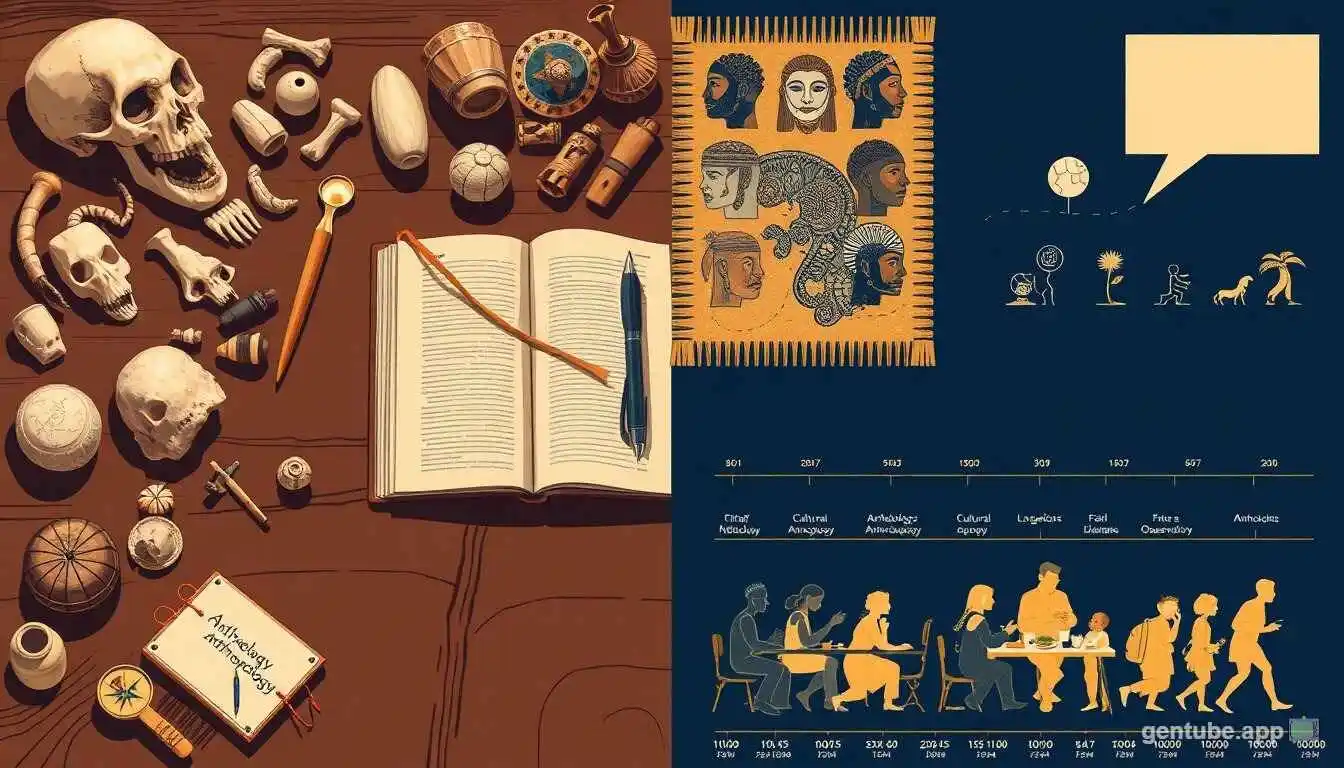
The Human Puzzle: How Anthropology Explains Why We Are the Way We Are
Inside the discipline that studies humanity from bones to belief systems — and why understanding it changes how you see everyone around you
Why do some cultures greet strangers with a bow and others with a firm handshake? Why does one society trace inheritance through the mother’s line while another insists on the father’s? Why did our ancestors start walking upright millions of years before their brains grew large, rather than the other way around? These questions sound unrelated, but they all belong to the same discipline: anthropology, the study of what it means to be human across every era, environment, and culture our species has ever produced.
Anthropology occupies an unusual position among academic fields. It is simultaneously a natural science, examining fossils, genetics, and primate behavior, and a social science, immersing researchers in living communities to understand belief, ritual, and daily life. Few other disciplines ask a person to move as comfortably between analyzing a 3-million-year-old skull fragment and living for a year inside a remote village, learning its language, customs, and worldview from the inside out. That range is exactly what makes anthropology valuable: it refuses to separate biology from culture, or the distant past from the living present, insisting instead that understanding humanity requires holding all of it together.
This piece walks through what anthropology actually studies, its four major subfields, the core concepts that shape how anthropologists think, and why a discipline sometimes dismissed as academic curiosity has quietly reshaped how modern societies think about culture, ethics, identity, and each other.
Along the way, it is worth keeping one idea in mind: anthropology is unusual among academic fields in that its central subject, the human being, is also the one doing the studying. Every anthropologist brings their own cultural assumptions into the field, which is precisely why the discipline has spent so much energy developing methods, like cultural relativism and reflexive fieldwork, designed to notice and account for that built-in bias rather than pretend it does not exist.
What Is Anthropology, Really?
At its broadest, anthropology is defined as the holistic study of humanity — past and present, biological and cultural, local and global. The word itself comes from the Greek anthropos, meaning ‘human,’ and logia, meaning ‘study of.’ Unlike disciplines that narrow their focus to a single dimension of human life, anthropology deliberately widens the lens, asking not just what people do, but why, how that behavior evolved, and what it reveals about the underlying structure of human experience.
This holistic ambition traces back to the discipline’s early development in the late nineteenth and early twentieth centuries, when scholars began systematically documenting cultures around the world, partly out of genuine intellectual curiosity and partly, uncomfortably, in service of colonial administration. Modern anthropology has spent much of the past century reckoning with that complicated origin, shifting away from an extractive, outsider-looking-in approach toward more collaborative, ethically grounded methods that center the perspectives and consent of the communities being studied.
Today, professional anthropology is generally organized into four interconnected subfields: cultural anthropology, biological anthropology, archaeology, and linguistic anthropology. Some academic traditions, particularly in the United States, formally teach all four together as a single unified discipline; others, especially in parts of Europe, treat social anthropology and biological anthropology as more separate fields. Regardless of institutional structure, the underlying commitment remains the same — no single lens, whether genetic, cultural, historical, or linguistic, fully explains a human being on its own.
This four-field model, sometimes called the ‘holistic’ or ‘Boasian’ approach after its most influential early advocate, Franz Boas, was itself a deliberate methodological stance rather than an accident of academic organization. Boas argued forcefully against the racial determinism common in late nineteenth-century science, insisting that biological, linguistic, and cultural variation needed to be studied together and on their own terms, rather than ranked against each other on a single scale of supposed civilizational progress. That argument, radical for its time, still underpins much of how the discipline approaches human difference today, even as specific methods and theories have evolved considerably since Boas’s era.
Cultural Anthropology: Understanding Living Societies
Cultural anthropology examines contemporary human societies, focusing on belief systems, social organization, kinship, ritual, economy, and daily practice. Its signature method is ethnography: extended, immersive fieldwork in which a researcher lives within a community, often for a year or more, learning the local language, participating in daily life, and systematically recording observations. This approach, called participant observation, was pioneered in the early twentieth century by figures such as Bronisław Malinowski, whose fieldwork among the Trobriand Islanders established immersive, long-term residence as the discipline’s methodological gold standard.
“You cannot understand a culture by reading about it from the outside. You have to live inside its logic first.”
The output of this fieldwork is typically what anthropologist Clifford Geertz famously termed ‘thick description’ — an account that goes beyond simply recording what people do, aiming instead to capture the layered cultural meaning behind an action. A wink, Geertz pointed out in his classic example, can be an involuntary twitch, a conspiratorial signal, or a parody of someone else’s wink, and only careful attention to context reveals which. Cultural anthropology treats this kind of layered interpretation as essential, resisting the temptation to reduce behavior to simple universal explanations that ignore local meaning.
One of cultural anthropology’s most influential contributions is the concept of cultural relativism: the principle that a society’s practices should be understood within their own context rather than judged against the standards of an outside culture. This does not mean anthropologists refuse to evaluate harmful practices, but it does mean the discipline insists on understanding the internal logic of a custom before passing judgment on it — a corrective to ethnocentrism, the natural human tendency to view one’s own culture as the standard against which all others are measured.
Kinship remains one of cultural anthropology’s richest areas of study, precisely because it reveals how differently societies can organize something Western readers often assume is universal and fixed: the family. Some societies trace descent and inheritance exclusively through the mother’s line, a pattern called matrilineal descent; others follow the father’s line patrilineally; still others recognize more flexible or dual systems. Marriage practices vary just as widely, from monogamous pairings to polygynous or polyandrous arrangements, each embedded in a broader web of economic obligation, political alliance, and social status that a narrow, Western-centric definition of family would miss entirely.
Margaret Mead’s mid-century fieldwork in Samoa, though later challenged and revised by subsequent researchers, illustrates both the promise and the pitfalls of this comparative approach. Mead used her fieldwork to argue that adolescent turmoil, widely assumed in her own society to be a universal biological stage, appeared far less pronounced in the Samoan communities she studied, suggesting that culture, not biology alone, shaped much of what her contemporaries took for granted as simply human nature. The subsequent scholarly debate over how accurately Mead had characterized Samoan society became, in its own way, a lasting lesson for the discipline about the difficulty of fully setting aside one’s own cultural lens, no matter how rigorous the fieldwork.
Biological Anthropology: Humans as an Evolving Species
Where cultural anthropology looks at living societies, biological anthropology — sometimes called physical anthropology — studies humans as a biological organism shaped by evolutionary processes. This subfield encompasses paleoanthropology, the study of fossil hominins; primatology, the study of humanity’s closest living relatives; human genetics; and skeletal biology, which examines bone structure to reconstruct health, diet, and physical activity in past populations.
Paleoanthropologists work to piece together the long, branching story of human evolution, from early bipedal hominins such as Australopithecus, walking upright millions of years before brain size increased significantly, through the emergence of the genus Homo and eventually to anatomically modern Homo sapiens. Contrary to a common popular assumption of evolution as a straight line from ape to human, the fossil record reveals a much messier picture: multiple hominin species often coexisted simultaneously, some evolutionary branches ended in extinction, and traits like large brains, complex tool use, and upright walking did not all emerge together in lockstep, but rather at different points and paces across millions of years.
Primatology contributes a comparative dimension to this picture, since studying the behavior, social structures, and cognition of living primates such as chimpanzees, bonobos, and gorillas offers indirect insight into which human traits are evolutionarily ancient and shared with close relatives, versus which are genuinely unique to our own lineage. Long-term studies of wild chimpanzee tool use, for example, have reshaped scientific understanding of how early hominins might have used simple tools long before the archaeological record shows direct evidence of human toolmaking.
Genetics has transformed biological anthropology over the past few decades, allowing researchers to trace ancient human migration patterns, identify interbreeding between Homo sapiens and other hominin groups such as Neanderthals and Denisovans, and study how populations have adapted genetically to different environments, diets, and diseases over tens of thousands of years. This genetic evidence frequently complements, and sometimes complicates, conclusions drawn purely from fossil or archaeological data, adding an additional layer of evidence to an already intricate evolutionary puzzle.
Skeletal biology, meanwhile, works at a more individual scale, examining bones recovered from archaeological and forensic contexts to reconstruct details of a person’s life: approximate age at death, nutritional history, evidence of physical labor or disease, and sometimes even cause of death. Markers left on bone by chronic malnutrition, repetitive physical strain, or healed fractures allow researchers to build a surprisingly detailed picture of everyday hardship and resilience in past populations, information that written historical records, when they exist at all, rarely capture for anyone outside society’s elite.
Archaeology: Reading the Physical Record of the Past
Archaeology, often popularly imagined as the discipline of excavation and artifact discovery, is formally considered one of anthropology’s four core subfields in many academic traditions, since it uses physical remains to answer fundamentally anthropological questions about how past societies organized themselves, what they valued, and how they lived. Archaeologists study everything from stone tools and pottery shards to house foundations, burial sites, and ancient garbage deposits, each offering clues about diet, technology, trade, social hierarchy, and belief.
Excavation itself is a slow, meticulous process, since the precise location and layering of an artifact within the soil, known as its stratigraphic context, often carries as much information as the object itself. A pottery fragment removed without careful documentation of its surrounding layer loses much of its scientific value, which is why professional archaeology emphasizes careful recording over simple treasure-hunting, in sharp contrast to the looting and unregulated collection that damaged so many sites throughout the colonial era and continues to threaten heritage sites today.
Archaeological evidence has repeatedly overturned assumptions drawn purely from written historical records, since writing itself is a relatively recent human invention and leaves enormous stretches of human history undocumented by text. Excavations of early agricultural settlements, for example, have revealed surprisingly complex social organization and trade networks long before the rise of the first cities typically credited with ‘civilization,’ challenging older narratives that treated large urban centers as the starting point of meaningful human social complexity rather than one development among many.
Dating techniques form the backbone of archaeological interpretation, since an artifact’s meaning depends heavily on knowing roughly when it was made or used. Radiocarbon dating, which measures the predictable decay of a radioactive carbon isotope in organic material, remains one of the most widely used methods for dating anything from charcoal in an ancient hearth to preserved textile fragments, typically effective for material up to around fifty thousand years old. For older material, techniques such as potassium-argon dating and thermoluminescence extend the timeline much further back, while relative dating methods, comparing the position of artifacts within layers of soil, remain essential even where absolute dating techniques are unavailable or too costly to apply to every find at a site.
Linguistic Anthropology: Language as a Window into Thought
Linguistic anthropology examines the relationship between language and culture, studying not just grammar and vocabulary but how speech shapes identity, social relationships, and even patterns of thought. This subfield draws heavily on the idea, associated with linguists Edward Sapir and Benjamin Lee Whorf, that the structure of a language can meaningfully influence how its speakers perceive and categorize the world, an idea now generally understood in a more moderate form than its earliest, more deterministic versions suggested.
Linguistic anthropologists study phenomena such as code-switching, where speakers shift between languages or dialects depending on social context; honorific speech systems, which encode social hierarchy directly into grammar in languages such as Japanese and Korean; and the alarming rate of language extinction occurring worldwide, as smaller indigenous languages are replaced by dominant national or global languages, often taking unique cultural knowledge and ways of categorizing the world down with them.
This concern with disappearing languages connects linguistic anthropology to a broader practice within the discipline known as salvage ethnography — early and ongoing efforts to document rapidly vanishing indigenous languages, oral traditions, and cultural practices before further contact, displacement, or generational change erodes them permanently. While the term carries some uncomfortable colonial history, contemporary versions of this work increasingly involve indigenous communities themselves as active partners and leaders in the documentation process, rather than passive subjects being studied and recorded by outside researchers.
Vocabulary itself can reveal a great deal about a culture’s priorities and environment. Languages spoken by communities with complex kinship obligations often contain far more specific kinship terms than English, distinguishing, for instance, between an older and younger sibling, or between a maternal and paternal aunt, in ways that reflect genuinely different social expectations attached to each relationship. Similarly, communities with deep, generational knowledge of a particular ecosystem frequently develop highly specific vocabulary for local plants, weather patterns, or terrain features that a language spoken elsewhere, without that same environmental relationship, simply has no practical need to distinguish.
Why Anthropology Matters Beyond Academia
Anthropology’s influence extends well beyond university departments. Applied anthropologists work directly with businesses, hospitals, government agencies, and international development organizations, using ethnographic methods to understand user behavior, patient experience, workplace culture, or community needs in ways that pure statistical data often misses. Technology companies, for instance, have increasingly employed anthropologists to conduct in-depth observational research on how people actually use products in their homes and daily routines, insight that surveys and click-data alone frequently fail to capture.
Forensic anthropology applies skeletal analysis techniques developed within biological anthropology to identify human remains, supporting criminal investigations, disaster victim identification, and international human rights work, including efforts to identify victims of genocide and mass atrocity for both legal accountability and family closure. Medical anthropology examines how culture shapes experiences of illness, healing, and healthcare systems, informing public health interventions that must account for local beliefs and practices to be effective rather than simply imposing outside medical models without cultural context.
Design and user-experience research offer another clear example of applied anthropology at work. Rather than relying solely on surveys or usage statistics, companies increasingly send trained researchers into people’s homes and workplaces to observe how a product is actually used, often uncovering workaround behaviors, frustrations, or unexpected uses that no amount of quantitative data alone would surface. This kind of contextual inquiry, borrowed directly from ethnographic method, has become a standard part of product development precisely because it captures the same kind of layered, situated meaning that cultural anthropologists have always argued gets lost when human behavior is reduced to numbers alone.
Perhaps anthropology’s most significant broader contribution, though, is conceptual rather than applied: the discipline’s insistence that there is no single ‘natural’ or ‘normal’ way to organize a family, structure an economy, understand illness, or practice religion. This perspective, hard-won through more than a century of careful cross-cultural fieldwork, offers a genuine corrective to the common assumption that one’s own cultural practices represent a neutral default rather than one option among many equally coherent ways of organizing human life.
Conclusion: The Discipline That Studies Everyone, Including Us
What ultimately distinguishes anthropology from other fields is not any single method or subject matter, but its underlying refusal to treat human life as simple. A discipline willing to study a three-million-year-old fossil skull, a contemporary kinship system, an endangered indigenous language, and the buried foundations of an ancient settlement, all as parts of the same fundamental inquiry, is making an implicit argument: that understanding humanity requires resisting the temptation to reduce people to a single explanatory framework, whether purely biological, purely cultural, or purely historical.
That resistance to oversimplification has real, practical value well beyond the classroom. It trains a particular habit of mind — approaching unfamiliar practices with curiosity rather than immediate judgment, recognizing that one’s own cultural assumptions are learned rather than natural, and appreciating that the deep past and the living present are far more connected than they first appear. In an era of rapid globalization, cultural friction, and renewed interest in questions of identity and belonging, that habit of mind may be exactly what anthropology has to offer that no other discipline quite replicates: not answers about who is right, but a disciplined, evidence-based way of understanding why people everywhere do what they do.
The next time an unfamiliar custom, an unexpected family structure, or a disappearing language crosses your path, anthropology offers a simple but genuinely difficult habit to practice: pause before judging, ask what problem this practice might be solving for the people who live it, and remember that your own default assumptions were learned too. That small shift in perspective, multiplied across enough people and enough encounters, is arguably the discipline’s most lasting contribution to public life.
FAQs
| Question | Answer |
| What is anthropology? | Anthropology is the holistic study of humanity, examining human biology, culture, language, and history to understand what makes people similar and different across time and place. |
| What are the four main subfields of anthropology? | The four main subfields are cultural anthropology, biological (or physical) anthropology, archaeology, and linguistic anthropology. |
| What does a cultural anthropologist study? | Cultural anthropologists study living societies, examining beliefs, customs, social structures, and daily practices, typically through extended fieldwork within a community. |
| What is ethnography? | Ethnography is the primary research method of cultural anthropology, involving immersive fieldwork and detailed written accounts of a community’s culture and social life. |
| What is participant observation? | Participant observation is a research technique where the anthropologist lives within a community and takes part in daily activities while systematically observing and recording behavior. |
| What does biological anthropology focus on? | Biological anthropology examines human evolution, genetics, primatology, and skeletal biology to understand humans as a biological species. |
| What is archaeology’s role within anthropology? | Archaeology recovers and analyzes physical remains and artifacts left behind by past human societies to reconstruct how people lived, worked, and organized themselves. |
| What does linguistic anthropology study? | Linguistic anthropology examines how language shapes and reflects culture, social identity, and thought across different societies. |
| Who are considered founding figures of anthropology? | Figures such as Franz Boas, Bronisław Malinowski, and Margaret Mead are widely regarded as foundational to modern anthropological methods and theory. |
| What is cultural relativism? | Cultural relativism is the principle of understanding a culture’s practices and beliefs on its own terms rather than judging them against the standards of another culture. |
| How is cultural relativism different from moral relativism? | Cultural relativism is primarily a methodological tool for understanding behavior in context, while moral relativism makes a broader philosophical claim that no universal ethical standards exist. |
| What is ethnocentrism? | Ethnocentrism is the tendency to judge other cultures using the standards and values of one’s own culture, often leading to biased or inaccurate interpretations. |
| What is kinship in anthropology? | Kinship refers to the socially recognized relationships between individuals, including family ties, marriage systems, and descent patterns, which vary significantly across cultures. |
| Why do anthropologists study kinship systems? | Kinship systems reveal how societies organize inheritance, obligation, marriage, and identity, offering insight into social structure beyond Western nuclear family assumptions. |
| What is the difference between anthropology and sociology? | Anthropology traditionally emphasizes small-scale, in-depth fieldwork and cross-cultural comparison, while sociology often focuses on large-scale patterns within industrialized societies using broader statistical methods. |
| What is applied anthropology? | Applied anthropology uses anthropological methods and insights to address practical problems in fields like public health, business, education, and international development. |
| How do anthropologists study human evolution? | Anthropologists study human evolution through fossil analysis, comparative primate studies, genetics, and the archaeological record of early hominin behavior. |
| What is a hominin? | A hominin refers to modern humans and our extinct bipedal ancestors and close relatives, a category used to trace the evolutionary lineage leading to Homo sapiens. |
| What is material culture? | Material culture refers to the physical objects, tools, and artifacts a society creates and uses, which anthropologists study to understand values, technology, and daily life. |
| What role does anthropology play in understanding globalization? | Anthropology examines how global economic and cultural forces interact with local traditions, producing new hybrid practices and identities worldwide. |
| What is the concept of ‘thick description’? | Thick description, a term associated with anthropologist Clifford Geertz, refers to richly detailed ethnographic writing that captures the layered meaning behind observed behavior. |
| How does anthropology approach religion? | Anthropologists study religion as a cultural system, examining its rituals, symbols, and social functions rather than evaluating the truth of specific beliefs. |
| What is salvage ethnography? | Salvage ethnography refers to early anthropological efforts to document rapidly disappearing indigenous cultures and languages before further contact and change occurred. |
| Why is anthropology considered a holistic discipline? | It is holistic because it integrates biological, cultural, historical, and linguistic perspectives to build a comprehensive understanding of human life. |
| What ethical concerns do anthropologists face in fieldwork? | Anthropologists must navigate informed consent, cultural sensitivity, potential harm to communities, and the responsible representation of the people they study. |
| How has anthropology changed since the colonial era? | Modern anthropology has moved away from its colonial-era roots toward more collaborative, ethical, and community-involved research practices that center local voices. |
| What is forensic anthropology? | Forensic anthropology applies skeletal and biological analysis techniques to identify human remains, often assisting criminal investigations and human rights work. |
| What is the significance of studying primates in anthropology? | Studying primates provides comparative insight into social behavior, communication, and cognition that helps researchers understand the evolutionary roots of human traits. |
| How do anthropologists define culture? | Anthropologists generally define culture as the shared beliefs, values, practices, and knowledge that a group of people learns and transmits across generations. |
| Why does anthropology matter in everyday life? | Anthropology helps people understand cultural differences, challenge assumptions, and navigate an increasingly interconnected world with greater empathy and insight. |
Disclaimer: The content on this blog is for informational purposes only. The author’s opinions are personal and not endorsed. Efforts are made to provide accurate information, but completeness, accuracy, or reliability are not guaranteed. The author is not liable for any loss or damage resulting from the use of this blog. It is recommended to use the information on this blog at your own discretion.

