

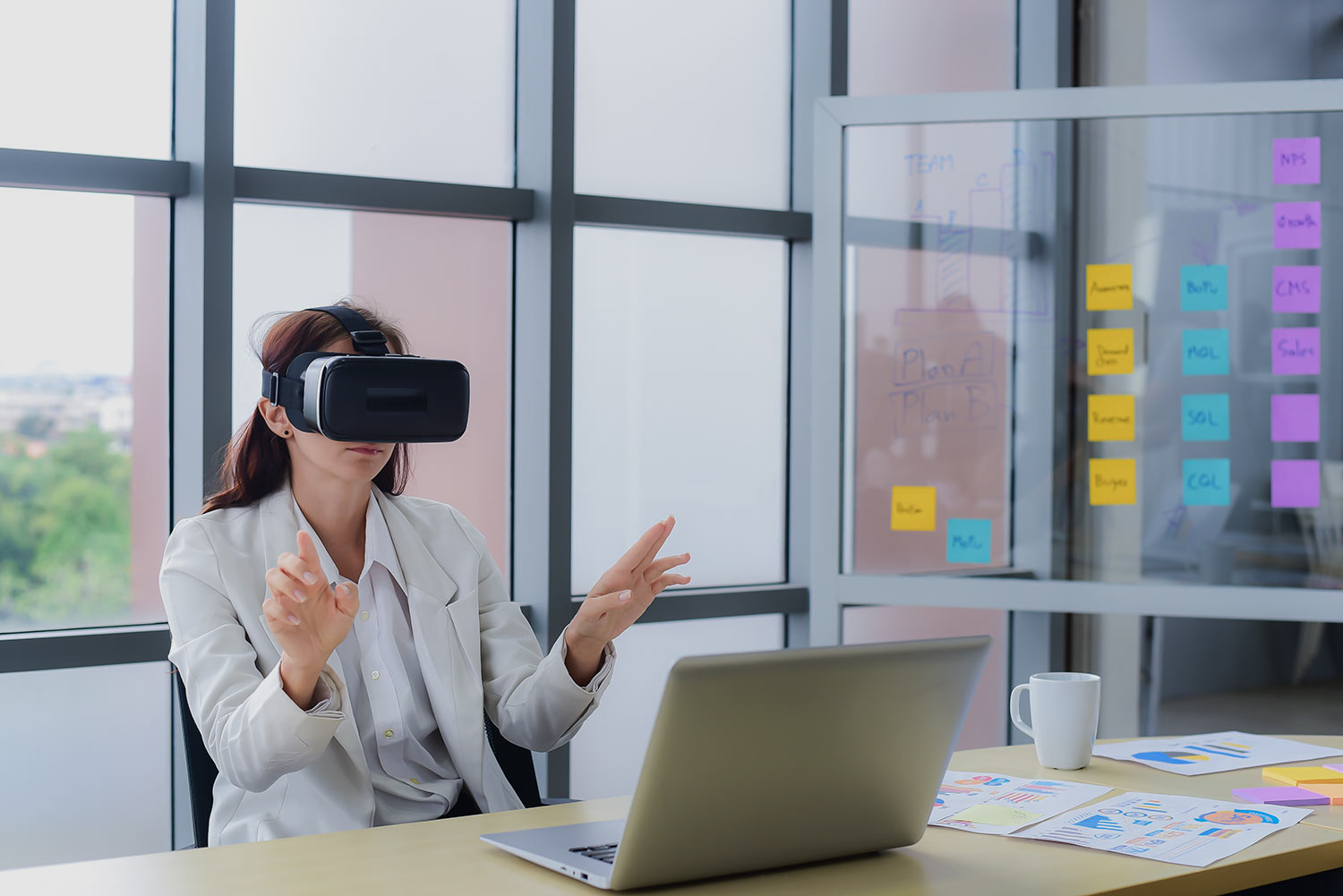
Perhaps the final nail in the coffin for the social media metaverse was not a failure of VR, but the sudden, explosive success of something else: Generative Artificial Intelligence.
In late 2022, as Meta was bleeding billions on the Metaverse, OpenAI released ChatGPT. The technology landscape shifted overnight. The narrative moved from “spatial computing is the future” to “AI is the future.”
Frictionless Magic vs. Clunky Hardware
Generative AI succeeded precisely where the metaverse failed: it removed friction. To use the metaverse, you had to buy a $400 headset, clear your living room, charge the batteries, strap it to your face, and learn new controller mechanics.
To use Generative AI, you type a sentence into a text box—the exact same interface you have been using for 30 years.
AI enhanced the existing 2D internet. It gave us better search, automated writing, incredible image generation (Midjourney, DALL-E), and soon, AI video generation (Sora). It made the flat screen infinitely more powerful and magical without requiring us to change our physical behavior.
AI is Actually Improving Social Media
While Meta was trying to build an alternative to social media, AI was actively making current social media better (from a corporate and user-engagement perspective). TikTok’s algorithm, which is essentially a masterclass in AI-driven predictive modeling, is the most addictive social product ever created. AI-driven deepfakes, voice cloning, and personalized content feeds are keeping people glued to their 2D screens.
AI can also generate virtual influencers, automated video editors, and personalized avatars for your 2D feed. It provides the “sci-fi” feeling of advanced technology without the nausea of a VR headset. The tech giants realized that pouring billions into AI software yielded immediate, tangible financial results, whereas pouring billions into VR hardware yielded mostly losses and memes. The money followed the frictionless magic, abandoning the clunky headset.
Chapter 7: What Actually Survives? The Micro-Metaverse
If the grand, unified social media metaverse is dead, does that mean VR and spatial computing are entirely useless? No. Technology rarely dies completely; it fragments and finds its true niche.
The metaverse will not be a singular, ubiquitous social network like Facebook. Instead, it will splinter into highly specialized, utilitarian “micro-metaverses” that serve specific purposes, largely divorced from traditional social media.
The Gaming Niche
The most successful “metaverse” environments will remain hardcore video games. VRChat has a dedicated, passionate community. Half-Life: Alyx is a masterpiece. Gamers are willing to endure clunky hardware, motion sickness, and high friction because they are actively seeking an interactive challenge, not a casual social hangout. The metaverse survives as a gaming peripheral, not a social media replacement.
The Industrial Metaverse (B2B)
The real money and utility in spatial computing are currently being found in business-to-business (B2B) applications. Companies like Nvidia are building “digital twins”—highly accurate 3D replicas of factories, warehouses, and supply chains. Engineers across the globe can put on a headset and collaboratively design a physical engine in 3D space. This is incredibly valuable. It saves millions in prototyping. But this is corporate simulation, not social media.
The Apple Vision Pro and “Spatial Computing”
Apple’s entry into the market with the Vision Pro highlighted the divergence of paths. Apple explicitly avoided the word “metaverse.” They called it a “spatial computer.” Instead of trying to connect you to avatars in a virtual world, the Vision Pro’s primary use case is augmenting your physical world. It puts infinite screens on your desk, lets you watch movies on a virtual IMAX screen, and connects to your Mac.
Apple recognizes that people do not want to leave reality to connect with others; they want to enhance their solitary reality. The future of headsets is likely a lonely one—used for focused productivity, immersive media consumption, and gaming—not for hanging out in a virtual bar.
Chapter 8: The Societal Pushback Against the Virtual
There is a broader sociological shift happening that the architects of the metaverse completely misjudged. They assumed the trajectory of humanity was an eager, willing departure from the physical world. They assumed we wanted to upload our consciousness to the cloud.
The pandemic proved the exact opposite.
When billions of people were locked inside, forced to conduct their entire lives through Zoom and social media, we experienced a collective psychological breaking point. We developed “Zoom fatigue.” We realized the catastrophic limitations of digital-only connection.
When the lockdowns lifted, there was a massive, visceral societal rejection of the virtual. People demanded to go back to the office (at least partially). Concerts and music festivals sold out at record rates. Travel boomed. We remembered that digital communication is a poor substitute for the pheromones, the shared air, the micro-expressions, and the tactile reality of physical presence.
In this post-pandemic context, the metaverse felt less like a utopian dream and more like a dystopian punishment. The idea of putting on a blindfold to simulate human connection felt grotesque to a society starving for authentic, physical reality. The “Metaverse” became synonymous with isolation, a tech-bro solution to a problem that didn’t exist: the supposed “lack” of digital connection, when in reality, we were drowning in it and desperate for the physical kind.
Conclusion: Back to the Future of 2D Screens
The story of the social media metaverse is a classic tale of technological hubris. It was built by engineers who view human beings as input/output devices, ignoring the messy, complex, lazy, and deeply physical reality of human nature.
They tried to fix something that wasn’t broken. The 2D social media feed is one of the most powerful psychological tools ever invented. It perfectly balances our desire for connection with our desire for voyeurism, our need for validation with our fear of synchronous performance, and our craving for visual aesthetics with our biological need for physical comfort.
The hurdles facing the social metaverse are not mere engineering problems waiting to be solved. They are fundamental limits of physics, ergonomics, psychology, and economics. We will not overcome the weight of a battery, the nausea of vection, or the human desire for passive curation in the next decade, or perhaps ever.
Mark Zuckerberg’s $100 billion gamble will not be entirely in vain; the underlying technologies—better optics, hand tracking, spatial audio—will trickle down into other industries. We will have incredible VR video games, highly trained surgeons will practice on virtual organs, and architects will build digital cities.
But you will not log into a virtual world to check your friend’s status update. You will not replace your Instagram feed with a virtual walk down a digital runway. The smartphone and the 2D screen will remain the sovereign rulers of social media because they are invisible, effortless, and perfectly aligned with human psychology.
The social media metaverse will remain exactly where it belongs: in the pages of brilliant science fiction novels, a fascinating thought experiment about a future that we, thankfully, do not have to live in.
Disclaimer: The content on this blog is for informational purposes only. Author’s opinions are personal and not endorsed. Efforts are made to provide accurate information, but completeness, accuracy, or reliability are not guaranteed. Author is not liable for any loss or damage resulting from the use of this blog. It is recommended to use information on this blog at your own terms.

