

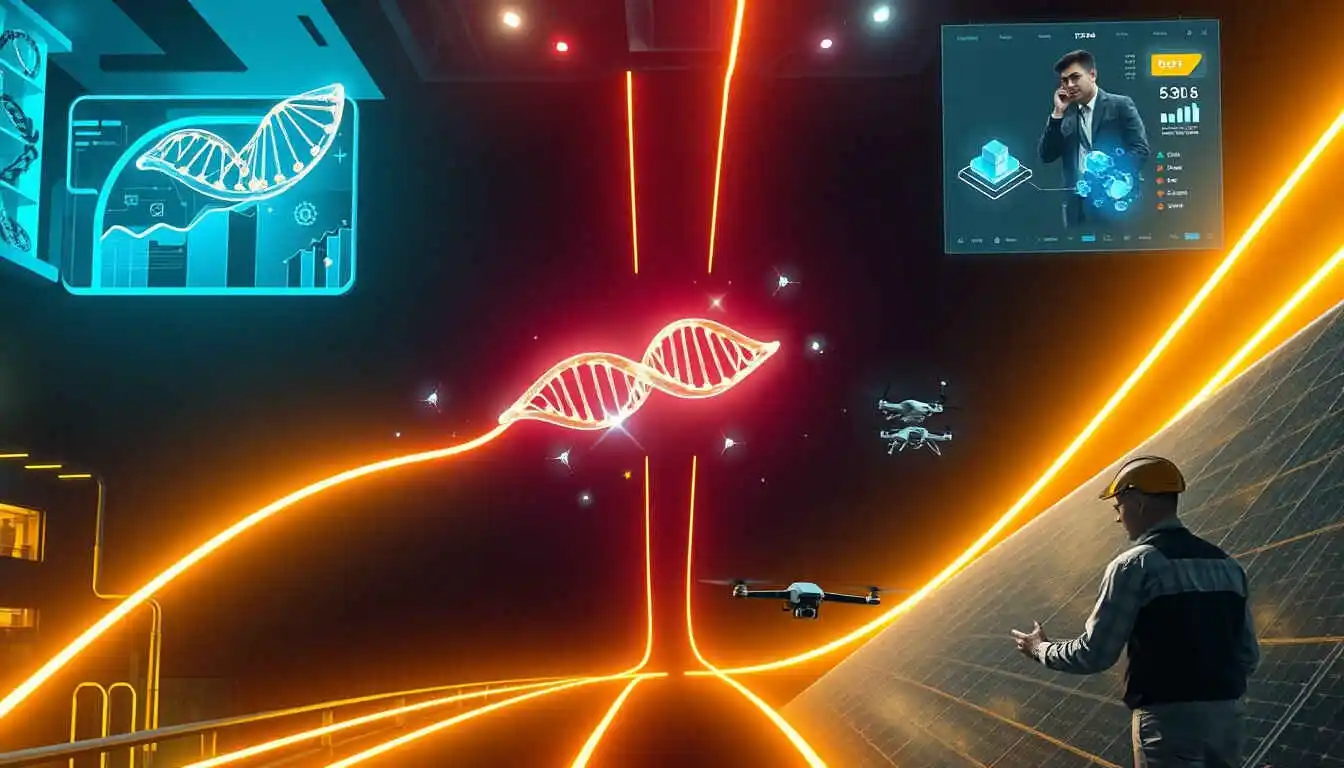
The elephant in the room is Artificial Intelligence. Will a robot take your job? Yes, if your job consists of repetitive, predictable tasks. But if you adapt, AI will not replace you; a person using AI will. Job market trends show that the key to professional growth is not competing with machines, but complementing them.
- Cultivate “Soft” Skills (The Hardest to Automate)
Critical thinking, emotional intelligence, complex problem solving, and adaptability. AI can write a legal brief, but it cannot negotiate a settlement with an angry, grieving client. It can generate code, but it cannot empathize with a user’s frustration. The more “human” your skills, the safer you are.
- Become an AI Conductor
You don’t need to build the AI; you need to know how to use it. Prompt engineering—the art of asking AI the right questions to get the best output—is becoming a foundational skill across all streams. Learn to use ChatGPT, Midjourney, and Copilot as force multipliers for your own creativity and output.
- Embrace Lifelong Learning
The half-life of a learned skill is shrinking. What you learned in year one might be obsolete by year three. The most successful professionals dedicate 5 hours a week to learning new tools, reading industry shifts, and upskilling.
- Build a Personal Brand
In a sea of AI-generated content and automated resumes, trust becomes the ultimate currency. A personal brand built on authentic human experiences, opinions, and relationships cannot be faked by an algorithm. Share your journey, your failures, and your unique perspective.
Conclusion: The Stream is Yours to Redirect
The lines between science, commerce, arts, and vocational trades are blurring into a single, vast ocean of opportunity. Whether you are analyzing the genetic code, managing the global supply chain, curating the digital archives of humanity, or installing the solar panels that will power our future, your worth is determined not by the stream you chose, but by the curiosity, adaptability, and passion you bring to it.
The highest paying jobs and the most future careers belong to those who refuse to be boxed in by outdated labels. Your stream was just the starting line. The track ahead is whatever you dare to build.
FAQS
General Career & Stream Navigation
1.Do I have to stick to a career directly related to my academic stream?
No. The modern professional landscape has detonated traditional boundaries. Your degree is merely a launching pad, and interdisciplinary career paths are often the most lucrative and fulfilling.
- Are linear career paths still the norm?
No, the concept of a linear career is a 20th-century relic. Today, making a career transition or pivot is common and is often viewed as a strategic advantage rather than a setback.
- What is the most important factor for career success today?
Adaptability. Because the half-life of a learned skill is shrinking, your ability to learn new tools, pivot across industries, and complement AI with human skills is more valuable than your initial degree.
Science Stream Careers
- Do I need a medical degree to have a high-paying career in science?
Not at all. While medicine is respected, massive growth and high salaries are found in specializations like data science, bioinformatics, and environmental sustainability.
- What exactly is bioinformatics?
Bioinformatics is the intersection of biology and big data. Professionals in this field build software and algorithms to process massive sets of biological data, such as genome sequences, to develop personalized medicine.
- Are space careers only available through government agencies like NASA?
No. The commercial space industry is booming. Private companies like SpaceX, Blue Origin, and Rocket Lab are driving massive demand for astrophysicists and aerospace engineers.
- Why is environmental science such a growing field?
As climate change becomes the defining crisis of our era, corporations and governments are being forced to adapt to green regulations, creating huge demand for sustainability consultants and climate policy advisors.
- What is cognitive science, and how does it relate to tech?
Cognitive science blends psychology, neuroscience, linguistics, and computer science. It is highly relevant today because it drives the development of Brain-Computer Interfaces (BCIs) and helps tech companies understand human-computer interaction.
Commerce Stream Careers
- What is FinTech, and how is it disrupting traditional banking?
FinTech (Financial Technology) involves using technology to improve financial activities. It replaces traditional banking with decentralized finance (DeFi), seamless payment gateways, and automated robo-advisors.
- What does an actuary actually do?
Actuaries use mathematics and statistics to calculate the probability of future events—such as death, sickness, or natural disasters—to help insurance companies and corporations manage risk.
- Is investment banking really as intense as people say?
Yes. It involves extreme stress and 80-to-100-hour work weeks, but it balances that grind with compensation packages that can exceed half a million dollars in your mid-twenties.
- How does e-commerce supply chain analytics differ from traditional logistics?
Modern supply chain analytics relies heavily on data analysis and predictive modeling to forecast consumer demand and optimize global logistics, moving far beyond traditional manual tracking.
- Do I need an MBA to break into management consulting?
While an MBA helps, consulting is fundamentally about problem-solving and crisis management. Experience in analyzing business operations and strategic thinking can also get you through the door.
Humanities & Arts Stream Careers
- Can a humanities graduate actually get a job in the tech industry?
Absolutely. Humanities majors make excellent UX/UI researchers because they are trained to understand human behavior, empathy, and sociology—skills essential for designing intuitive technology.
- What is computational linguistics?
It’s the intersection of linguistics and computer science. Computational linguists train AI models to understand human language, forming the brains behind virtual assistants like Siri and Alexa, as well as large language models like ChatGPT.
- Is technical writing still relevant in the age of AI?
More than ever. As technology gets more complex, the need for writers who can translate dense jargon into clear, readable guides and dictate brand narratives is vital.
- How is museum curation evolving?
It is shifting toward digital humanities. Curators are now managing immersive AR/VR exhibitions and preserving cultural heritage for the metaverse, rather than just managing physical artifacts.
- What does a geopolitical analyst do?
They forecast how international events, trade wars, and shifting alliances will affect global markets and security. This role requires deep knowledge of history, economics, and culture.
Vocational & Skill-Based Careers
- Are vocational careers low-paying compared to corporate jobs?
No. A massive deficit of skilled tradespeople has given blue-collar workers immense leverage. Today, vocational skills generate high incomes without the burden of student debt.
- What kind of certifications do I need for renewable energy?
Most renewable energy technician roles (like solar and wind) require short-term, specialized certifications rather than four-year degrees, leading to high-paying, future-proof jobs quickly.
- How has automation changed manufacturing jobs?
Modern manufacturing is no longer grimy or purely physical. It is a clean, high-tech environment where operators manage robotic arms, CNC machines, and automated assembly lines.
- Is drone piloting a viable full-time career?
Yes. UAV (Unmanned Aerial Vehicle) operators are in high demand for real estate photography, agricultural surveying, mapping, and delivery logistics.
- Why is HVAC considered a “tech” job now?
Because modern HVAC involves programming IoT (Internet of Things) thermostats, managing smart home ecosystems, and optimizing energy efficiency, blending traditional mechanical skills with digital tech.
- What is food innovation in the culinary arts?
It goes beyond the restaurant kitchen. Food scientists and innovative chefs are creating plant-based meats, optimizing vertical farming, and designing zero-waste culinary experiences.
Interdisciplinary Careers
- What is bioethics?
Bioethics sits at the intersection of science and humanities. As we gain the power to edit genes and integrate AI into human bodies, bioethicists navigate the moral dilemmas and set legal frameworks for these advancements.
- What is Legal Tech?
Legal tech is where law meets coding. Professionals in this space create AI that can scan thousands of contracts in seconds, predict case outcomes, and automate legal paperwork, modernizing the justice system.
- What does a health informatics professional do?
They organize, analyze, and secure patient data across healthcare networks. Their goal is to make healthcare more efficient, reduce fatal errors, and ensure privacy in a digital age.
Career Transition & AI Future-Proofing
- What is the first step in making a career transition?
Identify your transferable skills. For example, an accountant moving into data analysis already understands logic, formulas, and auditing. You are not starting from scratch.
- Do I need to go back to college for four years to change careers?
No. The micro-credential revolution allows you to take 3-to-6-month courses on platforms like Coursera or edX. In tech especially, a strong portfolio often trumps a degree.
- Will AI steal my job?
If your job consists solely of repetitive, predictable tasks, yes. However, if you adapt and become an “AI conductor” by learning prompt engineering and doubling down on soft skills like empathy and critical thinking, AI will become your tool, not your replacement.
Disclaimer: The content on this blog is for informational purposes only. Author’s opinions are personal and not endorsed. Efforts are made to provide accurate information, but completeness, accuracy, or reliability are not guaranteed. Author is not liable for any loss or damage resulting from the use of this blog. It is recommended to use information on this blog at your own terms.
Keywords: Career guidance, Highest paying jobs, Commerce careers, Science streams, Humanities jobs, Future careers, Vocational skills, Tech careers, Career transition, Professional growth, Job market trends
Hashtags: #CareerGuidance #FutureCareers #CommerceCareers #ScienceStreams #HumanitiesJobs #VocationalSkills #TechCareers #CareerTransition #ProfessionalGrowth #JobMarketTrends #HighestPayingJobs

