

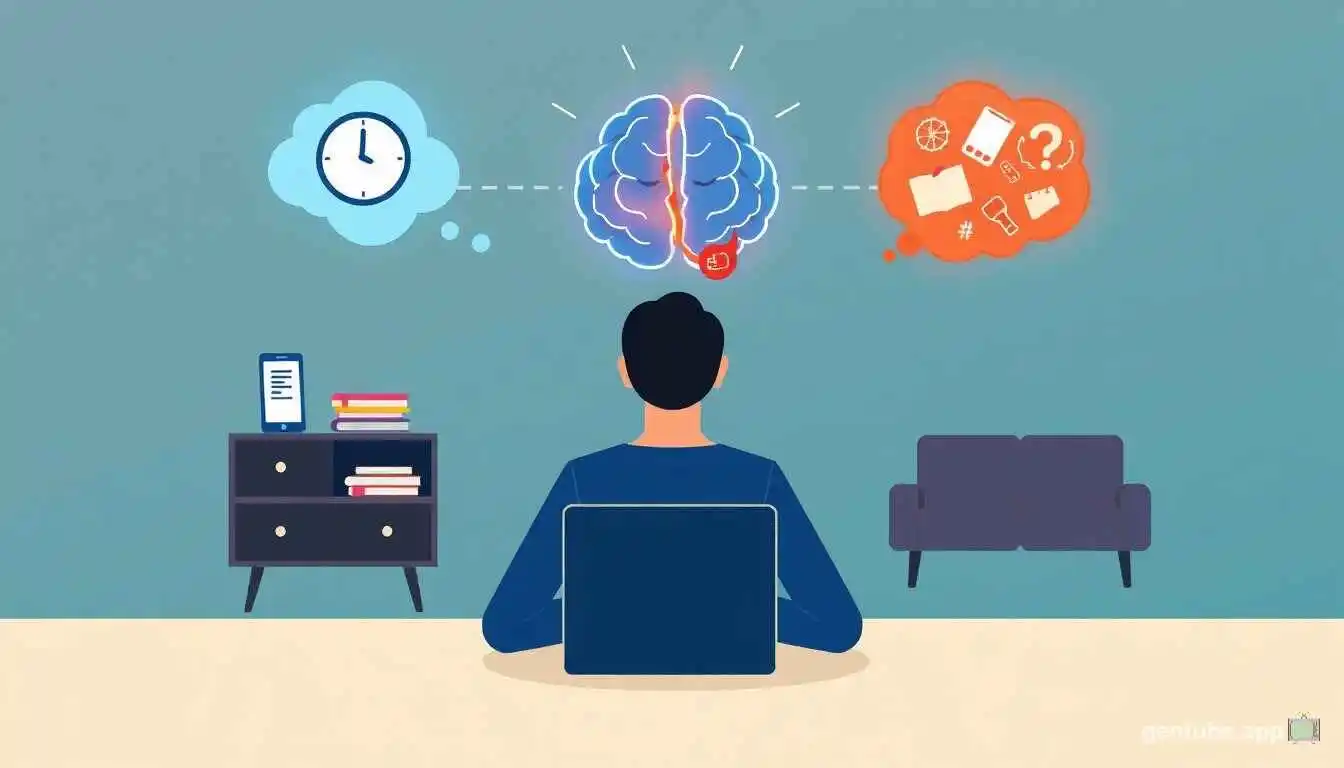
The Psychology of Procrastination: How to Actually Beat It
Why Your Brain Chooses Short-Term Relief Over Long-Term Goals, and the Science-Backed Strategies That Finally Break the Cycle
It’s 11 p.m., the deadline is tomorrow, and you’re somehow reorganizing your bookshelf instead of opening the document you’ve been avoiding for a week. You know exactly what needs to be done. You have the skills to do it. And yet, night after night, something invisible keeps steering you away from the thing you most need to focus on.
If this sounds familiar, you are far from alone — and you are not lazy, undisciplined, or broken. Procrastination is one of the most misunderstood human behaviors, and decades of psychological research have made one thing clear: it has almost nothing to do with time management and almost everything to do with emotion.
This guide takes a deep, evidence-based look at what’s actually happening in your brain when you procrastinate, why traditional advice like ‘just do it’ so often fails, and which strategies are genuinely backed by research to help you break the cycle for good.
1. What Procrastination Really Is (And What It Isn’t)
Procrastination is commonly defined by researchers as the voluntary delay of an intended action despite expecting to be worse off for the delay. That definition matters because it distinguishes procrastination from simple prioritization or rest. If you consciously decide a task can wait because something more urgent has appeared, that’s not procrastination — that’s planning. Procrastination specifically involves knowing a delay is against your own best interest and doing it anyway.
This distinction reframes the entire problem. Procrastination isn’t a failure to understand consequences — procrastinators are often acutely aware of the consequences, sometimes painfully so. The real driver isn’t a knowledge gap. It’s an emotional one.
2. The Emotion-Regulation Theory of Procrastination
The leading psychological model of procrastination today treats it primarily as a problem of mood repair rather than time management. According to this view, certain tasks generate uncomfortable emotions — anxiety, boredom, insecurity, resentment, or overwhelm — and procrastination functions as a short-term coping mechanism to escape those feelings.
In this framework, opening a different tab, cleaning your kitchen, or scrolling your phone isn’t a random distraction. It’s an active, if unconscious, choice to prioritize immediate emotional relief over long-term goal progress. The task itself hasn’t changed; what’s changed is your brain’s assessment that avoiding the associated discomfort is worth more right now than the future benefit of finishing it.
Why This Reframing Matters
Understanding procrastination as emotional avoidance — rather than poor planning — explains why classic productivity hacks like better to-do lists or stricter schedules often fail on their own. They address the visible symptom (not doing the task) without addressing the underlying cause (the discomfort the task generates). Real, lasting change requires working with that emotional layer, not just around it.
3. Present Bias and Temporal Discounting
Behavioral economics offers another crucial piece of the puzzle: temporal discounting, sometimes called present bias. This is the well-documented tendency for humans to value immediate rewards far more highly than future ones — even when the future reward is objectively larger or the future cost is objectively higher.
In practical terms, your brain treats ‘relief from discomfort right now’ as more valuable than ‘avoiding a much bigger problem in three days.’ This isn’t a character flaw; it’s a deeply wired cognitive bias shared across virtually all humans to varying degrees. Some people are simply more sensitive to it than others, which is part of why procrastination varies so much between individuals facing the exact same task.
This bias also explains why procrastination tends to worsen as a deadline moves further away. A task due in three weeks doesn’t yet feel emotionally real, so its associated discomfort is easy to discount. As the deadline approaches, the cost of further delay becomes impossible to discount away, which is often why people suddenly find a burst of motivation in the final 24 hours — not because willpower magically appeared, but because the balance between immediate discomfort and imminent consequence has finally flipped.
4. What’s Happening in the Brain During Procrastination
Neuroscience research offers a helpful, if simplified, picture of the tug-of-war behind procrastination: a contest between the prefrontal cortex and the limbic system.
The Prefrontal Cortex: Your Planning Brain
The prefrontal cortex is responsible for executive functions — planning, impulse control, weighing long-term consequences, and initiating goal-directed behavior. This is the part of your brain that ‘knows’ you should start the report.
The Limbic System: Your Emotional Brain
The limbic system, including the amygdala, governs emotional processing and threat response. When a task is perceived as threatening — whether because of fear of failure, boredom, or overwhelm — the limbic system can effectively override the prefrontal cortex’s more measured, long-term reasoning, pushing you toward whatever behavior offers the fastest relief.
Under stress, fatigue, or high emotional intensity, this balance tips further in favor of the limbic system, which is part of why procrastination often gets worse precisely when the stakes — and the stress — are highest.
5. The Many Faces of Procrastination: Common Types
Not all procrastination looks the same, and identifying your own pattern can make it far easier to choose an effective strategy.
The Perfectionist
Starting feels dangerous because it risks producing something imperfect. Delay becomes a way of protecting an idealized, unstarted version of the work from the vulnerability of an imperfect real draft.
The Dreamer
Enjoys envisioning the outcome — the finished product, the praise, the result — far more than doing the unglamorous work required to get there, so planning and imagining quietly substitute for actual progress.
The Crisis-Maker
Believes, often accurately in the short term, that they perform best under pressure, and so delays intentionally or semi-intentionally to manufacture the adrenaline of a looming deadline.
The Avoider
Delays tasks tied to fear of judgment, failure, or even success (since success can raise future expectations), often driven by underlying self-esteem concerns rather than the task’s actual difficulty.
The Overwhelmed Procrastinator
Faces a task that feels too large, vague, or complex to know where to begin, and freezes rather than acts — a response closely tied to executive-function overload rather than emotional avoidance alone.
The Busy Procrastinator
Stays occupied with lower-stakes, easier tasks — email, tidying, minor errands — that create a genuine feeling of productivity while sidestepping the one task generating real anxiety. Researchers sometimes call this ‘structured procrastination.’
6. Why Willpower Alone Doesn’t Work
If procrastination were simply a matter of insufficient willpower, then simply trying harder would fix it. But willpower operates more like a depletable resource than a fixed trait: repeated demands on self-control throughout the day — resisting distractions, managing emotions, making decisions — draw down the same limited reserve, leaving less available by the time you sit down to tackle your hardest task.
More importantly, willpower doesn’t address the emotional trigger driving the avoidance in the first place. You can force yourself to open the document through sheer effort, but if the underlying anxiety or boredom hasn’t been addressed, that discomfort will resurface the next time — and the time after that — requiring an ever-larger reserve of willpower just to maintain the same behavior.
7. The Procrastination–Guilt–Anxiety Loop
One of the most damaging aspects of chronic procrastination is the self-reinforcing cycle it creates. Avoiding a task provides immediate emotional relief, but that relief is quickly followed by guilt, self-criticism, and anxiety about the task still looming ahead. Rather than motivating action, this negative emotional state often increases the very discomfort that drove the original avoidance — making the task feel even more unpleasant to approach the next time.
Left unaddressed, this loop tends to intensify over time: more procrastination leads to more negative self-judgment, which leads to a more aversive relationship with the task, which leads to more procrastination. Breaking this cycle typically requires interrupting it at the emotional level — through self-compassion and smaller, less threatening entry points — rather than trying to simply push harder through the same pattern.
8. Digital Distraction and the Dopamine Problem
Modern procrastination unfolds inside an environment engineered to make avoidance easy and immediately rewarding. Social media, streaming platforms, and notification-driven apps are specifically designed to deliver frequent, low-effort dopamine hits — quick hits of novelty and social reward that are far easier to access than the delayed, effortful payoff of completing meaningful work.
This creates a lopsided competition: a task requiring sustained focus and tolerance of discomfort is competing directly against a phone offering instant, engineered gratification. Recognizing this as a structural, designed imbalance — rather than a personal weakness — can make it easier to address with deliberate environmental changes rather than self-blame.
9. Evidence-Based Strategies That Actually Work
Because procrastination is rooted in emotional avoidance and cognitive bias, the most effective strategies target those mechanisms directly, rather than relying on discipline alone.
Lower the Barrier to Starting
Since task initiation — not sustained effort — is usually where procrastination takes hold, techniques that shrink the first step are disproportionately effective.
- The two-minute rule: commit to just two minutes of work to get past the initiation barrier
- Break large tasks into small, specific, concrete sub-steps rather than vague goals
- Prepare the environment in advance so the first action requires minimal friction
Use Implementation Intentions
Research consistently shows that specific ‘if-then’ plans — such as ‘If it’s 8 a.m. and I’ve finished coffee, then I will write for 25 minutes’ — significantly outperform vague intentions like ‘I’ll work on it sometime today.’ The specificity removes the need for in-the-moment decision-making, which is often where avoidance sneaks in.
Try Temptation Bundling
Pairing an aversive task with something enjoyable — listening to a favorite playlist only while doing a dreaded task, for instance — can shift the emotional tone of the task itself, making it feel less purely unpleasant.
Work in Focused Intervals
Structured techniques like the Pomodoro Technique — short, timed work sessions followed by brief breaks — reduce the sense of an open-ended, overwhelming commitment and provide frequent natural stopping points, which lowers the psychological cost of starting.
Redesign Your Environment
Reducing the number of distracting cues within reach — silencing notifications, keeping your phone in another room, closing unrelated tabs — removes small decision points that otherwise invite avoidance. Conversely, making the desired task more visible and accessible (a notebook already open, materials already laid out) nudges behavior in the opposite direction.
Practice Self-Compassion, Not Self-Criticism
Multiple studies have found that treating yourself with understanding after a procrastination episode — rather than harsh self-criticism — is associated with lower procrastination going forward. Self-compassion appears to interrupt the guilt-avoidance loop, making it easier to re-engage with the task without the added weight of shame.
Build in Accountability
Sharing a goal or deadline with someone else, or working alongside another person even on unrelated tasks (a technique often called body doubling), introduces social motivation that can offset the pull toward avoidance, particularly for tasks with no external deadline.
Reward Completion, Not Just Outcomes
Pairing the completion of a task — not just its final result — with a small, genuine reward helps the brain build a more positive association with finishing, gradually counterbalancing the aversive emotional charge the task previously carried.
Reduce Ambiguity
Since unclear tasks are disproportionately likely to be delayed, spending a few minutes clarifying exactly what the first concrete action looks like — before attempting to start — can meaningfully lower the emotional and cognitive barrier to beginning.
10. When Procrastination Signals Something Deeper
While everyone procrastinates occasionally, persistent, severe procrastination that significantly interferes with work, relationships, or well-being can sometimes point to an underlying condition that deserves its own attention.
ADHD
Procrastination is a core feature of ADHD, tied to differences in executive function that affect task initiation, time perception, and sustained motivation — particularly for tasks that aren’t inherently novel or stimulating.
Anxiety and Depression
Anxiety can drive avoidance of tasks perceived as threatening or high-stakes, while depression can broadly reduce motivation and energy, making even simple task initiation feel disproportionately difficult.
Burnout
Chronic overwork without adequate recovery can deplete the cognitive and emotional resources needed for self-regulation, making procrastination — essentially the nervous system seeking relief — more likely even for previously manageable tasks.
If procrastination feels persistent, distressing, and resistant to the strategies above, it’s worth discussing with a healthcare provider or therapist, who can help identify whether an underlying condition is contributing to the pattern.
11. Building a Sustainable, Long-Term System
Beating procrastination isn’t usually about finding one perfect trick — it’s about building a small set of habits and environmental defaults that reduce friction and emotional resistance on an ongoing basis. A sustainable system might combine a consistent daily starting ritual, a workspace largely free of distracting cues, tasks broken down in advance rather than in the moment, and a default of self-compassion rather than self-criticism when things don’t go as planned.
Progress here is rarely linear. Expecting occasional relapses into old patterns — rather than treating them as proof that nothing is working — tends to keep people engaged with these strategies long enough for them to genuinely take hold.
12. Common Myths About Procrastination
Because procrastination is so widely experienced, it’s also widely misunderstood. Clearing up a few persistent myths can make it easier to approach your own patterns with more accuracy — and less unnecessary self-blame.
Myth: Procrastinators Just Need Better Time-Management Tools
Planners, apps, and calendars can help organize what needs to be done, but they don’t address why a task feels aversive in the first place. Many chronic procrastinators are highly organized people who still struggle to start — proof that the missing piece usually isn’t logistical.
Myth: Procrastination Means You Don’t Care About the Outcome
In reality, procrastination is often most intense on the tasks people care about most, precisely because higher personal stakes generate more emotional discomfort. Ironically, indifference tends to produce far less procrastination than genuine investment paired with fear of falling short.
Myth: Some People Just ‘Work Better Under Pressure’
Crisis-driven work can feel more energized because of an adrenaline and cortisol surge near a deadline, but research on the actual quality of last-minute work is far less flattering than the narrative suggests. What feels like heightened performance is often a lower bar for comparison, since there was no earlier draft to measure against.
Myth: Procrastination Is a Fixed Personality Trait
While some people are more prone to procrastination than others, the behavior is highly situational — most people procrastinate far more on tasks that are ambiguous, boring, or emotionally loaded than on tasks that are clear, engaging, and low-stakes. This variability is good news: it means procrastination is a pattern that responds to changes in task design and environment, not a permanent identity.
13. Procrastination in Different Areas of Life
Procrastination doesn’t show up identically everywhere. Recognizing how it shifts across contexts can help you apply the right strategy to the right situation.
Workplace Procrastination
In professional settings, procrastination is often tied to unclear expectations, fear of critical feedback, or tasks that feel disconnected from meaningful purpose. Breaking projects into clearly scoped deliverables and seeking early, low-stakes feedback can reduce the ambiguity and evaluative fear that often drive workplace avoidance.
Academic Procrastination
Among students, procrastination is frequently linked to perfectionism, fear of poor grades, and tasks that feel externally imposed rather than personally chosen. Framing assignments around personal relevance, and starting with the smallest possible first step rather than the full scope of the paper or exam, tends to reduce the overwhelm that drives delay.
Health and Self-Care Procrastination
Delaying medical appointments, exercise, or other self-care tasks often stems from a mix of present bias — the benefits are distant and abstract while the effort is immediate — and sometimes genuine anxiety about what a doctor’s visit might reveal. Scheduling these tasks with the same specificity as a work meeting, using implementation intentions, can help counteract their tendency to be indefinitely postponed.
Household and Administrative Procrastination
Tasks like taxes, paperwork, or household repairs are often delayed simply because they’re boring rather than emotionally threatening. Temptation bundling and time-boxed work sessions tend to be especially effective here, since the barrier is more about tedium than fear.
14. The Bottom Line
Procrastination isn’t a character flaw, a discipline problem, or evidence that you don’t care about your goals. It’s a deeply human response to discomfort, shaped by present bias, emotional avoidance, and a modern environment engineered to make avoidance easy. Once you understand it this way, the path forward changes: instead of trying to muscle through with willpower alone, you can work directly with the emotional and cognitive mechanisms driving the behavior.
Small, specific first steps. A little more self-compassion. An environment that makes starting easier rather than harder. None of these are dramatic changes, but together, they target the actual psychology behind procrastination — which is exactly why they tend to work when sheer willpower alone so often doesn’t.
15. A Quick-Start Checklist for Today
If you’re looking for somewhere to begin right now, rather than after reading everything above, this short checklist distills the highest-leverage actions into a starting point you can use immediately.
- Pick the one task you’ve been avoiding longest and write down its smallest possible first step
- Set a specific if-then plan for when and where you’ll take that first step today
- Remove your phone or other high-distraction triggers from arm’s reach before starting
- Commit to just two minutes of effort, and let momentum decide what happens after that
- If you slip up, respond with the same understanding you’d offer a friend, not harsh criticism
None of these steps require a perfect plan or a completely reorganized life. They simply lower the emotional and cognitive barrier just enough to make starting more likely than avoiding — which, as the research throughout this piece suggests, is usually the entire battle.
FAQS
1.Is procrastination just laziness?
No. Psychological research consistently shows procrastination is an emotion-regulation problem, not a time-management or laziness problem. People delay tasks to avoid the negative feelings — anxiety, boredom, self-doubt — that the task triggers, not because they lack the desire to succeed.
2.Why do I procrastinate even when I know it will hurt me later?
This happens because of present bias: the brain consistently overvalues immediate relief (avoiding discomfort now) compared to future consequences, even when the future cost is objectively larger. Your ‘present self’ essentially outvotes your ‘future self’ in the moment of decision.
3.Is procrastination linked to perfectionism?
Yes, strongly. Many perfectionists procrastinate because starting a task activates fear of producing imperfect work. Delaying the task also delays the risk of confronting that imperfection, which offers short-term emotional relief.
4.Can procrastination be a sign of ADHD?
It can be. Procrastination is a hallmark symptom of ADHD, tied to executive function differences that affect task initiation, time perception, and motivation regulation. If procrastination is severe, chronic, and paired with other attention difficulties, it’s worth discussing with a professional.
5.Does procrastination cause anxiety, or does anxiety cause procrastination?
Both. Anxiety about a task often triggers avoidance, and then the guilt and pressure from having avoided it generates even more anxiety, creating a self-reinforcing loop that becomes harder to escape the longer it continues.
6.Why doesn’t willpower fix procrastination?
Willpower is a limited, fatigable resource, and procrastination is driven by automatic emotional avoidance rather than a simple lack of effort. Relying on willpower alone ignores the underlying emotional trigger, so the urge to avoid returns as soon as willpower is depleted.
7.What is temporal discounting?
Temporal discounting is the psychological tendency to value immediate rewards more highly than future ones, even when the future reward or consequence is larger. It’s a core mechanism behind why procrastination feels rational in the moment despite being costly later.
8.Are there different types of procrastinators?
Yes. Common patterns include the perfectionist, who avoids starting for fear of imperfect results; the dreamer, who enjoys imagining outcomes more than doing the work; the crisis-maker, who thrives on last-minute adrenaline; the avoider, who dodges tasks tied to fear of failure or judgment; and the overwhelmed procrastinator, who freezes when a task feels too large.
9.Why do I procrastinate on tasks I actually want to do?
Even desired tasks can trigger procrastination if they feel ambiguous, high-stakes, or emotionally loaded — for example, a creative project you care deeply about can trigger more anxiety, not less, because the personal investment raises the emotional stakes of failure.
10.Does procrastination get worse with stress?
Generally, yes. Elevated stress reduces prefrontal cortex function — the brain region responsible for planning and self-control — while increasing reliance on the amygdala’s automatic avoidance responses, making procrastination more likely under pressure.
11.What is the ‘two-minute rule’ for procrastination?
It’s a strategy where you commit to working on a task for just two minutes. Because task initiation is often the hardest part, this small commitment frequently lowers the emotional barrier enough that momentum carries you past the two-minute mark.
12.What is temptation bundling?
Temptation bundling is pairing a task you tend to avoid with something enjoyable — for example, only allowing yourself to listen to a favorite podcast while doing a dreaded chore — which can make the avoided task feel less aversive.
13.How does breaking tasks into smaller steps help with procrastination?
Large, vague tasks feel more threatening and overwhelming, which intensifies avoidance. Breaking them into small, specific, concrete steps reduces the perceived size of the task and makes the first action easier to take.
14.What are implementation intentions?
Implementation intentions are specific ‘if-then’ plans that link a situational cue to a planned action, such as ‘If it’s 9 a.m., then I will open my laptop and write for 20 minutes.’ Research shows these concrete plans significantly increase follow-through compared to vague intentions.
15.Why does self-criticism make procrastination worse?
Harsh self-judgment after procrastinating increases negative emotion associated with the task, which paradoxically makes future avoidance more likely, since the brain continues seeking relief from that same discomfort.
16.Does self-compassion actually help reduce procrastination?
Yes. Multiple studies have found that self-compassion after a procrastination episode reduces the guilt-avoidance cycle and is associated with lower procrastination over time, compared to self-criticism.
17.What role does dopamine play in procrastination?
Dopamine drives motivation toward rewarding stimuli. Digital distractions like social media and notifications offer frequent, low-effort dopamine hits, which can out-compete the delayed, effortful reward of completing a meaningful task.
18.Can environment design reduce procrastination?
Yes. Removing distracting cues (phone notifications, open tabs) and making the desired behavior more visible and accessible (laying out materials in advance) reduces the number of small decisions and frictions that invite avoidance.
19.Is procrastination more common in certain personality types?
Research links higher procrastination to traits like lower conscientiousness and higher impulsivity, though procrastination also arises situationally in highly conscientious people when a task is unusually emotionally loaded.
20.Why do deadlines sometimes make procrastination worse?
Distant deadlines can feel psychologically unreal, reducing urgency, while looming deadlines can trigger overwhelming anxiety that leads to avoidance rather than action. Both extremes can paradoxically increase procrastination.
21.What is ‘structured procrastination’?
It’s a concept describing how procrastinators often stay busy with lower-priority tasks to avoid a higher-priority one, which can create the appearance of productivity while sidestepping the task generating the most anxiety.
22.How does the Pomodoro Technique help with procrastination?
The Pomodoro Technique breaks work into short, timed intervals (often 25 minutes) followed by brief breaks, which lowers the psychological barrier to starting and provides frequent natural stopping points that reduce the sense of an open-ended, overwhelming task.
23.Can procrastination be a symptom of depression?
Yes, in some cases. Depression can reduce motivation and energy broadly, making task initiation significantly harder. Persistent procrastination alongside low mood, fatigue, or loss of interest is worth discussing with a healthcare provider.
24.Does accountability help reduce procrastination?
Yes. Sharing goals or deadlines with another person, or working alongside someone else (sometimes called body doubling), introduces social motivation and a sense of external commitment that can offset the pull toward avoidance.
25.Why do I procrastinate more on tasks with unclear instructions?
Ambiguity increases the cognitive and emotional effort required just to figure out where to start, which raises the perceived difficulty of the task and makes avoidance more appealing than trying to solve that ambiguity.
26.Is chronic procrastination a mental health concern?
It can be, particularly when it consistently interferes with work, relationships, health, or well-being, or when it coexists with anxiety, depression, or ADHD. In those cases, professional support can address both the procrastination and its underlying drivers.
27.What is task aversiveness, and why does it matter?
Task aversiveness refers to how unpleasant, boring, or emotionally difficult a task feels. Research consistently identifies it as one of the strongest predictors of procrastination — the more aversive a task feels, the more likely it is to be delayed.
28.Can rewarding myself after finishing a task help long-term?
Yes. Pairing task completion with a genuine, timed reward helps the brain build a positive association with finishing rather than only associating the task with stress, which can reduce avoidance in future instances of that task.
29.How long does it take to build a habit that reduces procrastination?
Habit-formation research suggests it varies significantly by individual and behavior complexity, often ranging from a few weeks to a few months of consistent repetition before a behavior starts to feel more automatic.
30.What’s the single most effective first step to reduce procrastination?
Most research points to lowering the barrier to starting — through smaller first steps, implementation intentions, or the two-minute rule — since task initiation, not sustained effort, is typically where procrastination takes hold.
Disclaimer: The content on this blog is for informational purposes only. The author’s opinions are personal and not endorsed. Efforts are made to provide accurate information, but completeness, accuracy, or reliability are not guaranteed. The author is not liable for any loss or damage resulting from the use of this blog. It is recommended to use the information on this blog at your own discretion.

