

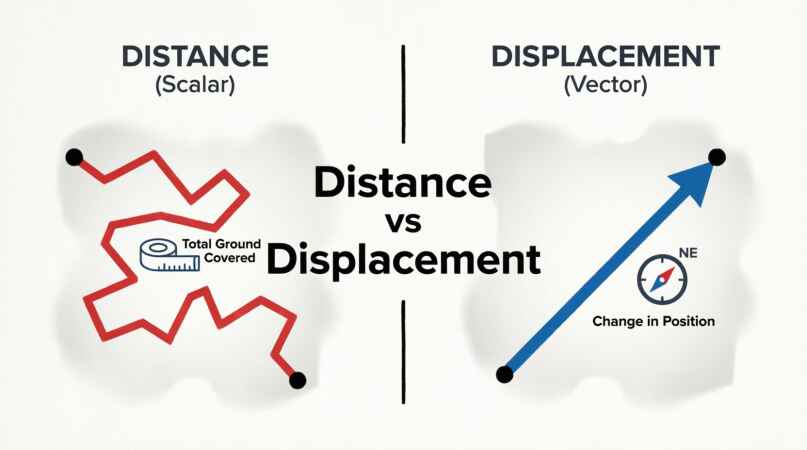
The Path You Walk vs. The Arrow That Points Home: Mastering Distance and Displacement
The Day Mark Got Lost on the Way to the Cafeteria (And Learned Physics)
I remember a Tuesday in October, about fifteen years ago, when I was teaching introductory physics to a group of anxious high school juniors. The topic was kinematics—specifically, the difference between distance and displacement. It sounds dry on paper, doesn’t it? “Kinematics.” “Vectors.” “Scalars.” It sounds like something you’d find in a dusty textbook, not something that matters to your life.
But then Mark raised his hand. Mark was a good kid, but he struggled with abstract concepts. He needed things to be concrete. He needed to see it.
“Mr. Rivera,” Mark said, looking genuinely confused, “if I walk from my house to school, and then walk back home, I’ve walked a long way. But I’m back where I started. So, did I move at all?”
The class went silent. Some students nodded. Others looked puzzled. This was the moment. This was the spark.
I didn’t jump into equations. I didn’t write $d = vt$ on the board. Instead, I asked the class to stand up. “Everyone, stand up,” I said. “Mark walked from his house to school. That’s a straight line. Now, he walked back. That’s the same line, but opposite direction. Mark, how far did you walk in total?”
“Two miles,” Mark said. “I live one mile from school.”
“Okay,” I said. “But how far are you from your house right now?”
Mark smiled. “Zero. I’m home.”
“Exactly,” I said. “Distance is two miles. Displacement is zero. Distance is the odometer in your car. Displacement is the bird’s eye view.”
That moment stuck with me. It wasn’t just about physics; it was about perspective. It was about understanding that how you get somewhere matters just as much as where you end up. In life, we often care about the journey (distance), but in science, and often in engineering, we care about the result (displacement).
If you’ve ever felt confused by these terms, you are not alone. They sound similar. They are both measured in meters. They both describe movement. But they are fundamentally different ideas. And understanding that difference is the key to unlocking everything from navigation apps to planetary orbits.
In this guide, we are going to break down distance and displacement. We will look at why they matter, how they work, and how to master them so you never confuse them again. We’ll use real stories, simple examples, and practical strategies to make this concept stick in your brain forever.
What Is the Difference Between Distance and Displacement?
Let’s start with the basics. If you can remember these two definitions, you are already ahead of 90% of students.
Distance is a scalar quantity. It tells you how much ground an object has covered during its motion. It is the total length of the path taken. Distance is always positive (or zero). It never cares about direction. It just adds up every step you take.
Displacement is a vector quantity. It tells you how far out of place an object is. It is the overall change in position. It is the straight-line distance from the starting point to the ending point, along with the direction. Displacement can be positive, negative, or zero.
Let’s that again, because it is crucial.
- Distance = Total path length. (Scalar)
- Displacement = Straight-line change in position. (Vector)
Think of it this way: Distance is the story of your journey. Displacement is the summary of your destination.
If you walk in a circle and end up where you started, your distance is the circumference of the circle. Your displacement is zero. Why? Because you didn’t go anywhere relative to your start. You are right back where you began.
Distance answers the question: “How much did I move?”
Displacement answers the question: “Where did I end up relative to where I started?”
Why Does This Matter? The Importance of Clear Thinking
You might be thinking, “Okay, I get it. One is the path, one is the straight line. Why do I need to know this? Is it just for tests?”
No. This distinction is fundamental to how we understand motion in the universe.
In Everyday Life
When you use Google Maps, it calculates distance. It adds up every turn, every highway merge, every street you drive on. That is your travel distance. But if you asked a bird flying from your house to your destination, it would draw a straight line. That is displacement.
When you run a marathon, your distance is 26.2 miles. Your displacement might be only a few miles, depending on whether the course loops back on itself.
In finance, “distance” might be the total revenue generated, while “displacement” might be the net profit after all costs and losses. The concepts are similar.
In Science and Engineering
Physics is the study of motion. To describe motion accurately, we need precise language. If an engineer is designing a rocket, the distance it burns fuel is important. But the displacement (how far it gets from Earth) is the goal. If a car manufacturer is testing braking systems, they care about the distance the car travels before stopping. But if they are testing navigation systems, they care about displacement—the direct route.
Understanding the difference prevents errors. Imagine a drone that needs to deliver a package. If it flies in a zigzag pattern due to wind, the distance it travels is long, and it uses more battery. But its displacement is short. If the drone’s software only tracks displacement, it might think it has plenty of battery left when it actually doesn’t. Understanding the difference saves money, time, and sometimes lives.
In Your Brain
Learning the difference between distance and displacement trains your brain to distinguish between process and outcome. It helps you think critically about data. Are we looking at the total activity, or the net result? This kind of thinking is valuable in math, economics, biology, and even philosophy.
Core Concepts: How Distance and Displacement Work
To truly master this topic, we need to look at the underlying concepts. Let’s break them down.
- Scalar vs. Vector
This is the most important technical distinction.
Scalar quantities have only magnitude (size). They tell you “how much.” Examples include distance, speed, mass, time, and temperature. A scalar is like a number on a thermometer. It doesn’t care about direction.
Vector quantities have both magnitude and direction. They tell you “how much” and “which way.” Examples include displacement, velocity, acceleration, force, and momentum. A vector is like a arrow on a map. It points somewhere.
Distance is a scalar. It is just a number. “I walked 5 kilometers.” That’s it. No direction needed.
Displacement is a vector. “I walked 5 kilometers North.” Now you have a complete description of the change in position.
- Path Dependence
Distance is path-dependent. This means the value of distance changes depending on the path you take. If you take a detour, the distance increases.
Displacement is path-independent. It only cares about the start and end points. No matter how many twists and turns you take, if you start at A and end at B, your displacement is the same. It is the straight line from A to B.
This is a crucial insight. Distance measures the effort of the journey. Displacement measures the efficiency of the result.
- Magnitude and Direction
For displacement, magnitude is the length of the straight line. Direction is the angle or compass point from start to finish.
For distance, there is no direction. The magnitude is the total length of the curve or line segments traveled.
- Zero Values
Distance is zero only if you don’t move at all. If you take a single step, your distance is greater than zero.
Displacement is zero if you return to your starting point. You can walk a million miles and end up at your couch. Your distance is huge. Your displacement is zero.
Types of Motion and Their Maps
Different types of motion create different relationships between distance and displacement.
Linear Motion
If you move in a straight line without turning back, distance equals displacement (in magnitude). For example, if you walk 10 meters forward, your distance is 10 meters, and your displacement is +10 meters.
Curved Motion
If you move along a curve, distance is always greater than the magnitude of displacement. For example, if you walk along a semi-circle from point A to point B, the distance is half the circumference. The displacement is the diameter of the circle.
Circular Motion
If you move in a full circle, distance is the circumference. Displacement is zero. If you move half a circle, distance is half the circumference. Displacement is the diameter.
Random Motion
In random motion, like a gas molecule bouncing around, distance is the total path length. Displacement is the straight line from start to finish. After a long time, the displacement might be small, even if the distance is huge.
Real-Life Case Study: The Hiker’s Dilemma
Let’s look at a real-world example to solidify these concepts.
Sarah is a hiker. She starts at the trailhead of a popular national park. Her goal is to reach a scenic viewpoint called “Eagle’s Peak.” The trail is winding, going up and down hills, crossing streams, and taking detours.
The Journey:
- Sarah walks 2 km North to a ridge.
- She walks 1 km East along the ridge.
- She walks 2 km South to a valley.
- She walks 1 km West back to the trailhead.
Calculating Distance:
Distance is the sum of all segments.
Distance = 2 km + 1 km + 2 km + 1 km = 6 km.
Sarah’s feet covered 6 kilometers. Her heart rate went up for 6 kilometers worth of effort. Her shoes wore down over 6 kilometers.
Calculating Displacement:
Displacement is the straight line from start to finish.
Start point: Trailhead.
End point: Trailhead.
Since she ended where she started, her displacement is 0 km.
Why This Matters:
If Sarah’s smartwatch only tracked displacement, it would tell her she hasn’t moved. But her body knows she moved 6 km. If she wants to know how much energy she burned, she needs distance. If she wants to know how far she is from the trailhead in a straight line (maybe to estimate rescue time), she needs displacement.
This case study shows that both numbers are true. They answer different questions. Neither is “wrong.” They are just different lenses.
Benefits of Mastering Distance and Displacement
Why should you spend time mastering these concepts? Here are the benefits.
- Better Problem Solving
In physics problems, distinguishing between distance and displacement helps you choose the right formula. If you confuse them, you will get the wrong answer. Mastering the difference makes you a more precise thinker.
- Improved Visualization
Understanding vectors helps you visualize motion in space. You start to see arrows and paths in your mind. This spatial intelligence is useful in many fields, from architecture to gaming.
- Clearer Communication
When you say “displacement,” people know you mean the net change in position. When you say “distance,” they know you mean the total path. Using the right term makes your communication more accurate and professional.
- Deeper Understanding of Physics
Distance and displacement are the foundations of velocity and acceleration. Velocity is displacement over time. Speed is distance over time. If you don’t understand the difference between distance and displacement, you will struggle with velocity and acceleration. Mastering these basics makes advanced physics easier.
- Real-World Awareness
You start to notice these concepts everywhere. When you drive, you see the odometer (distance) and the navigation map (displacement). When you play sports, you run drills (distance) but score goals (displacement of the ball).
Common Mistakes and Challenges
Even experienced students make mistakes with these concepts. Here are the common pitfalls.
Mistake 1: Confusing Magnitude with Value
Students often think distance and displacement are the same because they have the same units (meters). But they are different types of quantities. One is a scalar, one is a vector. Always check the direction.
Mistake 2: Ignoring Direction in Displacement
Displacement has a direction. If you walk 5 meters East and then 5 meters West, your displacement is 0, not 10. Many students add the magnitudes and forget the direction.
Mistake 3: Assuming Distance is Always Greater
Distance is always greater than or equal to the magnitude of displacement. It is never less. If you see a problem where distance is less, you made a mistake.
Mistake 4: Forgetting Signs
In one-dimensional motion, we use positive and negative signs to indicate direction. Displacement can be negative. Distance is always positive. Mixing up the signs is a common error.
Challenge 1: Visualizing Curved Paths
It can be hard to visualize the straight-line displacement for a curved path. Drawing a diagram helps. Sketch the path, then draw a straight arrow from start to finish.
Challenge 2: Multiple Segments
When there are many segments, it’s easy to get lost. Break the problem into steps. Calculate the displacement for each segment, then add them vectorially. Don’t just add the distances.
Comparison Table: Distance vs. Displacement
| Feature | Distance | Displacement |
| Definition | Total path length | Straight-line change in position |
| Type | Scalar | Vector |
| Direction | No | Yes |
| Value | Always positive (or zero) | Can be positive, negative, or zero |
| Path Dependence | Yes | No |
| Symbol | $d$ or $s$ | $\Delta x$ or $\vec{d}$ |
| Unit | Meters (m), Kilometers (km) | Meters (m), Kilometers (km) |
| Example | Odometer reading | Bird’s eye view |
| Zero Condition | Only if no motion | If start = end |
| Calculation | Sum of all segments | Vector sum of segments |
| Graphical Representation | Length of curve | Straight arrow from start to end |
| Use in Formula | Speed = Distance / Time | Velocity = Displacement / Time |
| Real-world Analogy | Taxi meter | Straight line on a map |
| Dependency | Path taken | Start and end points |
| Additivity | Always adds up | Can cancel out |
| Measurement | Tape measure, odometer | Compass, GPS coordinates |
| Complexity | Simple addition | Vector addition |
| Physical Meaning | Effort, cost, wear | Result, net change |
| Mathematical Tool | Arithmetic sum | Vector algebra |
| Common Error | Ignoring path shape | Ignoring direction |
| Educational Goal | Understanding accumulation | Understanding change |
| Application | Fuel consumption, exercise | Navigation, engineering |
| Visualization | Trace the path | Draw an arrow |
| Conceptual Depth | Basic | Intermediate |
| Prerequisite | None | Scalars, Vectors |
| Extension | Arc length | Vector fields |
| Historical Context | Ancient measurement | Vector calculus |
| Modern Relevance | Fitness trackers | Autonomous vehicles |
| Final Summary | How far you traveled | How far you are from start |
5 Proven Study Tips/Strategies
Here are five strategies to help you master distance and displacement.
Tip 1: Draw Diagrams
Always draw a picture. Sketch the path. Mark the start and end points. Draw the straight arrow for displacement. Visualizing the problem reduces cognitive load and makes errors obvious.
Tip 2: Use the “Bird’s Eye” Test
Ask yourself: “What would a bird see?” A bird sees the straight line. That is displacement. A bird sees the total area covered? No, a bird sees the total flight path? That is distance. This mental image helps distinguish the two.
Tip 3: Practice with Zero Displacement
Create problems where the displacement is zero. Walk in a square. Walk in a circle. Return home. Calculate the distance and displacement. This reinforces the idea that displacement depends only on start and end points.
Tip 4: Use Vectors for Multi-Step Problems
When there are multiple steps, treat each step as a vector. Add the vectors tip-to-tail. The resultant vector is the total displacement. The sum of the lengths of the vectors is the total distance.
Tip 5: Relate to Real Life
Connect the concepts to your daily life. Calculate the distance you walk to school. Estimate the displacement. Use your phone’s GPS to see the straight-line distance. Making it personal makes it memorable.
Conclusion: The Path and The Point
Distance and displacement are two sides of the same coin. One is the journey; the other is the destination. One is the effort; the other is the result.
In physics, we need both. We need to know how much energy was expended (distance) and where the object ended up (displacement). In life, we need both. We need to know how far we’ve come (distance) and where we are going (displacement).
Don’t let these terms confuse you. Remember the story of Mark. Remember Sarah’s hike. Remember the bird’s eye view.
Distance is the sum of your steps. Displacement is your net progress.
Master these concepts, and you will master the language of motion. You will see the world not just as a place you move through, but as a field of vectors and scalars, waiting to be understood.
Start drawing your paths today. Trace your arrows. And remember: it’s not just about how far you’ve gone, but where you’ve landed.
FAQS
1.What is the main difference between distance and displacement?
Distance is the total path length traveled, while displacement is the straight-line change in position from start to end. Distance is a scalar; displacement is a vector.
2.Can displacement be greater than distance?
No, the magnitude of displacement is always less than or equal to the distance traveled. Distance accounts for every twist and turn.
3.Is displacement always positive?
No, displacement can be positive, negative, or zero depending on the direction relative to the origin. It is a vector quantity.
4.Why is distance always positive?
Distance is a scalar quantity that measures the total ground covered, which cannot be negative. It is the sum of all path lengths.
5.What happens to displacement if you return to your starting point?
The displacement is zero because the start and end points are the same, regardless of how far you traveled.
6.Can distance be zero?
Yes, if you do not move at all, the distance traveled is zero. Any movement results in a positive distance.
7.What is a scalar quantity?
A scalar quantity has only magnitude (size) and no direction. Examples include distance, mass, and time.
8.What is a vector quantity?
A vector quantity has both magnitude and direction. Examples include displacement, velocity, and force.
9.How do you calculate distance in a straight line?
In a straight line without turning back, distance equals the magnitude of displacement. You simply subtract the start from the end.
10.How do you calculate displacement in multiple directions?
You use vector addition. Break each segment into components, sum the components, and find the resultant vector.
11.Is speed the same as velocity?
No. Speed is distance over time (scalar). Velocity is displacement over time (vector).
12.Can average speed be equal to average velocity?
Yes, only if the motion is in a straight line without changing direction. Otherwise, average speed is greater.
13.What unit is used for distance and displacement?
The standard unit is the meter (m). Other units like kilometers (km) or miles (mi) are also used.
14.Does the path shape affect distance?
Yes, a longer or more winding path results in a greater distance. Distance is path-dependent.
15.Does the path shape affect displacement?
No, displacement only depends on the start and end points. The path shape does not matter for displacement.
16.What is the displacement of a object moving in a circle?
If it completes one full circle, displacement is zero. If it moves half a circle, displacement is the diameter.
17.How does a GPS calculate distance vs. displacement?
GPS calculates distance by summing small segments of your path. It calculates displacement as the straight line between coordinates.
18.Why is displacement important in navigation?
Navigation often requires knowing the direct route (displacement) to reach a destination efficiently.
19.Can displacement be negative?
Yes, in one-dimensional motion, negative displacement indicates movement in the negative direction.
20.What is the magnitude of displacement?
It is the shortest straight-line distance between the start and end points. It is always non-negative.
21.How do you represent displacement graphically?
As an arrow pointing from the initial position to the final position. The length represents magnitude.
22.Is distance a vector or scalar?
Distance is a scalar quantity. It has no direction.
23.Is displacement a vector or scalar?
Displacement is a vector quantity. It has both magnitude and direction.
24.Can you have zero distance?
Yes, if the object remains stationary. No movement means zero distance.
25.Can you have zero displacement?
Yes, if the object returns to its starting point. Net change in position is zero.
26.What is the formula for distance in uniform motion?
Distance = Speed × Time. This assumes constant speed in a straight line.
27.What is the formula for displacement in uniform motion?
Displacement = Velocity × Time. This accounts for direction.
28.How does friction affect distance vs. displacement?
Friction affects the effort (distance) but not the net position (displacement) if the start and end are fixed.
29.Why do athletes care about distance?
Athletes care about distance for training load, energy expenditure, and performance metrics.
30.Why do engineers care about displacement?
Engineers care about displacement for structural integrity, positioning, and alignment of components.

