

The Social Media Metaverse: Why the Ultimate Virtual World May Remain Science Fiction
In the autumn of 2021, the technology world experienced a seismic shock. Facebook, the undisputed titan of social connectivity for over a decade, changed its name. It ceased to be Facebook and became Meta. Alongside this dramatic rebranding, the company’s enigmatic founder, Mark Zuckerberg, unveiled a sweeping, utopian vision for the future of human interaction: the Metaverse.
We were promised a paradigm shift. The two-dimensional, rectangular confines of our smartphone screens were allegedly obsolete. The future was a persistent, interconnected network of 3D virtual worlds where we would work, play, socialize, and shop as photorealistic avatars. It was to be the internet’s next iteration, the logical evolution of social media.
Yet, here we are, just a few short years later, and the fervor has evaporated. Billions of dollars in investments have evaporated into “efficiency” layoffs. Consumer interest in virtual reality (VR) headsets, while steady in niche gaming circles, has flatlined among the general public. The term “metaverse” has gone from being the hottest buzzword in Silicon Valley to a punchline, a rhetorical shorthand for corporate hubris and out-of-touch tech billionaires.
But beyond the financial losses and the endless memes of legless, floating avatars in poorly lit virtual boardrooms lies a much deeper, more fundamental truth. When we view the metaverse through the specific lens of social media—the primary vehicle through which this vision was supposed to be realized—we reach a startling conclusion.
The grand, all-encompassing social media metaverse is not just delayed; it is fundamentally flawed. Driven by insurmountable hurdles in hardware, human psychology, economic models, and cultural aesthetics, the social media metaverse is highly likely to remain exactly what it has always been: a fascinating concept relegated to the realm of science fiction.
To understand why the social metaverse is destined to fail, we must deconstruct the illusion, examine the true nature of how we connect online, and look at why the physical world—and our current, flat screens—offer something that virtual reality simply cannot replace.
Chapter 1: The Myth vs. The Marketing
To begin, we must clarify what we mean by the “metaverse,” because the word itself became a victim of extreme semantic drift.
If we define the metaverse simply as “the internet,” then sure, it already exists. If we define it as “multiplayer video games with voice chat,” like Fortnite or Roblox, then it already exists. If we define it as “using an AR filter on Instagram,” that exists too.
But the social media metaverse pitched by Meta and echoed by other tech evangelists was something entirely different. It was the vision articulated in Neal Stephenson’s 1992 novel Snow Crash and Ernest Cline’s Ready Player One. It posited a seamless, interoperable virtual universe. You could buy a pair of digital Nike shoes in one virtual mall, wear them to a virtual Taylor Swift concert hosted by a different platform, and then teleport to a virtual Starbucks to meet a friend—all while maintaining your exact same digital identity and carrying your digital assets across these walled gardens.
This was the marketing pitch. The reality of what was built was a series of fragmented, graphically limited, clunky VR chat rooms. The chasm between the cinematic, sci-fi marketing renders and the actual product users experienced was so vast that it bred immediate disillusionment.
The core failure of the metaverse pitch was assuming that social media is primarily about place. Social media is not a location; it is a protocol for broadcasting identity. Facebook, Instagram, TikTok, and X (formerly Twitter) succeeded because they mastered the art of the asynchronous, curated feed. They allowed us to project an idealized version of ourselves to a vast audience with minimal effort. The metaverse, by contrast, demanded we inhabit a physical space in real-time, stripping away the curatorial power that makes social media so psychologically addictive.
The tech industry mistook the medium (the screen) for the mechanism (the dopamine hit of social validation). In doing so, they built a spatial solution to a psychological desire.
Chapter 2: The Human Face-Plant: The Insurmountable Hardware Problem
For the social media metaverse to replace the smartphone, it must be worn on the face. This is the foundational bottleneck upon which the entire sci-fi dream collapses.
Consider the history of personal technology. It has followed a clear trajectory toward frictionless integration. Mainframe computers required a dedicated room. Desktops required a desk. Laptops allowed us to work at a coffee shop. Smartphones allowed us to carry the internet in our pockets. Notice the trend? The technology has become smaller, lighter, more passive, and increasingly invisible to our surroundings.
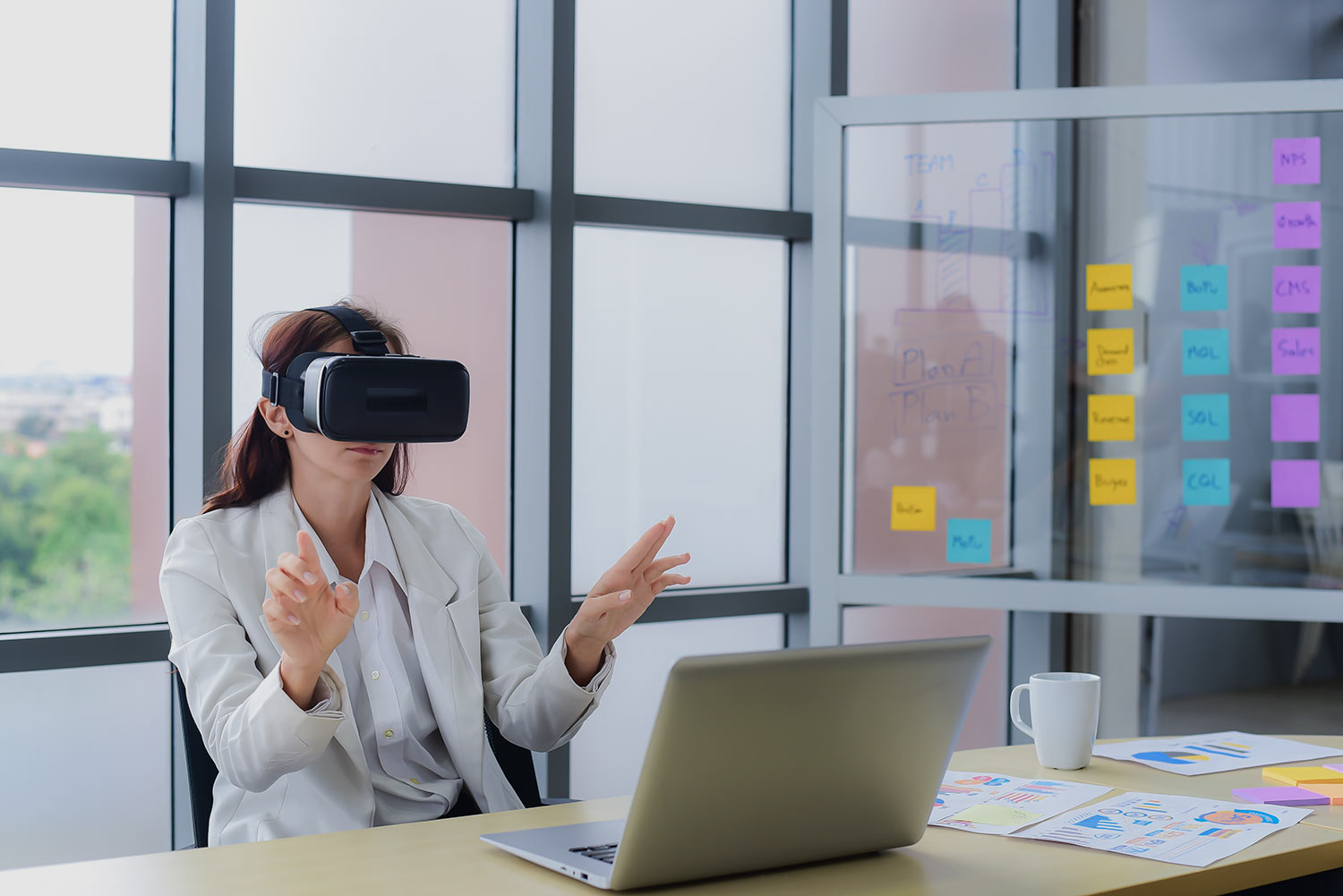
Virtual reality headsets represent a violent break in this evolutionary chain. They are a regression in ergonomics. To enter the social metaverse, you must strap a heavy, battery-powered plastic box to your face, effectively blindfolding and deafening yourself to the physical world.
The Physics of Discomfort
No matter how much money Apple, Meta, or Sony pours into micro-OLED displays and pancake lenses, they cannot defeat basic human anatomy and physics. A VR headset must block out all external light to maintain immersion, requiring a tight seal against the face. This creates pressure points, messes up makeup, and ruins hairstyles. Furthermore, the “screen door effect,” motion sickness (vection-induced sickness), and eye strain remain persistent issues for a significant percentage of the population. Our vestibular system—the inner ear—gets confused when our eyes tell us we are moving but our physical body is sitting still on a couch.
The Anti-Social Nature of VR
There is a deep, tragic irony in the fact that a device designed to enhance social connection requires the user to completely isolate themselves from their immediate physical environment. If you are sitting in your living room wearing a Meta Quest, you are fundamentally ignoring your spouse, your children, or your roommates. You cannot glance up from your VR headset to acknowledge someone walking into the room, the way you can glance up from an iPhone.
The smartphone is a socially permissible distraction; it exists in the real world. VR is an aggressive rejection of the real world. It demands a level of physical commitment that humans are simply not willing to engage in for casual socialization. We are tactile, ambient creatures. We like to multitask—watching TV while scrolling on a phone, or texting a friend while eating a sandwich. VR forbids multitasking. It demands your entire sensory bandwidth. For a quick social check-in, this is massive overkill.
Chapter 3: The Psychology of the Scroll: Why 2D Won
To understand why the metaverse will not replace social media, we have to look at why we use social media in the first place. The tech elites in Silicon Valley view human socialization through the lens of efficiency and presence. They believe that because face-to-face interaction is the “richest” form of communication (citing things like non-verbal cues and spatial presence), a virtual simulation of face-to-face interaction must be the ultimate upgrade for online socializing.
They are fundamentally wrong.
Social media is not a degraded version of real-life hanging out; it is an entirely new, distinctly modern form of communication with its own unique psychological rewards.
The Power of Asynchronicity
Real-life interactions are synchronous. They require you to be present, to think on your feet, to manage your facial expressions, and to respond in real-time. This is exhausting. Social media is primarily asynchronous. You can consume content at your own pace. You can see a funny video, put your phone down, think of a witty reply while you are in the shower, and type it out three hours later.
The metaverse, by its very nature, forces us back into exhausting synchronicity. If you are hanging out in a virtual room as an avatar, you have to “perform” being there. You have to stand around, think of things to say, and manage virtual body language. For an introverted, screen-fatigued population, this sounds less like a fun social network and more like a mandatory corporate networking event.
Voyeurism vs. Participation
Let’s be honest about how most people use Instagram, TikTok, and X. They are voyeurs. The primary activity is passive consumption. We scroll through feeds watching other people live their lives, perform their talents, or argue about politics. We do not actively participate in 99% of the content we view.
The metaverse forces participation. You cannot passively scroll through a 3D room. You are placed inside the content. This violates the fundamental social contract of modern social media, which allows us to be lazy observers. We want to watch the drama unfold from a safe distance; we do not want to be placed in the center of the virtual room where the drama is happening.
The Curated Self vs. The Embodied Self
On Instagram, you carefully curate your grid. You use filters, you choose the best lighting, you take fifty selfies and post the one where your jawline looks best. You control the narrative of your identity.
In the metaverse, you are an embodied avatar. Even with highly customizable avatars, the illusion shatters the moment you start moving. Hand tracking is jittery; eye contact is uncanny; body language is awkward. The metaverse strips away the protective layer of curation that 2D social media provides. It forces us to be physically present in a way that reveals our awkwardness, destroying the idealized digital personas we spend hours cultivating.
Chapter 4: The Economic Mirage and the Web3 Collapse
A science fiction world requires a science fiction economy, and for a brief, chaotic moment, the tech industry thought it had found one: Web3, Cryptocurrency, and NFTs.
The social metaverse was intrinsically tied to the idea of digital ownership. If you are going to spend your life in a virtual world, the logic went, you need to own virtual things: virtual land, virtual clothes, virtual furniture. To prove you owned these things—and to prevent a central company like Meta from just duplicating them—we needed decentralized ledgers (blockchains).
This economic model has largely collapsed, taking the metaverse’s financial viability down with it.
The Illusion of Digital Scarcity
The entire Web3 metaverse economy was based on the premise of artificial scarcity. A company would create a virtual world, declare that there were only 100,000 “parcels” of virtual land, and sell them for thousands of dollars worth of Ethereum.
But digital space is not scarce. It is infinitely replicable. The only thing making that land scarce was the arbitrary rules of the developers. When the hype died and users stopped logging in, the demand for virtual land evaporated. Platforms like Decentraland and The Sandbox saw their transaction volumes plummet by over 90%. People who spent six figures on virtual real estate next to Snoop Dogg’s virtual mansion found themselves holding worthless pixels.
No One Wants to Work a Second Job for Fun
The economic vision of the metaverse also required users to become micro-entrepreneurs. We were told we would monetize our hobbies, designing 3D models of hats to sell to other users, or acting as virtual tour guides.
Again, this ignored human psychology. People play video games and use social media to escape work. Forcing an economic grind onto leisure time—designing virtual assets just to afford a virtual apartment—turns play into labor. The mainstream consumer has absolutely no desire to participate in a gig economy inside a video game. We want to pay a flat fee (or nothing) to be entertained, not engage in complex crypto-commerce just to change our avatar’s shoes.
The Real-World Signaling Mechanism
Why do people buy luxury goods in the real world? A Rolex watch or a Louis Vuitton bag is a signaling mechanism. It tells the world, “I have disposable income and high social status.”
This signaling mechanism completely breaks down in the metaverse. If everyone is represented by a cartoon avatar, a $500 digital Gucci jacket has no real-world cachet. You cannot wear it to a physical dinner party to impress your peers. Because the metaverse lacks real-world physical consequences or visibility, the primary psychological driver for luxury consumption evaporates. Without a functioning economy based on real human desires, the metaverse cannot sustain itself as a social platform.
Chapter 5: The Aesthetic Nightmare and the Uncanny Valley
If the metaverse is going to replace social media, it has to be a place where people want to be seen. Instagram and TikTok succeeded wildly because they are visually beautiful platforms. They offer high-definition cameras, sophisticated filters, and aesthetic environments. They flatter the user.
The current iteration of the metaverse is, frankly, visually hideous.
The Horror of the Uncanny Valley
When Meta first unveiled Horizon Worlds—their flagship social VR app—the internet erupted in mockery. The avatars looked like horrifying, legless, smooth-skinned mannequins with dead, unblinking eyes. They existed squarely in the “Uncanny Valley”—the psychological phenomenon where things that look almost human evoke a feeling of revulsion and eeriness.
Zuckerberg later posted a selfie from an updated version with higher-resolution avatars, and it was still widely mocked. The truth is, simulating a realistic human being in real-time 3D is one of the hardest problems in computer graphics. Lighting, micro-expressions, skin subsurface scattering, and fluid physics are incredibly computationally expensive. Until we have quantum computers or photorealistic ray-tracing in a lightweight pair of glasses, avatars will remain slightly creepy.
The Generic emptiness of Virtual Spaces
Furthermore, the environments in these social metaverses are devoid of soul. Because assets must be optimized to run on mobile chips inside a headset, the worlds look like slightly upgraded PlayStation 2 games. They are filled with low-poly furniture, flat lighting, and empty, echoing spaces.
When you log into a social metaverse, you aren’t transported to a breathtaking sci-fi cityscape like in Blade Runner; you are transported to a sterile, brightly lit digital cafeteria. There is no weather, no smell, no texture. Compare this to the rich, highly curated, high-definition aesthetic of a TikTok feed or an Instagram story, and it is no wonder users immediately take the headset off.

