

Why You Actually Finish the 5-Minute Course (And Never Touch the 40-Hour One)
The real case for microlearning, micro credentials, and building skills in bite-sized pieces
You’ve done this before. You sign up for a 40-hour certification course on a Sunday night, fueled by a genuine burst of motivation and three tabs open comparing course reviews. You finish module one. Maybe module two, if the week goes well. And then it sits there, 6% complete, quietly guilt-tripping you from your dashboard for the next eight months until you finally unenroll to clean up your account.
Now compare that to the last time you learned something from a 90-second video while waiting for your coffee order. You probably remember it. You might have even used it that same day.
That gap isn’t a willpower problem. It’s a format problem. Microlearning — bite-sized learning delivered in short, focused chunks — has quietly become the dominant way people actually acquire new skills, and it’s not a trend built on shrinking attention spans out of laziness. It’s built on how memory, motivation, and mobile life genuinely work. This guide breaks down why bite-sized learning outperforms marathon courses for most people, how micro credentials are reshaping what employers actually value, and how to build a learning habit around units that take less time than your commute.
What Microlearning Actually Is (And What It Isn’t)
Microlearning gets thrown around loosely enough that it’s worth pinning down. It’s not just “a short video.” A proper microlearning unit is a single, complete learning objective delivered in a compressed format — usually two to ten minutes — that stands on its own rather than being a fragment chopped out of a longer lecture.
That distinction matters more than it sounds. Chopping a 60-minute lecture into six 10-minute clips isn’t microlearning; it’s just a long course with more scroll bars. Real bite-sized learning is designed from the start as a self-contained unit: one clear objective, one explanation, one way to check that it landed. Think of it like a single LEGO brick versus a shard broken off a finished model. Both are small, but only one is actually built to connect cleanly with the next piece.
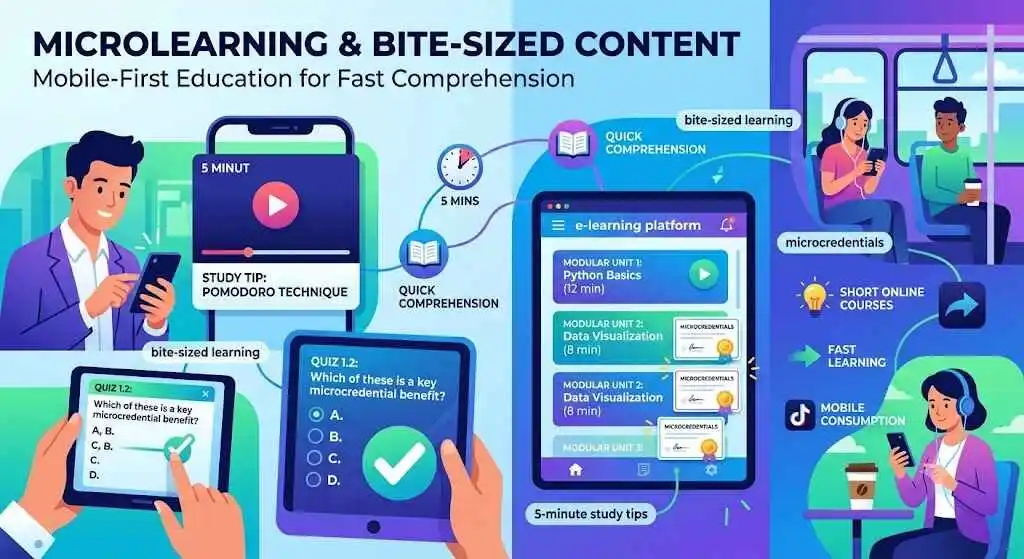
The format typically includes a short instructional video or animated explainer, a quick quiz or interactive check to confirm the concept stuck, and sometimes a small task to apply it immediately. Stack enough of these modular learning units together in the right sequence, and you get something surprisingly close to a full course — just one that people actually finish.
That completion difference isn’t a minor footnote. It’s arguably the entire point. A brilliant 40-hour curriculum that 8% of enrollees finish delivers less real-world value than a modest bite-sized course that 70% of people actually complete, even if the modest course covers less ground per session. Reach and completion compound over time in a way that raw content depth alone doesn’t.
“Microlearning isn’t a shorter course. It’s a differently engineered one — built around how attention and memory actually behave, not around how a syllabus looks on paper.”
This is also why microlearning shows up so naturally on mobile learning apps and social platforms rather than staying confined to corporate training portals. A properly built modular unit doesn’t lose much by being viewed on a five-inch screen between tasks, because it was never designed to require an hour of undivided desktop attention in the first place. That portability is a feature of the design, not a compromise bolted on afterward.
The Science Behind Why Bite-Sized Learning Works
There’s real cognitive science underneath this, not just convenience. Working memory — the mental workspace where you actively process new information — has a famously limited capacity. Try to cram too many new concepts into one sitting, and the brain starts dropping earlier ones to make room for new ones. This is called cognitive overload, and it’s the quiet killer of most long-form training.
Short online courses built around microlearning sidestep this almost by design. Each unit introduces one idea, lets it settle, and checks comprehension before moving on. That checking step matters more than people expect. Retrieval practice — actively recalling information rather than just re-reading it — is one of the most well-supported findings in learning science, and quick quizzes are essentially retrieval practice wearing a friendlier outfit.
There’s also a spacing effect at work. Information reviewed in short sessions spread across several days sticks dramatically better than the same information crammed into one long session. A single two-hour workshop and eight fifteen-minute microlearning sessions spread across two weeks can cover identical content, but the spaced version consistently wins on long-term retention. This is well-documented in educational psychology research going back decades, and it’s a big part of why bite-sized learning isn’t just a trend chasing shorter attention spans — it’s arguably closer to how the brain wanted to learn all along.
Traditional Long-Form Training vs. Microlearning
| Factor | Long-Form Course | Microlearning |
| Typical session length | 45–90 minutes | 2–10 minutes |
| Completion rates | Often below 15% | Frequently 70%+ |
| Retention approach | Single dense exposure | Spaced repetition |
| Best consumed on | Desktop, dedicated time block | Mobile, in-between moments |
| Comprehension checks | End-of-course exam | Quick quiz after each unit |
None of this means people have gotten worse at focusing over the years — that’s a common but shaky claim. What’s actually changed is the amount of competing information and the number of legitimate demands on a person’s time in any given day. A learning format has to compete with everything else asking for those same minutes, and long-form training simply loses that competition more often than short, immediately useful units do.
There’s a workplace-training angle worth mentioning too. Studies on corporate training consistently find that employees forget the majority of what they learn in a single long workshop within days if there’s no reinforcement. Microlearning platforms that follow up an initial lesson with short, spaced review quizzes over the following weeks measurably outperform one-and-done sessions on actual applied performance, not just quiz scores.
Micro credentials: The New Currency of Skills
Here’s where this shifts from a study-habit conversation into a career conversation. Micro credentials — focused, verifiable certificates earned by completing a specific skill-based course or module — have moved from a nice-to-have resume line to something hiring managers actively search for, especially in fast-moving fields like data analytics, digital marketing, cybersecurity, and project management.
The appeal on both sides is straightforward. For learners, a micro credential proves a specific, current skill without requiring a multi-year degree commitment. For employers, it’s a faster, cheaper signal than a full degree, and often a more accurate one — a micro credential in a specific tool or method tells you exactly what someone can do right now, rather than what they studied broadly years ago.
This is also reshaping what “short online courses” even mean as a category. A decade ago, a short course was treated as a lightweight alternative to real education. Today, stacking several micro credentials into a coherent skill path is a legitimate, employer-recognized way to build a career narrative — especially for people changing fields or filling a specific gap rather than starting from zero.
- Look for stack ability — the best micro credential programs let smaller certificates combine into a larger recognized credential later, so early effort isn’t wasted if your goals grow.
- Check who’s actually behind it — credentials issued or recognized by established universities, professional bodies, or well-known platforms carry more weight with employers than obscure, unverifiable badges.
- Prioritize skill-based learning over topic-based learning — a credential titled “Google Analytics 4 Reporting” tells an employer more than one titled “Introduction to Marketing.”
- Keep a portfolio, not just a certificate wall — a micro credential paired with a real project or work sample is worth more than the badge alone.
There’s a practical reason this matters beyond resume optics. Hiring managers sorting through hundreds of applications don’t have time to infer competency from a vague degree line item written a decade ago. A specific micro credential does the interpretive work for them — it names the tool, the skill, and roughly how current that skill is. That specificity is exactly why a well-chosen short online course, completed and documented properly, can sometimes move a candidate past someone with a more impressive but less legible background.
This shift also changes how people think about career development itself. Instead of treating learning as something that happens in one big block before a career starts, more professionals now treat it as an ongoing, modular process — adding a relevant microcredential every few months as tools and requirements shift, rather than waiting for a dramatic reason to go back to school.
5-Minute Study Tips That Actually Fit Into a Real Day
The theory is nice, but the actual habit is what determines whether any of this sticks. Most people don’t fail at bite-sized learning because the content is bad — they fail because they never build a repeatable slot for it. Here are 5-minute study tips that hold up against an actual, unpredictable daily schedule.
“You don’t find five minutes for learning. You take five minutes that were already going to disappear into a feed anyway, and redirect them.”
Consider two people trying to learn conversational Spanish over the same three months. One blocks off Saturday mornings for a two-hour lesson and, realistically, misses about a third of those sessions when weekends get busy. The other does one five-minute vocabulary module every day, including weekends, with a quick quiz at the end of each. By month three, the daily learner has logged more total practice time, hit far more spaced repetitions of the same words, and — this is the part that surprises people — reports feeling less burned out by the process, because no single session ever felt like a real time commitment worth dreading.
This is really the underlying case for bite-sized learning as a habit, not just a format: small and consistent beats large and sporadic almost every time attention, memory, and real-life scheduling are all factored in together.
- Anchor it to an existing habit. Attach one microlearning unit to something you already do daily — right after your morning coffee, during a commute, or while your lunch heats up. Habit-stacking removes the “when will I do this” decision entirely.
- Use dead time on purpose. Waiting rooms, checkout lines, the last five minutes before a meeting starts — these moments add up to real learning time over a month, and they’re otherwise spent on autopilot scrolling anyway.
- Cap sessions at one unit, not one hour. The goal of a five-minute session is consistency, not depth. Trying to squeeze in three units “while you’re at it” is exactly how the habit collapses in week two.
- Quiz yourself before you look anything up. Even a wrong guess strengthens the eventual correct answer more than passively rereading material would. This is retrieval practice in its simplest form.
- Track a streak, not a total. A visible streak counter is a surprisingly effective motivator for bite-sized learning specifically, because the low daily cost makes maintaining it genuinely realistic.
- Review, don’t just advance. Revisit yesterday’s unit for thirty seconds before starting today’s. This tiny bit of spaced repetition compounds noticeably over a few weeks.
Choosing the Right Learning Apps and Platforms
Not all learning apps are built around genuine microlearning principles, even when they market themselves that way. Some are just shorter versions of traditional courses; others are genuinely designed around spaced, modular, quiz-reinforced units. Knowing the difference saves a lot of wasted app-store downloads.
What to Look For in a Microlearning Platform
| Feature | Why It Matters | Red Flag If Missing |
| Units under 10 minutes | Matches actual attention span and dead-time usage | Sessions routinely run 20+ minutes |
| Built-in quick quizzes | Reinforces retrieval practice, the core learning mechanism | No comprehension check after lessons |
| Spaced review reminders | Leverages the spacing effect for long-term retention | No revisit or review scheduling at all |
| Offline/mobile-first design | Supports learning during commutes or low-connectivity moments | Desktop-only or heavy, slow-loading app |
| Clear skill or credential path | Turns scattered lessons into a career-relevant outcome | Content feels random with no defined endpoint |
It’s also worth paying attention to how a platform treats modular learning units structurally. The strongest apps let you jump into any relevant module without forcing a rigid, linear path — useful when you already know 80% of a topic and just need the 20% you’re missing. Rigid platforms that lock every unit behind the previous one tend to create the exact same drop-off problem as traditional long-form courses, just with smaller chapters.
Pricing structures are worth a quick sanity check too. Some learning apps charge per completed microcredential, others use a flat monthly subscription covering unlimited modules, and a few mix the two — free foundational units with paid, verified credentials at the end of a skill path. Neither model is inherently better, but knowing which one you’re in avoids the frustrating surprise of finishing a module only to find the actual verified certificate sits behind an unexpected paywall.
One more practical filter: read a handful of recent user reviews specifically looking for complaints about content going stale. Fast-moving technical fields punish outdated microlearning content quickly, and a platform that hasn’t refreshed its short online courses in a couple of years can end up teaching a workflow or interface that no longer matches the real tool.
Designing (and Consuming) Modular Content on Social Platforms
A huge share of bite-sized learning now happens outside dedicated learning apps entirely — on the same social platforms people already open a dozen times a day. Short instructional videos on these platforms have become a genuine, if informal, entry point into skill-based learning, especially for topics like coding basics, language learning, personal finance, and quick professional tips.
This works because the format constraints of social platforms happen to align almost perfectly with microlearning best practices: a hard time limit forces a single, focused objective, vertical mobile-first video matches how people actually hold their phones, and built-in engagement features like polls or quiz stickers double as comprehension checks without the term ever being used.
The catch is credibility and structure. Anyone can post a short instructional video, and not all of it is accurate or sequenced well. The most reliable approach is treating social platforms as a discovery layer — a way to find a topic or creator worth going deeper with — and then following up with a structured short course or micro credential path once a topic proves genuinely useful, rather than assuming a feed of unrelated clips adds up to real competency on its own.
A useful habit for separating genuinely useful short instructional videos from noise: check whether the creator explains why a method works, not just what to do. Content that only shows a result without any underlying reasoning is harder to adapt when your specific situation differs even slightly from the example. A short video that takes fifteen extra seconds to explain the underlying principle tends to transfer to real use far better than one that’s purely a scripted demo.
It’s also fine, and often smart, to treat a single creator’s short video series as your informal syllabus for a topic, provided you occasionally cross-check their advice against a more established source. The modular nature of this content means switching creators or supplementing with a structured short course later costs you nothing — you’re not locked into a single 40-hour path the way traditional course platforms often assume you will be.
Microlearning isn’t a workaround for people who supposedly can’t focus anymore. It’s a better-engineered response to how memory, motivation, and modern schedules actually operate. Five focused minutes a day, backed by a quick quiz and a little spaced review, will consistently outperform a 40-hour course sitting at 6% complete in a browser tab you’ve stopped opening.
If you’ve been putting off learning something because you can’t find a two-hour block, stop looking for the block. Find the next five minutes instead — the coffee line, the elevator ride, the wait before a meeting starts — and build one small module into it today. That’s the whole system. Start with one unit, and let the habit compound from there.
Pick one skill you’ve been meaning to pick up, find a single microlearning unit or short online course related to it, and complete just that one module before the day ends. Don’t plan the next ten. Just do the one in front of you, quiz included, and see how it feels tomorrow to already have somewhere to pick back up.
FAQs
| Question | Answer |
| What is microlearning in simple terms? | It’s learning delivered in short, focused units — usually two to ten minutes — each covering a single, complete concept rather than a fragment of a longer lesson. |
| How is microlearning different from a regular online course? | A regular course is typically long-form and linear, while microlearning breaks content into standalone modular units that can often be taken in any order and completed in a few minutes each. |
| Does bite-sized learning actually work, or is it just marketing? | It’s backed by real cognitive science, particularly retrieval practice and the spacing effect, both of which show that short, spaced study sessions improve long-term retention compared to single long sessions. |
| What is a micro credential? | A micro credential is a focused, verifiable certificate earned by completing a specific skill-based course or module, often stackable into a larger recognized qualification over time. |
| Are micro credentials respected by employers? | Increasingly, yes, especially in fast-moving fields like tech, data, and digital marketing, where employers value proof of a specific current skill over a broad, older credential. |
| Can micro credentials replace a college degree? | For some roles and industries, a strong stack of relevant micro credentials paired with real project work can substitute for a degree, but for many regulated or highly credentialed fields, a degree is still required or strongly preferred. |
| How long should a microlearning unit be? | Most effective units run between two and ten minutes, long enough to cover one complete idea but short enough to fit into a spare moment without feeling like a chore. |
| What are good 5-minute study tips for a busy schedule? | Anchor a learning session to an existing daily habit, use unavoidable dead time like commutes or waiting rooms, quiz yourself before checking the answer, and briefly review yesterday’s material before starting something new. |
| Why do quick quizzes matter so much in microlearning? | They force active recall of the material, known as retrieval practice, which strengthens memory far more effectively than simply rereading or rewatching content. |
| Is microlearning effective for complex technical skills? | Yes, when the skill is broken into a well-sequenced series of modular units rather than treated as a single standalone lesson; complex skills just require more connected units, not longer individual ones. |
| What’s the difference between microlearning and mobile learning? | Mobile learning refers to any learning done on a phone or tablet, while microlearning refers specifically to the short, modular format of the content itself — the two frequently overlap but aren’t the same thing. |
| Can microlearning fully replace traditional training? | For skill-specific, practical training, often yes. For deep theoretical grounding or heavily regulated certifications, microlearning usually works best as a supplement rather than a full replacement. |
| How do I know if a learning app is genuinely built for microlearning? | Check for units under ten minutes, built-in comprehension quizzes, spaced review reminders, and a mobile-first design — apps missing most of these are often just shortened traditional courses. |
| What is the spacing effect and why does it matter for learning? | The spacing effect describes how information reviewed in short sessions spread over several days is retained far better than the same material studied in one long session. |
| Are short instructional videos on social media a legitimate way to learn? | They’re a solid discovery tool for finding topics and creators worth exploring further, but they work best as an entry point rather than a complete, structured learning path on their own. |
| How many microlearning units should I do per day? | One consistent unit a day, done reliably, produces better long-term results than sporadic bursts of five or six units followed by long gaps. |
| What industries use micro credentials the most? | Technology, digital marketing, data analytics, project management, healthcare administration, and cybersecurity are among the fields where micro credentials are most commonly recognized. |
| Do micro credentials expire? | Some do, particularly in fast-changing technical fields where platforms or tools update frequently; it’s worth checking the issuing body’s renewal policy before relying on one long-term. |
| How do I stay motivated with bite-sized learning? | Track a visible daily streak rather than a total hours count, since the low time cost of microlearning makes maintaining a streak far more realistic than sustaining motivation for long sessions. |
| Is it better to take modular units in order or jump around? | It depends on the topic and your existing knowledge; strong platforms allow both, letting you follow a structured path or jump directly to the specific gap you need to fill. |
| Can microlearning help with skill-based learning for a career change? | Yes, stacking targeted micro credentials around a specific skill gap is one of the more efficient ways to build a credible, employer-relevant profile for a career pivot. |
| What’s the biggest mistake people make with bite-sized learning? | Treating five-minute sessions as flexible and skippable rather than as a fixed daily habit, which is usually what causes the approach to fall apart within a few weeks. |
| Does microlearning work for children and students, or just adults? | It works across age groups; younger learners in particular tend to respond well to short, quiz-reinforced modules because of naturally shorter sustained-attention windows. |
| How do quick quizzes differ from traditional exams? | Quick quizzes are typically low-stakes, immediate, and tied to a single small unit, designed to reinforce memory in the moment rather than evaluate broad performance at the end of a course. |
| Are free microlearning apps as effective as paid ones? | Effectiveness depends more on instructional design — spacing, quizzing, modular structure — than on price, though paid platforms often offer more structured credential paths and support. |
| What is a modular learning unit? | It’s a self-contained lesson built around one specific objective, designed to be completed independently and combined with other units to build toward a larger skill or credential. |
| How long does it take to earn a micro credential? | Timelines vary widely, but most focused micro credentials are designed to be completed in anywhere from a few hours to a few weeks of cumulative short sessions. |
| Can I list micro credentials on a resume or LinkedIn? | Yes, and doing so is increasingly common and expected in fast-moving fields; listing the specific skill and issuing platform adds more credibility than a vague course title. |
| What are current online learning trends worth watching? | Growth in stackable micro credentials, AI-personalized learning paths, short-form video as a discovery layer, and spaced-repetition-based apps are among the most notable current shifts. |
| Is microlearning just a passing trend? | The short-content format may evolve, but the underlying cognitive principles it’s built on — spacing, retrieval practice, reduced cognitive load — are well-established and unlikely to go out of style. |

