

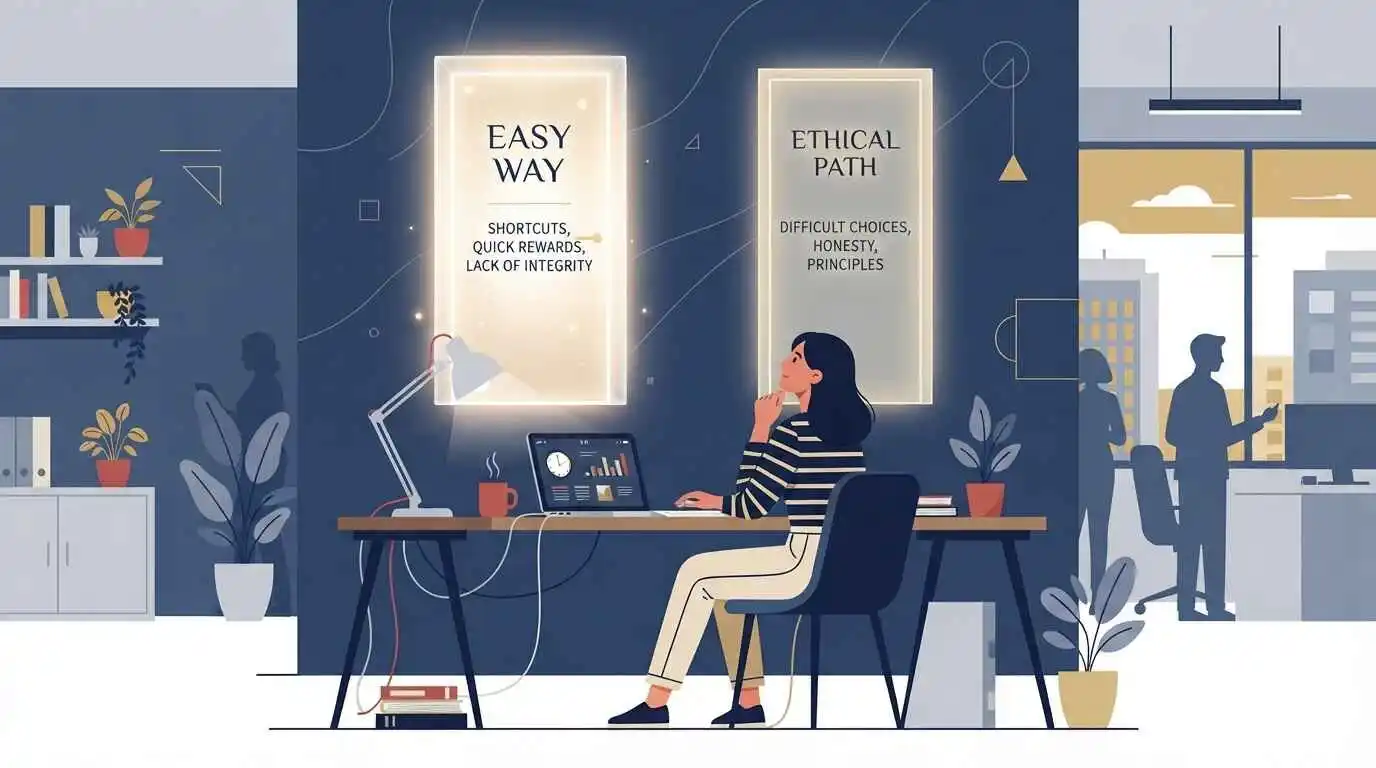
The Harder Right, The Easier Wrong : The Choice Hiding Inside Every Ordinary Day
Every life, looked at closely enough, turns out to be made of forks rather than a single road. Most of them are small enough to pass unnoticed — a shortcut here, a convenient silence there — and yet an entire life eventually reveals itself to be nothing more than the sum of which fork got taken, over and over, thousands of times, mostly when nobody else was watching. There is an old line, passed down in different forms across generations, that tries to name this pattern in a single breath: choose the harder right over the easier wrong, and never let a wishbone grow where a backbone should be. It sounds almost too simple to matter. It is, in practice, one of the more demanding ways a person can choose to live, precisely because it asks for the same small act of courage not once, but daily, for an entire lifetime.
This is not a philosophy about one dramatic decision. It is a philosophy about two ways of living the same ordinary life — one that bends toward whatever is easiest in the moment, and one that holds its shape under pressure, choice by choice, until the shape becomes permanent. Every person, regardless of profession, background, or circumstance, faces some version of this same fork, usually several times a day, and the two people who take opposite forks at the same moment often look identical from the outside. The difference only becomes visible later, in the kind of life each choice quietly built.
Two Ways to Live the Same Life
Nearly every meaningful decision can be reduced, at its core, to a choice between two paths available to the exact same person in the exact same moment. One path is well-lit, well-traveled, and rewarding immediately. It asks almost nothing of you right now. The other is narrower, often lonelier, and rarely rewarded on the spot. It asks for patience, discomfort, and sometimes real sacrifice, with no guarantee anyone will ever notice or thank you for taking it.
The easier wrong rarely announces itself as wrong. It almost always arrives dressed as practicality: everyone does it this way, it’s a small exception, no one will be hurt, this one time doesn’t count. That framing is exactly what makes it dangerous. Genuinely tempting choices are almost never presented as villainous; they’re presented as reasonable, situational, and entirely understandable. Moral compromise, in real life, rarely looks like a dramatic betrayal. Far more often, it looks like a shrug.
The harder right, meanwhile, is almost never framed attractively. It typically involves an uncomfortable conversation, an admission that costs something, a delay in gratification, or a stance that invites disagreement. It’s called ‘harder’ for a reason — not because it’s morally unclear, but because doing it well requires overriding the mind’s natural pull toward whatever option is immediate, comfortable, and low-friction.
There is a useful test for telling the two paths apart when the labeling isn’t obvious: ask which choice you’d be comfortable explaining, in full and honest detail, to someone whose respect you value most. The easier wrong tends to need euphemism, omission, or justification to survive that kind of explanation intact. The harder right, however uncomfortable in the moment, usually survives full daylight without needing to be softened or hidden at all.
Wishbone vs. Backbone: The Image That Sticks
The second half of this old line is arguably the more memorable half, thanks to its plain, almost physical imagery. A wishbone bends. It’s fragile, forked, and eventually snaps under any real pressure, existing mainly to be pulled apart in a game of chance. A backbone, by contrast, is the structure that holds an entire body upright. It bears weight. It allows movement without collapse. It isn’t decorative. It’s load-bearing.
Applied to character, the image lands precisely. A person with a ‘wishbone’ where their backbone should be tends to bend toward whichever direction offers the least resistance in a given moment — agreeing with whoever spoke last, avoiding conflict even when conflict is warranted, shifting conviction based on the room’s temperature rather than any underlying principle. It isn’t that such a person is malicious. It’s that the internal structure required to hold a position under pressure was simply never built.
A backbone, on the other hand, doesn’t mean rigidity, or an unwillingness to ever change one’s mind. Genuine backbone includes the humility to update a position when new evidence actually warrants it. What it doesn’t tolerate is caving to social pressure, convenience, or fear simply because holding firm feels uncomfortable. The distinction is subtle but important: a backbone can bend under good reason. A wishbone bends under any pressure at all.
It’s also worth noting that a real backbone, unlike a wishbone, isn’t something displayed for effect. A person who constantly announces their own principled stands, seeking recognition for every small act of integrity, has often confused visibility with virtue. The load-bearing structure of real character tends to do its most important work quietly, holding a person upright in moments no one else will ever know about.
Why the Easier Wrong Is So Seductive Right Now
It would be convenient to believe that choosing rightly is simply a matter of good character, full stop. But modern life has engineered an unusually large number of forces that make the easier wrong more tempting than at almost any point before now. Instant gratification has become the default setting of daily existence — one-click purchases, algorithmically optimized entertainment, same-day everything. Each of these conveniences quietly trains the brain to expect friction-free outcomes, which makes genuine friction, the kind moral courage often requires, feel disproportionately unpleasant by comparison.
Social visibility compounds the problem in a strange, almost inverted way. In earlier eras, many small ethical choices were genuinely private, made or broken with no audience at all, which meant the only real incentive to choose rightly was internal. Today, enormous, permanent audiences exist for trivial choices, while many of the choices that matter most — how you treat a struggling coworker, whether you admit an error to your family, whether you follow through on a private promise — remain almost entirely unwitnessed. The habit of performing for an audience can quietly erode the older, quieter habit of doing right when no one is watching at all.
There’s also a simple economic logic working against moral courage: the easier wrong usually pays out immediately, while the harder right usually pays out later, if at all, and often in currencies — trust, self-respect, long-term reputation — that never show up on any short-term ledger. Recognizing this asymmetry is itself a form of wisdom, because it explains why willpower alone is rarely enough. The reward structure of the harder right has to be understood and chosen deliberately, again and again, precisely because it will not naturally out-compete the easier wrong on any single occasion.
The Compounding Cost of Small Compromises
One of the most dangerous myths about moral compromise is that it stays contained — that choosing the easier wrong once has no bearing on the next decision. Research on habit formation consistently shows the opposite: each choice, however minor, reinforces a pattern of decision-making that becomes the default the next time a similar fork appears. A single small compromise rarely stays small. It becomes a groove the mind falls into a little more easily each time.
This is why this old philosophy frames the challenge as a lifelong discipline rather than a single test to pass. There’s no point at which a person ‘graduates’ from needing to choose the harder right; the forks simply keep reappearing, in new disguises, at every stage of life. A teenager’s fork might involve academic honesty. A young professional’s fork might involve taking credit for someone else’s work. A parent’s fork might involve a difficult, honest conversation with a child instead of a convenient evasion. The stakes change shape. The underlying test doesn’t.
The encouraging flip side of this compounding effect is that virtue compounds just as reliably as compromise does. Every time the harder right is chosen, even in a moment no one else witnesses, the internal structure grows slightly sturdier, and the next hard choice becomes marginally easier to make. This isn’t a metaphor borrowed loosely from fitness; it operates through much the same mechanism as any skill built through repetition.
Building the Backbone: A Practical Framework
If moral courage were purely innate, none of this would be worth writing down. Fortunately, character development, much like physical training, responds to structure and repetition. The first practical step is naming your non-negotiables in advance, before pressure ever arrives. Deciding in a calm moment that you will not lie to protect your image, or that you will always credit others’ work honestly, removes the decision from the high-pressure moment itself, when willpower is at its weakest and rationalization is at its most persuasive.
The second step is practicing in low-stakes situations, deliberately. Just as physical strength is built with manageable weight before attempting a personal record, this kind of strength is built by choosing the harder right in small, low-consequence situations — admitting a minor mistake, declining a small unearned advantage — long before a high-stakes test ever arrives. Waiting for a major crisis to be the first time this muscle gets used is a reliable recipe for failure.
The third step is building accountability into your life deliberately, rather than relying purely on private resolve. Mentors, close friends, communities of shared conviction, or even a simple daily journaling habit that asks ‘where did I choose the easier wrong today’ all create external structure that reinforces internal discipline. Very few people sustain difficult virtues in total isolation; nearly every enduring tradition of character formation relies on some form of community and accountability, not willpower alone.
A fourth, often overlooked step is simply expecting the pull toward the easier wrong rather than being surprised by it. Many people abandon the harder right in a moment of temptation partly because they didn’t anticipate feeling tempted at all, and the surprise itself erodes resolve. Approaching each day with the quiet expectation that a fork will appear, and that it will feel genuinely tempting when it does, tends to produce steadier, less reactive decisions than assuming this should feel effortless.
A backbone can bend under good reason. A wishbone bends under any pressure at all.
Keeping the Discipline Alive
Whatever name is given to this quality — resolve, backbone, character, integrity — it is worth being honest about how it dies, because it rarely dies the way people expect. It is not usually destroyed by a single dramatic failure. It is far more often eroded by a slow accumulation of comfort. A life optimized entirely for ease, with every source of friction engineered away, gradually produces a person who has simply forgotten how to choose difficulty on purpose. That capacity doesn’t disappear in one bad moment. It disappears quietly, from disuse, across a thousand ordinary afternoons of taking the path of least resistance.
Keeping it alive, then, is less about seeking out artificial hardship for its own sake, and more about refusing to flinch from the real hardship daily life already offers in abundance. Every honest conversation you’d rather avoid, every accountability you’d rather dodge, every shortcut you decline to take, is a small rep for the same underlying strength. It isn’t kept alive in rare moments of crisis. It’s kept alive in the accumulated weight of ordinary days met with unusual honesty.
What This Looks Like in an Ordinary Life
The vast majority of people who live by this philosophy will never face a single dramatic test of it, and that is precisely the point — the idea was never meant to apply only to extraordinary circumstances. At work, the harder right might mean flagging an error in your own output before someone else discovers it, even when staying silent would likely go unnoticed. In a friendship, it might mean telling someone an honest, uncomfortable truth instead of the easy flattery they’re hoping to hear.
In parenting, the harder right often looks like consistency: holding a boundary you set, even when a child’s disappointment makes the easier wrong — giving in — momentarily more peaceful. In personal finances, it might mean living within a budget rather than the easier wrong of convenient debt. In civic life, it might mean engaging respectfully with people who disagree with you, rather than retreating into the easier wrong of contempt and dismissal.
None of these examples require a title, a badge of rank, or a crisis. All of them involve the exact same fork: a well-lit, immediately comfortable option, and a narrower, less rewarded, but structurally sound alternative. Giving that everyday fork a name makes it easier to recognize the next time it appears — which, for most people, will be sometime today.
One Life, Chosen a Thousand Times
Choosing the harder right, consistently, over an entire lifetime, is not something anyone accomplishes through gritted-teeth willpower alone. It takes humility to recognize your own capacity for rationalization, community to hold you accountable when private resolve weakens, and for many people, a set of convictions larger than the immediate moment to draw strength from when the easier wrong is standing right in front of you, fully lit and perfectly convenient.
What makes this old philosophy endure is that it refuses to romanticize moral courage as a single dramatic act. It insists instead that character is built the way a backbone is built — vertebra by vertebra, choice by choice, mostly in private, mostly unglamorous, mostly unnoticed by anyone but the person making the choice. There is no shortcut to that kind of structural strength, and no substitute for it once it’s actually needed.
So the next time the pull toward the well-lit, comfortable, fully justifiable easier wrong shows up, it’s worth pausing long enough to see the fork in the road for exactly what it is. No one chooses the harder right every single time. But each time it is chosen, one more vertebra gets laid down in a structure that will hold when it matters most. That, in the end, is the whole idea in a single sentence: one life, and two ways to live it — a wishbone that was always going to snap, or a backbone strong enough to hold. The choosing happens today, and tomorrow, and every ordinary day after that.
FAQs
| Question | Answer |
| Where does the phrase ‘choose the harder right over the easier wrong’ come from? | It comes from the Cadet Prayer recited at the United States Military Academy at West Point, which has been part of cadet tradition since the early twentieth century. |
| What does ‘never let a wishbone grow where a backbone should be’ mean? | It is a metaphor contrasting fragile, easily bent character, symbolized by a wishbone, with strong, load-bearing character, symbolized by a backbone, that can hold a position under pressure. |
| Is this philosophy only meant for soldiers? | No, although it originated in a military context, the underlying principle of choosing integrity over convenience applies broadly to everyday life, work, relationships, and civic behavior. |
| Why is the easier wrong often more tempting than the harder right? | The easier wrong typically offers immediate comfort or reward, while the harder right often requires patience, discomfort, or sacrifice with delayed or invisible payoff, making it naturally less appealing in the moment. |
| Does choosing the harder right mean never compromising on anything? | Not exactly; genuine backbone includes the humility to update a position when new evidence or reasoning warrants it. What it resists is caving to convenience, fear, or social pressure alone. |
| How can someone build moral courage if it doesn’t come naturally? | Character can be developed through deliberate practice, similar to physical training, by naming personal non-negotiables in advance, practicing integrity in low-stakes situations, and building accountability through mentors or community. |
| What role does accountability play in choosing the harder right? | Accountability structures, such as mentors, close friends, or reflective habits like journaling, provide external reinforcement that supports internal discipline, since willpower alone is often insufficient under pressure. |
| Why do small ethical compromises matter if they seem minor? | Behavioral patterns compound over time; small compromises reinforce a decision-making groove that makes similar compromises easier in the future, while small acts of integrity build the opposite pattern. |
| What does it mean to ‘keep the warrior alive’ in everyday life? | It refers to maintaining the willingness to move toward difficulty rather than away from it, rather than allowing a life of increasing comfort to erode one’s capacity for moral courage. |
| How does modern convenience affect our ability to choose the harder right? | Modern life is engineered for instant gratification and minimal friction, which can make the genuine friction required for moral courage feel disproportionately difficult compared to earlier eras. |
| Can this philosophy apply to parenting? | Yes, examples include maintaining consistent boundaries even when a child’s disappointment makes giving in tempting, which mirrors the same harder-right, easier-wrong dynamic described in the creed. |
| How does this apply to workplace situations? | Examples include proactively flagging one’s own mistakes, giving honest feedback instead of convenient flattery, and declining to take credit for someone else’s work. |
| Why does the Cadet Prayer describe choosing rightly as something requiring divine strength? | It acknowledges that sustained moral courage is difficult to achieve through willpower alone and often draws on humility, community, and for many people, religious or spiritual conviction. |
| Is moral courage the same as being confrontational or aggressive? | No, moral courage as described here is about principled consistency and honesty, not aggression; a person can hold a position firmly while remaining respectful and open to genuine reconsideration. |
| What is the danger of living a life optimized entirely for comfort? | It can gradually erode a person’s capacity to choose difficulty on purpose, since the habit of moral courage weakens through disuse rather than through any single dramatic failure. |
| How can a person recognize the ‘easier wrong’ when it appears? | The easier wrong often disguises itself as practicality or normalcy, using reasoning like ‘everyone does this’ or ‘it’s just this once,’ rather than presenting itself as obviously unethical. |
| Does this philosophy suggest character is fixed or can it change over time? | It suggests character is built through repeated choices over time, much like a physical skill, meaning it can be strengthened or weakened depending on the pattern of decisions a person makes. |
| What is one practical first step to start applying this philosophy? | Naming personal non-negotiables in advance, during a calm moment, removes some of the decision-making burden from high-pressure situations when rationalization is strongest. |
| How does social media affect the practice of quiet moral courage? | Widespread visibility for trivial choices can shift focus toward performing virtue for an audience, potentially weakening the habit of choosing rightly in private, unwitnessed moments that matter most. |
| Can this creed be applied to financial decisions? | Yes, examples include living within a budget and avoiding convenient debt, which mirrors the same pattern of choosing a harder, more disciplined path over an easier, more comfortable one. |
| Why does the article compare character building to physical training? | Both rely on progressive, repeated practice; attempting a major test of character without prior practice in smaller situations is compared to attempting a personal best without prior conditioning. |
| What is the significance of the phrase being a ‘prayer’ rather than a command? | Framing it as a prayer acknowledges that consistently choosing rightly is not purely a matter of self-discipline, but often requires humility and support beyond the individual’s own willpower. |
| How can someone recover after choosing the easier wrong? | While the article emphasizes prevention through practice and accountability, acknowledging a lapse honestly and recommitting to future choices is consistent with the same principle of building character through repeated effort. |
| Is this philosophy relevant to civic or political engagement? | Yes, an example given is engaging respectfully with people who hold differing views rather than retreating into contempt or dismissal, which reflects the same harder-right dynamic in a civic context. |
| Why might someone struggle even when they know the ‘right’ choice? | The reward structure of the easier wrong is typically immediate, while the harder right’s benefits, such as trust and self-respect, are often delayed, making the right choice harder to sustain through willpower alone. |
| Does the article suggest seeking out hardship deliberately? | No, it suggests refusing to avoid the hardship that already naturally occurs in daily life, rather than manufacturing artificial difficulty for its own sake. |
| What is the relationship between honesty and this philosophy? | Honesty, including admitting mistakes and avoiding half-truths, is presented as a core practical expression of choosing the harder right, referenced directly in the original Cadet Prayer language. |
| How often does a person typically face this kind of choice? | The article suggests this fork in the road appears frequently, often multiple times a day, usually in small, easily overlooked situations rather than dramatic, rare events. |
| Can this philosophy be taught to children? | Yes, many educators and coaches use similar language with students and athletes facing small ethical choices, such as resisting the temptation to cheat or cut corners. |
| What is the ultimate takeaway of this philosophy for everyday readers? | That character is built cumulatively through small, often private choices, and that consistently choosing the harder right, even imperfectly, gradually builds the internal strength needed for larger tests later in life. |
Disclaimer: The content on this blog is for informational purposes only. The author’s opinions are personal and not endorsed. Efforts are made to provide accurate information, but completeness, accuracy, or reliability are not guaranteed. The author is not liable for any loss or damage resulting from the use of this blog. It is recommended to use the information on this blog at your own discretion.

